


Last updated: November 24, 2026
The types of wooden fences run from solid privacy panels to open picket and split-rail designs, and the right pick depends on what you need most: privacy, a boundary marker, curb appeal, or a fence that holds up to weather. A wood fence style is the pattern the boards follow, and that pattern decides how much you can see through it, how it handles wind, and how hard it is to build.
Pick the style first, then the wood. A cheap board in a good design still looks tired in a few years, while a solid species in the wrong style will not give you the privacy you wanted. This guide walks through ten styles, the wood that suits each one, what each costs installed, and how long each tends to last.
Contents
- Which type fits your yard
- 1. Board-on-board
- 2. Solid privacy (stockade)
- 3. Shadowbox (good neighbor)
- 4. Picket
- 5. Post-and-rail (split-rail)
- 6. Lattice-top
- 7. Horizontal slat
- 8. Louver
- 9. Board and batten
- 10. Basketweave
- Fence anatomy: the parts that matter
- Which wood should you choose?
- What it costs
- Height, permits and HOA rules
- DIY or hire a pro?
- Keeping it standing
- Frequently asked questions
- Sources
Which type fits your yard
Before you fall for a photo, match the fence to the job. Read the table, pick two or three styles that fit, then read those sections in full.
| What you need | Best types | Why it works |
|---|---|---|
| Full privacy in a backyard | Board-on-board, solid privacy, shadowbox | Solid boards block the view from every angle |
| Privacy with some airflow | Shadowbox, louver, lattice-top | Gaps or angled boards let wind through |
| Front-yard curb appeal | Picket, lattice-top, horizontal slat | Open or low designs frame the house without hiding it |
| Marking a boundary cheaply | Post-and-rail, picket | Few boards, simple posts, fast to build |
| A modern look | Horizontal slat, louver, board and batten | Clean lines and flat faces suit newer homes |
| A decorative accent run | Basketweave, lattice-top, picket | Pattern and texture carry a short run |
| Containing a dog | Board-on-board, solid privacy, board and batten | No gaps to see through or push past |
| A windy site | Shadowbox, louver, post-and-rail | Air passes through instead of pushing the fence over |
For the full picture in motion, watch this walkthrough from Tobacco Road Fencing NC, which shows 18 wood fence styles side by side.
1. Board-on-board
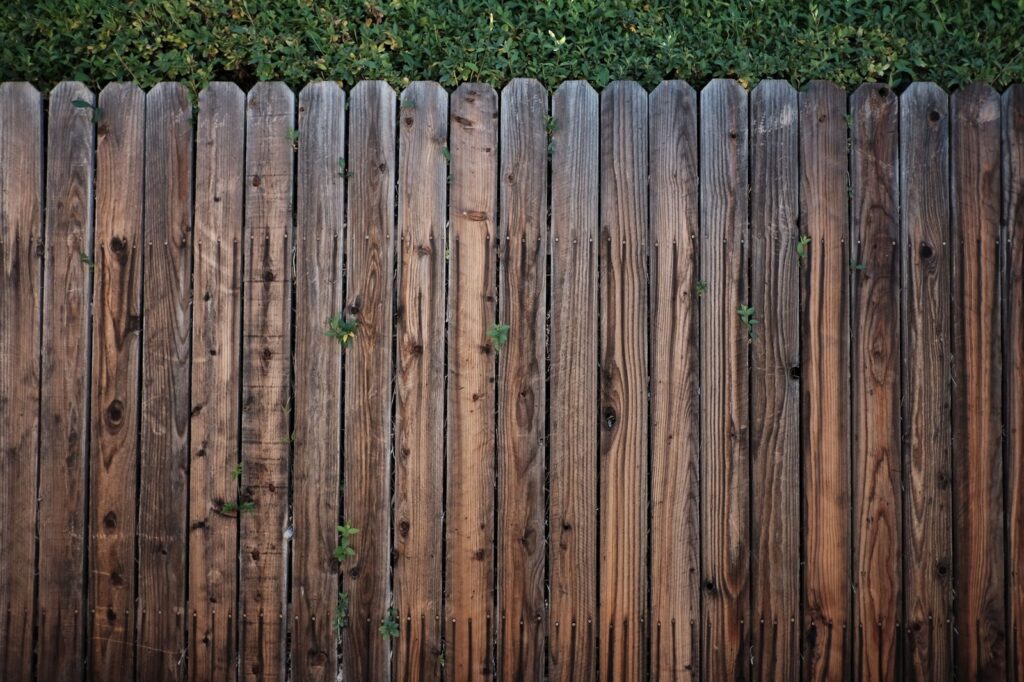
Board-on-board is a privacy fence where vertical boards overlap each other, so each board covers the edge of the one next to it. From the street it reads as one solid wall of wood, and from either side you cannot see through it.
Privacy is complete. Typical height is 6 feet. Woodworking Advisor’s designs guide puts installed cost at $30 to $55 per linear foot, one of the pricier privacy styles, mostly from the extra board footage in the overlap.
It suits backyards and any spot where a neighbor’s window sits close, and it works well for dog owners, since there is no gap for a curious nose. Watch out for weight: the overlap adds load on the posts, so spacing and depth matter more here. Cedar is the usual pick for the boards, with pressure-treated posts.
DIY or pro? A confident DIYer can build it on flat ground, but a wavy line shows up fast on a long run. If the ground slopes or the run is long, hire it out.
2. Solid privacy (stockade)
A solid privacy fence, often called a stockade fence, is a row of vertical boards set edge to edge with no gap between them. It is the plainest privacy fence you can buy, and that is the point. It blocks the view, blocks the wind, and gives a clean backdrop for a garden.
Privacy is complete. Typical height is 6 feet. Woodworking Advisor’s designs guide puts installed cost at $25 to $50 per linear foot, a little less than board-on-board because it uses fewer boards. Best for backyards where privacy matters more than pattern, and the most common choice for a first fence.
Watch out for wind: a solid wall catches a storm the way a sail does, so posts need to be set deep. On a long run, a cap rail or a planted bed in front of it helps.
DIY or pro? This is one of the friendliest privacy fences for a DIY build. The boards go up in a straight line with no gap to space. Set the posts right and the rest follows.
3. Shadowbox (good neighbor)
A shadowbox fence, also called a good neighbor fence, is a privacy fence with boards on both faces of the rails, staggered so the gaps on one side are covered by boards on the other. You cannot see through it, but air can move through the offset gaps.
Privacy is near complete, with just a sliver of light at a sharp angle. Typical height is 6 feet. Woodworking Advisor’s designs guide puts installed cost at $25 to $45 per linear foot.
It suits shared boundaries best, since both sides look finished. It also suits windy yards, since air slips through the staggered gaps instead of pressing on a solid wall. Watch out for the board count: two faces means roughly twice the pickets of a one-sided fence.
DIY or pro? Middle of the road. The stagger takes care, and keeping both faces even is fiddly for a first build. A careful DIYer can do a short run, but a crew will be faster on a long boundary.
4. Picket
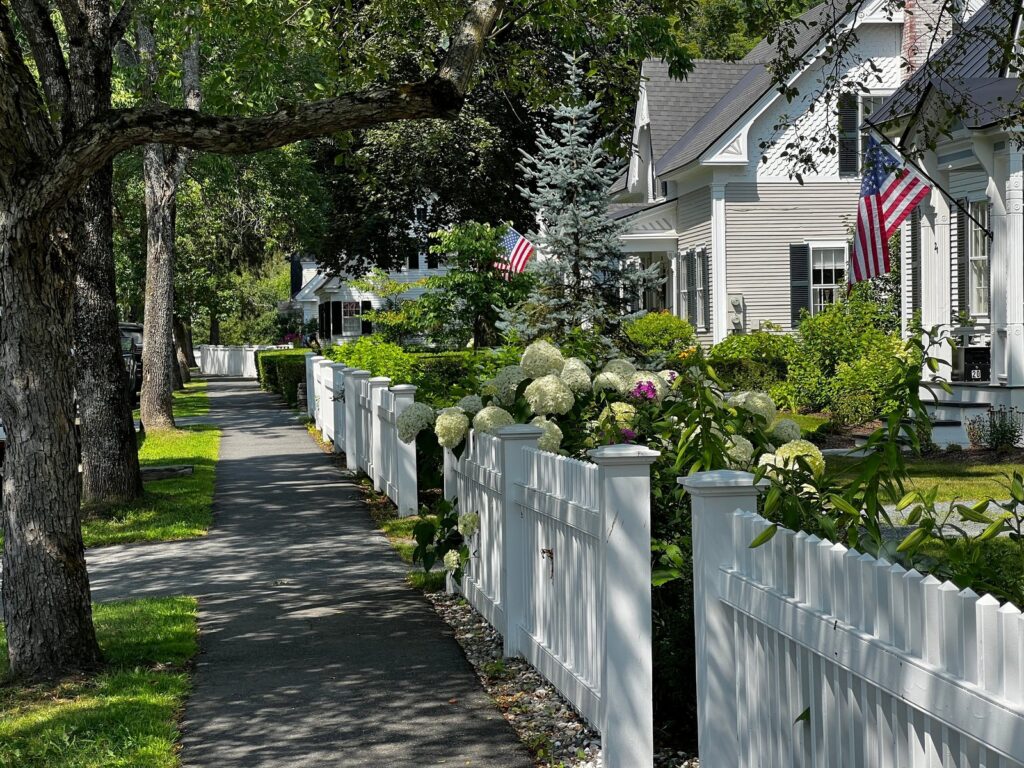
A picket fence is a row of short vertical boards, called pickets, spaced apart on horizontal rails, usually with pointed or rounded tops. It marks a boundary and frames a front yard without hiding the house behind it.
Privacy is low, and that is the trade. Typical height is 3 to 4 feet, which fits most front-yard rules. Woodworking Advisor’s designs guide puts installed cost at $15 to $30 per linear foot, one of the cheapest wood fences to install.
It suits front yards, garden edges, and cottage-style homes, and a fresh coat of white paint does more for it than any fancy detail. It does not suit backyards where privacy matters, and it will not contain a large dog that likes to jump. Watch out for spacing drift, since uneven gaps stand out, so use a spacer block to keep every gap the same.
DIY or pro? This is the most DIY-friendly wood fence on this list. The boards are light, the posts are shallow, and a weekend is often enough for a front-yard run. For picket spacing math, heights, and vinyl or aluminum options beyond wood, see our guide to picket fence styles and spacing.
5. Post-and-rail (split-rail)
A post-and-rail fence, also called a split-rail fence, is a set of posts joined by two or three long horizontal rails, with wide open space between the rails. The classic version uses rough split rails; the neater version uses sawn rails. Either way, it is a boundary marker, not a barrier.
Privacy is none. Typical height is 3 to 4 feet. Woodworking Advisor’s designs guide puts installed cost at $12 to $25 per linear foot, the lowest on this list. Best for large lots, rural edges, and garden borders, where it fits a rustic or farmhouse look.
It will not keep a dog in, and it will not keep a view out. That is fine when the goal is simply to say where your land starts. On a tight suburban lot it can read as unfinished, so it works best where there is space around it.
DIY or pro? Very DIY-friendly. Posts and rails, no pickets to space. The main work is setting posts straight and level, and that is a skill worth learning on this fence before you try a taller one.
6. Lattice-top
A lattice-top fence is a solid privacy fence with a lattice panel, a crisscross grid of thin wood strips, set into the top foot or so. The solid boards give privacy at eye level, and the lattice opens up the top.
Privacy is high below the lattice and partial above it. Typical height is 6 feet, with the lattice taking the top 12 inches or so. Woodworking Advisor’s designs guide puts installed cost at $30 to $50 per linear foot. Best for backyards where you want privacy without a heavy, flat wall.
Watch out for the lattice itself. Thin strips are the first part to crack or rot, and they are fiddly to replace one at a time. Buy a sturdy panel rather than the thinnest one on the shelf.
DIY or pro? A DIYer can build the solid part and add a ready-made lattice panel on top. Building the lattice from scratch is slow work, so buy the panel.
7. Horizontal slat
A horizontal slat fence is a fence of boards run side to side instead of up and down, with narrow gaps between them. The look is clean and modern, and the lines draw the eye along the yard instead of up.
Privacy is high when the gaps are tight, and partial when the gaps are wide. Typical height is 6 feet. Woodworking Advisor’s designs guide puts installed cost at $35 to $60 per linear foot, near the top of this list. Best for modern homes, patios, and small yards where a long horizontal line makes the space feel wider.
Watch out for sag. Long horizontal boards need mid posts or a stiff frame, or they bow over time. The boards are often wider, clearer stock, and that pushes the price up.
DIY or pro? Hire it out unless you have built a fence before. Spacing has to be exact across a long run, and a gap that drifts at one end shows across the whole fence.
8. Louver
A louver fence is a fence of boards set at an angle, like the slats on a vent, so you cannot see straight through it but air and some light can pass. It gives privacy and ventilation in the same panel.
Privacy is high from straight on and partial from a sharp angle. Typical height is 6 feet. Woodworking Advisor’s designs guide puts installed cost at $40 to $65 per linear foot. Best for patios, pool areas, and yards that get hot, since air moves through while the view stays blocked.
Watch out for the build. Every board sits at the same angle, held by a grooved post or a routed rail, and that precision is the whole job.
DIY or pro? Hire a pro. This is one of the hardest wood fences to build well, and a crew with the right jigs will do it faster and straighter than a first attempt.
9. Board and batten
Board and batten is a fence of wide vertical boards with narrow strips, called battens, nailed over the seams where the boards meet. The battens cover the gaps, so the fence reads as solid, with a strong vertical rhythm.
Privacy is complete. Typical height is 6 feet, though taller versions appear on farm and barn-style properties. Woodworking Advisor’s designs guide puts installed cost at $28 to $48 per linear foot. Best for farmhouse and barn-style homes, and for a long boundary where the vertical lines break up an otherwise flat wall.
It also hides small gaps well, since the battens cover the seams as boards shrink and swell. Watch out for the batten count. Every seam needs a batten, so the board count and nailing time both run higher than a plain privacy fence.
DIY or pro? A patient DIYer can build it. The work is repetitive: set a board, cover the seam, repeat. Keep a string line tight and check each board for plumb as you go.
10. Basketweave
A basketweave fence is a fence where horizontal and vertical boards weave over and under each other, like a basket. The woven pattern is the whole point, so it is usually used for a short accent run rather than a full boundary.
Privacy is high, since the weave leaves almost no straight sightline. Typical height is 6 feet, though accent runs are often lower. Woodworking Advisor’s designs guide puts installed cost at $45 to $70 per linear foot, the highest on this list, and that is the labor in the weave. Best for a feature panel, a garden wall, or the fence around a patio, where the pattern can be seen up close.
It does not suit a long boundary, where the cost adds up fast and the pattern gets lost at a distance. Watch out for repairs. A damaged board sits woven into its neighbors, so a fix means unweaving a section.
DIY or pro? Hire a pro. The weave needs boards held in the right order and tension, and it is slow work that rewards a crew that has done it before.
Fence anatomy: the parts that matter
A wood fence is only as strong as its posts. The boards get the attention, but the posts do the work, and they fail first.
The posts are the uprights set in the ground, usually 6 to 8 feet apart. This Old House notes that posts should be buried at least one-third of their length. A post buried shallow will lean, and a leaning post pulls the whole run with it.
The rails are the horizontal boards that join the posts and carry the pickets. Most fences use two rails, and a 6-foot fence often uses three. The boards or pickets give the fence its face, and the cap is the board across the top that sheds water and keeps rain off the end grain below it.
Fasteners matter more than they look. This Old House recommends hot-dipped galvanized or stainless fasteners, and that advice matters most with cedar, whose tannins can stain and corrode lesser nails. Cheap nails rust, streak the boards, and loosen their grip.

Which wood should you choose?
Wood choice decides how long a fence lasts and how much care it needs. The style is the look, and the species is the lifespan. BuildMatInsight’s species comparison gives 2026 installed cost per linear foot for a standard 6-foot privacy fence, and the table below pulls those figures together with lifespan ranges from the sources cited here.
For species, heartwood grades, and treatment tags in depth, see our wood fences material guide.
| Wood | Rot resistance | Typical lifespan | Installed cost per linear foot (6-ft privacy) | Best for | Watch out for |
|---|---|---|---|---|---|
| Western red cedar | High, naturally rot and insect resistant | 20 to 30 years | $28 to $45 | Privacy fences, pickets, a warm natural look | Tannins stain cheap fasteners, so use hot-dipped galvanized or stainless |
| Redwood (heartwood) | High, naturally decay resistant | 25 to 35 years | $40 to $60 | A premium privacy fence that ages well | Heartwood lasts far longer than sapwood, so check what you are buying |
| Pressure-treated pine | Good once treated, depends on the treatment | 15 to 20 years | $18 to $28 | A budget privacy fence, posts with the right rating | Needs a UC4A or UC4B ground-contact rating for posts, and it can warp as it dries |
| White oak | Good, dense and durable | 15 to 20 years | Varies by region, often above pine | A sturdy traditional fence | Heavy and less common than cedar or pine |
| Cypress | Good, naturally resistant | Roughly in the cedar range where available | Varies by region | Southern yards where it is local | Supply is regional, so it can be hard to find elsewhere |
| Black locust | Very high, one of the toughest native woods | Long, often past cedar in ground contact | Varies by region | Posts and rails where rot is the main worry | Hard and heavy, not widely stocked |
Cedar is the safe middle choice for most yards. Better Homes & Gardens notes that cedar runs pricier than pine and lasts over 20 years with stain or paint, and This Old House puts naturally resistant cedar, mahogany, or redwood at 15 to 25 years above ground and 10 to 15 years as posts. Redwood is the premium step up: Better Homes & Gardens gives it about 20 years, while BuildMatInsight’s species comparison puts heartwood at 25 to 35 years, so treat the range as 20 to 35 years.
Pressure-treated pine is the budget pick, and the treatment rating is the detail to check. Fence Report notes that Penn State Extension gives a 10 to 25 year planning range for pressure-treated fence posts, and that pickets and rails take a UC3B above-ground rating while posts take UC4A ground-contact. For a deeper read, our guide to how long wood fences last breaks the numbers down by species and by part of the fence.
What it costs
A fence price is style plus species plus height, and each one moves the total. A 6-foot board-on-board fence in cedar will cost more per foot than a 4-foot picket fence in pine. Height adds boards and taller posts. Species adds cost per board. Style adds labor, and the labor-heavy styles, louver and basketweave, cost the most per foot for that reason.
Use the per-foot ranges above to sketch a budget, then check the full breakdown, including posts, gates, and removal of an old fence, in our fence cost guide. For a privacy fence specifically, our guide to privacy fence costs breaks the numbers down by material and height. Get two or three quotes for the same style, species, and height, and compare them on the same terms.
Height, permits and HOA rules
Height limits are local, and they are the first thing to check before you order boards. Most cities cap front-yard fences at 3 to 4 feet and backyard fences at 6 to 8 feet, according to Woodworking Advisor’s designs guide. A corner lot often has a stricter sightline rule near the street, since a tall fence can block a driver’s view.
Check three things before you build: the city or county fence code, the HOA rules if you have one, and the property line. An HOA can limit style and color as well as height, and a fence built over the line can turn into a long argument. Our guide to privacy fence height limits covers the common caps and the questions to ask your local office.
DIY or hire a pro?
A wood fence is a fair DIY project, but not every style is. Picket, post-and-rail, and solid privacy fences suit a confident DIYer with a weekend, a level, and a helper. Board and batten and shadowbox are doable with care. Horizontal slat, louver, and basketweave are pro jobs for most people, because the spacing and the angles punish small slips.
The hard part is rarely the boards. It is the posts. A post needs a straight hole, the right depth, and concrete or packed gravel set so it stays plumb while it cures. A string line keeps the run straight, and a level on every post keeps the top line even. If the ground slopes, that is where a crew earns its fee.
Hire a pro when the run is long, the ground is sloped or rocky, the style is louver or basketweave, or the fence sits on a shared boundary. Build it yourself when the style is simple, the ground is flat, and you have a helper for the day the posts go in.
Keeping it standing
A wood fence lasts longest when water does not sit on it and soil does not touch it. Keep the bottom of the boards a couple of inches off the soil, and keep mulch from piling against the base. That one habit slows rot more than any product.
Inspect the fence each spring for leaning posts, loose rails, and boards that have started to cup or split. Clean it once a year with a gentle wash, and stain or seal it every 2 to 3 years, or as the finish wears. A yearly gentle wash covers the cleaning step, and if the boards start to look green, that is usually algae. A well-built fence lasts about 20 years, according to This Old House.
Frequently asked questions
Post-and-rail is usually the cheapest, at $12 to $25 per linear foot installed, according to Woodworking Advisor’s designs guide. Picket runs next at $15 to $30 per foot. Both use few boards and simple posts, which is why they cost less than a solid privacy fence.
Tropical hardwood lasts longest, at 40 to 50 years or more, according to BuildMatInsight’s species comparison, but it costs $65 to $95 per linear foot installed. Among common choices, redwood heartwood at 25 to 35 years and western red cedar at 20 to 30 years are the long-lived picks, and both beat pressure-treated pine at 15 to 20 years.
Most cities cap front-yard fences at 3 to 4 feet and backyard fences at 6 to 8 feet, according to Woodworking Advisor’s designs guide. The exact limit is local, and corner lots often have a stricter sightline rule, so check your city code and HOA rules before you build.
Choose board-on-board for full privacy on your side and a flat face, and choose shadowbox when the fence sits on a shared boundary or a windy site. Shadowbox looks finished from both sides and lets air through, while board-on-board gives a solid wall and a cleaner face on one side.
Yes, for simple styles. Picket, post-and-rail, and solid privacy fences are realistic DIY builds on flat ground. Leave horizontal slat, louver, and basketweave to a pro, since spacing and angles need precision. Whichever route you take, post setting is the skill that decides whether the fence stays straight.
Yes, for a long life. A water-repellent preservative protects above-ground wood, and posts in the ground should be pressure-treated or naturally decay-resistant wood, according to USDA Forest Service research. Plan to stain or seal every 2 to 3 years, and sooner if water stops beading on the boards.
