

Last updated: November 27, 2026
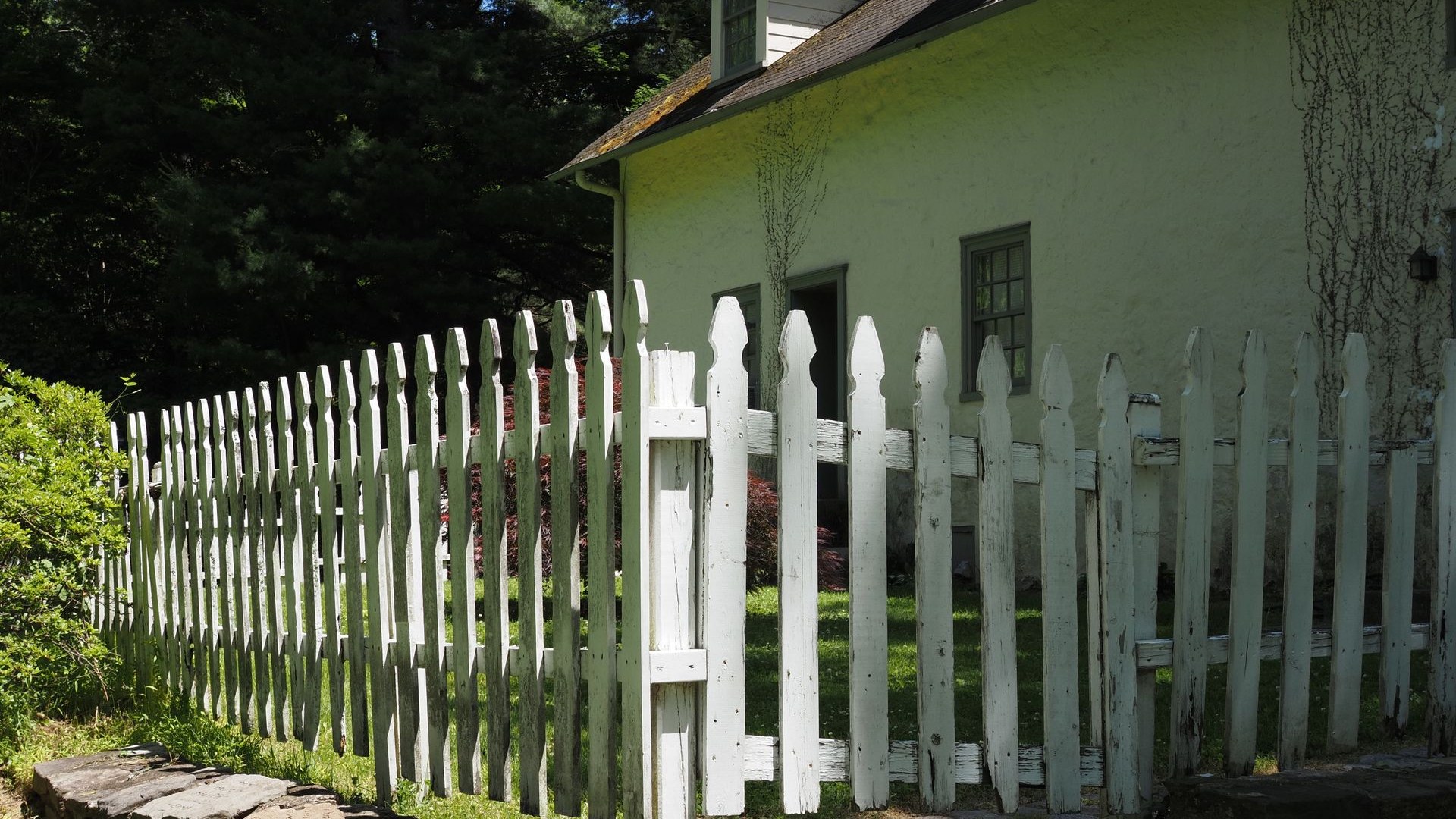
A picket fence is a fence made of upright boards, called pickets, fixed to two or three horizontal rails with a gap between each board. Most picket fences stand 3 to 4 feet tall in a front yard. The gaps are the whole point: the fence marks your boundary and keeps dogs and kids in, but you can still see through it, so the yard stays open to the street.
Three choices decide how a picket fence looks and how long it lasts. The first is the picket style, meaning the shape of the tops and the line they make across the panel. The second is the material: cedar, pressure-treated pine, vinyl, composite, or aluminum. The third is the spacing, which controls how open or private the fence feels and whether a small dog can slip through. Get those three right and the fence looks deliberate. Get them wrong and it looks like an afterthought, even if the workmanship is fine.
Contents
- What a picket fence is made of
- Picket styles and the houses they suit
- Picket fence materials compared
- How far apart should pickets be?
- Working out even gaps
- How tall should a picket fence be?
- Picket fences around pools and small dogs
- Front-yard details that make it look right
- Upkeep by material
- What a picket fence costs
- Frequently asked questions
- Sources
What a picket fence is made of
A picket fence has three parts: vertical pickets, horizontal rails that the pickets are screwed or nailed to, and posts set in the ground that carry the rails. Two rails suit a low front fence. A third rail in the middle keeps taller pickets from bowing and stiffens wide bays. That is the whole structure, which is why picket fences go up fast and why single damaged pickets are easy to swap out.
Pickets are narrow boards, usually 1 1/2 to 4 inches wide. The rails sit behind them, one near the top and one near the bottom, set a little in from the picket ends so the tops and feet stay free. Posts do the structural work, so they need the most care: a post that rots at the ground line takes a whole bay down with it, no matter how good the pickets are. If you are weighing a picket fence against other ways to enclose a yard, our guide to choosing a fence for your yard covers the wider decision.
The video below shows a simple picket fence going up, from setting posts to spacing the pickets, which is a good way to see how the parts fit together before you commit to a style.
Picket styles and the houses they suit
The main picket styles are flat-top, dog-ear, French Gothic, round-top, scalloped, and convex, and the right one depends mostly on the age and shape of your house. Flat-top and dog-ear pickets suit most traditional homes. Pointed French Gothic pickets belong on Victorian and Tudor houses. Scalloped and convex lines read as cottage or craftsman. Match the fence to the house and it looks like it was always there.
Style is really two decisions. The first is the shape cut into the top of each picket. The second is the line those tops make across a panel: level, dipped in the middle, or arched. The table below covers the common combinations.
| Style | What it looks like | Houses it suits |
|---|---|---|
| Flat-top | Straight, level top edge across the whole fence | Craftsman, farmhouse, modern traditional |
| Dog-ear | Both top corners clipped at 45 degrees | Colonial, standard suburban, budget builds |
| French Gothic | Each picket comes to a sharp point | Victorian, Gothic Revival, Tudor |
| Round-top | Smooth rounded top on each picket | Cape Cod, cottage, country homes |
| Scalloped | Tops dip low in the middle of each panel | Cottages, farmhouses, flower-garden front yards |
| Convex | Tops arch high in the middle of each panel | Formal entrances, symmetrical landscaping |
| Victorian ornamental | Turned or cut detail, finials on the pickets | Victorian homes and historic districts |
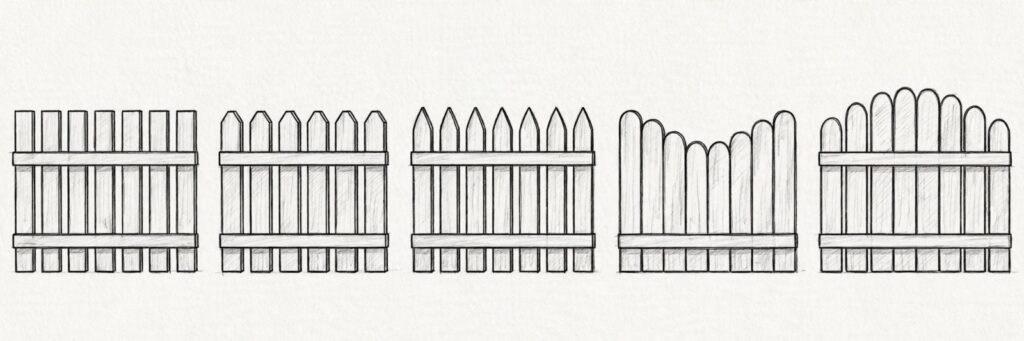
On a wood picket, the top shape is cut straight into the board, so a dog-ear is just two saw cuts and a French Gothic point is a more careful cut. That is why dog-ear pickets are the budget standard and ornate tops cost more: you are paying for cutting time, not extra wood. A picket fence styles guide from Stand Strong Fencing walks through these pairings house by house if you want more examples.
One safety note on pointed tops. French Gothic pickets look right on a period house, but a sharp point is a bad idea where small children climb or fall against the fence. Flat, dog-ear, and round tops give the same traditional read without the point. Save the spears for metal fences around pools and formal gardens, where the height and spacing are controlled by code anyway.
Picket fence materials compared
Picket fences come in cedar, pressure-treated pine, vinyl, composite, and aluminum, and the honest differences are upkeep and how each one handles water. Cedar resists rot on its own above ground. Treated pine relies on preservative and costs less. Vinyl and aluminum skip painting entirely. Composite gives a wood look with less upkeep at a premium price. Posts matter as much as pickets: use ground-contact treated wood or metal posts, because that is where fences fail first.
| Material | Why it lasts | Upkeep | Best for |
|---|---|---|---|
| Cedar | Natural extractives in the heartwood resist decay above ground | Stain or paint to hold color, or let it weather gray | Traditional look, custom heights and curved tops |
| Pressure-treated pine | Preservative forced into the wood under pressure | Restain more often than cedar, can warp as it dries | Lowest upfront cost, posts and rails |
| Vinyl (PVC) | Color runs through the material, nothing to rot | Wash once or twice a year | White picket look with no painting |
| Composite | Wood fiber and plastic blend resists moisture | Wash yearly | Wood look without wood upkeep, at a price |
| Aluminum | Powder-coated metal panels, no rot, no paint | Wash, touch up chips | Crisp modern lines, pool enclosures |
Cedar: the traditional picket, with one catch
Cedar is the classic picket material because it stays stable, takes stain well, and resists decay without chemicals. The catch is that the protection lives in the heartwood, the darker wood at the center of the log. The USDA Forest Products Laboratory rates cedar heartwood as resistant to decay, good above ground but not for burying, and its Wood Handbook decay ratings are clear that pale sapwood has little resistance in any species. So a cheap cedar picket with a wide pale edge is not the same product as a heartwood picket. Look at the boards before you buy, and keep cedar out of the soil.
Pressure-treated pine: cheap, strong, thirsty
Treated pine is usually southern yellow pine with preservative forced deep into the fibers. It is the budget picket and the right choice for posts, but read the end tag. The American Wood Protection Association sorts treated wood by use category: UC3B covers exterior wood above ground, and UC4A covers ground contact. Pickets and rails can be above-ground stock. Posts need ground-contact stock, full stop. Treated pine also arrives wet and shrinks as it dries, so gaps you set on day one can widen over the first year. That matters for the spacing math below.
Vinyl: the white picket without the paintbrush
Vinyl pickets are extruded PVC with UV stabilizers and color mixed through the material, so there is nothing to peel and nothing for insects to eat. Standard vinyl picket panels come in 36-inch and 48-inch heights, with picket spacing that typically runs 2 1/2 to 4 inches. The trade-off is movement: vinyl expands and contracts with temperature more than wood does, so panels need small expansion gaps at the posts. A PVC picket fence guide from HZJ Fence covers the panel sizes and the expansion detail if you go this route. White holds up best in strong sun, because the white pigment does the most UV blocking.
Aluminum: pickets that read as ornamental
Aluminum picket fences come as welded panels with a factory powder coat. They never need painting and the pickets are hollow tubes with cast caps or spear tops, so the look is crisper and more ornamental than wood. Panels set the post spacing for you, which makes layout simple and custom sizes harder. Our guide to aluminum fences covers that material in more depth. A picket fence design guide from CAD60 compares timber and aluminum picket sizes side by side if you are torn between the two.
Whichever material you pick for the pickets, spend the money on the posts. Ground-contact treated posts or metal posts outlast cedar posts set in soil, and a fence is only as straight as its posts. Our rundown of how long wood fences last shows where each part usually fails first. If wood is your material, the types of wooden fences guide compares picket against the other wood styles.
How far apart should pickets be?
Most picket fences use a gap of 1 1/2 to 3 inches between pickets, with about 2 to 2 1/2 inches giving the classic look. Tighter gaps read as fuller and more private. Wider gaps look lighter and more decorative. Anything under about 2 inches helps contain small dogs, and pool fences have their own code limits, covered below.
| Gap | How it reads | Good for |
|---|---|---|
| 1 1/2 inches | Dense, close to solid | Small dogs, a more private front yard |
| 2 inches | The classic picket look | Most front yards |
| 2 1/2 inches | Open and airy | Cottage and country fronts |
| 3 inches | Very open, almost ornamental | Decorative boundaries, garden edges |
| 4 inches | Ornamental spacing | Metal pool fencing that meets code |
Spacing also decides how the fence feels from the sidewalk. A 3-inch gap with narrow pickets can look sparse, like the fence is mostly air. Wide pickets with a 2-inch gap look solid and formal. A useful rule of thumb: the gap should be narrower than the picket. A 3 1/2-inch picket with a 2 1/2-inch gap looks balanced from the street. A 1 1/2-inch picket with a 3-inch gap looks like a railing, not a picket fence.
For small dogs, standard spacing is often not enough. A determined Yorkie treats a 2 1/2-inch gap as a door. Two fixes work: run the whole fence at 1 1/2 inches, or add puppy pickets, a second row of shorter pickets along the bottom with about a 1-inch gap. Puppy pickets keep the open look up top and close the escape route at dog height.
Working out even gaps
Even gaps are what separate a fence that looks built from one that looks rushed, and the fix is arithmetic, not eyeballing. Pick a target gap, count how many pickets fit the bay, then spread what is left evenly across every gap, including the two at the posts. A spacer block cut to your final gap width keeps every picket honest as you work down the rail.
- Measure the space between the two posts in one bay.
- Subtract one target gap, then divide by the picket width plus the target gap. Round down. That is your picket count.
- Subtract the total width of those pickets from the bay width.
- Divide what remains by the picket count plus one. That is your real gap, the same at the posts and between every picket.
Here is the math on a real bay. Say the posts are 96 inches apart, your pickets are 3 1/2 inches wide, and you want roughly a 2 1/2-inch gap. Subtract one gap: 93.5 inches. Divide by 6 (3.5 plus 2.5): 15.58, so 15 pickets. Those pickets take up 52.5 inches, leaving 43.5 inches. Divide by 16 gaps: about 2.72 inches each. Cut a spacer block to that width, check each picket for plumb as you go, and the bay will look even end to end.
One warning for treated pine. The boards shrink as they dry, so a gap set at 2.72 inches in wet lumber can open up over the first year. If the fence has to hold a small dog or pass a pool inspection, build in a margin and aim a little under your maximum gap. Vinyl and aluminum do not shrink, so their gaps stay where you set them.
How tall should a picket fence be?
Most picket fences are 3 to 4 feet tall, and front-yard zoning often caps them there anyway. Three feet reads as a garden boundary. Four feet contains most dogs and meets the minimum height for a pool barrier. Side and rear yards usually allow more height, but a picket fence past 5 feet stops looking like a picket fence and starts looking like a privacy fence with gaps.
Height rules are local, so treat any number you read online as a starting point. As one example, the Mt. Healthy, Ohio zoning code allows only decorative fencing in the front yard, caps it at four feet, and drops the limit to three feet inside the clear vision triangle at corners, with wood picket named as an approved decorative type. Plenty of towns follow the same pattern: 4 feet in front, 6 feet at the sides and rear, lower at corner sight lines. Your city or county code, plus any HOA rules, decides what you can build, and many places want a permit before you dig.
Two practical checks before you order materials. First, corner lots: the vision triangle near the street corner is where drivers need to see, so expect a lower limit there even if the rest of the front yard allows 4 feet. Second, slope: on a sloped yard, decide whether the fence steps down in level panels or follows the grade with raked panels. Stepped panels look tidy on gentle slopes. On steeper ground, following the grade keeps the gap under the fence even, which matters for dogs.
Picket fences around pools and small dogs
A picket fence can enclose a pool, but it has to meet barrier code, not just look right. Under the residential pool rules in IRC Section R326, the barrier must stand at least 48 inches tall and no opening can let a 4-inch sphere pass through. That 4-inch test applies between pickets, under the bottom rail, and at the gate. Gates must close and latch on their own and swing away from the water.
The rail layout matters as much as the gap. Where horizontal rails sit less than 45 inches apart, the rails go on the pool side and the vertical spacing tightens to 1 3/4 inches, because rails on the outside turn the fence into a ladder. A summary of the IRC pool barrier requirements lays out the height, opening, and gate rules together. This is the one place to be conservative: build the barrier to the code your inspector uses, keep a margin under the 4-inch limit for shrinkage, and treat a pro install as money well spent if you are unsure.
For dogs, the test is simpler. Measure the widest part of your dog’s head and chest, then keep every gap, including the space under the gate, clearly smaller. A 4-foot fence with 1 1/2-inch gaps holds most small and medium dogs. Jumping is a separate problem: a picket fence is a boundary, not a kennel, and a dog that clears 4 feet needs a taller fence or a different plan.
Front-yard details that make it look right
Most picket fences fail on proportions, not materials. Keep the posts in scale: 4×4 posts suit a low picket fence, and chunky 6×6 posts overwhelm it. Put the finished side toward the street, since that is the side everyone sees, and carry the picket line straight across the gate so the tops line up when the gate is closed. A gate that sags or sits at a different height breaks the whole run visually.
Color does a lot of quiet work. White is the classic choice and suits colonial, Cape Cod, and farmhouse fronts. Natural cedar, left to weather or held with a clear sealer, fits craftsman and modern homes. Dark stain pairs well with brick. Black pickets, usually metal or vinyl, read modern and work on updated ranches. Whatever you choose, match the fence to the trim or the siding rather than introducing a new color family.
Planting finishes the job. A low bed of flowers or shrubs along the fence line softens the bottom rail and hides the gap under the pickets. Keep plants a few inches off the wood so the fence can dry after rain, and keep mulch from piling against the picket feet. Wet soil and mulch held against wood is where rot starts, even on cedar.
Upkeep by material
Wood picket fences need a finish renewed on a cycle: paint holds longest, stain needs redoing sooner, and bare cedar weathers to gray without structural harm if it can dry out. Vinyl and aluminum need washing and little else. Every material benefits from one walk a year to catch a loose picket, a sagging gate, or soil creeping up against the bottom rail.
Painted wood usually wants repainting every 5 to 7 years, and stained wood a fresh coat every 3 to 4 years, though sun exposure moves those numbers around. The prep matters more than the product: wash the fence, let it dry fully, scrape anything loose, and prime bare wood before the topcoat. Our guide to cleaning a fence by material covers the washing step for wood, vinyl, and metal. Vinyl mildew in shade comes off with a soft brush and mild cleaner. Skip high-pressure washing on vinyl, since it can force water into joints and crack picket tops.
Repairs are where picket fences shine. One cracked or rotted picket unscrews and a new one goes in its place, which is a twenty-minute job if you kept a spare board from the original build. Buy a few extra pickets when you build, and store them flat in the garage. Matching a weathered board years later is harder than matching a spare.
What a picket fence costs
Picket fence cost turns on material, total length, gate count, and how much cutting the style needs. Pressure-treated pine is the budget option. Cedar costs more per board. Vinyl and aluminum cost more up front and less over time because there is no repainting cycle. Ornate tops like French Gothic and Victorian styles add labor, since every picket gets individual cuts.
Because prices move with lumber and labor markets, treat any single number with suspicion and get two or three local quotes for the same spec: same height, same spacing, same gate count. Our fence cost guide by material breaks down what drives the total, and the all-in budget guide linked there shows what a full yard project usually includes beyond the fence itself. If the quotes come back high, the honest savings are a simpler top style and treated pine pickets on good posts, not thinner posts or wider spacing.
Frequently asked questions
Most picket fences use a gap of 1 1/2 to 3 inches between pickets, with 2 to 2 1/2 inches giving the classic look. Tighter gaps feel more private and help contain small dogs. Wider gaps look lighter and more decorative.
Most picket fences stand 3 to 4 feet tall. Three feet suits a garden boundary, and 4 feet contains most dogs and meets the minimum height for a pool barrier. Front-yard zoning often caps height at 4 feet, so check your local code first.
A picket fence has gaps between the boards, so you can see through it. A privacy fence sets the boards edge to edge or overlapping so there is no view through. Same boards and rails, different spacing and usually different height.
Aluminum and vinyl last longest with the least upkeep, since neither rots nor needs painting. Cedar heartwood holds up well above ground with a maintained finish. Treated pine costs least up front and needs the most frequent restaining.
Yes, if the gaps are small enough. Keep every gap, including under the gate, clearly smaller than your dog’s head and chest. A 1 1/2-inch gap or puppy pickets along the bottom handle most small dogs at 3 1/2 to 4 feet tall.
Often, yes. Many towns require a fence permit, set height limits by yard, and restrict what can sit in the front yard and near street corners. HOA rules can be stricter than city code. Check both before you buy materials, and call 811 before digging post holes.
