


Last updated: November 28, 2026
A fence type is a material, a style, and a job bundled into one choice. Wood privacy, vinyl picket, and chain link are not just different looks. Each one blocks a different amount of view, asks for a different amount of upkeep, and lands in a different price band. Pick the job first and the type list gets short fast.
Most fence shopping goes wrong in the first five minutes. People compare prices per foot before they decide whether the fence needs to hide a patio, hold a dog, frame a front yard, or guard a pool. A cheap open fence is a bad buy for privacy at any price. A solid privacy fence is wasted money on a side line nobody sees. This guide compares the main types of fences and cost side by side, with cost kept to one honest column. For the full per-foot breakdown by material and height, see our fence cost guide by material. For whole-project budgets with gates and removal added, see our all-in fence project budgets.
Contents
- Start with the job, not the material
- Fence types at a glance
- Privacy fence types
- Open fence types for boundaries and front yards
- Wood, vinyl, and composite compared
- Metal fence types compared
- What moves the price inside each type
- Lifespan and upkeep by type
- Rules that can rule a type out
- Which type fits your yard
- Frequently asked questions
- Sources
Start with the job, not the material
The fastest way to choose a fence type is to name the job first: privacy, pets, a front-yard boundary, pool safety, or a rural line. Each job rules out half the catalogue at once. Privacy needs solid panels at six feet. Pets need height and small gaps. Front yards need looks and sight lines. Pools need code spacing.
Our guide to choosing a fence for your yard walks through privacy, pets, slopes, and neighbors in detail. The short version is in the table below. Read your row, then compare only the types that survive it. That one step stops the most common mistake, which is falling for a price on a fence that cannot do the job.
| The job | Types that fit | Types to skip |
|---|---|---|
| Backyard privacy | Wood privacy, vinyl privacy, composite, masonry | Chain link, picket, split rail, open metal |
| Dogs and kids in the yard | Wood privacy, vinyl, chain link at 5 to 6 feet, aluminum with tight pickets | Low picket, split rail, wide-gap styles |
| Front yard and curb appeal | Picket in wood or vinyl, aluminum, wrought iron style steel | Tall solid panels where rules ban them, chain link in most streets |
| Pool barrier | Aluminum, vinyl, wood, or chain link built to barrier spacing and gate rules | Any style with climbable rails or wide gaps, whatever the material |
| Rural line, garden, or acreage | Split rail, post-and-rail, woven or welded wire, chain link | Solid privacy panels over long runs, masonry |
Two jobs often share one yard. A common split is a solid fence at the back for privacy and an open fence at the front for looks. That is fine. Types can mix by side, as long as each run does its own job and the heights step cleanly at the corners.
Fence types at a glance
The main residential fence types are wood, vinyl, composite, chain link, aluminum, wrought iron style steel, picket, split rail, and masonry. Solid types give privacy and cost more per foot. Open types mark a line or hold pets for less money. The table below puts privacy, upkeep, lifespan, and cost in one view.
Costs are typical installed ranges per linear foot, drawn from the guides in the Sources list. They move with height, style, region, and ground conditions, so treat them as planning bands, not quotes. Split rail is shown as a do-it-yourself build, since that is how most split-rail fences go in. Masonry is priced by the linear foot here for comparison, though builders often price walls by the square foot.
| Type | Privacy | Upkeep | Typical lifespan | Cost per linear foot |
|---|---|---|---|---|
| Wood privacy | Full | Stain or seal every few years | 10 to 25 years, by species and care | $15 to $45 |
| Vinyl privacy | Full | Wash only | 20 years or more | $15 to $45 |
| Composite | Full | Wash only | 25 years or more | $11 to $45, high end above |
| Chain link | None on its own | Almost none | 15 to 25 years | $13 to $30 |
| Aluminum | Low, open pickets | Almost none | 30 years or more | $15 to $50 |
| Wrought iron style steel | Low, open pickets | Touch up rust spots | Decades with care | $28 to $56 |
| Picket, wood or vinyl | Low, gaps by design | Wood needs finish, vinyl needs washing | Follows the material | $10 to $45 |
| Split rail | None | Occasional stain | About 10 to 15 years | $11 to $24, do-it-yourself |
| Masonry, brick or stone | Full | Repair cracks, wash | Decades, up to 100 years for walls | $80 to $480 |
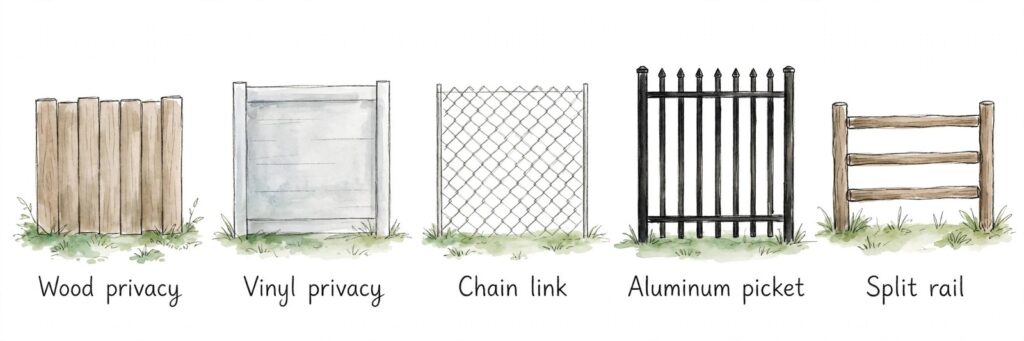
The sketch below shows five of these types at the same scale. Notice how much of the difference is simply how much material sits in each foot of fence. Solid panels use the most material and give privacy. Open types use less and let sight and air through. Price follows that material count more than most people expect.
Privacy fence types
Privacy fence types are solid fences at least six feet tall with no gaps between boards or panels. Wood, vinyl, and composite are the common choices, with masonry at the top end. Style matters as much as material here. Board-on-board and tongue-and-groove panels stay closed as wood moves, while a shadowbox style trades a little privacy for airflow.
Wood is the classic privacy fence, and The Spruce puts wood fences at $17 to $45 per linear foot across plain and ornate builds. Pine needs staining, cedar costs more and weathers better, and every wood privacy fence asks for finish work over the years. Vinyl privacy panels sit in a similar band, roughly $10 to $40 a foot in the same guide, and they never need stain. Composite privacy fencing runs about $11 to $45 a foot and looks closer to wood, though quality varies by brand.
For the style-by-style breakdown, see our guide to different types of privacy fences, which covers stockade, board-on-board, shadowbox, and horizontal layouts. One caution from experience: a privacy fence only works at the sight line. A six-foot fence on a slope can still leave a patio exposed from a raised deck next door. Check the view from the neighbor side before you pick a height.
Open fence types for boundaries and front yards
Open fence types mark a boundary, hold pets, or frame a front yard without blocking the view. Chain link, aluminum, picket, and split rail cover most of these jobs. They cost less per foot than solid fences because each foot holds less material. The trade is plain: no privacy, and gaps that small dogs can test.
Chain link is the workhorse here. Family Handyman puts professional chain link installation at $15 to $30 per linear foot, and the mesh gives a secure barrier for pets and kids with almost no upkeep. Privacy slats can soften the look, but they do not turn chain link into a privacy fence. Aluminum picket fences suit front yards and pools, with clean lines and no rust. Picket fences in wood or vinyl give the cottage front-yard look, and our picket fence styles and spacing guide covers picket tops, heights, and front-yard rules.
Split rail and post-and-rail fences belong on rural lines, gardens, and large lots where the job is to say “this side is mine” without closing the view. Family Handyman puts a do-it-yourself post-and-rail build at $11 to $24 per linear foot. Add welded wire behind the rails if the fence also needs to hold a dog, since rails alone stop nothing smaller than a horse.
Wood, vinyl, and composite compared
Wood, vinyl, and composite are the three solid-panel families, and they split on upkeep more than on looks. Wood costs least to start in many quotes and needs stain or seal work for life. Vinyl costs more upfront and asks only for washing. Composite sits between them on looks, with a wood-like face and no refinishing, at the highest panel prices.
This Old House notes that vinyl fencing needs little to no maintenance and can last up to 20 years without sanding or repairs, though a hard hit can crack a panel. The same guide puts cedar fences at up to 30 years with care, and untreated pine or spruce at only four or five years. That spread is the whole wood story in one line: species and finish decide whether a wood fence is a bargain or a chore. Our guide to wood fence species and treatment covers cedar, redwood, and pressure-treated pine part by part.
Composite panels are made from wood fiber and plastic, so they resist rot and insects and hold color better than early products did. The panels are heavy, which makes do-it-yourself work harder than the brochures suggest. Cheap vinyl and cheap composite both exist, and both show it within a few summers through fading, sagging, or brittle rails. In all three families, the panel grade matters more than the family name. Ask what the panel is made of, how thick the walls are, and what the warranty actually covers.

Metal fence types compared
Metal fence types split into chain link for utility, aluminum for looks without rust, and steel or wrought iron style panels for strength and formality. Aluminum never rusts and suits pools and front yards. Steel panels are stronger and heavier, and they need paint touch-ups where the coating breaks. Chain link wins on price and loses on looks.
The Spruce puts aluminum fence costs at $15 to $16 per linear foot for basic black or pool fencing, rising to around $50 for privacy or ornamental styles. Wrought iron fences sit higher, at $30 to $55 a foot in the same guide. Family Handyman puts professional aluminum and steel installation at $35 to $60 a foot, which shows how much panel grade and region move these numbers. Our guide to metal fence types compared breaks down aluminum, steel, chain link, and welded wire by job, coating, and slope handling.
One metal detail decides pool and pet jobs: picket spacing. Wide spacing looks fine in a catalogue photo and fails a pool inspection or a small dog. If the fence guards a pool or a yard with small children, spec the spacing first and the finish second. The rules section below gives the numbers to check.
What moves the price inside each type
Inside any fence type, five things move the price: height, style density, panel grade, gates, and ground conditions. Height adds material to every foot. Style density decides how much material sits in each foot. Gates are priced per unit, not per foot. Rocky or root-filled soil slows post digging more than any other surprise on the bill.
Style density is the driver people miss. A picket fence with wide gaps uses far less material per foot than a board-on-board privacy fence in the same wood. A shadowbox fence uses more boards than a stockade fence of the same height. Horizontal layouts often need extra rails or steel posts. Two quotes for “wood fence” can differ by a third on style alone, with both quotes honest.
Height works the same way. Moving from four feet to six feet adds roughly a quarter more material and often deeper posts. Eight-foot fences add more again and may need a permit where six feet does not. Panel grade is the quiet driver: thicker vinyl walls, heavier composite boards, and higher chain-link gauges all cost more per foot and hold up better. When a quote looks too low for the type, grade is usually where the money came out.
Gates and ground finish the list. A walk gate and a double drive gate are separate line items with their own posts and hardware. Old fence removal, tree roots, and rock all add labour that no per-foot table can predict. That is why this guide keeps cost to one column and sends you to the detailed guides for the rest: per-foot prices by material and height in our fence cost guide by material, and whole-project totals in our all-in fence project budgets.
Lifespan and upkeep by type
Lifespan decides what a fence type really costs, because a fence replaced twice costs more than a fence bought once. Masonry walls last longest, then metal and composite, then vinyl, then wood. Upkeep runs in the opposite order. Wood asks the most, vinyl and aluminum ask the least, and steel asks for rust touch-ups.
This Old House puts brick and stone fence life at up to 100 years, with cracks and soil movement as the main repairs. Chain link lasts up to 20 years with minimal care in the same guide, and vinyl-coated chain link resists rust better than plain galvanized mesh. Wood sits at the short end unless the species and finish are right. A pressure-treated pine fence with a maintained finish is a different purchase from an untreated spruce fence, even at the same height.
Upkeep is where the cheap quote can turn expensive. Wood needs cleaning and fresh stain or seal every few years to hold its color and slow water uptake. Vinyl needs washing so algae and mildew do not stain the surface. Aluminum needs almost nothing. Steel and wrought iron style panels need a yearly look for rust at scratches and welds, with touch-up paint before rust spreads. Price the upkeep honestly over 20 years and the type ranking often flips.
Rules that can rule a type out
Local rules, homeowners association rules, and pool codes can rule out a fence type before price ever matters. Height limits often cap front-yard fences at three or four feet and back-yard fences at six. Some associations ban chain link or set approved colors. Pool fences must meet barrier height, spacing, and gate rules that many pretty panels fail.
Pool rules are the strictest. The U.S. Consumer Product Safety Commission barrier guidelines call for a pool fence at least 48 inches high, with openings too small for a 4-inch sphere to pass through. Chain-link mesh should be no larger than 1¼ inches square unless slats close the openings down. Gates should open away from the pool and close and latch on their own. Some states and towns require 60 inches, so check your local code before you order panels.
Digging rules apply to every type with posts. The Greater Houston Builders Association notes that fence builders must contact 811 at least 48 hours before installing a fence, and a posthole digger counts as digging. The locate service is free, and hitting a gas or water line is not. Confirm the property line too. A fence built a foot over the line can cost more to move than it cost to build.
Which type fits your yard
Most yards settle into one of four picks. Privacy on a budget points to wood. Privacy with no refinishing points to vinyl or composite. A front yard or pool points to aluminum or picket. A large lot or rural line points to chain link, split rail, or wire. Masonry fits where the fence is really a wall: noise, slope, and decades of service.
Work through it in order. Name the job for each side of the yard. Check the rules that apply to that side: height, association limits, pool code, and the property line. Shortlist two types that pass, then compare them on lifespan and upkeep, not just the per-foot price. Get quotes on the same spec from at least two or three installers, with height, style, panel grade, gates, and removal written down. Quotes on different specs tell you nothing.
A last word on mixing types. A wood privacy fence at the back and an aluminum fence at the front is a normal, sensible yard. So is chain link on a long side line nobody sees, with the money saved spent on a better gate. Fence types are tools. The right answer is the one that does each side’s job at a price and upkeep level you can live with for 20 years.
Frequently asked questions
Wood is the most common fence type for homes. It suits privacy, picket, and ranch styles, works on slopes, and can be cut and repaired board by board. Vinyl is the closest rival, mainly where owners want solid panels without stain work.
Chain link is usually the cheapest full barrier fence, at about $13 to $30 per linear foot installed. Split rail and wire fences cost less per foot, but they only mark a line and will not hold most dogs or give privacy. For solid privacy, wood is usually the lowest-cost type.
Wood privacy fencing usually gives full privacy at the lowest upfront cost. Vinyl and composite privacy panels cost more to buy and less to maintain. Over 20 years, the gap narrows once wood stain work and board repairs are counted.
Masonry lasts longest. Brick and stone walls can serve for decades, up to 100 years in some guides. Aluminum, steel, and composite fences also run for decades. Wood life depends on species and finish, from a few years for untreated boards to 25 years or more for well-kept cedar or treated pine.
A solid wood or vinyl fence at five to six feet suits most dogs, since it blocks sight lines and jumping routes. Chain link at the same height also works for calm dogs. Check gaps at gates and under panels, since dogs test the weakest point first.
Often, yes. Many towns set height limits and require a permit for tall fences, and homeowners associations may approve materials and colors. Pool fences must meet barrier rules. Check your town, your association, and your property line before you buy materials.
