


Last updated: November 28, 2026
A wood fence is a fence built from wood posts, horizontal rails, and vertical boards or pickets, used for privacy, security, and marking a boundary. The wood itself does most of the deciding. Species, grade, and treatment set how the fence looks, how it handles rain and sun, and how much upkeep it asks for over the years.
Most buying mistakes come from treating a fence as one material choice. A fence is really three choices stacked together: posts that sit in soil, rails that hold water at their joints, and boards that face the weather and your neighbors. This guide works through the wood species, the treatment tags, and the part-by-part picks that keep each piece doing the job it is good at. If you are still deciding whether wood is even the right family, start with our guide to choosing a fence for your yard, then come back here for the wood.
Contents
- What a wood fence is made of
- Wood fence species compared
- Cedar, redwood, and pressure-treated pine
- Which wood goes where: posts, rails, and boards
- Wood fences vs vinyl and metal
- How long wood fences last
- Wood fence styles in brief
- Wood fence maintenance basics
- What wood fences cost
- Choosing wood for your climate and yard
- Frequently asked questions
- Sources
What a wood fence is made of
A wood fence has three structural parts: posts set in the ground, rails fixed across the posts, and boards or pickets fixed to the rails. Posts carry the load and face the hardest conditions. Rails tie the posts together and trap water where they meet. Boards give privacy and take the sun, rain, and knocks. Each part ages at its own speed, so each part deserves its own wood choice.
Posts usually sit 6 to 8 feet apart, with two rails on a low fence and three on a 6-foot privacy fence. A gate needs its own heavier posts, since a swinging gate works its hinges every day. A cap rail on top looks finished and sheds water off the board ends, which are the thirstiest part of any board. End grain drinks water faster than face grain, and a sloped cap is cheap insurance.
The ground line is where wood fences live or die. The few inches of post just above and below the soil stay damp longest, get the least air, and sit closest to decay fungi. The USDA Forest Products Laboratory notes that decay fungi need sustained moisture to grow, which is exactly what the ground line provides. Keep that picture in mind and most of the choices below make sense.
Wood fence species compared
The common wood fence species are western red cedar, redwood, pressure-treated pine, cypress, and spruce or fir. Cedar and redwood resist decay naturally through extractives in their heartwood. Pressure-treated pine gets its protection from preservative forced into the wood. Cypress resists decay naturally in humid regions. Spruce and fir are budget boards that need treatment or a maintained finish to hold up outdoors.
One word does a lot of work in that paragraph: heartwood. Heartwood is the inner, older wood of the tree, and it carries the natural chemicals that slow decay and insects. Sapwood is the pale outer wood, and it has almost none of that protection in any species. A cedar board that is half sapwood is half unprotected, whatever the label says. Grade names exist to tell you which one you are buying, and the next section covers the grades that matter.
| Species | Where the protection comes from | Best fence job | Watch out for |
|---|---|---|---|
| Western red cedar | Natural extractives in the heartwood | Boards, rails, and trim above ground | Soft surface that dents, sapwood streaks, untreated posts in soil |
| Redwood | Natural tannins in the heartwood | Boards and garden-grade framing, premium builds | Price climbs far from the West Coast, sapwood grades near soil |
| Pressure-treated pine | Preservative forced in under pressure | Posts and any wood in or near soil | Wrong treatment rating for the job, warping as wet boards dry |
| Cypress | Natural extractives in the heartwood | Boards and framing in humid climates | Regional availability, grade quality varies by yard |
| Spruce and fir | Finish or treatment, little natural resistance | Budget boards above ground | Short life untreated, needs regular restaining |
Read the table by exposure, not by reputation. The best board wood is not automatically the best post wood, and the cheapest post wood is rarely the board you want facing the street. The mixed build, treated posts with cedar or redwood boards, exists because it puts each wood where it wins.

Cedar, redwood, and pressure-treated pine
Cedar, redwood, and pressure-treated pine cover most wood fences, and they protect the wood in two different ways. Cedar and redwood carry natural decay resistance in their heartwood. Treated pine starts with little natural resistance and gets protection from preservative. Pick by where the piece sits: natural heartwood above ground, rated treatment in the soil.
Western red cedar
Western red cedar is light, stable, and easy to cut and fasten, with a warm reddish tone that weathers to silver gray if left unfinished. Its heartwood resists decay and insects well above ground. Its sapwood does not, so ask for heartwood on the faces you will see. Select Tight Knot is the common fence grade, with sound knots that stay put. Clear grades cost more and suit horizontal slat fences where every board shows.
Cedar is soft, so it dents under ladders, bins, and ball games. Use stainless steel or hot-dip galvanized fasteners. Plain steel reacts with cedar extractives and leaves black streaks running down the boards. I have seen a two-year-old cedar fence ruined visually by cheap screws, and the fix is a full refasten, not a wash.
Redwood
Redwood is a touch harder than cedar, with a deeper, more even red color. It grows in a narrow coastal belt, so price and availability swing a lot by region. In California the choice is easy. Two time zones away, cedar usually wins on practicality alone.
Redwood grading makes the heartwood rule easy to shop. The California Redwood Association grades redwood by color and durability, and every heartwood grade carries the word Heart in its name. Construction Heart and Deck Heart suit fences and posts near soil. Construction Common mixes in sapwood and belongs above ground where decay pressure is low. If a quote just says redwood, ask which grade. That one answer explains most price gaps between bids.
Pressure-treated pine
Pressure-treated pine is southern yellow pine with preservative forced deep into the wood. It is the budget workhorse and the right default for posts. The catch is that treatment comes in ratings, and the rating is printed on the end tag of every board. The American Wood Protection Association Use Categories separate above-ground from ground-contact lumber: UC3B covers pickets and rails that can dry out, and UC4A covers fence posts and other wood in soil. UC4B is the heavy-duty rating for severe conditions and hard-to-replace parts.
Color tells you nothing. A greenish or brown tint does not mean ground contact. Read the tag, and if the tag is gone, pick different lumber. When you cut a treated post to length, brush the fresh end with a copper naphthenate field treatment before it goes in the hole. The cut exposes wood the preservative barely reached, and the ground line will find it.
Treated boards often arrive wet and heavy. They shrink as they dry, so tight privacy boards can open small gaps in the first season. That is normal wood behavior, not a defect. Board-on-board layouts hide the movement, which is one reason they cost more.
Which wood goes where: posts, rails, and boards
Match the wood to the exposure: ground-contact treated lumber for posts, heartwood cedar or redwood or above-ground treated lumber for rails and boards, and a sloped cap to shed water off the tops. Gate posts deserve the heaviest spec on the fence. This part-by-part split is the single most useful idea in this guide, and most failed fences trace back to ignoring it.
| Fence part | Solid choice | What to check |
|---|---|---|
| Posts in soil | Pressure-treated, ground-contact rated | End tag reading UC4A or higher, cut ends field-treated |
| Gate posts | Ground-contact treated, heavier section | Deeper setting, strong hinges, no sapwood shortcuts |
| Rails | Cedar heartwood or above-ground treated | UC3B or higher if treated, heartwood face if cedar |
| Boards and pickets | Cedar or redwood heartwood, or treated boards | Few sapwood streaks, tight knots, straight stock |
| Cap and trim | Cedar or redwood | Slope to shed water, stainless or coated fasteners |
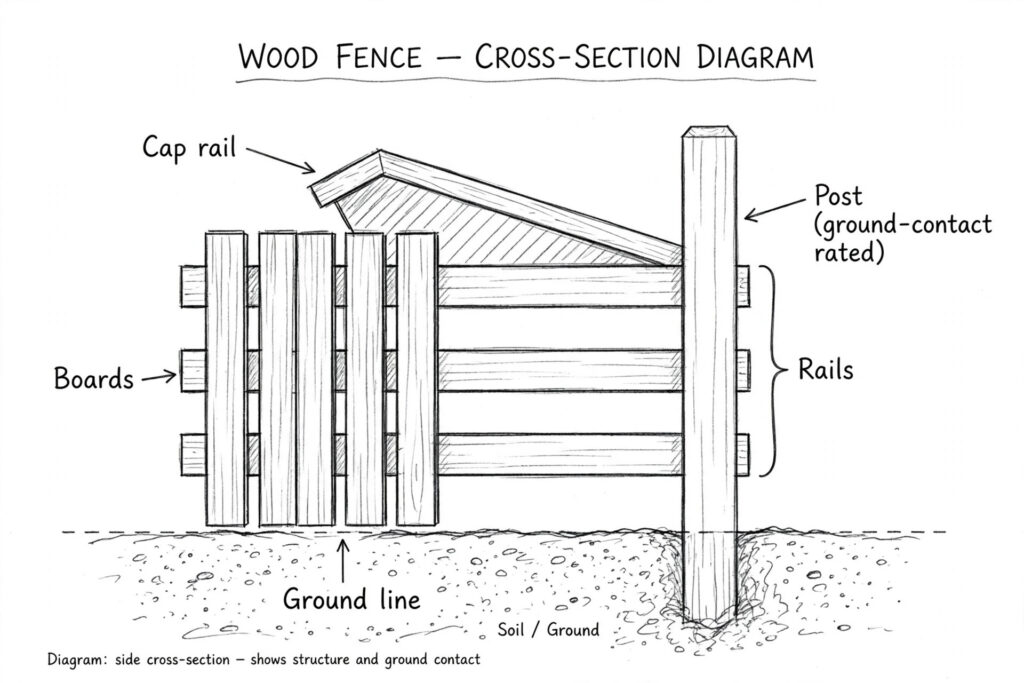
Steel posts are the honest alternative when you want cedar boards with no wood in the soil at all. Many pros set galvanized steel posts and hang cedar rails and boards on them. The fence looks like wood from both sides, and the ground-line problem disappears. It costs more up front and removes the most common repair.
Whatever the mix, keep board bottoms off the soil. A small gap at the base lets the wood dry after rain and keeps mulch and leaf litter from holding moisture against the boards. Kickboards at the base take the mower and trimmer hits so the fence boards do not have to.
Wood fences vs vinyl and metal
Wood wins on looks, custom fitting, and board-by-board repair. Vinyl wins on upkeep, since it never needs stain and does not rot. Metal wins on slim profiles and long service with little care. The right pick depends on how much maintenance you will honestly do, not how much you plan to do in April.
The Family Handyman comparison of vinyl and wood fences puts maintenance first, and that matches what I see on real fences. Vinyl asks for a wash now and then. Wood asks for stain or sealer every few years, plus the odd board swap. In return, wood cuts to odd slopes and corners without special parts, takes any color you like, and repairs one board at a time. A cracked vinyl panel often means a whole panel.
Metal splits the difference. Aluminum and steel fences stay straight, ignore insects, and suit pool and front-yard lines where you want to see through the fence. They do not give solid privacy without added slats, and they cost more than basic wood. If privacy is the whole point, wood and vinyl are the realistic pair. If openness and low upkeep lead, metal deserves a look before you commit.
Climate tips the scale too. In warm, wet, termite-heavy regions, wood needs its best spec and steady upkeep, and vinyl or metal gets more attractive. In dry regions, wood weathers slowly and the maintenance cycle stretches out. Buy for your weather, not for a photo from another state.
How long wood fences last
A well-built wood fence commonly serves 15 to 25 years, with posts and ground-line details deciding where in that range you land. Species matters less than spec: rated posts, heartwood boards, boards held off the soil, and a maintained finish. Neglected fences fail early at the post bases and board bottoms, whatever the species.
That range is a planning figure, not a promise. Soil drainage, sun exposure, sprinkler overspray, and how often the finish gets renewed move the number a lot. Our full guide to how long wood fences last breaks lifespan down by species, part, and climate, with the failure points to inspect first. Read it before you price a replacement, since many tired fences need posts and boards, not a full rebuild.
Wood fence styles in brief
Wood fence styles divide by how much they block the view: solid privacy, semi-private shadowbox, open picket, and rustic split rail. Style changes board count, wind load, and cost, but the material rules above stay the same. Pick the style for the job, then spec the wood by part.
Solid privacy fences use edge-to-edge or board-on-board layouts at 6 feet. Shadowbox fences alternate boards on both sides of the rails, so both neighbors get a finished face and air still moves through. Picket fences trade privacy for a classic front-yard line, covered in our picket fence style and spacing guide. Split rail suits large lots and rustic boundaries. For the full catalogue with heights and use cases, see our guide to the types of wooden fences.
Wind deserves one sentence of respect. A solid 6-foot fence is a sail, and post depth and spacing decide whether it stands through storm season. Shadowbox and spaced layouts shed some wind. On exposed lots, ask your installer how the posts are set before you argue about board species.
Wood fence maintenance basics
Wood fence maintenance is four habits: wash the fence, renew the finish, inspect the ground line, and keep plants and soil off the boards. None of it is hard. All of it works better on a schedule than after damage shows. A fence that gets an hour twice a year outlasts a fence that gets a weekend every five years.
Wash with water and a soft brush or a gentle pressure rinse, working with the grain. Harsh pressure tears soft cedar and redwood fibers and leaves a fuzzy surface that holds dirt. Our guide to cleaning a fence by material covers safe pressure and cleaners by wood type. Let the fence dry fully before any stain goes on, and test new treated wood with a sprinkle of water: if it beads, wait.
Stain or sealer slows water uptake and sun damage. Semi-transparent stains keep the grain visible and are easier to renew than paint. Paint gives the strongest color and the most peeling risk when prep is rushed. Whatever you choose, the end grain at board tops and the ground line at post bases deserve the extra coat.
Inspect twice a year, spring and fall. Push each post: movement means the base needs attention. Look for soft board bottoms, loose rails, rust streaks under fasteners, and vegetation holding moisture against the wood. Trim plants back so air can move. Before winter, clear snow away from the base where you can, and remember that winter screening is a different job from a boundary fence: our guide to wood slat snow fences explains how those temporary fences manage drifting snow.
Small repairs stay small when you catch them early. One soft board swaps in minutes. A leaning post section means digging, resetting, and rehanging rails. Keep a few spare boards from the original build stored flat in the garage. Matching weathered wood years later is guesswork, and a spare board weathers in place within a season.
What wood fences cost
Wood fence cost turns on species and grade, total length, height, gates, and ground conditions. Pressure-treated pine sits at the low end. Cedar costs more per board. Redwood heart grades cost the most in most regions. Steel posts, board-on-board layouts, and cap rails each add a step. Rocky soil and slopes add labor, not materials.
Because lumber and labor prices move, treat any single per-foot number with suspicion and get two or three quotes on the same spec: same species and grade, same post rating, same height, same gates. Our fence cost guide by material shows what drives the total and how wood stacks up against vinyl and metal. When quotes differ a lot, the gap usually hides in post rating, board grade, or gate hardware. Ask for those three lines in writing.
The cheapest honest savings are a simpler style and treated boards on properly rated posts. The false savings are thinner posts, above-ground lumber in the soil, and sapwood-heavy boards. Those choices do not lower the cost of the fence. They move the cost to the repair year.
Choosing wood for your climate and yard
Choose wood by climate first, exposure second, and looks third. Wet and humid regions reward heartwood boards, rated posts, and details that shed water. Dry sunny regions reward finishes with strong sun protection. Cold regions reward sound posts and hardware that tolerates freeze and thaw. Then match the style to the job: privacy, containment, or boundary.
Work through it in order. Name the job the fence must do. Check local height and permit rules and any HOA limits before buying anything. Walk the line and note drainage, sprinkler spray, shade, and slope. Spec posts for the soil, boards for the view, and hardware for the wood. Get quotes on that spec. Call 811 before digging, since utility lines do not care how good your lumber choices are.
DIY or pro comes down to posts. Boards and rails are forgiving work for a careful homeowner. Setting posts plumb, deep, and in line on a slope is where fences are won and lost. If the line is long, sloped, or rocky, paying for post setting alone can be money well spent. If you hire the whole job, the spec questions in this guide are your quality control: grade, tag rating, fasteners, and board clearance.
Wood asks more of you than vinyl or metal, and it gives back a fence you can cut, color, and repair board by board for decades. Spec it by part, keep the ground line honest, and it earns its keep.
Frequently asked questions
For most yards, the best build mixes woods: ground-contact pressure-treated posts with cedar or redwood heartwood boards. Cedar wins above ground on looks and stability. Treated pine wins in the soil and on price. One species for the whole fence is rarely the best answer.
Pressure-treated lumber rated for ground contact is the safer post choice. Cedar heartwood resists decay above ground, but posts sit in damp soil at the ground line, the hardest exposure on the fence. Look for an end tag reading UC4A or higher.
Read the end tag stapled to the board. It lists the preservative, the retention, and the Use Category. UC4A or UC4B means ground contact. UC3B means above ground only, whatever the color looks like. No tag, no guess: choose tagged lumber.
It does not need stain to stand up, but a maintained finish slows water uptake and sun damage and keeps the color closer to new. Unfinished cedar and redwood weather to silver gray. If you like that look, inspect and clean on schedule and skip the stain.
Wood moves as it dries and as seasons change. Treated boards often arrive wet, then shrink and open small gaps. Wide boards move more than narrow ones. Board-on-board layouts and a third rail hide and control most of the movement.
Yes, and that is a real wood advantage. Remove the fasteners, swap the board, and refasten with stainless or coated screws. Keep spare boards from the original build if you can. Vinyl panels, by contrast, often need a whole panel replaced for one crack.
