


Most wood fences do not die all at once. They go board by board, post by post, and the first sign is usually a post that leans a little after a storm, or a picket that feels soft at the bottom when you press it with your thumb. The question is not really whether a wood fence wears out. It is when, and whether the number on your fence is closer to 10 years or 30.
A wood fence is a living material standing outside in the rain, and its lifespan is really two numbers in one: how long the boards last, and how long the posts last. The boards almost always win. The posts sit in wet soil, and that is where most fences are decided. This guide gives you the honest range for each wood, explains why posts fail first, and shows you how to read the signs on your own fence before a small repair turns into a full rebuild.
Last updated: November 15, 2026
The short answer: 15 to 20 years for most wood fences
A wood fence lasts 15 to 20 years in most yards. Cedar and redwood fences that get regular stain and seal can reach 25 to 30 years, while pressure-treated pine usually lands between 10 and 20. The posts decide the number more than the boards do, because posts sit in wet soil while boards dry out between rains.
Contents
- How long does each type of wood fence last?
- Why the posts fail first
- Do steel posts make a wood fence last longer?
- What shortens a wood fence’s life
- Signs your wood fence is failing
- How to make a wood fence last longer
- Repair or replace: how to decide
- Wood vs other fence materials
- When to call a pro
- Questions people ask
- Sources
How long does each type of wood fence last?
The species you pick sets the starting range, and the numbers below are the typical ranges from the guides I opened for this article. They assume a fence that gets basic care. A fence in a dry climate with good drainage lands at the top of its range, while the same fence in wet clay soil lands at the bottom.
Choosing the wood itself is covered in our guide to wood fence species and treatment.
| Wood | Treatment | Typical lifespan | What usually ends it |
|---|---|---|---|
| Pressure-treated pine | Chemical preservative, ground-contact rated posts | 10 to 20 years | Posts rotting at grade; boards cupping, checking, and splitting as they weather |
| Western red cedar | Natural oils in the heartwood | 15 to 30 years, up to 40 with regular stain and seal | Sapwood boards going soft; posts if they are untreated cedar in soil |
| Redwood | Natural oils in the heartwood | 20 to 25 years | Same weak points as cedar; high cost means repairs get put off |
| Cypress | Natural oils | 20 to 25 years | Softness in very wet ground; insect pressure in some regions |
| Oak | Usually sealed, rarely treated | About 20 years | Heavy boards that dry slowly; checking and splitting |
| Untreated pine or spruce | None | Often just a few years in damp soil | Rot at the ground line and insect damage, fast |
Two things in that table deserve a closer look. First, the wide range on pressure-treated pine is not sloppy reporting. Penn State Extension gives a 10 to 25 year planning range for pressure-treated fence posts, as laid out in this detailed guide to pressure-treated fence lumber, and soil and treatment quality are the big variables. A correctly treated post in well-drained soil can stay sound well past 20 years, while the same nominal “pressure-treated” post can fail in under 10 if it carries the wrong treatment rating or sits in soil that never dries.
Second, cedar’s long life depends on heartwood, not on the name cedar. The USDA Forest Products Laboratory’s Wood Handbook ranks western redcedar heartwood as very resistant to decay, and says untreated sapwood of essentially all species has low resistance. Sapwood is the pale outer rings of the log, and it holds almost none of the natural oils that protect cedar. A cedar fence built with sapwood-heavy boards rots about as fast as untreated pine. When you buy cedar, ask for heartwood, and use pressure-treated or steel posts below grade. That mixed build, cedar boards above and treated posts below, is how most long-lived cedar fences are actually built. If you have not picked a style yet, our guide to the types of wooden fences compares the ten common styles, the wood that suits each one, and what each costs.
So where does your fence sit in its range? Start with the soil. Dig a small hole near the fence line after rain: sandy soil that drains in hours is kind to posts, while heavy clay that stays wet for days is not. Then look at the sun and the sprinklers. A south-facing run with a sprinkler head spraying it every night will age years faster than a shaded run on the same property. None of this changes the species you already have, but it tells you whether to plan for the low end of the range or the high end, and whether the next fence deserves the better post.
Why the posts fail first
A fence post fails at the soil line, where the wood meets the ground, because that narrow band stays wet while oxygen is still available. Above the line, the post dries between rains. Well below it, the soil is stable and cool. At grade, the wood stays damp for days after rain, and damp wood is what decay fungi need.
The USDA Forest Products Laboratory’s Wood Handbook puts a number on it: decay can be prevented from starting or progressing if wood is kept below 20 percent moisture content. A post at grade rarely is. That is the whole story in one line. Everything that extends a fence’s life, from drainage to stain to post caps, works by keeping wood drier than that threshold for more of the year.
The concrete collar around a post can make this worse or better, and most of the failures I have seen come down to that detail. A collar with a flat or dished top holds a puddle against the post, and a post end bedded in a cup of concrete cannot drain at all. A collar crowned so water runs away from the wood, with gravel under the post end, keeps the base drier and buys years. The post itself matters less than the water sitting against it.
Treatment ratings matter here too. The American Wood Protection Association puts fence pickets and rails in category UC3B, which means above ground and fully exposed, and puts fence and deck posts in UC4A, which means general ground contact. A post stamped UC3B and set in soil is the single most common build mistake in fencing, and it is an expensive one: above-ground stock used in the ground is excluded from most treatment warranties, and it can rot through in a few seasons. Check the end tag before you buy, and look for the AWPA U1 mark with the use category, preservative, and retention printed on it.
Do steel posts make a wood fence last longer?
Yes, and by a lot, because a steel post removes the exact failure point this guide keeps coming back to. Galvanized steel does not rot, so a wood fence on steel posts no longer dies at the ground line. The boards and rails still age the same way, but the frame underneath them can outlast two sets of pickets.
That is why the mixed build is so common now: cedar or pine boards and rails on steel posts, often with the posts hidden behind the pickets so the fence still looks all wood from the street. It costs more than wood posts up front, and the posts need the right brackets and caps so water cannot sit inside them, but for a fence you plan to keep for decades it is the simplest way to buy extra life. The boards will still need stain every few years. The posts just stop being the thing you worry about.
What shortens a wood fence’s life
Moisture is the thread running through almost everything that kills a wood fence. The table below names the seven factors that show up most often, what each one does to the wood, and the fix that actually helps. Most of them come back to one thing: wood that stays wet rots, and wood that dries out does not.
| Factor | What it does | What helps |
|---|---|---|
| Standing water and clay soil | Keeps posts wet at grade for days after rain; fungi thrive | Grade soil away from the fence line; gravel under posts; crowned concrete collars |
| Wrong treatment rating | UC3B above-ground stock in soil rots years early | UC4A or higher for any post in soil; check the end tag |
| Sprinklers hitting the fence | Wets the same posts and boards every night, like ground contact | Aim heads away; water the lawn, not the fence |
| Soil, mulch, and leaves piled against boards | Traps moisture against the bottom pickets and rails | Keep a clear gap at the bottom; fit a rot board |
| Cut ends left unsealed | Fresh cuts expose wood the treatment never reached | Brush a copper-naphthenate end-cut preservative on every cut, especially below grade |
| Sun, wind, and freeze-thaw | Dries and splits boards; opens checks that let water in | Penetrating stain or sealer every 2 to 3 years |
| Termites, carpenter ants, and wood-boring beetles | Tunnel through posts and rails, often unseen until the wood is hollow | Keep wood dry and off the soil; treat or call a pro at the first sign of frass or tunnels |
Climate sits behind all seven. A fence in a hot, humid region with heavy rain works harder than the same fence in a dry one, and Angi’s guide to how long a wood fence lasts notes that people in harsher climates with extreme heat or cold snaps often replace wood fences sooner than 15 years. That does not mean a wood fence is a bad pick in a wet climate. It means the details matter more there: drainage, post rating, and keeping the bottom of the fence clear of soil and plants.
Signs your wood fence is failing
A wood fence tells you it is failing long before it falls over, if you know where to look. Walk the line twice a year, in spring and fall, and check the same five spots every time: the posts at grade, the rail joints, the bottom pickets, the gate posts, and the fasteners.
The table below is the symptom map I use, and the diagram after it shows where each sign shows up on a real fence.
| Symptom | What it usually means | How urgent |
|---|---|---|
| Grey, silvered boards | Sun and rain have worn the surface; the wood below is often still sound | Cosmetic; restain when the look bothers you |
| Boards cupping, checking, or splitting | Repeated wetting and drying; finish has worn off | Soon; recoat and replace the worst boards |
| Soft or punky wood at a post base | Decay fungi active at the ground line | Urgent; probe and plan a post replacement |
| Post leans or wobbles when pushed | Post has lost section at grade, or the footing has heaved | Urgent; brace it the same day if it leans over a path or driveway |
| Rails sagging or pulling off posts | Rail ends rotted or fasteners rusted through | Soon; sister or replace the rail before pickets follow |
| Small holes, tunnels, or piles of frass | Wood-boring insects at work | Urgent; find the extent before you repair around it |
| Green or black film on boards | Algae, mold, or mildew feeding on surface moisture | Low; clean it and improve airflow and sun |
| Gate dragging or not latching | Gate post moving, or hinges pulling out of soft wood | Soon; a sagging gate loads the post harder every week |
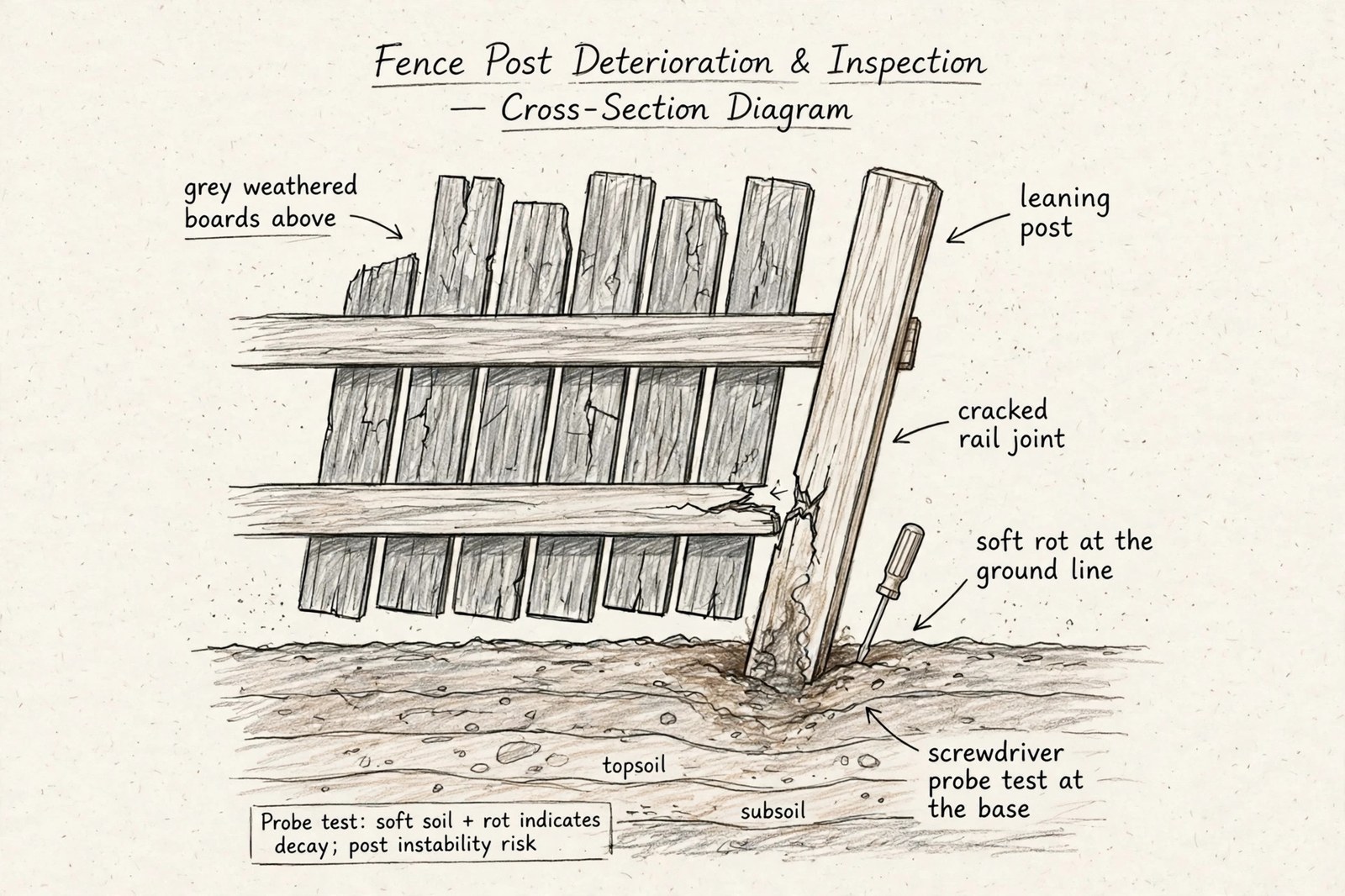
The screwdriver test is the fastest way to separate cosmetic wear from real decay. Push a screwdriver or an awl into the post at grade, a few inches above the soil. Sound wood resists and the tool barely bites. Decayed wood lets the point sink in easily, and the wood comes away in soft, crumbly chunks. Test every post, not just the ones that look bad, because rot at grade often hides under a surface that still looks solid. Do not judge by grey color alone: a silvered board can be structurally fine for years, while a brown post that looks new can be soft inside.

How to make a wood fence last longer
You can add years to a wood fence with a short list of habits, and none of them takes a weekend. A fence lasts longest when it stays dry, stays clear of soil and plants, and gets a fresh finish before the old one gives up.
The schedule below is the rhythm most of the guides I opened agree on, and it is the one I would follow on my own fence.
| When | What to do |
|---|---|
| Every spring and fall | Walk the line; probe posts at grade; tighten loose fasteners; clear soil, mulch, and leaves from the bottom boards |
| Every year | Redirect sprinklers; trim vines and shrubs back off the fence; check gate posts and hardware |
| Every 1 to 2 years | Wash the fence to remove algae, mold, and mildew before they hold moisture against the wood |
| Every 2 to 3 years | Recoat with a penetrating stain or sealer; sooner on south- and west-facing runs that take the most sun |
| As needed | Replace single pickets and rails promptly; fit a rot board along the bottom so pickets never touch soil |
Cleaning deserves its own note, because a dirty fence holds water against the wood all year. A gentle wash with a garden hose and a soft brush, or a low-pressure wash with a wood-safe cleaner, clears the film that feeds mold and mildew. Our guide to fence cleaning walks through the full process, including when to soft wash instead of pressure washing so you do not scar the boards.
Stain is the other big lever. A penetrating stain slows the wetting and drying cycle that checks and splits boards, and it keeps the wood from greying as fast. Paint can work too, but it sits on the surface and peels when water gets behind it, while a penetrating stain soaks in and fades instead of flaking. Whichever you pick, coat the end grain and the bottoms of pickets, since those are the faces that drink the most water.
Before you reach for the brush, watch this short video from Fence Armor, where Connor from Deck Refresh shows the prep and staining steps that keep outdoor wood looking good. The same technique applies to fence boards.
One more habit is free and easy to forget: keep the bottom of the fence out of the dirt. Pickets that touch soil wick moisture straight up the grain, and the bottom six inches rot while the rest of the board looks fine. A pressure-treated rot board along the base, or simply holding the pickets an inch or two above grade, breaks that path. When the rot board itself starts to go, you swap one cheap board instead of a whole run of pickets.
A few habits shorten a fence’s life faster than neglect does. Do not pressure wash boards from a few inches away: the jet scars the surface and opens the grain so the next rain soaks in deeper. Do not paint over wood that is still wet from washing, since the finish traps the moisture underneath and peels off in sheets. Do not let vines climb the fence, and do not stack firewood against it, since both hold damp air against the boards all year. All four feel like care. All four do the opposite.
Repair or replace: how to decide
Repair when the posts are sound and the trouble sits above them: a split picket, a loose rail, a sagging gate, a worn finish. Replace when the posts are going as a group, because every new board you hang is then hung on a structure that still has to come out.
| Situation | Best move |
|---|---|
| A few split or cupped pickets, posts firm | Replace the pickets; restain the run |
| One leaning or soft post, rest of the line sound | Replace that post; brace the run while you work |
| Rails pulling off posts, fasteners rusted | Replace rails and hardware; check post faces for rot |
| Several posts soft at grade, line leaning one way | Price a full rebuild; spot repairs will chase the problem |
| Gate post cannot carry the gate safely | Replace the gate post with a ground-contact rated post, or a steel post |
| Repair costs keep climbing past half the price of a new fence | Replace; Angi uses the same 50 percent rule of thumb |
Boards and rails are cheap and replaceable one at a time, and one soft or leaning post on an otherwise sound line is a post replacement, not a fence replacement. That is the key distinction in the whole table: fix parts while the frame is sound, and stop fixing parts once the frame itself is going.
If the numbers are close, get a quote for the whole job before you commit to repairs. Our guide to what a whole fence project costs covers the all-in number with gates and permits, which is the figure you need for a fair comparison. A fence that has needed a repair every year for three years is telling you something, even if each repair looked small on its own.
There is also a middle path worth knowing about: replacing the posts in stages. If half the posts are soft and half are firm, a crew can pull and reset the bad ones, reusing the sound boards and rails, and you get several more years out of the fence for a fraction of a rebuild. The trick is matching the work to the frame. New boards on dying posts are money thrown away, but new posts under sound boards are one of the best buys in fence care.
Wood vs other fence materials
Wood is the cheapest route to a full privacy fence, and the most flexible: any height, any style, any stain color, and it follows a sloping yard without a fuss. The trade is upkeep. No other common fence material asks for a fresh finish every few years, and none rots at the ground line.
Vinyl and aluminum last longer with almost no maintenance, and steel and wrought iron can outlast the house, but they cost more up front and they do not take a new color the way wood does. Composite sits in between: boards that do not rot, on posts and a frame that still need care.
The right question is not which material lasts longest in a vacuum. It is which one fits your budget, your tolerance for maintenance, and how long you plan to stay in the house. If you like the look of wood and you will stain it on schedule, a cedar fence can serve 25 years or more. If you know you will never stain it, vinyl will treat you better. Our guide to fence costs by material lays out the per-foot prices side by side, so you can weigh the cheaper build against the years of upkeep before you choose.
For the price side of the same decision, see how much a privacy fence costs, with per-foot prices by material, height and board style.
Height is the one choice that changes both price and privacy: our guide to privacy fence height limits walks through the rules by yard and the sightline test.
When to call a pro
Most fence maintenance is honest DIY work: washing, staining, swapping a picket, tightening hardware. Call a pro when the job touches structure, safety, or your property line. A leaning fence over a path or driveway is a hazard before it is an eyesore, so brace it the day you find a post that has let go at grade.
Post replacement in a long run, gate posts that carry a heavy gate, and any fence on a steep slope are also pro jobs, because the posts need to be set deep, plumb, and properly braced or the new work inherits the old lean.
Two more cases belong to a pro. If you find termite tunnels or frass, get a pest inspection before you repair around the damage, since the insects may have reached posts that still look fine. And if a storm took down a run of fence, check your home insurance before you pay out of pocket: our guide to fences and home insurance explains what storm damage typically covers and what to document before the cleanup starts.
Questions people ask
Most wood fences last 15 to 20 years. Cedar and redwood fences with regular stain and seal can reach 25 to 30 years, and pressure-treated pine usually lands between 10 and 20. The posts set the number, since they sit in wet soil while the boards dry out between rains.
Yes, usually. A cedar fence typically lasts 15 to 30 years against about 10 to 20 for pressure-treated pine, and the gap widens when the cedar is stained on schedule. The catch is heartwood: only cedar heartwood carries the natural oils that resist decay, so sapwood-heavy boards will not outlast pine. Use treated or steel posts under cedar boards for the longest life.
The posts, at the ground line. That narrow band where wood meets soil stays wet while oxygen is still available, which is exactly what decay fungi need. Boards and rails dry out between rains, so they usually outlast the posts by years. When a fence leans, the post base is the first place to check.
Every 2 to 3 years is the usual rhythm for a penetrating stain or sealer, and sooner on south- and west-facing runs that take the most sun. Water-repellent coatings can wear faster, sometimes within a year or two, so watch for the signs: grey wood, water soaking in instead of beading, and surface checking. Recoat before the finish is fully gone, not after.
Yes, with the right build and care. A cedar or redwood fence on treated or steel posts, kept clear of soil and sprinklers and stained every few years, can reach 30 years and beyond. The posts are the limit: even a well-kept fence needs its posts checked at grade, since one bad post can take a whole run down with it.
Push a screwdriver or an awl into the post a few inches above the soil line. Sound wood resists and the point barely bites. Decayed wood lets the point sink in easily and comes away in soft, crumbly chunks. Test every post, not just the leaning ones, and do not judge by grey color alone: a silvered board can be sound for years while a brown post is soft inside.
It depends on the posts. If the posts are firm and only boards, rails, or the finish need work, repair it: those parts are cheap and replaceable one at a time. If several posts are soft at grade, or the repairs keep adding up past half the price of a new fence, put the money toward a replacement instead.
Sources
- Angi, How Long Does a Wood Fence Last?, for lifespan by wood type, climate and pest factors, and repair vs replace signs.
- Fence Report, How Long Does Pressure-Treated Lumber Last in a Fence?, for the Penn State Extension 10 to 25 year post range, AWPA use categories, and the five conditions that shorten fence life.
- PicketKit, How Long Does a Fence Last: Cedar to Vinyl, for the USDA Forest Products Laboratory Wood Handbook on decay resistance and the 20 percent moisture threshold, post ratings, and repair vs replace logic.
- Fence Armor, Pro Deck Staining Techniques for a Long-Lasting Finish! on YouTube, with Connor from Deck Refresh, showing prep and staining steps for outdoor wood; used for the video embed in the maintenance section.
