

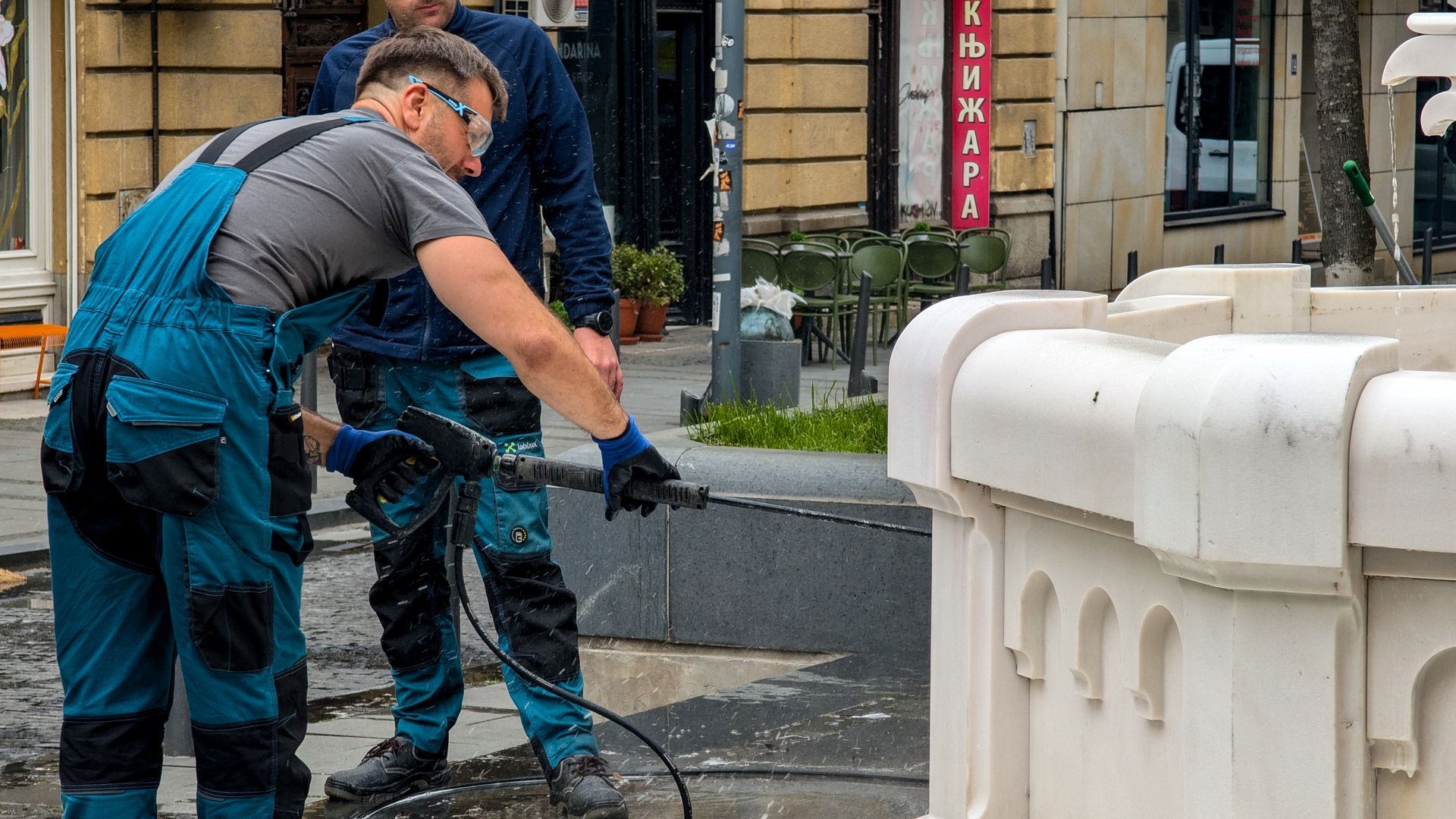
A patio cleaning service is a crew that clears, pre-treats, and washes your patio with a pressure washer or soft wash, and re-sands paver joints after. A typical patio runs about $150 to $400 and takes one to two hours. Hire it when the patio is large or stained, and do it yourself when it is small and lightly soiled.
This guide is written for people comparing quotes, not for people selling the service. It covers what a fair price looks like, what a good crew actually does, the questions that separate a careful company from a careless one, and the point where doing it yourself stops making sense.
Last updated: November 23, 2026
What is in this guide
- What a patio cleaning service costs in 2026
- What the service includes, and what it should include
- Pressure wash or soft wash: the method matters more than the machine
- Should you clean it yourself or hire it out?
- How to hire a patio cleaning service
- After the clean: sealing, and how often to repeat
- Patio cleaning service: questions people ask
What a patio cleaning service costs in 2026
Most patio cleaning jobs land between $100 and $350, and Homewyse puts the rate at $0.30 to $0.55 per square foot as of January 2026. A typical backyard patio runs about $150 to $400 and takes one to two hours. Size, surface, and stain level move the number more than anything else, and sealing or re-sanding adds to it.
The two price lists below agree with each other, which is a good sign. Homewyse gives the per-square-foot rate, and a Wisconsin pressure washing company publishes prices by patio size and surface, so you can check your own patio against both.
| Patio size and surface | Typical price | Notes |
|---|---|---|
| Small concrete patio, up to 200 sq ft | $100–$150 | Standard single level, easy access. |
| Medium concrete patio, 200–400 sq ft | $150–$225 | May include steps or border areas. |
| Large concrete patio, 400–700 sq ft | $225–$350 | Multi-level or heavy soiling adds cost. |
| Paver patio, up to 350 sq ft | $130–$250 | Joint re-sanding not included. |
| Natural stone or flagstone, up to 300 sq ft | $150–$280 | Soft wash method, longer dwell time. |
| Any basic surface, 500 sq ft | About $150–$275 | Homewyse rate of $0.30–$0.55 per sq ft, January 2026. |
Homewyse describes its rate as a basic clean in straightforward conditions: debris cleared off, cleaning solution applied, the surface brushed to lift embedded dirt and light staining, then rinsed. It also notes a two-hour minimum labor charge, which is why small patios rarely cost less than $100 even when the square footage is tiny. The crew still has to load up, drive out, set up, and clean up, and that fixed time is priced into every job.
Region moves the number too. Homewyse notes that actual costs vary with local labor and material prices, and the price lists above come from Wisconsin and New Jersey, so a quote in a high-cost metro will run higher than one in a smaller town. The fix is simple: get three written quotes for your exact patio and compare the square-foot rates, not just the totals, since a low total on a small patio can hide a high rate.
Five things push a quote up or down. Size matters most, since most companies price by the square foot. Surface comes next: concrete is the cheapest to clean, pavers and natural stone cost more because they need a gentler method and more time. Stains add money too, since oil, rust, and old grease need a pre-treatment before any water comes out, and one New Jersey company adds $50 to $100 for heavy staining for exactly that reason. Access matters as well: tight side yards, multiple levels, and long hose runs slow a crew down. Sealing and joint re-sanding are the last two, and both are usually priced as separate line items rather than folded into the cleaning price.
Two ways to bring the number down are worth knowing about. Booking the patio with a driveway or house wash on the same visit costs less than scheduling two separate visits, and the same New Jersey company prices a patio with walkways and front steps at $250 to $400 as a bundle. If the quote makes you wonder whether the patio is worth saving at all, our paver patio cost calculator prices a new paver patio so you can compare a clean against a replacement before you spend anything.
What the service includes, and what it should include
A proper patio cleaning service clears the furniture and debris, pre-treats stains and growth, washes the surface at a pressure matched to the material, and rinses everything clean, including the edges and corners most crews skip. On pavers it should also clear the joints and offer re-sanding. Sealing and furniture cleaning are usually priced separately, so ask before you book.
A good crew works in a clear order, and you can watch for it on the day. First they move the furniture off the patio and sweep the loose dirt away, since washing over leaves and grit just pushes it around. Then they pre-treat: degreaser on oil and food stains near the grill, a biocide where algae has a grip, and a specialty product for rust or leaf tannins. The solution needs time to sit, which is the part rushed crews skip, and it is also the part that does most of the actual cleaning. Then comes the wash itself, with a surface cleaner on open concrete and a wand along edges, steps, and corners. Last is the rinse, plus a check that dirty water runs off the patio and away from beds and the house, not into them.
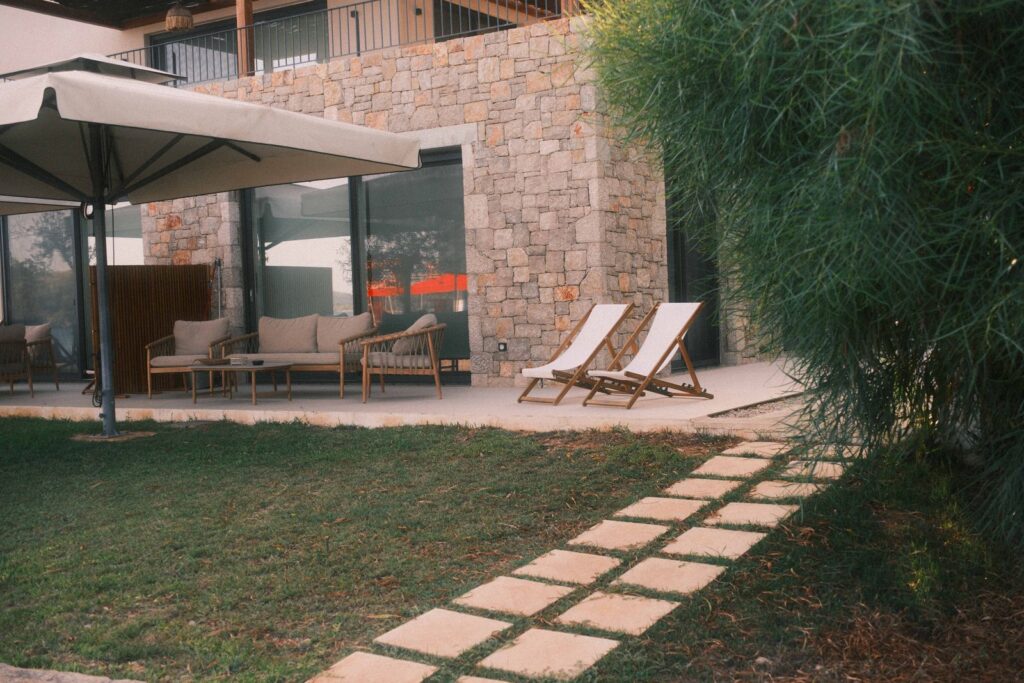
Some things look like part of the clean but usually are not. Furniture cleaning is often a separate tier: one Arizona cleaning company treats it as a deep-clean add-on, moving each piece, washing frames with the right detergent, and spot-treating cushions where the fabric allows. Sealing is almost always separate, and joint re-sanding on pavers is too. Cleaning a paver patio and re-sanding the joints together generally runs $400 to $900, according to the same New Jersey company, and it usually takes two visits, since polymeric sand has to go down on a fully dry surface. That is worth knowing before you compare quotes, because a cheap cleaning-only price can look like a bargain next to a higher price that already includes the sand.
Watch for these red flags when a company describes its work. One pressure setting for every surface is the biggest one: concrete, pavers, and stone do not take the same treatment, and a crew that treats them the same will damage the softer ones. No pre-treatment is another, since pressure alone does not lift oil, rust, or deep algae. No mention of joint re-sanding on a paver patio means the joints will be left empty after the wash, and empty joints are a worse problem than dirty ones. A quote given by phone with no photos, no visit, and no square-foot rate is a guess, not a quote. No insurance, or a refusal to show a certificate, is a reason to stop the conversation. And any promise that every stain will vanish completely is a promise nobody honest makes, since old oil and rust often lighten rather than disappear.
Pressure wash or soft wash: the method matters more than the machine
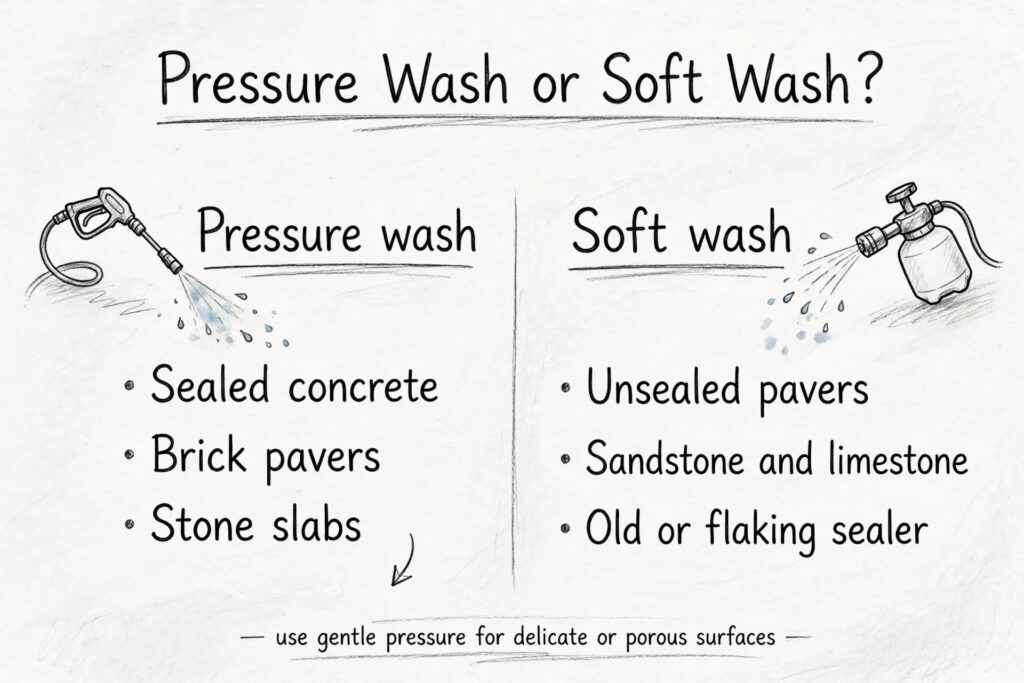
Pressure washing uses high-pressure water and suits hard concrete. Soft washing uses low pressure and cleaning solution, and it suits pavers, stone, wood, and anything sealed. The right crew picks the method by surface, not by the machine on the truck, and that choice is what keeps pavers and sealer intact.
The two methods are easy to confuse because both use a pressure washer. The difference is what does the work. In pressure washing, the water jet does the cleaning, and the pressure is high. In soft washing, the cleaning solution does the work and the water is only there to rinse it off, so the pressure stays low. That is why soft washing is the right call for anything that can be etched, flaked, or stripped, and why high pressure is fine on plain concrete that has nothing to lose.
| Surface | Safe pressure | Method | Watch out for |
|---|---|---|---|
| Concrete | 2,500–3,500 PSI | Hot water with a surface cleaner | Zero-degree nozzle held close; stripes from wand-only cleaning. |
| Brick and concrete pavers | 1,000–1,500 PSI | Low-to-medium soft wash | Joint sand blown out; narrow nozzle etches the face. |
| Flagstone and bluestone | 800–1,200 PSI | Soft wash, pH-neutral detergent | Pitting from high pressure. |
| Slate | 600–900 PSI | Soft wash | Flaking; slate is very porous. |
| Stamped or colored concrete | 1,200–2,000 PSI | Low-to-medium pressure | Sealer stripped by too much pressure. |
The pressure figures above come from The Total Wash Co., which publishes its settings by surface, and the risks are real rather than theoretical. A narrow nozzle held too close will etch the face of a paver and blow the joint sand out in stripes, and the New Jersey crew that explains its paver method in its FAQ uses a surface cleaner at a controlled distance so the whole field comes out one even color. The same logic applies to the rest of the house: pressure is right for concrete, brick, and pavers, while siding, roofs, and wood get soft washed instead. If a company cannot tell you which pressure it will use on your surface, that is the answer to your next question, and you should keep looking. For a closer look at how each surface should be cleaned, see our guide to patio cleaning by surface.
Should you clean it yourself or hire it out?
Hire the clean when the patio is bigger than 300 square feet, stained, or paved with joints that need re-sanding. Do it yourself when the patio is small and lightly soiled concrete, and you already own or can cheaply rent the gear. The break-even point is closer than most people expect, because a rental day plus cleaners costs real money.
| Do it yourself | Hire a service | |
|---|---|---|
| Cost | $47–$102 a day for the rental, plus cleaners, deposit, and fuel | $100–$350 for most patios; $400–$900 with paver re-sanding |
| Time | Half a day to a full day, including pickup, setup, and return | One to two hours on site for a typical patio |
| Risk | Etched pavers, blown joint sand, stripped sealer, water forced under slabs | Low, if the crew is vetted; ask for the method in writing |
| Result | Good on small, lightly soiled concrete; uneven on large or stained patios | Even finish, stain pre-treatment, edges done, after photos |
| Best for | Small concrete patio, light dirt, and a free Saturday | Pavers, stone, heavy stains, big patios, or a tight schedule |
The rental math is easy to check. Home Depot rents an electric pressure washer for about $47 a day, a gas unit in the 2,000 to 2,700 PSI range for about $87 a day, and a heavy 3,500 to 4,000 PSI machine for about $102 a day, according to a 2026 rental price guide. Add a refundable deposit roughly equal to the rental fee, cleaners, and fuel for the gas unit, plus the drive there and back and the time to learn the machine, and a small patio clean can easily cost half of what a pro charges, while eating your whole Saturday. The electric unit is also too weak for serious concrete work, and the gas unit strong enough for the job is the one most likely to etch a paver or strip sealer in inexperienced hands.
That said, DIY is the right call sometimes. A small concrete patio with light dirt and no stains is a forgiving first job, and a surface cleaner attachment, which the same rental guide says cuts the time roughly in half, keeps the finish even. If you go that way, our guide to cleaning patio pavers yourself covers the method, the settings, and the mistakes to avoid, and our patio cleaning guide by surface tells you which approach fits your material. Hire it out when the patio is paved, the stains are old, the surface is sealed stone, or the joints need re-sanding, since those are the jobs where a wrong nozzle or a skipped step costs more to fix than the clean itself.
How to hire a patio cleaning service
Start with three local companies, ask each one the same questions, and compare written quotes that state the square-foot rate, the method for your surface, and exactly what is included. Check insurance, reviews, and photos of the same surface type before you book, and pay only after a walkthrough of the finished work.
Work through these seven checks in order. They take one phone call each, and they filter out most of the bad hires before anyone comes to your house.
- Get the method in writing for your surface. Ask which pressure and which method they will use on your exact material, and get it in the quote. A company that names the surface and the setting is a company that has thought about it. One that says “we just pressure wash everything” is telling you its method, and it is the wrong one for pavers and stone.
- Ask for proof of insurance. Any company working with high-pressure water around your house, your windows, and your planting should carry general liability insurance and be able to show a certificate before work starts. This is a yes-or-no question, and a hesitation is an answer.
- Compare written quotes with a square-foot rate. A real quote states the area, the rate, the method, and what is included. Ask each company the same questions so the numbers are comparable, and be wary of a flat price that changes once the crew arrives. Most companies can quote from photos, and larger properties deserve a quick look in person.
- Ask what sealing and re-sanding cost, separately. Sealing is usually priced on its own, and paver re-sanding often doubles the job and adds a second visit. Get both numbers up front so the cheap quote and the complete quote are not confused with each other.
- Check reviews and photos of the same surface. Look for consistent reviews across more than one platform, and ask for before-and-after photos of patios made of your material. A company with fifty clean concrete driveways and no paver work is not proven on pavers.
- Ask how they handle stains, furniture, and runoff. Good questions include whether oil and rust get a pre-treatment, whether furniture is moved or washed around, and how they keep dirty water and cleaning solution out of beds and storm drains. The answers tell you how much care goes into the job.
- Agree on payment after a walkthrough. A fair arrangement is a clear price before work starts and payment after you have walked the patio with the crew, or after you have seen after photos if you were away. One Arizona cleaning company sends after photos for approval before running the final payment, which is a good model to ask for.
The same approach works for any exterior trade, and it is worth borrowing the full checklists from our other hiring guides. Our guide to hiring a gutter cleaning company and our questions to ask a pressure washing company both use the same pattern: insurance first, method second, written quote third, and reviews that match your exact job.
After the clean: sealing, and how often to repeat
Seal a paver or concrete patio after it is fully clean and dry, and plan on a professional clean about once a year, ideally in spring. Between cleans, sweep often, rinse spills fast, and skip the pressure washer for routine dirt, since repeated blasting wears joints and sealer faster than a broom ever will.
Sealing is the step that makes a clean last. A clean patio that is sealed stays cleaner longer, and The Total Wash Co. puts that at 40 to 60 percent longer than an unsealed surface in the same weather. The timing matters more than the product: seal only after the patio is fully clean and completely dry, and never seal over algae or growth, since sealer traps moisture underneath and speeds up the damage it was meant to prevent. For paver patios, seal after the joints have been re-sanded, not before. Our guide to sealing patio pavers covers the sealer types and the timing in full.
Once a year is the right rhythm for most patios, ideally in spring after the last frost, when winter grime, algae, and tannin stains are most visible. Patios with heavy shade, overhanging trees, or a north-facing orientation may need a second clean in fall to keep moss and algae under control. A deep clean resets the patio, and simple habits stretch the result: rinse with a garden hose every few weeks, deal with food and grease spills as soon as you see them, and use a broom or leaf blower on dry leaves instead of reaching for the pressure washer. Many companies offer lighter maintenance cleanings once or twice a year after the first deep clean, which costs less than letting the patio go for two or three years and then paying for a full reset.
Patio cleaning service: questions people ask
Homewyse puts the rate at $0.30 to $0.55 per square foot as of January 2026, which works out to about $150 to $275 for a 500 sq ft patio. Most published price lists land in the same range, with a typical backyard patio running $100 to $350 depending on size, surface, and stain level.
One to two hours for a typical backyard patio. A standard 200 to 300 sq ft concrete patio usually takes 60 to 90 minutes, while larger patios, heavily soiled pavers, or natural stone needing a soft wash can stretch to three or four hours. Paver re-sanding adds a second visit the next day, since the sand must go down on a fully dry surface.
Soft washing is better for pavers. Pavers should be cleaned at 1,000 to 1,500 PSI with a low-to-medium soft wash, since high pressure blows the joint sand out and can etch the face of the stone. Plain concrete is the surface that takes full pressure, at 2,500 to 3,500 PSI with a surface cleaner.
Not when the method matches the surface. Damage happens when a narrow nozzle is held too close, which etches pavers and strips joint sand in stripes, or when sealed or stamped concrete gets more pressure than the sealer can take. Ask for the pressure and method in writing before you book, and check that the quote names your surface.
Usually, yes. Sealing protects pavers and concrete from stains, keeps joints stable through freeze and thaw, and keeps the surface cleaner for longer: one cleaning company puts the difference at 40 to 60 percent. Seal only after the patio is fully clean and dry, and after re-sanding on pavers. Our guide to sealing patio pavers covers the sealer types and timing.
Do it yourself when the patio is small, lightly soiled concrete, and you can rent the gear cheaply: an electric pressure washer rents for about $47 a day, and a gas unit for $87 to $102 a day. Hire it out when the patio is paved, badly stained, sealed stone, or large, since those are the jobs where a wrong nozzle or a skipped step costs more to fix than the clean. Our guide to cleaning patio pavers yourself covers the DIY method.
About once a year for most patios, ideally in spring after the last frost. Patios with heavy shade, overhanging trees, or a north-facing orientation may need a second clean in fall to keep moss and algae under control. Between cleans, sweep often and rinse spills fast, and skip the pressure washer for routine dirt.
Sources
- Homewyse cost to clean a patio: January 2026 rate of $0.30 to $0.55 per square foot, what a basic clean includes, and the two-hour minimum labor charge.
- The Total Wash Co. patio cleaning guide: prices by patio size and surface, safe pressure by surface, one to four hour time frame, once-a-year frequency, and sealing benefits.
- Nicky Blue Power Washing FAQ: paver cleaning and re-sanding at $400 to $900, two-visit timing, stain pre-treatment charges, insurance, and the surface cleaner method.
- Doxa Cleaning deep patio cleaning guide: what a deep clean includes, furniture handling, stain treatment, mid-hundreds pricing for an average patio, and maintenance between cleans.
- Pressure Wash Tips rental price guide: Home Depot and Lowe’s pressure washer rental rates by machine tier, deposits, and accessory costs.
