

Those black spots on your vinyl siding are almost always one of three things: mold, mildew, or artillery fungus. Mold and mildew are living films that grow on damp, shaded siding and wipe off with the right cleaner. Artillery fungus is something else entirely: tiny glue-like spore packets shot onto the wall from mulch below, and no amount of ordinary washing will touch them. Identify first, clean second.
Keep reading for the spot map that tells the three apart, three field tests you can do in minutes, and honest cleaning limits for each one.
Table of contents
- The three usual suspects, in one paragraph
- Read the pattern first: the spot map
- Three field tests that settle it in minutes
- Artillery fungus: the one that is not mold at all
- Mold and mildew: the ones that grow where moisture lingers
- What actually removes each one
- Stop new spots: fix the source, not just the symptom
- DIY or call a pro? The honest line
- Frequently asked questions
- Sources
The three usual suspects, in one paragraph
Mold on siding is a surface fungus that shows up as patchy, often fuzzy dark spots where moisture lingers. Mildew is its close cousin, usually grayer and powdery, and both feed on dampness, shade, and the film of dirt on the panels. Artillery fungus is not a siding problem at all: it is a wood-decay fungus living in landscape mulch that fires sticky black spore packets onto nearby walls, and the dots it leaves are bonded to the surface like tar. Same symptom, three very different fixes, which is why the first job is identification, not the hose.
Read the pattern first: the spot map
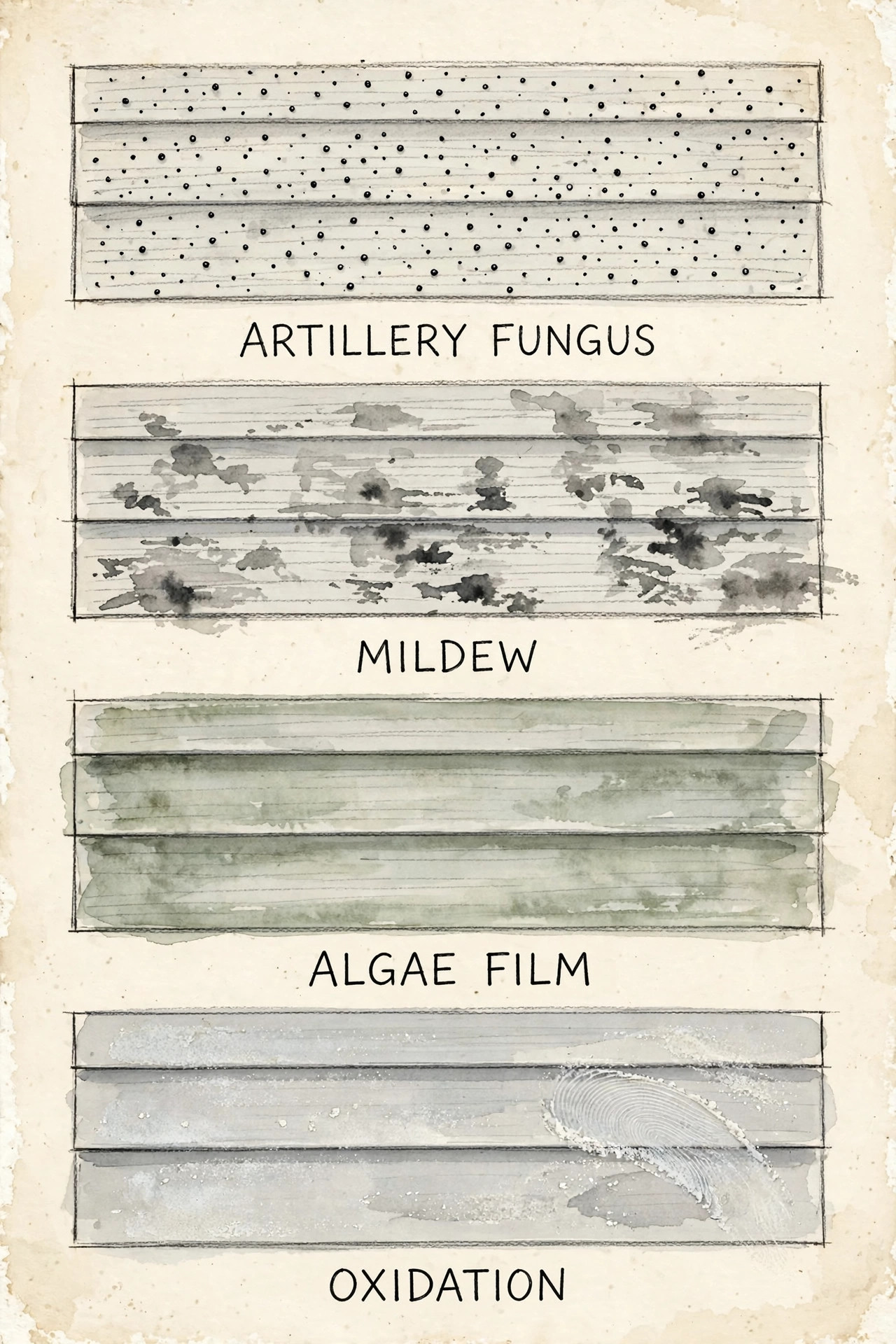
The pattern on your wall is the diagnosis. Artillery fungus makes discrete, raised dots clustered on the lower few feet of siding near a mulch bed. Mold and mildew make irregular patches or films, often with a greenish or gray cast, spreading across shaded, slow-drying walls. If your spots match neither pattern, the table below lists the lookalikes before you spend a weekend scrubbing the wrong thing.
| What you see | Most likely cause | Where it clusters | The giveaway |
|---|---|---|---|
| Tiny raised black dots, gritty to the touch, each separate | Artillery fungus | Lower siding, above or near mulch beds, worst on light colors | Dots do not smear when rubbed; standard cleaner does nothing |
| Patchy gray-black or brown spots, slightly fuzzy or powdery | Mildew | Behind shutters, under window sills, along bottom edges, anywhere splashback lands | Returns to the same damp spots year after year |
| Dark or greenish film, sometimes with a slimy feel | Mold or algae film | North-facing walls, deep shade, anywhere air circulation is poor | Wipes or bleaches off readily; wall stays wet long after rain For the full method, see our guide on how to clean green algae from vinyl siding. |
| White powder that comes off on your fingertip | Oxidation, not growth | Sun-battered walls, worst on dark colors | Chalky residue, no texture under it; if that is your symptom, read why vinyl siding looks chalky |
| Small dark specks that flake off easily | Tar, fly specks, or pollution | Near driveways, roads, or under eaves where insects gather | Scrapes off with a fingernail; no stain underneath |
If your siding is just chalky and you are not sure whether it is oxidation or plain dirt, run through our oxidation vs. dirt test before choosing a cleaning method.
I have seen homeowners pressure-wash the same wall three summers in a row before learning the dots were artillery fungus. A wash will never fix a mulch problem, and a mulch change will never fix a moisture problem. The table above keeps you from chasing the wrong one.
Three field tests that settle it in minutes
You do not need a lab. Three quick tests, done in daylight, separate the three suspects with good confidence.
- The touch test. Run your fingertip over a spot. Artillery fungus dots feel raised and gritty, like grains of sand glued on, and your finger will not dislodge them. Mold and mildew feel flat or slightly fuzzy, and oxidation feels chalky and powders onto your skin.
- The location test. Walk the wall and note where the spots concentrate. A band of dots on the lower siding directly above a mulch bed, fading as you go higher, points to artillery fungus. Broad patches on the shadiest, slowest-drying wall, especially the north side, point to mold or mildew.
- The bleach dab test. Dab a little diluted household bleach on one spot, wait a minute, and rinse. If the spot lightens dramatically, it is organic growth, most likely mildew or algae. If nothing changes, it is likely artillery fungus, dirt, pollution, or oxidation.
Photos alone are not enough to be sure: small raised black dots above a mulch bed only suggest artillery fungus, so run the tests before you decide what to clean with.
Artillery fungus: the one that is not mold at all
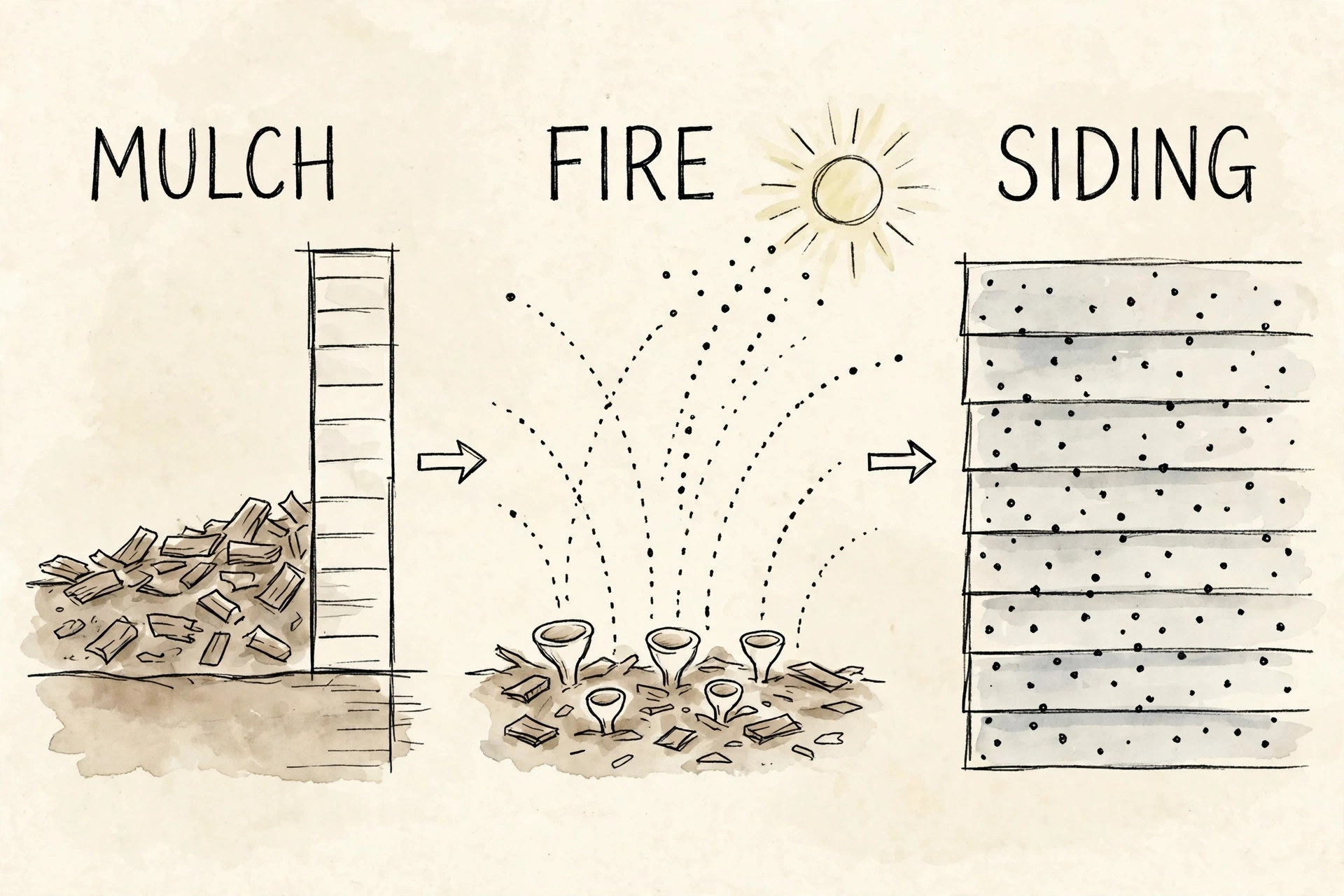
Artillery fungus (Sphaerobolus species) is a wood-decay fungus that lives in damp organic mulch, not on your house. It grows tiny cup-shaped fruiting bodies, about a tenth of an inch across, each holding a dark, round spore packet. When water collects in the cup, it builds pressure until the packet fires toward light, landing on siding, windows, cars, and anything bright within several feet. The University of Delaware’s fact sheet on the fungus describes exactly this: the packets carry a sticky coating that makes removal extremely difficult once they bond.
The spots themselves are dormant, not a spreading infection. They will not eat your siding, rot the panels, or harm your plants or pets. What they will do is sit there, year after year, getting more noticeable as new shooting seasons add fresh dots on top of old ones. Cool, moist conditions favor the fungus, which is why outbreaks cluster in damp stretches of the year rather than hot, dry spells.
It favors hardwood mulch, wet beds, and the north side of the house where shade keeps things damp. It is also light-seeking, which is why the dots show up heaviest on light-colored, reflective siding and why a white car parked near the bed can look peppered while a dark wall a few feet away looks clean.
Mold and mildew: the ones that grow where moisture lingers
Mold and mildew on siding are not mysteries: they are fungi growing on a film of dirt, pollen, and moisture that never quite dries. Iowa State University Extension notes that mold spores are everywhere and that they thrive in damp, shaded spots with poor air circulation, and that most molds on the outside of a house are an eyesore rather than a health threat.
Three conditions feed them, and every one of them is worth checking before you clean:
- Shade and still air. The north side of the house, walls under deep eaves, and siding crowded by shrubs stay wet longest after rain. Trimming plants back so sun and air reach the wall is the single best prevention.
- Water landing where it should not. Overflowing gutters, a downspout splashing against the wall, or sprinklers hitting the siding keep panels wet between rains. If you see green algaeor black streaks below a gutter, read why gutters overflow in heavy rain and how often gutters actually need cleaning before you scrub, because the gutter is the cause and the spots are the symptom.
- A dirty surface. Mold feeds on the dust and organic film on the siding. A yearly wash removes its food supply, which is why siding that gets washed regularly grows far less of it; the exterior house cleaning guide by surface lays out a schedule that keeps that film from building up.
What actually removes each one
Different causes, different cleaning. Using the wrong method wastes a weekend or damages the siding, so match the fix to the diagnosis.
For mold and mildew, soft cleaning works. The Vinyl Siding Institute’s cleaning guidance, as published in the Worcester Telegram & Gazette, points to a simple mix of 30 percent white vinegar and 70 percent water for mold and mildew stains, applied with a soft cloth or soft-bristle brush, with a spot test on a hidden area first. Iowa State Extension suggests a slightly stronger wash when needed: a third of a cup of a mild cleaner such as TSP in a gallon of water, or a quart of bleach added to the mix for stubborn growth, with a clear warning to never mix bleach with anything containing ammonia and to cover nearby plants with plastic before you start. Work from the bottom up, rinse each section before the solution dries, and never aim the hose upward at the panels, since water forced behind the siding creates the exact damp conditions mold loves. If you are weighing methods, soft washing versus pressure washing walks through which surfaces suit each.
For artillery fungus, set expectations honestly. The dots are bonded with a natural adhesive, and no standard house wash, mold cleaner, or pressure washer reliably removes established ones. A routine wash may clean the surrounding dirt and leave the bonded packets standing out more than before. Gentle scraping can pop individual dots off, but it is slow work and very often leaves a brown stain behind, and abrasive tools trade one problem for another: Ohio Power Washing’s detailed guide on the fungus warns that steel wool, metal scrapers, abrasive pads, and harsh solvents can damage the finish worse than the original spots, and advises testing any approach on a hidden area first.
A few practical rules for artillery fungus spots:
- Start with soap, water, and a soft brush on fresh dots; once the packets have cured for weeks, removal gets much harder.
- Never scrape dots off over the mulch bed below. Penn State’s researchers warn that the dislodged spore masses are dormant but alive, and they germinate and infest the mulch they land on, restarting the whole cycle.
- Be skeptical of any product or company promising complete removal of established spots. Honest pros treat it as spot-by-spot work with realistic limits, not a guaranteed clean.
Stop new spots: fix the source, not just the symptom
Cleaning the wall without addressing the mulch is mowing the lawn while the sprinkler runs. The fungus lives in the bed, and new shooting seasons will re-spot the siding unless the bed changes. Penn State’s plant pathologists tested 27 mulches in the field, and their results give a clear picture of what helps.
| Mulch choice | How it performs against artillery fungus | Notes |
|---|---|---|
| Large pine bark nuggets | Best performer in Penn State’s tests | Big pieces stay hard and dry, which the fungus dislikes |
| Cypress mulch | Performed well | May contain natural anti-decay compounds; check sustainability concerns in your area |
| Bark mulch (general) | Better than shredded wood | Less favorable substrate than hardwood shreds |
| Shredded hardwood mulch | Worst | Holds moisture and decays into exactly what the fungus feeds on |
| Dyed or colored mulch | Barely better, and only briefly | The colorants do not inhibit the fungus; the effect fades as the color weathers |
| Stone or gravel | The fungus cannot grow on it | No organic food source; consider drainage and heat around plantings |
No mulch proved completely immune: Penn State found that every type eventually supported the fungus after several years outdoors. But several habits cut the pressure dramatically:
- Refresh the top layer yearly. Homeowners who add a fresh layer of mulch each year report fewer problems. Keep the total depth to a few inches, no deeper; roots need to breathe too.
- Rake and stir the bed. Turning the mulch breaks up the fungal growth, dries it out, and makes the bed far less inviting.
- Keep beds from staying soggy. The fungus is favored by excessive rain and irrigation of foundation plantings, so redirect sprinklers and fix grading that ponds water in the beds.
- Consider mushroom compost. The University of Delaware’s fact sheet notes Penn State research showing that blending fresh mushroom compost into landscape mulch at 40 percent or more can suppress the fungus, a solid strategy for beds with a history of the problem.
- Give the fungus nothing to fire at. In the worst beds, right against light siding, a non-wood cover like stone breaks the cycle entirely.
For mold and mildew, the equivalent of “fix the source” is drying the wall out: trim the shrubs, keep gutters clean and downspouts discharging away from the foundation, and aim sprinklers at the lawn, not the house. Spots that keep returning to the same patch of siding are telling you the wall stays wet there; the fall exterior home maintenance checklist covers the seasonal version of this routine.
DIY or call a pro? The honest line
Most black-spot problems are DIY-friendly, but artillery fungus has honest limits that no elbow grease overcomes.
| Safe DIY | Call a pro |
|---|---|
| Identifying the spots with the three field tests | Widespread spotting high on the building or across whole walls |
| Washing mold and mildew with vinegar or mild bleach solutions (one story, stable footing) | Delicate, aged, or already damaged siding where scrubbing risks the finish |
| Changing or refreshing mulch beds | Large landscape redesigns, drainage work, or stone conversion |
| Raking and stirring mulch to suppress the fungus | A previous cleaning attempt that changed the siding’s color or sheen |
| Spot-scraping a few fresh artillery fungus dots | When you cannot identify the marks with confidence |
Cleaning chemicals deserve respect even on a one-story house: wear gloves and eye protection, never mix bleach with ammonia or acidic cleaners, and protect plantings from runoff. If a pro is the answer, a soft-wash company that treats spot removal as a separate job from a standard house wash, with a test area and realistic expectations, is the honest choice.
Not in the way most people fear. Artillery fungus spots are dormant spore packets; they stain but do not eat, rot, or weaken the siding. Mold and mildew on the outside of a house are mostly an eyesore, according to Iowa State University Extension, and do not usually pose health problems. The real risk is cosmetic and, with mildew, the moisture problem feeding it.
No. A routine house wash may remove the surrounding dirt while leaving the bonded spore packets behind, and blasting harder risks stripping the finish or forcing water behind the panels. Ohio Power Washing’s guide puts it plainly: more pressure is not a reliable answer, and a test area on a hidden spot should come before any aggressive attempt.
Bleach is useful against mold and mildew, but artillery fungus dots are not a growing colony on the wall; they are fired spore packets already bonded to the surface. No cleaner has proven reliable at dissolving them once cured, which is why prevention in the mulch bed matters far more than any spray bottle.
Change the mulch, not just the wall. Switch to large pine bark nuggets or another bark mulch, refresh the top layer yearly, rake the bed to keep it dry, and keep the total depth to a few inches. No organic mulch is fully immune, but Penn State’s field tests show these choices dramatically reduce new spotting.
The north side gets the least sun, so it stays damp longest, which suits both mildew and artillery fungus. For mildew, trim shrubs and fix whatever keeps the wall wet. For artillery fungus, check the mulch beds along that wall, since shaded, moist beds are where the fungus fruits most actively.
You can, but the dots are raised, so they will show through as tiny bumps, and painting seals dormant spores onto the wall. Most homeowners find it looks worse up close than the spots did. Addressing the mulch source and cleaning what you can is the better route; painting is a last resort for walls that are already due for it.
Use the three field tests: touch (artillery fungus feels raised and gritty; mold feels flat or fuzzy), location (dots in a band above mulch point to the fungus; broad patches on shaded walls point to mold or mildew), and a bleach dab (organic growth lightens; artillery fungus does not). When the tests disagree, assume the harder problem and treat gently.
Sources
- Penn State Extension’s Q&A on artillery fungus in mulch, including the 27-mulch field study results and why dislodged spore masses must not fall back onto the bed
- University of Delaware Cooperative Extension’s fact sheet on artillery fungus and other mulch fungi, reviewed March 2025, covering identification, bark versus hardwood mulch, and mushroom compost suppression
- Iowa State University Extension’s guide to removing mildew and mold from house siding, with cleaning mixes, plant protection, and prevention
- Ohio Power Washing’s guide to artillery mold on siding, updated October 2026, on identification-first cleaning, removal limits, and what not to use
- The Vinyl Siding Institute’s cleaning guidance, via the Worcester Telegram & Gazette, on the 30/70 vinegar mix, spot testing, and safe pressure-washer technique

5 Comments
Pingback: Why Does Vinyl Siding Look Chalky? Causes & Fixes | Home Exterior Lab
Pingback: How to Clean Green Algae from Vinyl Siding Without Damage
Pingback: What Is Vinyl Siding? Types, Materials & Protection Guide
Pingback: Can You Paint Vinyl Siding? What Works & What Fails
Pingback: How to Clean Vinyl Siding Safely: Dirt, Mold & Stains