


covers that routineSoft washing cleans with chemistry at low pressure. Pressure washing cleans with force at high pressure. For siding, roofs, stucco, and wood, soft washing is the right call. For concrete, pavers, and stone, pressure washing wins. Most houses need both, each on the surfaces it suits.
The confusion costs people real money when they book a house washing service or rent a machine for the weekend. A pressure washer in the wrong hands strips granules off a shingle roof, drives water behind vinyl siding, and chews up a wood deck. The method matters more than the muscle. Here is what each method actually is, and which surfaces get which.
The Two Methods, in Plain Terms
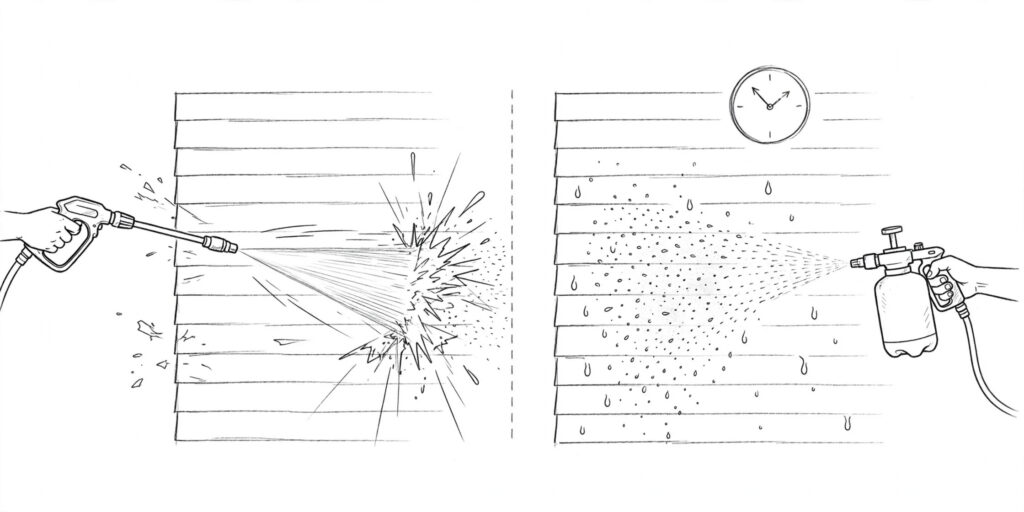
The one-line version: pressure washing is cleaning exterior surfaces with water at 1,500 to 4,000 PSI, using force to blast away dirt, mildew, and stains. Soft washing is cleaning exterior surfaces with a bleach-based solution applied at 300 to 500 PSI, using chemical dwell time to kill algae, mold, and mildew before a low-pressure rinse. Everything below is about which one your surfaces need.
Pressure washing (power washing is the same thing, just a different name) blasts water at 1,500 to 4,000 PSI. A garden hose puts out about 50 PSI, so a pressure washer multiplies that force 30 to 80 times, according to Consumer Reports’ testing. It cleans by impact: the stream physically knocks dirt, mildew, and stains off the surface. No dwell time, no chemistry required, though detergents help.
Soft washing runs at 300 to 500 PSI with high water volume, 15 to 20 gallons a minute, per trade guidance from Trotta’s Power Washing. The cleaning is done by the solution, usually a bleach-based mix with a surfactant so it clings, which sits on the surface for 10 to 20 minutes and kills algae, mold, and mildew down to the root. Then it gets rinsed away at low pressure. Think of it as a garden hose with serious reach and chemistry doing the work.
The practical difference: pressure washing moves what is on the surface. Soft washing kills what is growing in it. On a shaded north wall covered in green algae, blasting removes the green but leaves the organism. A soft wash kills it, so the clean tends to last longer.
How They Compare, Side by Side
| Pressure washing | Soft washing | |
|---|---|---|
| How it cleans | Water force physically removes dirt and stains | Cleaning solution kills organic growth, then rinses off |
| Pressure range | 1,500 to 4,000 PSI | 300 to 500 PSI |
| Water use | Lower volume, around 3 gallons a minute | Higher volume, 15 to 20 gallons a minute |
| Dwell time | None needed | 10 to 20 minutes for the chemistry to work |
| Best for | Concrete, pavers, stone, brick hardscapes | Siding, roofs, stucco, wood, painted surfaces |
| Main risk | Surface damage and personal injury from the stream | Plant damage from runoff if landscaping is not protected |
| DIY-friendly | Yes for ground-level concrete, with the right nozzle | Possible, but chemical handling favors a pro |
The Verdict, Surface by Surface
This is the part that actually matters. Match the method to the material, not to whatever machine you happen to own.
Vinyl siding: soft wash
Vinyl is thin, flexible, and hung in overlapping courses that shed water downward. A pressure washer aimed upward drives water behind the panels, where it feeds mold in the wall cavity. The Vinyl Siding Institute (VSI) cleaning guidance, relayed through a NewsUSA homeowner piece, says that if you use a pressure washer at all, keep the stream at eye level and pointed straight at the siding, never angled upward, and stay cautious around windows, doors, and plumbing penetrations. It also notes that some siding manufacturers do not want pressure washers used on their products at all.
A siding soft wash sidesteps the whole problem: low pressure, detergent, dwell, rinse. For the full vinyl routine, our exterior house cleaning guide by surface walks through it step by step. And wash the gutters before the siding, not after, so the rinse does not streak what you just cleaned. Our gutter maintenance guide covers that routine. If the vinyl looks chalky rather than dirty, that is oxidation, not grime, and our guide to why vinyl siding looks chalky explains the test and the fix.
Fiber-cement siding: garden hose first, pressure washer only with limits
James Hardie, the biggest name in fiber cement, is blunt: do not use a high-pressure power washer on its siding. Its recommended method is a garden hose plus a soft, nonmetal brush, once or twice a year, and it specifically warns against bleach and acid cleaners on the finish.
If you do bring out a pressure washer, the company’s homeowner care guide sets hard limits: a wide fan tip, at least six feet from the wall, pressure below 1,500 PSI. It also warns that damage from improper cleaning may not be covered by the warranty. That is about as close to “soft wash it” as a manufacturer gets without using the term.
Stucco: soft wash, and pre-wet first
Stucco is a cement skin over your wall, and it does not forgive aggressive washing. The Portland Cement Association (PCA) plaster and stucco manual lays out the method: pre-wet the entire wall from the bottom up, then wash top-down with a garden hose, and flush with a follow-up rinse. If accumulated grime needs more than a hose, it says to test low pressure on a small section first before committing to the whole wall.
Translation for homeowners: stucco is a soft-wash surface. High pressure erodes the finish coat and can force water into cracks you cannot see.
Brick: low pressure, and test first
Brick looks indestructible and is not. The Brick Industry Association’s acceptable methods, published in an Interstate Brick technical bulletin, are bucket-and-brush hand cleaning or low-pressure water and detergent spray first, with high-pressure spray reserved for cases where gentler methods failed. For applying cleaners, it specifies low pressure at 50 PSI or lower and says plainly: do not use high-pressure spray.
Old brick with soft lime mortar is the danger zone. High pressure eats mortar joints and can pop the face off soft or handmade brick. New, hard-fired brick on a patio can take more, but start with a test patch in an inconspicuous spot and work up, never down from full blast.
Wood decks and fences: low pressure, wide fan, keep it moving
Wood is the surface where DIY pressure washing goes wrong most visibly. Too much pressure raises the grain and leaves the boards fuzzy, a condition that no amount of staining fixes. Consumer Reports’ nozzle guide puts decks and patios on the 25-degree (green) fan tip, not the narrow ones, and trade guidance warns that highly pressurized water damages wood decks and siding when it is not managed carefully.
The safe approach: a wide fan, moderate pressure, consistent sweeping motion, and never let the stream sit in one spot. On painted wood, expect high pressure to lift the paint along with the dirt; Consumer Reports lists paint stripping as a job for the 15-degree tip, so test first. If the deck is old, gray, and soft, soft washing with a deck-safe cleaner is the kinder option.
Asphalt shingle roofs: soft wash only, never pressure wash
This one is not a judgment call. GAF’s technical bulletin on algae staining says it directly: do not power wash shingles, because it dislodges the protective granules and can lead to premature shingle failure. Those granules are the roof’s sunscreen. Lose them and the asphalt underneath ages fast.
GAF’s approved method is a soft wash in all but name: mix 4 gallons of water, 1 gallon of bleach, and 1 cup of TSP, apply it with a garden sprayer, let it dwell up to 20 minutes, and rinse with low-pressure water. Protect the shrubs below, because the runoff is not kind to landscaping. And remember the surface gets slippery when wet. Roof work belongs to a pro with the right equipment in most cases.
Concrete, pavers, and stone: pressure washing’s home turf
This is where pressure washing earns its keep. Driveways, sidewalks, and patios are dense, horizontal, and built to take force. A 15-degree (yellow) fan tip is the standard choice for concrete, per Consumer Reports’ nozzle chart, and hot water helps on oil and grease, which is one reason pros run heated machines on flatwork.
Two caveats. First, pavers with polymeric sand joints do not like aggressive pressure, which can blow the joint sand out. Second, pre-treat oil stains with a degreaser and give it dwell time rather than trying to erase them with pressure alone. Even on concrete, chemistry plus moderate pressure beats brute force. If concrete is your main surface, our concrete driveway maintenance guide lays out the full seasonal routine.
Three Mistakes That Get Expensive
Pressure washing the roof. Covered above, worth repeating because it is the costliest mistake on this list. Granule loss is permanent, it shortens roof life, and manufacturers flag it. Professional roof cleaning costs a fraction of a re-roof.
Aiming up at the siding. The instinct is to start at the top and work down, but with a pressure washer the upward angle is what forces water behind vinyl courses and into soffits. Keep the stream level or angled slightly down. The Vinyl Siding Institute’s eye-level, straight-on rule exists because of this exact mistake.
The red zero-degree nozzle. It concentrates the machine’s full pressure into a pinpoint jet. Consumer Reports advises against using it at all, noting that the same cleaning can be done with wider-angle settings and that rental shops increasingly leave it out of the kit. It can cut skin in an instant and etch lines into concrete. If yours came with one, leave it in the box.
If You Hire This Out
A good exterior cleaning company matches the method to the surface without being asked. When you are getting quotes, ask these:
- Which method will you use on each surface, and why?
- What pressure are you running on the siding and the roof?
- How do you protect plants and rinse the landscaping?
- Are you insured, and do you guarantee against surface damage?
If a company wants to pressure wash your asphalt shingle roof or blast your stucco at full pressure, that is your answer. Keep looking.
Once you are comparing companies, these nine questions to ask a pressure washing company expose the red flags before anyone touches your house.
If You Do It Yourself
DIY is reasonable for ground-level concrete and a single-story siding wash, with a few non-negotiables:
- Gear up. Consumer Reports cites a U.S. Consumer Product Safety Commission (CPSC) estimate of 6,057 emergency-room visits in a single year from pressure washer injuries, with lacerations the most common. Wear goggles, long pants, and sturdy closed footwear. Never flip-flops.
- Skip the red nozzle. Start with the 25-degree green tip for general work and the 40-degree white tip for siding. You can always step up, but you cannot undo a gouge.
- Test somewhere hidden. A low corner behind a bush tells you what the pressure does before the front of the house finds out.
- Protect the plants. Pre-wet shrubs and grass before you start and rinse them after. Bleach-based soft wash solutions are the usual culprit in browned landscaping.
- Stay off the ladder. A pressure washer kicks, and a kick on a ladder rung ends badly. Use a wand extension for high spots instead.
- Budget the rental. Gas units rent for roughly $75 to $100 a day, per Consumer Reports. For a single driveway cleaning, renting beats buying and storing a machine you will use twice a year.
One more practical note: a soft wash rig moves 10 to 20 gallons of water a minute, and all of it ends up at your foundation. Make sure the ground slopes away from the house and your downspouts carry water well clear of the walls before you start soaking the siding.
Frequently Asked Questions
Is there a difference between pressure washing and power washing?
Not in any way that matters to a homeowner. The terms are used interchangeably in the trade. Both mean high-pressure water cleaning, as opposed to soft washing, which is low pressure plus cleaning chemistry.
Can I pressure wash my roof if I use a wide nozzle and stand back?
No. GAF’s technical guidance says not to power wash shingles at any setting, because it dislodges the protective granules and can cause premature shingle failure. Roofs get a soft wash: a bleach-based solution, dwell time, and a low-pressure rinse.
What PSI is safe for vinyl siding?
As low as gets the job done. The Vinyl Siding Institute’s guidance focuses on technique rather than a number: keep the stream at eye level, pointed straight at the siding, never angled upward, and be careful around openings. If you need real pressure to clean vinyl, the method is wrong. Switch to a soft wash.
Will soft washing kill mold and algae permanently?
It kills the growth that is there, down to the root, which is why the results outlast a pressure wash. Nothing stops regrowth permanently on a shaded, damp wall. North-facing walls and areas under trees will need it again in a couple of seasons.
Is soft washing safe for my plants?
Only with precautions. The bleach-based solutions pros use will brown landscaping on contact. Pre-wet all plants before starting, cover the delicate ones, and rinse everything thoroughly afterward. GAF’s roof-cleaning guidance makes the same point about protecting shrubs below the work area.
Can I soft wash with a regular pressure washer?
Yes, with the soap tip (usually black), which drops the pressure so the machine draws detergent. That gets you the chemical application at low pressure. A dedicated soft wash system adds higher water volume and reach, but for a single-story house wash, a pressure washer on its soap setting does the job.
What chemicals are used in soft washing?
Mostly a bleach-based cleaner (sodium hypochlorite) mixed with water and a surfactant that helps it cling to the surface instead of running straight off. GAF’s roof recipe adds a cup of trisodium phosphate, TSP, to four gallons of water. One exception worth knowing: James Hardie warns against using bleach or acid cleaners on its fiber-cement siding, so the mix has to match the material.
What should you never pressure wash?
Asphalt shingle roofs, full stop. GAF says power washing dislodges the protective granules and can cause premature shingle failure. Stucco and old brick with soft lime mortar are next on the list. Vinyl siding can take a careful rinse, but never an upward blast. When in doubt, the method that cleans without force is the safe default.
How often should you wash your house exterior?
James Hardie recommends hosing down fiber-cement siding every 6 to 12 months, which is a decent rhythm for a light rinse on any siding. A full soft wash is a when-it-needs-it job: shaded, damp walls grow algae fastest, a pattern GAF documents on north-facing roof slopes as well, so they need it sooner, while sunny walls can go longer.
How much does it cost to soft wash a house?
It depends on the size of the house, the region, and how much growth has to be treated, so get two or three quotes and compare the method each company proposes, not just the number. For the DIY route, a gas pressure washer rents for about $75 to $100 a day, per Consumer Reports.
Does pressure washing use more water than a garden hose?
Less than you would think. A pressure washer uses about 3 gallons a minute because the pressure does the work, while a garden hose flows around 10. Soft washing is the thirsty one at 15 to 20 gallons a minute, which is why the rinse-water note in the DIY section matters.
Sources
- GAF, Technical Advisory Bulletin TAB-R-102, “Blue-Green Algae Staining on Shingled Roof Surfaces” (rev. 9/2024). Do not power wash shingles; granule loss can cause premature failure. Cleaning mix: 4 gal water, 1 gal bleach, 1 cup TSP; garden sprayer; dwell up to 20 minutes; rinse with low-pressure water; protect shrubs. GAF Technical Bulletin TAB-R-102 (PDF)
- James Hardie, “How to Clean Siding on Your House.” Do not use a high-pressure power washer; a low-pressure hose and soft nonmetal brush is the recommended method; do not use bleach or acid cleaners on the finish. James Hardie’s siding-cleaning guide
- James Hardie, Homeowner Care & Maintenance Guide. Pressure washer warning: wide fan tip, minimum 6 feet from the wall, pressure below 1,500 PSI; damage from improper cleaning may not be covered by the warranty. James Hardie Homeowner Care and Maintenance Guide (PDF)
- Consumer Reports, “Pressure Washer Safety Alert.” CPSC estimate: 6,057 ER visits in 2014 from pressure washer injuries, 14% hospitalized; machines generate 1,500 to 4,000 PSI vs ~50 PSI from a garden hose; avoid zero-degree nozzles, use 15-degree or wider; nozzle chart (0°/15°/25°/40°/soap tip); wear goggles, long pants, sturdy footwear; gas rentals ~$75-$100/day. Consumer Reports pressure-washer safety alert
- Vinyl Siding Institute (via NewsUSA/Daily Eastern News), “Spring Cleaning Tips: It’s Easy to Keep Your Vinyl Siding Looking New.” If using a pressure washer, keep the stream at eye level and pointed straight at the siding, not at an angle, to avoid driving water behind it; use caution around windows, doors, and openings; some manufacturers do not allow pressure washers at all. VSI spring-cleaning tips for vinyl siding
- Portland Cement Association, Portland Cement Plaster/Stucco Manual (EB049), “Care and Maintenance of Plaster.” Pre-wet the entire wall bottom-to-top; wash top-down with a garden hose; flush with a follow-up rinse; if stronger equipment is needed for contaminants, test low pressure on a small section first. Portland Cement Association stucco manual (PDF)
- Interstate Brick / Brick Industry Association, Technical Bulletin 4, “Brick Cleaning Recommendations.” BIA’s acceptable methods: bucket-and-brush or low-pressure water/detergent spray first; high-pressure spray reserved for cases where gentler methods failed; apply cleaners at 50 PSI or lower, do not use high-pressure spray; test panel first; pre-wet; do not let solution dry on brick. Brick Industry Association Technical Bulletin 4 (PDF)
- Trotta’s Power Washing, “Pressure Washing, Power Washing and Soft Washing: What’s the Difference?” Soft washing: 300 to 500 PSI at 15 to 20 gallons per minute; pressure washing and power washing are interchangeable terms; bleach-based cleaners with dwell time; hot water suits concrete and stone but should be avoided on siding; high pressure can damage wood decks and siding. Trotta’s guide to the three washing methods

8 Comments
Pingback: Exterior House Cleaning Guide by Surface | Home Exterior Lab
Pingback: Why Does Vinyl Siding Look Chalky? Causes & Fixes | Home Exterior Lab
Pingback: Wood Deck Maintenance: Inspect, Clean & Protect | Home Exterior Lab
Pingback: How to Identify Green Growth on a Deck | Home Exterior Lab
Pingback: Concrete Driveway Maintenance Guide: Clean, Seal & Repair
Pingback: Black Spots on Vinyl Siding: Mold, Mildew or Artillery Fungus?
Pingback: Soft Washing Cost Factors: 6 Things That Move Your Quote
Pingback: Fall Exterior Home Maintenance Checklist: 35 Tasks Before Winter