

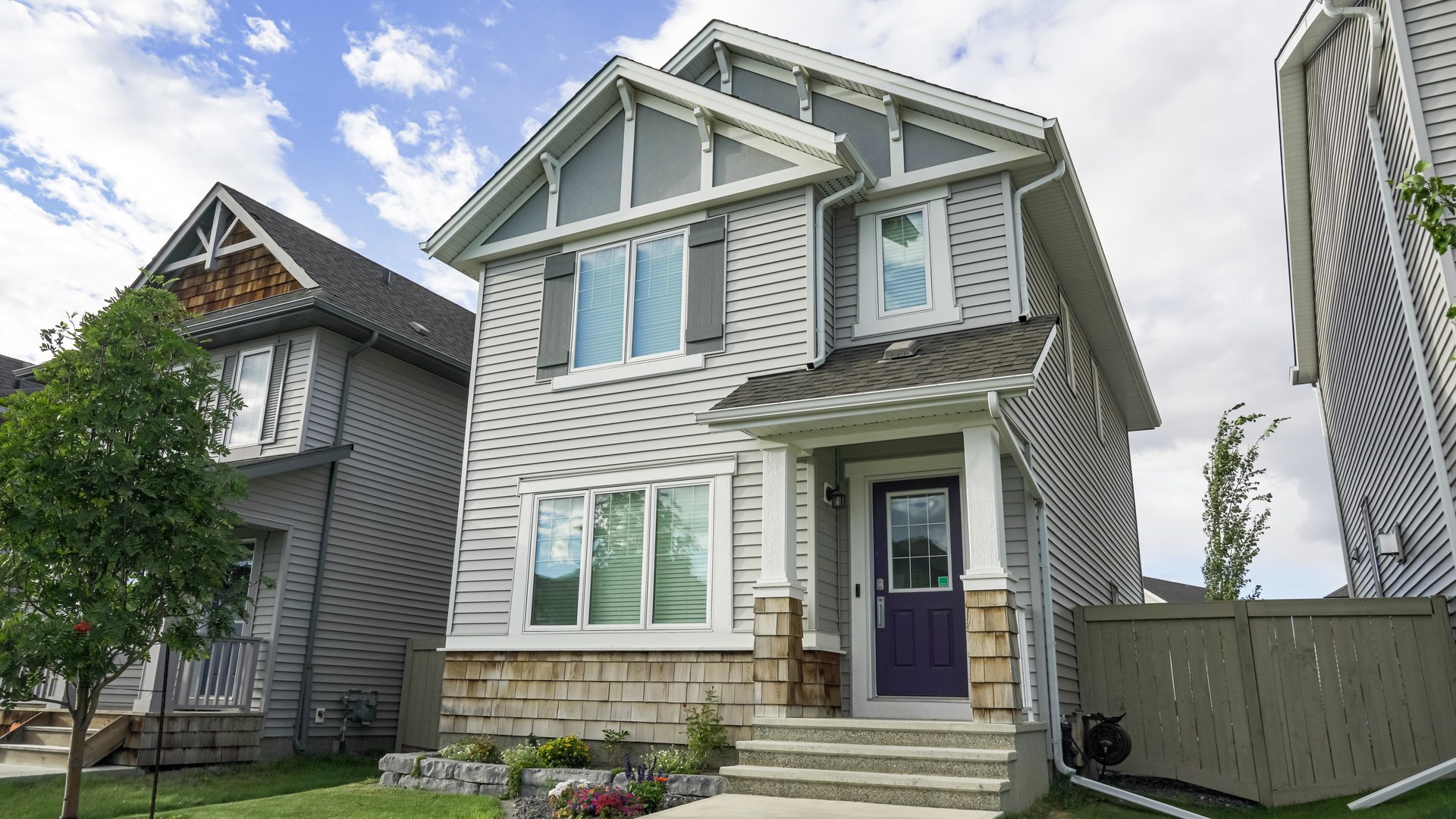
Painting vinyl siding means bonding a flexible 100% acrylic coating to PVC panels that expand and contract with every temperature swing, so the answer is yes, but only if the paint, the color, and the prep all respect how vinyl moves.
Your siding looks tired, replacement quotes are steep, and a few gallons of paint are cheap. That is the exact spot this question comes from. The short answer is encouraging: paint sticks to vinyl siding just fine when you use the right product. The long answer is where most people go wrong, because vinyl is not wood, and the rules that make a great wood paint job will wreck a vinyl one. Dark colors can warp panels in the sun, the wrong paint peels in sheets, and one skipped prep step can cost you the whole wall.
This guide gives you the full picture in one place: a 60-second go/no-go check, an honest paint-or-replace decision, the four ways a vinyl paint job fails, what the manufacturers actually say, and the compact method that works. If your siding is chalky or dirty, read our oxidation vs. dirt test first, because painting over chalk or grime is one of the fastest ways to fail.
Contents
- The short answer
- The 60-second go/no-go check
- Paint it or replace it?
- The four ways a vinyl paint job fails
- What the manufacturers actually say
- The color rule, in plain terms
- How to paint vinyl siding, step by step
- DIY or hire a pro?
- How long painted vinyl siding lasts
- Frequently asked questions
- Sources
The short answer
Yes, you can paint vinyl siding. Use a 100% acrylic exterior paint formulated for vinyl (look for a “vinyl safe” line), pick a color that is the same shade or lighter than your current siding, and clean the walls thoroughly before you start. Done that way, a painted finish can look sharp for a decade or more. The failures come from three mistakes: going darker without a vinyl-safe formula, painting over chalk or grime, and using oil-based or rigid paint that cannot flex with the panels. If your siding is cracked, brittle, or badly warped, skip the paint and price replacement instead.
The 60-second go/no-go check
Before you buy a single gallon, walk the house and answer these six questions. They take about a minute per wall and they predict your outcome better than anything else.
- Flex a panel. Press a panel with your thumb. If it gives a little and springs back, the vinyl is healthy. If it cracks, flakes at the edge, or feels brittle, paint cannot save it.
- Look for warping. Sight down each wall. Panels that already wave or buckle are a hard no for painting, because paint makes heat buildup worse, not better.
- Check the chalk. Rub a dry finger across the sunniest wall. If white powder comes away, that is oxidation, and paint will not bond to it until it is properly dealt with.
- Check your warranty. Dig out your siding paperwork or search your brand’s site. Some manufacturers state plainly that painting voids the warranty, which changes the math.
- Confirm your color direction. If your dream color is darker than the current siding, you need a vinyl-safe formula made for dark colors, not ordinary exterior paint.
- Run the tape test on the sunniest wall. Press a strip of painter’s tape firmly onto a clean, dry panel, wait a minute, and rip it off. If it comes away clean, the surface is ready to hold paint. If it lifts chalk, old paint flakes, or a powdery film, that layer has to be dealt with before any coating goes on. I have seen jobs saved by this one-minute test because it catches the chalk problem that eyes miss.
The matrix below turns those answers into a decision. If you land mostly in the left column, paint with confidence. Mostly right, get replacement quotes.
| Check | Green light for paint | Stop and rethink |
|---|---|---|
| Panel flex | Solid, flexible panels | Cracked, brittle, or crumbly edges |
| Shape | Walls read flat and straight | Buckled or wavy courses |
| Surface | Clean vinyl, little or no chalk | Heavy chalking that survives a wash |
| Warranty | No live warranty, or terms you accept losing | Active warranty you want to keep |
| Color plan | Same shade or lighter, or vinyl-safe dark color | Dark standard paint over light siding |
| Moisture | Dry walls, sound trim and caulking | Rotting sheathing or leaks behind the siding |
One more honest note before you commit. Painting is a coating over the existing surface, not a repair. If the siding itself is failing, paint just makes a failing surface a nicer color for a while. For the full background on what vinyl siding is and how it ages, see our guide to what vinyl siding actually is.
Paint it or replace it?
This is really a three-way decision, not two. Here is how the options compare on the factors that matter.
| Factor | Repaint | Replace | Leave as-is |
|---|---|---|---|
| Upfront cost | Lowest, paint and supplies only | Highest by a wide margin | Zero |
| Best when | Siding is sound but faded or dated | Panels are cracked, brittle, or warped | Siding looks fine and the color works |
| Color freedom | Any same-or-lighter color, vinyl-safe darks | Anything, including bold dark colors | None |
| Warranty | May void your siding warranty | New warranty starts fresh | Preserved |
| Lifespan of the fix | Roughly 10 to 12 years with good prep | 30-plus years for new siding | Whatever life the siding has left |
| Effort | A long weekend or two, mostly prep | Hire a crew, live with a job site | None |
Painting wins when the siding is structurally fine and you just hate how it looks. Replacement wins when the material is done: cracks, brittleness, warping, or chalk that returns weeks after a good wash. Leaving it alone wins when the problem is dirt, algae, or a few spots, because those have cheaper fixes. Green film washes off with the method in our guide to cleaning green algae from vinyl siding, and black spots get their own diagnosis in our black spots on vinyl siding guide. Only when the whole wall looks tired after cleaning does paint earn its keep.
To budget the job, measure your walls and convert to squares with our siding calculator before you shop for paint, so you buy enough for two full coats plus waste.
The four ways a vinyl paint job fails
Every failed vinyl paint job I have seen falls into one of four buckets. Learn to recognize them and you will avoid all four.
| Failure | What it looks like | What caused it | How to prevent it |
|---|---|---|---|
| Peeling | Paint lifts in curled sheets, sometimes whole panels’ worth | Paint applied over chalk, dirt, or an uncleaned surface | Wash thoroughly and let dry completely; never paint over powder |
| Blistering | Small raised bubbles under the film, usually on sun walls | Moisture trapped under the paint or painting in hot sun | Paint in mild weather, on a fully dry wall, 60 to 85 degrees |
| Chalking through | White powder shows through the new color within a season | Oxidation was painted over instead of removed | Remove the chalk first with a proper wash before painting |
| Warping | Panels buckle or wave after a hot summer | Dark standard paint absorbed too much heat | Same-shade-or-lighter colors, or vinyl-safe formulas for dark shades |
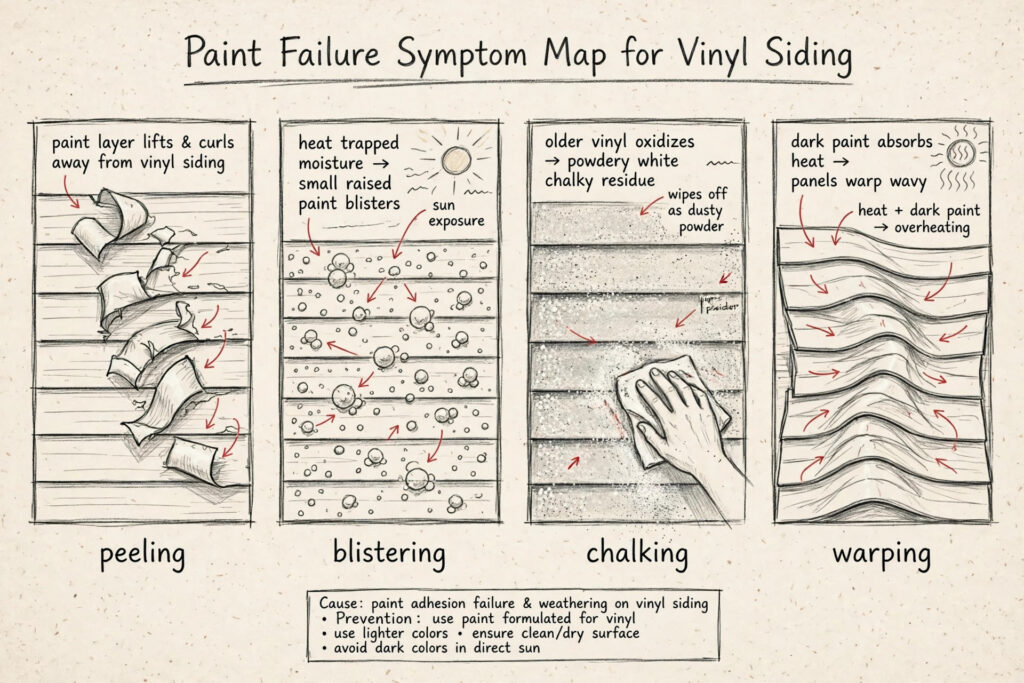
Notice that three of the four are prep or color failures, not paint-quality failures. That matches what contractors say: evaluation failures, not product failures. The paint rarely loses. The plan loses.
What the manufacturers actually say
Paint companies and siding makers agree more than you might expect. Here is what the primary sources actually state.
Sherwin-Williams lays out the color rule plainly in its vinyl siding painting guide: painting vinyl with any color darker than the original shade can cause warping and other defects, but its VinylSafe colors are formulated to resist warping and buckling, including bold dark colors. For product, it recommends Emerald Exterior Acrylic Latex, a paint-and-primer-in-one, and says priming is not required on vinyl that is in sound condition: two coats on new or bare siding, one coat on previously painted siding. For prep, it calls for cleaning with a house and siding cleaner, rinsing with a hose, and letting the wall dry fully before taping.
Benjamin Moore maintains a dedicated vinyl-safe palette, its Colors for Vinyl sheet (PDF), built with heat-reflective pigments. The exact LRV cutoff varies by product line and data sheet, so the safe move is to follow the data sheet for the specific paint and color you buy rather than trusting a single universal number you read online.
CertainTeed draws the line with a number in its vinyl-safe paint brochure (PDF): for colors with a light reflectance value (LRV) of 54 or lower, use VinylSafe technology or equivalent colors, and for LRV 55 or higher, a standard acrylic latex is fine. I will unpack LRV in the next section.
Norandex, an ABC Supply siding maker, is blunt about warranties in its vinyl siding FAQ: choosing to paint your siding will void your Norandex warranty. On technique, it stresses that the key is in the prep: roughing all surfaces and making sure they are clean and free of dirt, dust, or moisture, using a high-quality exterior paint with professional-grade tools under ideal weather conditions. That warranty warning is worth taking seriously and checking against your own brand before you start.
The industry association has a new name. The Vinyl Siding Institute is now the Polymeric Exterior Products Association, as its own site states. It publishes no dedicated painting guide, which is exactly why this article leans on the paint manufacturers and siding makers above instead of vague “the institute says” claims you see on thin pages.
The color rule, in plain terms
Vinyl siding expands and contracts with temperature more than wood or fiber cement. A dark color absorbs more solar heat, the panel gets hotter than it was designed for, and it can warp or buckle. That is the whole physics of the color rule, and it is the reason every manufacturer lands in the same place: stay the same shade or lighter than your current color, unless your paint is specifically formulated to be vinyl safe in dark colors.
LRV, light reflectance value, is the 0-to-100 scale paint makers use to say how much light a color reflects. White sits near 100, black near 0. For vinyl, the practical line most manufacturers draw is in the mid-50s: colors at LRV 55 or above behave like light colors on vinyl, while colors below that need a vinyl-safe formula with heat-reflective pigments.
| Color choice | Example LRV range | What to do |
|---|---|---|
| Light colors | LRV 55 to 100 | Standard 100% acrylic exterior paint is fine |
| Mid tones near the line | LRV around 50 to 55 | Check the product data sheet, or step up to a vinyl-safe line |
| Dark colors | LRV below 50 | Use only a vinyl-safe formula made for vinyl siding |
| Bold darks (navy, black, deep red) | LRV below 25 | Vinyl-safe formula only, and expect faster fading in sun |
A word of caution about bold colors. Even vinyl-safe dark paint fades faster than light paint, especially on the sunniest wall, as paint pros like Mauro Henrique note. If you go dark, plan on the south and west walls aging first. Another practical point: sun is not the only enemy of a dark paint job on vinyl. Dark colors also show dust, pollen film, and water streaks more readily, so they reward the once-a-year wash more than light colors do. And one detail people miss: “vinyl safe” is a formulation claim, not a magic shield. Painted vinyl still needs the same washing routine as bare vinyl, which our guide to why vinyl siding looks chalky explains in the context of how sun breaks panels down over time.
How to paint vinyl siding, step by step
The method below is compact because the decision work above did the heavy lifting. Every step comes from manufacturer guidance, not guesswork. For a visual walkthrough, watch Mauro Henrique paint vinyl siding on Ask This Old House before you start.
- Pick your weather window. Paint between 60 and 85 degrees Fahrenheit with low humidity, and look for a stretch of dry days. Weather that is too hot, cold, humid, or windy can undermine the best prep work, as This Old House Magazine puts it.
- Wash the walls like you mean it. Scrub with a house and siding cleaner, or pressure wash on a light setting, then rinse with a hose. Do not gouge the panels or drive water behind the laps. Then wait: This Old House advises at least two full days of drying before painting.
- Protect everything else. Mist nearby plants and soak the soil, then cover plantings with fabric drop cloths, not plastic, which cooks them. Tape windows, trim, fixtures, and outlets, and lay drop cloths along the foundation.
- Scuff glossy or chalky spots. On older or glossy panels, a light scuff helps the coating bite. Norandex’s own advice is to rough all surfaces so the paint bonds evenly. Wipe the dust off after.
- Cut in, then roll or spray. Start with a flat brush around windows, doors, and corners. For the field, a paint sprayer covers fastest, or use a mini foam roller in small sections to keep a wet edge and avoid drips. Mauro Henrique’s own kit for this job is a 3-inch flat brush plus a mini foam roller. Whichever tool you use, keep coats light and even: heavy coats bridge the panel laps and fill the shadow lines that give siding its profile, and they take longer to cure.
- Apply two coats. One coat on previously painted siding can work with a paint-and-primer-in-one, but two coats is the durable standard. Let the first coat dry about four hours before the second.
- Pull tape while wet. Remove painter’s tape while the topcoat is still wet for crisp lines, then clean your brushes and rollers before the paint cures in them.
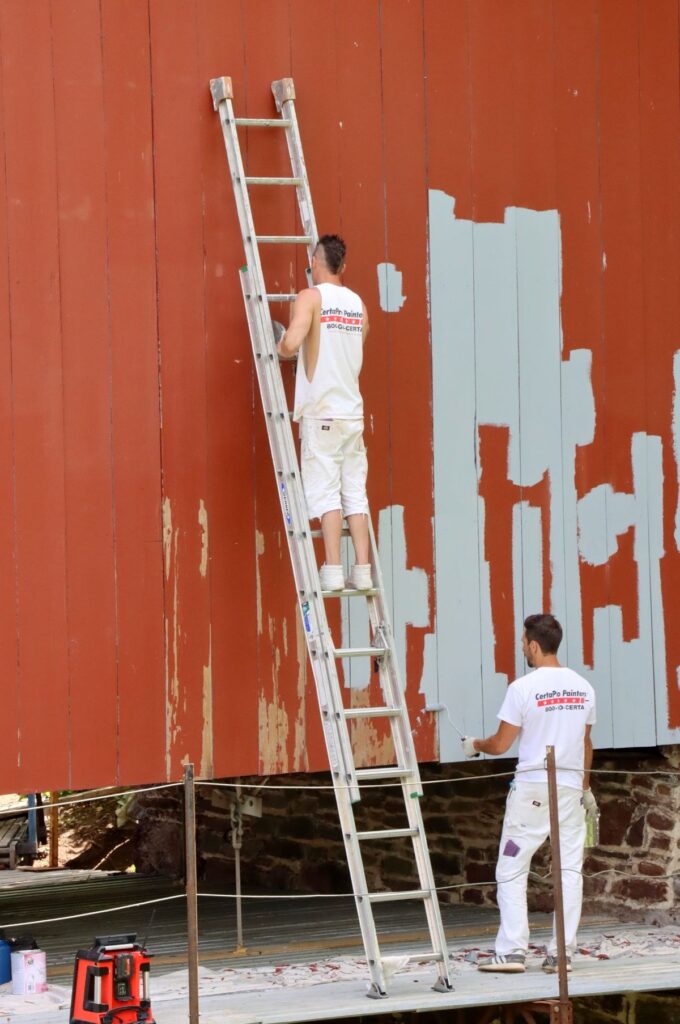
A few things not to do: do not paint in direct midday sun on a hot wall, do not use oil-based paint (it goes rigid and cracks as the vinyl flexes), and do not spray into the weep holes at the bottom of each panel, where trapped paint can block the drainage the siding was designed with.
DIY or hire a pro?
Painting vinyl siding is one of the more forgiving exterior DIY projects, but the line between DIY and pro is real.
| DIY is fine when | Call a pro when |
|---|---|
| Single story or reachable with a short ladder | Two stories or steep slopes under the work area |
| Siding is sound and mostly one plane | Siding needs repairs, caulking, or rot work first |
| You can dedicate several dry days | The house is large enough that pros’ sprayers pay for themselves |
| You are comfortable on a ladder | Anyone in the crew would have to stretch or overreach |
Two safety rules are non-negotiable either way. On ladders, set the base one foot out for every four feet of height, keep three points of contact, and never stand on the top three rungs or lean past your belt buckle; those are OSHA’s extension-ladder rules and they exist because falls from ladders are one of the most common home-project injuries. And if your house was built before 1978 and a pro will disturb the paint, the EPA’s renovation rule requires a lead-safe certified firm; homeowners doing their own work in their own home are generally exempt, but landlords, flippers, and childcare operators are not.
How long painted vinyl siding lasts
A well-prepped job with quality 100% acrylic paint holds up about 10 to 12 years, per Mauro Henrique’s estimate at This Old House, though sun exposure and color choice move that number. Darker colors fade faster, south and west walls age first, and a yearly wash with mild soap keeps mildew and grime from eating into the film. Touch up chips and scratches when you see them so moisture never gets a foothold behind the coating. One pro habit worth copying: buy an extra gallon and store it somewhere cool and dry. Touch-ups with the exact same batch blend invisibly; touch-ups with a newly mixed can of “the same color” almost never do. When fading gets blotchy or the chalk comes back through, that is the signal for the next round.
Frequently asked questions
Can you paint vinyl siding a darker color?
Only with a vinyl-safe paint formulated for dark colors on vinyl. Standard dark paint absorbs too much heat and can warp the panels. Check the color’s LRV: below about 55, you need the specialty formula, not ordinary exterior paint.
Will painting vinyl siding void the warranty?
It can. Norandex states plainly that painting voids its warranty, and other manufacturers have similar terms. Read your siding warranty or ask the manufacturer before you start, and factor the lost coverage into your decision.
What kind of paint should I use on vinyl siding?
A 100% acrylic exterior latex, ideally one labeled vinyl safe. Acrylic flexes with the panel’s expansion and contraction, while oil-based and rigid paints crack and peel. Pick your color from the manufacturer’s vinyl-safe palette when going dark.
Do I need to prime vinyl siding before painting?
Not if the siding is in sound condition and you use a quality paint-and-primer-in-one. Prime first if the vinyl is badly faded, chalky after washing, or has bare patches, since primer improves adhesion on compromised surfaces.
How long does paint last on vinyl siding?
About 10 to 12 years with good prep and quality paint, though heavy sun and dark colors shorten that. A yearly wash and prompt touch-ups keep you at the long end of the range.
Can you paint vinyl siding in cold weather?
It is a bad idea. Paint below about 50 degrees does not cure properly, and manufacturers generally call for 60 to 85 degrees with low humidity. A rushed cold-weather job is one of the classic ways a paint job fails early.
Is it cheaper to paint vinyl siding or replace it?
Painting costs a fraction of replacement: paint and supplies versus a full crew tearing off and re-hanging siding. Painting is the budget answer when the siding is sound; replacement is the honest answer when panels are cracked, brittle, or warped, because no paint fixes those.
Sources
The claims in this guide come from the pages actually opened during research: Sherwin-Williams’ vinyl siding guide, This Old House’s vinyl siding painting guide, Norandex’s vinyl siding FAQ, CertainTeed’s vinyl-safe paint brochure (PDF), Benjamin Moore’s Colors for Vinyl sheet (PDF), the Polymeric Exterior Products Association (formerly the Vinyl Siding Institute), the EPA’s lead renovation, repair, and painting program, OSHA’s ladder standard summary, and the Ask This Old House video on painting vinyl siding.

1 Comment
Pingback: Why Does Vinyl Siding Look Chalky? Causes & Fixes | Home Exterior Lab