

Your siding looks dusty, pale, and a little tired, and you cannot tell whether it just needs a wash or something has gone wrong with the vinyl itself. Run a finger across it. If a white powder comes away and the panels underneath look washed out, that is oxidation, not dirt. Dirt rinses off. Oxidation does not.
Keep reading for the wall-reading routine that maps the problem before you touch a brush, the three-minute chalk test with every check that matters, a side-by-side oxidation-versus-dirt table, why ordinary washing cannot fix oxidation, and what to do in each case.
On this page
- What oxidation actually is
- Read your wall like a symptom map
- The chalk test: three minutes to an answer
- Oxidation vs. dirt, side by side
- Why washing fixes dirt but not oxidation
- If it is dirt: the wash that works
- If it is oxidation: clean, restore, or replace
- DIY or call a pro?
- Frequently asked questions
- Sources
What oxidation actually is
Oxidation is a chemical change in the vinyl itself, not grime on top. Years of ultraviolet light break down the panel surface, and the material comes off as a white powder, what the paint trade calls chalking. CertainTeed’s cleaning instructions call this a normal condition for pigmented materials exposed to the elements: the siding aging, not dirt landing on it.
Put plainly, oxidation is the slow breakdown of vinyl siding’s surface under years of sun and weather, and it shows up as a chalky white powder that dulls the color.
It helps to separate oxidation from plain fading. Fading is color loss. Oxidation is color loss plus that powdery film, and the powder is the tell. The process runs hardest where the sun hits squarely, which is why the south and west walls usually look the oldest. Darker colors show it worst, partly because white powder on a dark panel is impossible to miss.
Here is the reassuring part. If the panels are not cracking or breaking, chalking is a cosmetic defect, not a structural one. That is how InspectAPedia’s stain guide frames it, with the honest footnote that chalking also signals the siding’s age, its formulation, and how much sun it has taken. Some vinyl formulations, especially older ones, oxidize more readily than others. And one caution worth keeping: older oxidized plastic can turn more brittle and more vulnerable to mechanical damage, so the rougher your cleaning method, the more care the panels deserve.
For the full story of why it happens and how the timeline runs, our guide to why vinyl siding looks chalky goes deeper into the mechanism.
Read your wall like a symptom map
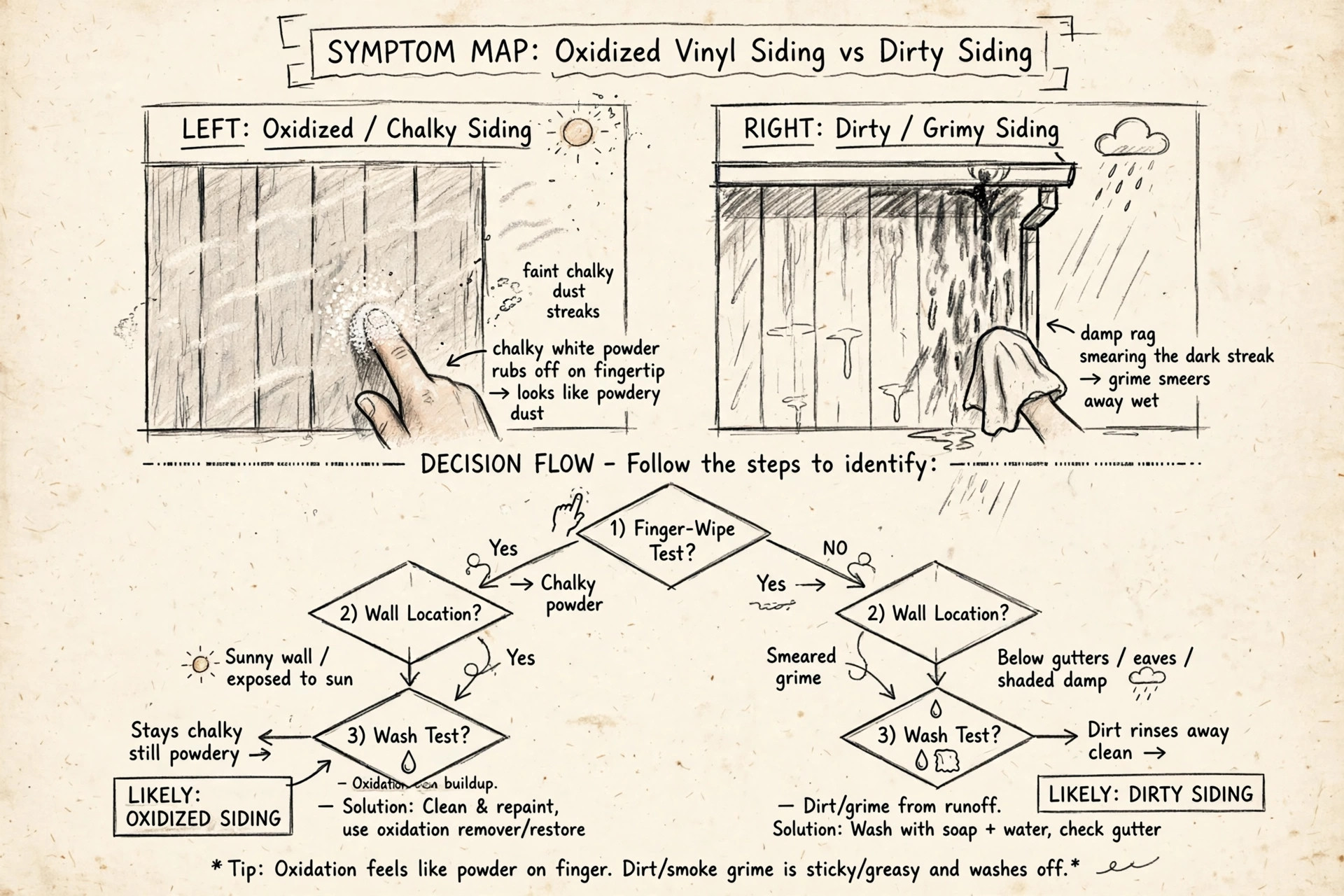
Start the diagnosis by walking around the house and noting where the dull film lives. Oxidation favors the sunniest wall and shows as an even, dry, chalky veil across whole panels. Dirt and grime gather below gutters, under downspout outlets, near the ground, and on shaded walls, usually in streaks that follow water paths.
Think of the house as four zones. The sun wall, usually south or west, is oxidation country: an even chalky film, worst at mid-wall height where the sun strikes directly. The shaded wall, usually north, is the control group. If the shaded wall wipes clean and looks richer in color while the sunny wall chalks, you are looking at oxidation. If both walls wipe dirty, dirt is the bigger problem. I walked a house once where the south wall looked ten years older than the north wall. Same siding, same age. The difference was pure sun.
The splash zone along the bottom courses belongs to dirt: gritty splatter from rain hitting the ground. Streaks running down from gutters, downspout outlets, and window sills are runoff grime, and they follow water paths like a map. One pattern deserves special attention. If the white film appears only in streaks directly below windows or trim, the powder is probably wash-down from oxidized paint or coating on those components, not your vinyl. InspectAPedia’s stain guide flags exactly this pattern: staining just below such objects usually means they are the source.
Color is the last clue. Chalky white points to oxidation. Gray-brown streaks point to dirt. Green film is a different organism entirely, and how to clean green algae from vinyl siding covers that decision. Black spots get their own workup too, since mold, mildew, and artillery fungus each clean up differently.
The chalk test: three minutes to an answer
The chalk test takes three minutes and settles most cases. Rub a dry finger across a dull panel on the sunniest wall. White powder that brushes off like flour points to oxidation. A smear of gray or brown grime, or a clean wipe, points to dirt. The steps below add the confirmations that keep you from misreading it.
The three-minute chalk test for vinyl siding: finger wipe, cloth check, shaded-wall comparison, hose check, and the trim differential. Run it on a dry day for the clearest read.
- Step 1: Start on the sunniest wall
Pick a dull-looking panel on the wall that gets the most sun, around chest height, and make sure the siding is dry. Morning dew or a recent rain will mute the powder and muddy the result.
- Step 2: The finger wipe
Press a dry fingertip firmly and rub it across the panel twice. A white powder that comes away freely and brushes off your skin like flour means oxidation. Note the color: oxidation powder is white or light gray.
- Step 3: The dark-cloth check
Rub the same spot with a dark rag. Heavy white transfer confirms chalking. A brown or gray smear that looks wet even when dry means grime. If your finger came away clean, you are likely looking at plain dirt film or fading without chalk.
- Step 4: The shaded-wall comparison
Repeat the finger wipe on the most shaded wall, behind shrubs if you have them. If the shaded wall wipes clean and looks richer in color while the sunny wall chalks, oxidation is the verdict. If both walls wipe dirty, dirt is the bigger problem.
- Step 5: The hose check
Spray a small patch with the garden hose and let it dry. Dirt streaks usually wash lighter. Oxidation dries right back to its chalky, dull self. Scrubbing with a household cleaner and a soft-bristle brush will remove some of the oxidized coating, which is why a washed patch can look briefly better before the chalk returns.
- Step 6: The trim differential
If the white film appears only in streaks directly below windows or trim, the powder is probably wash-down from oxidized paint or coating on those components, not your vinyl. InspectAPedia’s stain guide flags exactly this pattern: staining just below such objects usually means they are the source.
Oxidation vs. dirt, side by side
The core difference is simple: dirt sits on the vinyl, and oxidation is the vinyl. Dirt washes off with soap and water because it never bonded with the panel. Oxidation is the panel’s own surface breaking down, so washing lifts only the loose powder while the dull, washed-out look stays. The table below lines up every practical difference.
| Attribute | Oxidation | Dirt |
|---|---|---|
| What it is | The vinyl’s own surface breaking down under sun and weather | Soil, dust, and pollution resting on the panel surface |
| Touch | Dry white or light-gray powder that brushes off like flour | Gritty or greasy smear; may feel tacky when damp |
| Color of the film | Chalky white, even across the panel | Gray, brown, or black streaks, often uneven |
| Where it shows | Sunniest walls first, as an even veil across whole panels | Below gutters and downspout outlets, near the ground, on shaded walls; follows water paths |
| After rain | Looks the same or worse once it dries | Often washes into cleaner streaks where water ran |
| The wipe test | Powder on your fingertip | Grime smears, or not much transfers at all |
| Underneath the film | The panel itself looks faded and dull where powder was | The panel’s real color shows through once washed |
| What fixes it | Cleaning plus an oxidation remover or restorer; washing alone only tidies | A proper wash with soap and water |
Why washing fixes dirt but not oxidation
Washing works on dirt because dirt is a separate layer you can dissolve and rinse away. Oxidation is a change in the panel’s own surface, so soap has nothing to grab. A good wash lifts the loose powder and the siding looks better for a day, until the wall dries and the chalky dullness shows through again.
You will find cleaning guides on both sides of the vinegar question, and the disagreement makes more sense once you know what washing can and cannot do. Some guides say a vinegar wash clears the chalk; restoration-minded sources say acids barely touch it. Both observations can be true at once. A mild acid wash can lift the loose powder in a test patch, and the patch looks better, which reads as a fix. It is not reversing anything. The panel surface underneath is still broken down, so the chalk comes back. Scrubbing works the same way: InspectAPedia notes that scrubbing with a household cleaner and a soft-bristle brush removes some of the oxidized coating. Some, not all, and never the underlying change.
CertainTeed treats the chalk as an expected part of a pigmented material’s life outdoors, not a defect and not a dirt problem, which is exactly why no wash, however thorough, finishes the job. Washing is maintenance. Reversing oxidation is restoration. They are different tasks with different tools.
If it is dirt: the wash that works
Dirt is the easy diagnosis. Rinse the wall with a garden hose, wash from the bottom up with a bucket of soapy water and a soft-bristle brush so dirty runoff does not streak the panels below, then rinse each section with clean water before the soap dries. That bottom-up rhythm comes straight from CertainTeed’s care instructions.
A few details make the job cleaner. Work on a cool, overcast day when you can, since cleaner that dries on the panels can leave its own marks. Test any new cleaner on a hidden spot first, and keep the mix mild; CertainTeed cautions that stronger concentrations can damage the siding and soffit. Since siding wash runoff goes straight into the yard and the storm drain, the cleaner you pick matters beyond the wall. The EPA’s Safer Choice program added an outdoor-use label for cleaners whose ingredients break down quickly and carry lower aquatic toxicity, and its product search lets you filter for outdoor-use certified options.
CertainTeed recommends washing vinyl siding at least once a year for best appearance, and that yearly rhythm is the whole prevention program for dirt. Our exterior house cleaning guide by surface lays out a schedule that covers the rest of the exterior in the same pass.
Ready to wash it? Our step-by-step guide to cleaning vinyl siding covers the manufacturer recipes, safe pressure-washer limits, and the stain chart for the stubborn spots.
If it is oxidation: clean, restore, or replace
Oxidized siding leaves you with three paths. A careful wash clears the loose chalk and tidies light cases. An oxidation remover or wipe-on restorer goes further by clearing the degraded layer and bringing back color. Replacement is the honest answer when panels are cracked, brittle, or the chalk returns within weeks of a proper cleaning.
| Path | What it involves | Best for | Honest limits |
|---|---|---|---|
| A careful wash | Garden hose, soft-bristle brush, soapy water; work bottom-up and rinse before anything dries | Light chalk on siding that is otherwise sound | Removes loose powder only; the dull look returns as the surface keeps breaking down |
| Oxidation remover or restorer | A specialty cleaner or wipe-on coating made for oxidized vinyl, applied per its label after a full wash | Moderate oxidation where the panels are still solid | Needs the full wash first; results vary by product and by how far the surface has gone |
| Replacement | New siding on the affected walls | Cracked, brittle, or deeply chalked panels; chalk back within weeks of cleaning | The only fix for panels past their serviceable life; plan the color across walls so one wall does not stand out |
Whichever path you take, test first. CertainTeed says to try any cleaner on an inconspicuous area before full use, and that advice matters doubly on oxidized siding, where older panels can be more brittle and less forgiving. Keep the pressure gentle and the brush soft. InspectAPedia warns against blowing water into the siding with power washing, and CertainTeed advises against prolonged or high-pressure rinsing; on chalky, aged vinyl the safe move is a hose and a soft brush. Our soft washing versus pressure washing guide spells out the pressure limits for vinyl in detail.
Two safety rules close out the section. Never mix bleach with ammonia-based cleaners, and keep any wash mix off the plantings or rinse them right away. If the job needs a ladder, keep your footing stable and your reach short; stretching off a ladder to scrub a high panel is how walls and weekends get ruined.
DIY or call a pro?
Most of this diagnosis is easy DIY. The call turns on height, the condition of the panels, and how far the oxidation has gone.
| Safe DIY | Call a pro |
|---|---|
| Ground-level walls with stable footing | Second story or any reach that needs a ladder stretch |
| Light to moderate chalk, panels solid and flexible | Panels cracked, warped, or crumbly at the edges |
| You can identify the film with the tests above | The chalk returns within weeks of a careful wash |
| A wash or a wipe-on restorer on a test section | Whole-house oxidation or a full restoration job |
| You want a straight quote on restoration versus replacement — see our breakdown of soft washing cost factors before you compare quotes. |
If a pro is the answer, look for a soft-wash or siding restoration outfit rather than a pure pressure-washing crew, and ask how they protect plantings and keep water out from behind the laps before they start.
Frequently asked questions
Rub a dry finger across a dull panel on the sunniest wall. White powder that brushes off like flour means oxidation. A gray or brown smear, or a clean wipe, means dirt. The shaded-wall comparison in the chalk test above settles the close calls.
It is the finger-wipe test by its common name. Rub a dry fingertip firmly across the siding; if white, chalk-like powder comes away, the vinyl is oxidizing. The name comes from the paint trade, where “chalking” describes the same powdery breakdown on old paint.
Cleaning removes the loose powder and helps light cases look better, and scrubbing with a household cleaner and a soft-bristle brush will take off some of the oxidized coating. It does not reverse the surface change. For the color and sheen to come back, the degraded layer has to be addressed with an oxidation remover or restorer, or the panels replaced.
If the panels are not cracking or breaking, it is cosmetic, but it is also a signal. InspectAPedia’s stain guide puts it plainly: chalking on sound siding is a cosmetic defect, and it indicates the siding’s age, its formulation, and how much sun it has taken. Treat it as an early warning, not an emergency.
Usually, yes, because the surface keeps breaking down under sun exposure. A yearly wash keeps the chalk from building up and keeps the siding looking its best, which is also what CertainTeed recommends for appearance. If the chalk returns within weeks of a careful wash, the oxidation is advanced and a restorer or replacement deserves a look.
Be careful. InspectAPedia warns against blowing water into the siding with power washing, and CertainTeed advises against prolonged or high-pressure rinsing. Older oxidized vinyl can also be more brittle and more vulnerable to mechanical damage, so aggressive pressure risks the panels. A garden hose and a soft brush are the safer tools.
Probably not from the vinyl. InspectAPedia’s stain guide flags this exact pattern: powdery white film showing up just below windows or trim is usually wash-down from oxidized paint or coating on those components. The fix starts with the trim, not the siding.
Sources
- CertainTeed’s official cleaning instructions for vinyl siding and trim, covering chalk as a normal condition for pigmented materials, bottom-up washing, yearly cleaning, and the caution that stronger mixes can damage the siding
- InspectAPedia’s guide to the causes of vinyl siding stains, with the chalking Q&A on older formulations oxidizing into a powdery film like paint chalking, worst in sun, cosmetic if sound, the brittleness warning, the wash-down differential below windows and trim, and the power-washing caution
- The EPA’s announcement of the Safer Choice outdoor-use label, with extra criteria for outdoor cleaners whose ingredients break down quickly and carry lower aquatic toxicity, since wash runoff goes straight into the environment

5 Comments
Pingback: Black Spots on Vinyl Siding: Mold, Mildew or Artillery Fungus?
Pingback: How Often to Wash a House Exterior? Schedules by Siding
Pingback: Can You Paint Vinyl Siding? What Works & What Fails
Pingback: How to Install Vinyl Siding (Step-by-Step DIY Guide)
Pingback: What Is Vinyl Siding? Types, Materials & Protection Guide