


A fall exterior home maintenance checklist is a seasonal task list for the outside of your house, done once a year before freezing weather arrives, to prepare the roof, gutters, siding, windows, and yard for winter. That is the whole job in one sentence: find the weak spots while the weather is still friendly, and fix them before snow and ice do the testing for you.
I have done this walk-around for years, and the pattern never changes. The problems that cost real money in February almost always start as small, visible things in October: a gutter corner packed with leaves, a strip of cracked caulk, a downspout ending a foot from the foundation. Cheap to fix now, expensive to fix later.
This checklist covers the full exterior in priority order. It starts with what to do first if you only have a weekend, then walks area by area: roof, gutters, siding, windows and doors, deck and patio, driveway, grading, outdoor faucets, and the yard. It closes with a fall timing guide by climate, DIY-versus-pro boundaries, and answers to the most common questions.
The short answer
A fall exterior home maintenance checklist covers cleaning the gutters, inspecting the roof from the ground, sealing gaps with caulk and weatherstripping, disconnecting and draining outdoor faucets, checking soil grading and downspout discharge, and preparing the deck, driveway, and yard. Handle the water-protection tasks first, then work down by priority before the first freeze.
In this checklist
- What to do first: the highest-stakes tasks
- Roof: check what winter will exploit
- Gutters and downspouts: fall’s most unforgiving system
- Siding, trim, and the caulk walk
- Windows, doors, and drafts
- Deck, patio, and fence
- Driveway and walkways
- Grading and drainage around the foundation
- Outdoor faucets, hoses, and irrigation
- Outdoor HVAC unit and the yard
- When to do what: a fall timing guide
- What to do yourself, and what to hand off
- Frequently asked questions
- Sources
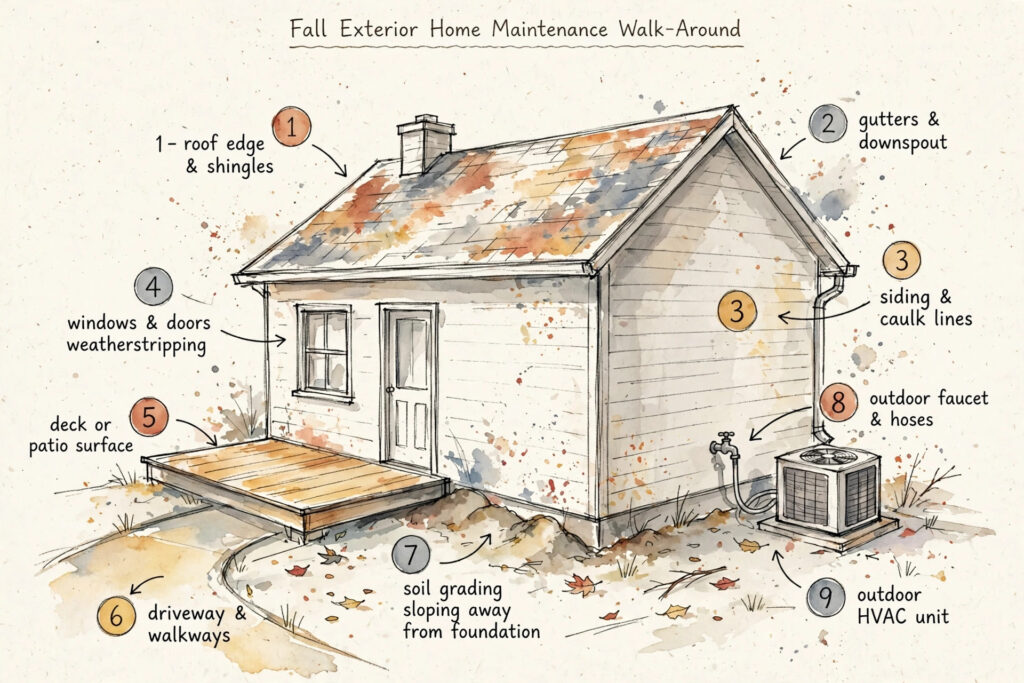
What to do first: the highest-stakes tasks
If your time is limited, start here. These are the fall tasks with the worst consequences when skipped, ranked by damage prevented.
| Priority | Task | Why it ranks here |
|---|---|---|
| 1 | Clean the gutters and confirm the downspouts flow | Packed gutters overflow at the roof edge, soak the fascia, and dump water beside the foundation. West Virginia University Extension recommends cleaning at least twice a year. |
| 2 | Disconnect, drain, and store garden hoses; shut off and drain outdoor faucets | Frozen water expands and can split the pipe inside the wall. The American Red Cross lists this among its first steps before cold weather. |
| 3 | Walk the roof from the ground with binoculars; note missing shingles and damaged flashing | Snow and ice find every weak spot you missed. A shingle replaced in October is an afternoon’s work; a leak patched in January is an insurance claim. |
| 4 | Seal the obvious gaps: caulk around windows, doors, hose bibs, and utility penetrations | The Department of Energy points to drafts as a major source of wasted heating energy, and fall is the last comfortable season to fix them. |
| 5 | Walk the yard after rain; confirm water flows away from the foundation | Grading and downspout failures show up as foundation moisture, and foundation moisture shows up as bills. |
| 6 | Trim branches that touch the roof, siding, or power lines | Wet snow adds serious weight to weak limbs, and branches over the roof feed the gutters all season. |
| 7 | Check the deck, steps, and railings for rot and loose fasteners | Freeze-thaw cycles make soft wood worse fast, and a wobbly railing plus ice is a bad combination. |
Roof: check what winter will exploit
Do your roof check from the ground or a ladder, never by walking the roof. The National Roofing Contractors Association advises homeowners to inspect from ground level only and leave roof work to a professional with proper fall protection.
Check shingles with binoculars. Look for missing, cracked, curling, or buckled shingles, and scan the ridge line for gaps. Pay special attention to flashing around chimneys, vent pipes, and skylights, the most common entry points for wind-driven rain and ice melt.
Clear the valleys and roof edges of debris. Branches and leaf mats trap moisture against shingles and feed moss. Use a leaf blower from a ladder or hire it out.
Peek into the attic on a sunny day. Look for daylight through the roof boards and stains on the sheathing or insulation. Stains are old leaks telling you where the next one will happen.
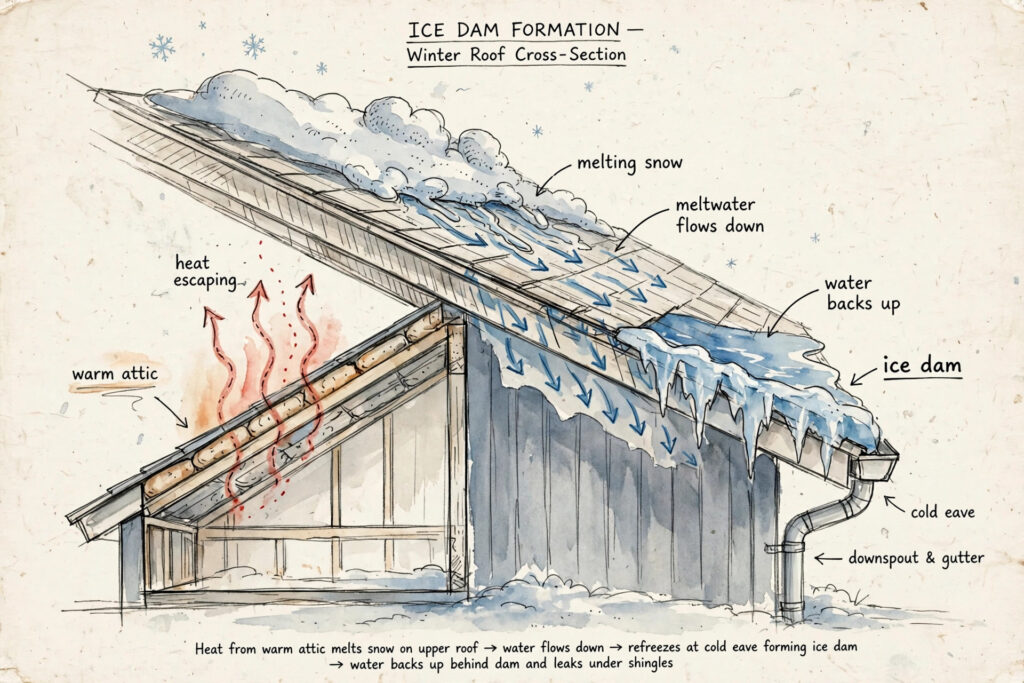
An ice dam is a ridge of ice at the roof edge that blocks melting snow from draining, so water backs up and leaks into walls and ceilings. The University of Minnesota Extension explains the root cause is heat escaping from the house: it warms the upper roof, the snow melts, and meltwater refreezes at the colder eave. Attic insulation and air sealing are the real long-term prevention. If you had a heavy row of icicles on one stretch of roof last winter, treat it as a clue and check the attic above that spot this fall.
Gutters and downspouts: fall’s most unforgiving system
Clean them once most of the leaves are down, then plan a second check after the last trees drop. West Virginia University Extension recommends cleaning at least twice a year, and its gutter safety guide lays out the job: gloves, glasses, a sturdy ladder on level ground, and never crawling onto the roof.
Scoop from the low end toward the outlets. Start at the end nearest the downspout and work away from it, scraping out packed debris. Then flush toward the outlet with a garden hose. If water does not flow freely out of the downspout, a blockage is sitting in it, and our guide to the signs of a clogged downspout walks through how to locate it without dismantling everything. Mind the ladder the whole time: stable footing, someone steadying it, and the job stops when the weather turns.
Check the system, not just the debris. Look for sagging runs, loose hangers, leaking corners, and downspouts that end too close to the house. Downspouts should carry water well away from the foundation; our downspout distance guide explains how far is far enough. If gutters overflow in heavy rain even when clean, the system may be undersized or under-sloped rather than dirty, which our guide to why gutters overflow in heavy rain covers in detail. Our full gutter maintenance guide and our answer to how often gutters should be cleaned have the complete seasonal routine if you want to go deeper.
Siding, trim, and the caulk walk
Look for cracks in the siding, gaps where trim meets the wall, loose sections, and peeling paint on fascia and sills. Peeling paint is not just cosmetic: it leaves bare wood open to months of moisture.
Seal the gaps that move air and water. Caulk the joints that do not move: window and door frames, hose bibs, vents, and utility penetrations. Press it into clean, dry joints and tool it smooth. The Department of Energy lists caulking and weatherstripping among its core winter-prep steps.
Touch up bare wood before it sits under snow. A quick spot-prime and paint on exposed trim now prevents rot that would otherwise need carpentry in spring.
Wash off the season. If the siding has a summer of grime, algae, or oxidation, fall is a good time to wash it. Match the method to the surface: our exterior house cleaning guide by surface and our soft washing versus pressure washing guide lay out which surfaces need a gentle wash and which can take pressure. If the vinyl has a chalky white film, check our guide to chalky vinyl siding first.
Windows, doors, and drafts
On a breezy fall day, move a damp hand slowly around each window and exterior door. Where you feel cold air moving, you have found a leak worth fixing.
Replace worn weatherstripping. Check every exterior door, the door to an attached garage, and sliding patio doors. If you can see daylight around a closed door, air is getting through. Foam tape, V-strip, and door sweeps are cheap and go on in minutes. Tighten loose handles and hinges while you are at it.
Caulk the frames. Pull out the loose material first, then lay a clean bead of exterior caulk around window and door frames.
Swap screens for storms if you have them. Wash the windows while you are at it, inside and out. A door that does not latch tightly cannot seal tightly, so confirm locks engage fully before winter.
Deck, patio, and fence
Start by clearing leaves off the deck, patio, and fence lines. Wet leaf piles hold moisture against wood and pavers for weeks, feeding the exact conditions our guide to identifying green growth on a deck describes.
Inspect before the freeze. Walk every board. Look for soft or spongy spots, popped nails or screws, loose railings, and boards starting to cup or warp. Our wood deck maintenance guide has the full inspect-clean-protect routine, and our guide to why deck boards cup explains what warping tells you about moisture.
Wash what needs washing, gently. A low-pressure wash or deck cleaner removes the grime and growth that would otherwise overwinter under snow. Keep pressure modest on softwoods.
Touch up the finish if it is worn. If water no longer beads on the surface, fall is your last good window to reseal. Check the label for a minimum application temperature; late-season staining that cannot cure is worse than no staining.
Put the soft stuff away. Store cushions, bring grills under cover, and stack or cover patio furniture. Check that fence gates still latch and posts are solid before the ground freezes.
Driveway and walkways
Concrete spends winter expanding and contracting, and water is the engine. Walk the driveway and all walkways and look for cracks wider than a hairline, settled or rocking sections, and low spots where water sits after rain.
Clean before winter. Oil spots, leaves, and algae are easier to remove now than after months of freeze-thaw. Our concrete driveway maintenance guide covers the cleaning routine, and our guide to why a concrete driveway turns black explains dark patches.
Fill the cracks you can. Small cracks let water in, and water in a crack becomes ice that wedges it wider. A concrete crack filler from the hardware store handles the small ones; settled or heaved slabs are contractor territory.
Note where water pools. If water sits in the same place after every rain, read our guide to why water pools on a driveway before winter, because standing water that freezes becomes a slip hazard and a spalling risk.
Check steps, railings, and lighting. Loose handrails and dark walkways are a bad combination with ice. Tighten what you can and replace burned-out bulbs now.
Grading and drainage around the foundation
Soil should slope away from the foundation in every direction, and downspouts should discharge far from the house, not at its base.
Walk the perimeter after a good rain. Look for puddles against the foundation, mulch washed into drifts, and soil that has settled into a bowl near the wall. Backfill compacts over the years, so even a house that graded fine when built can develop a low spot.
Rebuild the slope where it has failed. Adding soil to restore a gentle slope away from the house is a shovel-and-wheelbarrow job for small dips. Water sitting against a whole side of the house, or entering the basement, is drainage-contractor territory. For a deeper look at what keeps ground wet after rain, our yard drainage problems guide names the nine most common causes and how to tell them apart.
Clear window wells and area drains. Scoop out leaves and debris so they can do their job when the fall rains come.
Outdoor faucets, hoses, and irrigation
Water expands as it freezes, and the American Red Cross notes this expansion can break metal or plastic pipe no matter how strong the container.
Disconnect every hose, drain it, and store it inside. A hose left connected traps water in the spigot line, and that is the water that splits the pipe inside the wall.
Shut off the inside valve, then drain the outside bib. The Red Cross procedure is specific: close the inside valve that feeds the outdoor faucet, open the outside bib to let the water drain out, and leave the outside valve open so any remaining water has room to expand without breaking the pipe. Insulated faucet covers are cheap insurance on spigots that face the wind.
Winterize irrigation by the book. Drain sprinkler and pool supply lines per the manufacturer’s directions, and do not put antifreeze in them unless directed; the Red Cross warns it is harmful to people, pets, and landscaping. Compressed-air blowout is a pro or rental-compressor job.
Know where your main water shutoff is. If a pipe does burst in January, the difference between a mess and a disaster is knowing which valve to turn first.
Outdoor HVAC unit and the yard
Clear leaves and debris from around the outdoor AC unit so airflow stays open. If you cover it, cover the top only; a full wrap holds condensation against the metal.
Trim with restraint. Cut back branches that touch the roof, siding, or power lines, and keep shrubs from pressing against the house. Clemson Extension’s October garden notes add a useful warning: stop fertilizing trees and shrubs for the season, because late feeding pushes soft growth that frost will injure.
Feed the lawn by the soil, not by habit. Clemson Extension’s fertilizing guidance says the best program starts with a soil test. Where the test supports it, a potassium application in late August through mid-September can increase winter hardiness. Mow until growth stops and keep leaves from smothering the turf; a mulching mower handles light cover, while heavy mats need raking. Drain the mower per the manual and store it out of the weather.
When to do what: a fall timing guide
Not everything needs to happen in September. Split the checklist into three waves so the weather-sensitive work lands before the weather turns.
| Wave | When | Do these first |
|---|---|---|
| Early fall | As temperatures start dropping | Roof inspection, tree trimming, deck and driveway repairs, attic and insulation checks, caulk and weatherstripping |
| Mid fall | After most leaves have fallen | Gutter cleaning, downspout checks, second look at the roof, siding wash, outdoor furniture storage |
| Before the first freeze | When frost is in the forecast | Disconnect and drain hoses and faucets, winterize irrigation, faucet covers, shutoff valve check, final yard cleanup |
Climate changes the calendar, so adjust by where you live:
| Climate | Rough timing cue |
|---|---|
| Cold North (upper Midwest, New England, northern tier) | Start in early September; water tasks should be done well before an early first freeze |
| Transition zone (Mid-Atlantic, lower Midwest) | Late September through October fits most tasks; expect a second gutter pass in November |
| Mild South (Deep South, Gulf Coast) | October into November; freezes are brief or rare, so weight the list toward gutters, grading, and storm prep |
| Mountain West | Start early; first freezes and snow can arrive weeks ahead of the calendar at elevation |
When in doubt, your local extension service publishes first-frost guidance for your county, and it beats any national calendar.
What to do yourself, and what to hand off
Most of this checklist is comfortable DIY with basic tools. The boundary is access, height, and consequence: if the task needs a roof, a tall ladder, or a buried line, the savings rarely justify the risk.
| Task | DIY when | Call a pro when |
|---|---|---|
| Gutter cleaning | Single story, stable ladder, firm level ground | Two stories or steep roof, no safe ladder footing, or gutters pulling off the fascia |
| Roof inspection | From the ground with binoculars or from a ladder at the eave | Anything requires walking the roof; shingles need replacing; flashing needs resealing |
| Caulk and weatherstripping | Everywhere you can reach comfortably | Gaps are high overhead in siding or around a chimney chase |
| Outdoor faucets and hoses | Disconnecting, draining, covers | The inside shutoff valve is stuck, leaking, or missing |
| Ice-dam prevention | Sealing obvious attic air leaks, adding insulation batts | Blower-door testing, spray foam, or structural questions |
| Chimney and fireplace | Visual check from the ground, damper test | Any actual sweeping or creosote concern |
| Tree trimming | Small branches reachable from the ground with a pole saw | Anything near power lines, large, or over the roof |
| Drainage and grading | Small dips, extending a downspout, clearing a window well | Water against a whole wall, basement moisture, buried drain lines |
The ladder rule covers half of these decisions: a sturdy ladder on level ground, someone steadying it, gloves and glasses on, and the job stops when the weather turns. Anything that cannot be done within those limits is not a DIY task.
Frequently asked questions
When should I start my fall exterior maintenance checklist?
Start the inspection tasks in early fall, as soon as the heat breaks, and finish the water tasks, hoses, faucets, and irrigation, before the first expected freeze in your area. In cold northern regions that can mean September; in the mild South, October or November is fine.
Do I really need to clean my gutters in the fall if they look okay from the ground?
Yes. Gutters can look fine from the ground while the outlets and elbows are packed with leaves. West Virginia University Extension recommends cleaning gutters at least twice a year, and fall is the most important of those cleanings because winter water has nowhere else to go.
Will gutter guards prevent ice dams?
No. Ice dams come from heat escaping the house and melting roof snow, which then refreezes at the colder eave, according to the University of Minnesota Extension. Guards keep debris out but do nothing about the heat loss that causes dams. See whether gutter guards are worth it for your home before deciding.
Should I shut off my outdoor faucets before the first freeze?
Yes. Disconnect and drain every hose, close the inside valve feeding each outdoor faucet, open the outside bib to drain, and leave the outside valve open so remaining water can expand. That is the American Red Cross procedure, and it exists because frozen water can split pipes inside the wall.
Is fall a good time to caulk and add weatherstripping?
It is the best time. Temperatures are comfortable, caulk cures well, and the Department of Energy lists sealing cracks and weatherstripping among its core winter-prep steps. Just keep ventilation in mind as you seal.
Can I still fertilize my lawn in the fall?
Only by the soil test. Clemson Extension advises building the fertilizer program on soil analysis results, with potassium in late August through mid-September able to improve winter hardiness where the test supports it. Stop feeding trees and shrubs for the season; late feeding pushes soft growth that frost injures.
Do I need a professional to inspect my roof, or can I do it myself?
Do the looking yourself, from the ground with binoculars or from a ladder at the eave. The National Roofing Contractors Association advises homeowners to inspect from ground level only. Bring in a roofer for anything that needs walking the roof, replacing shingles, or resealing flashing.
Sources
- West Virginia University Extension’s guide to gutter safety, on fall leaf clogging, twice-a-year cleaning, and ladder rules
- The University of Minnesota Extension’s guide to dealing with and preventing ice dams, on what ice dams are, how heat loss causes them, and why prevention means controlling heat loss
- The American Red Cross’s guide to preventing and thawing frozen pipes, on draining hoses and outdoor faucets and winterizing irrigation and pool lines
- The U.S. Department of Energy’s energy-saving hacks to weather the winter, on sealing drafts, weatherstripping, and air sealing before cold weather
- Clemson Extension’s factsheet on fertilizing lawns, on soil-test-based fertilizer programs and potassium timing for winter hardiness
- Clemson Extension’s October 2026 garden notes, on stopping fertilizer for trees and shrubs in fall
- The National Roofing Contractors Association’s severe-weather guidance for homeowners, on ground-level-only roof inspection and hiring professionals for roof work

4 Comments
Pingback: Gutter Maintenance Guide for Homeowners | Home Exterior Lab
Pingback: How Often Should Gutters Be Cleaned? (Full Schedule)
Pingback: Wood Deck Maintenance: Inspect, Clean & Protect | Home Exterior Lab
Pingback: Black Spots on Vinyl Siding: Mold, Mildew or Artillery Fungus?