


Short answer: For most homes with trees overhead, yes, gutter guards are worth it. They cut gutter cleaning from a twice-a-year ladder chore to an occasional rinse, and they keep clogs from sending water where it does not belong. They are not worth it for a home with almost no debris, or as a shortcut for gutters that already sag, leak, or overflow. And no guard on the market ends gutter maintenance for good. The guard just changes what the chore looks like.
A gutter guard is a cover, screen, or insert that sits over or inside the gutter trough, blocking leaves and debris while letting rainwater pass through into the downspouts.
The honest answer really is that simple, but the part most buyers get wrong is the fit. Guards are not one product. Six very different designs share the same shelf space, and the one that saves your neighbor hours of ladder work might clog within a season at your house. The difference is what falls on your roof, how it is installed, and what you expect it to do.
Contents
- Do gutter guards actually work?
- The six gutter guard types, compared
- Benefits of gutter guards
- The limits nobody puts on the brochure
- When gutter guards are worth it (and when they are not)
- How to choose the right gutter guard type
- Should you DIY it or hire a professional?
- Frequently asked questions
- Sources
Do gutter guards actually work?
Yes. Gutter guards work at the exact job they are designed for: keeping leaves, twigs, seed pods, and pine needles out of the gutter trough so rainwater can drain instead of piling up behind a clog. What they do not do is end maintenance. In This Old House’s November 2025 survey of 1,000 homeowners, 41% of guard owners reduced gutter cleaning to once a year and another 17% stopped cleaning entirely. The rest still cleaned sometimes, just far less than before.
That survey also shows why people buy them in the first place. About 70% wanted to prevent clogs or flooding, 52% wanted to protect their foundation, and 48% simply wanted less maintenance. After living with guards, 69% said they were very satisfied with the overall value. Those are real numbers from real homeowners, not marketing copy.
Here is the part that keeps the verdict honest. Even the best guards collect debris on top of themselves. A guard moves debris from inside the trough, where it causes clogs, to the surface, where rain and wind usually clear it. In a sheltered corner of the roof that never gets wind or a good wash of rain, surface debris can mat down and start shedding water over the gutter instead of into it.
The most honest long-term test I found came from a gutter installation company, not a manufacturer. Gutter Guards Direct ran 22 covers through an “Ultimate Gutter Guard Challenge,” and their three-year review of a micro-mesh cover is the single best gutter guard video for a buyer to watch:
Their verdict: the micro-mesh cover kept almost all debris out of the trough and would have ranked in the top 3 of the 22 covers tested. But it sat flat, collected debris on top that did not always blow off, and by year three it was taking in about 50% less water than in year one. That is guards in a nutshell. They work, they help, and they are not magic.
The six gutter guard types, compared
Walk any hardware store aisle and you will meet six basic designs. They differ in what debris they stop, how much cleaning they need, and whether you can install them yourself or need a crew. Here they are side by side.
| Type | What it is | Stops well | Struggles with | Ongoing maintenance | Cost band | Typical install |
|---|---|---|---|---|---|---|
| Perforated screen panel | Aluminum or plastic panel with punched holes, laid over the trough | Large leaves, twigs | Pine needles, seeds, shingle grit | Moderate: surface rinse once or twice a year | Low to mid | DIY-friendly |
| Micro-mesh | Fine stainless steel mesh on a rigid frame, openings around 500 microns or smaller | Leaves, needles, seeds, roof grit | Nothing much, if pitched right | Low: occasional surface brushing | Mid to high | DIY kits exist; pro recommended |
| Reverse curve (solid cover) | Solid cover that uses water surface tension to pull water into a narrow slot | Large leaves | Heavy downpours, fine needles, ice | Low to moderate: keep the slot clear | High | Professional |
| Foam insert | Triangular foam wedge that sits inside the trough | Large leaves | Everything small; foam traps grit and needles | High: foam eventually clogs and needs replacement | Low | DIY |
| Brush insert | Bottle-brush cylinder that fills the trough | Large leaves | Needles, seeds; debris wedges in the bristles | High: lift and clean the brush | Low | DIY |
| Snap-in flat mesh | Flat plastic or metal mesh that snaps under the shingles or onto the gutter lip | Large leaves | Pine needles lodge in the holes | Moderate | Low | DIY |
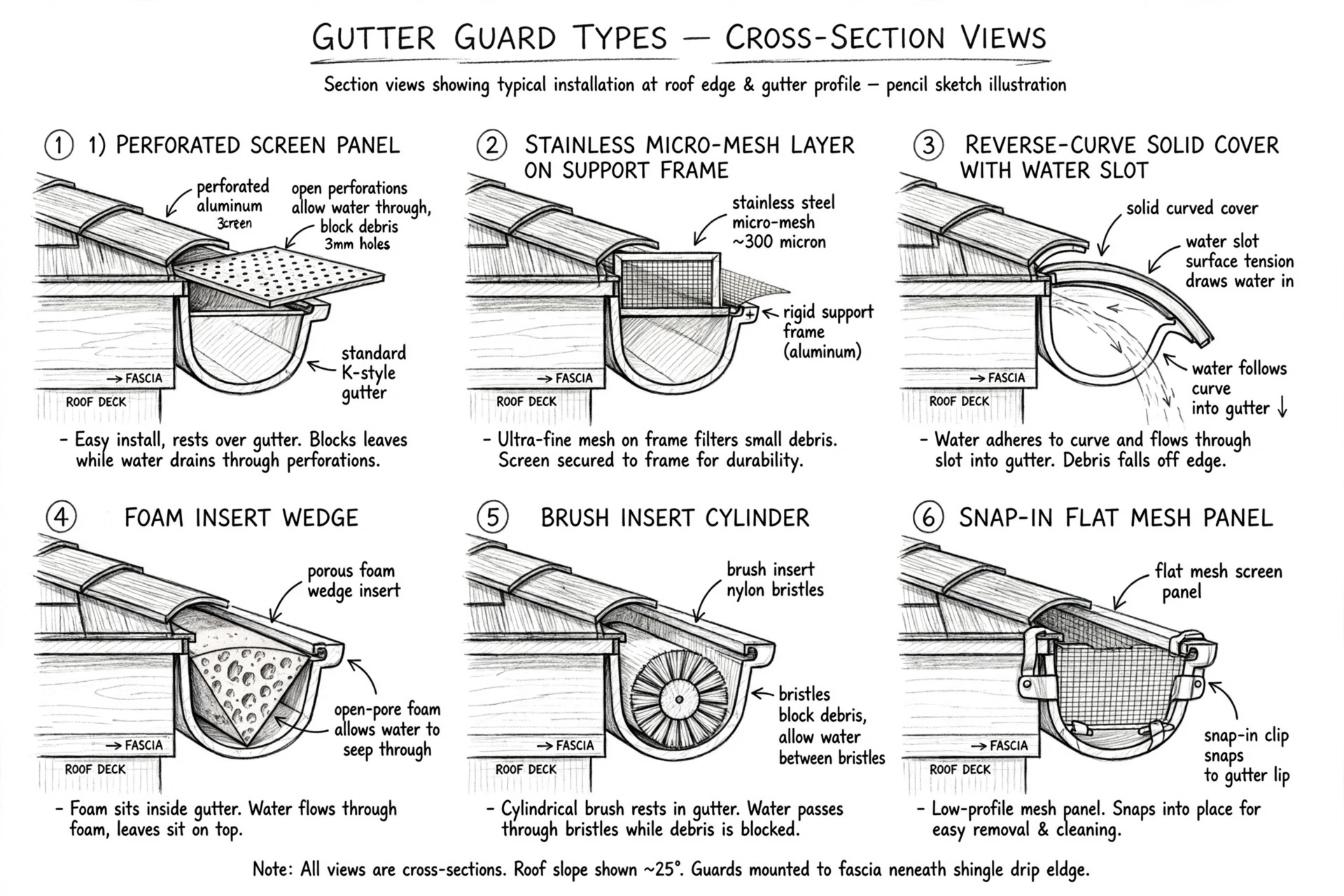
Two things stand out. First, micro-mesh is the only design that genuinely handles the full range of debris, including pine needles, which are thin enough to thread through standard screens. Second, the two cheapest options, foam and brush inserts, look clever in the store and become the hardest products to live with. Both trap fine debris inside their own structure, and cleaning a foam wedge or a bristle brush is more unpleasant than cleaning a plain gutter ever was.
Benefits of gutter guards
Less time on a ladder. This is the benefit homeowners keep citing. Gutters need cleaning at least twice a year in most areas, and mature trees push that number higher. Every cleaning avoided is one less afternoon on an extension ladder, and fewer ladder trips means fewer chances for the most common home maintenance accident there is.
Fewer clogs and overflows. A guard that matches your debris type keeps the trough open, so water reaches the downspouts instead of sheeting over the front edge or backing up under the shingles. If your main problem is gutters overflowing in heavy rain, a guard can help, but check that the gutters are actually sized for your roof first. An undersized gutter with a guard on top is still an undersized gutter.
Less damage from standing water. Clogged gutters are not just a nuisance. Standing water soaks the fascia, runs down the siding, and pours near the foundation. Over time that is rot, eroded soil, and basement moisture. In the This Old House survey, more than half of guard buyers said protecting their foundation was one of their reasons for installing them.
A quieter pest problem. Dry debris in open gutters is a nursery for mosquitoes, wasps, and rodents. Guards do not make the trough sterile, but they remove the biggest food and shelter source.
The limits nobody puts on the brochure
Every guard on the market has limits, and the marketing leaves most of them out.
They do not end cleaning. Guards change the chore, they do not erase it. Debris lands on top of the guard instead of inside the trough. Most of it blows or washes off, but seeds, pollen, and roof grit work into the mesh over time. Plan on a surface rinse or a walk-around inspection once or twice a year. This Old House’s survey found cleaning dropped dramatically, but only 17% of owners got to true zero.
Pine needles need micro-mesh, full stop. Standard screens and perforated covers are nearly useless under pines. The needles slip through the holes or lodge vertically in them, and once a mat forms on top of the guard it is harder to clean than an open trough was. Micro-mesh with openings around 500 microns or smaller is the only design that keeps fine needles out while water flows through. Brush and foam inserts should be avoided under pines entirely; their structure traps needles and creates an elevated clog you cannot easily reach.
They do not prevent ice dams. This one gets guards blamed for a problem they did not cause. Ice dams form when heat escapes from the house into the attic, melting roof snow that refreezes at the cold eaves. The University of Minnesota Extension is blunt about it: ice dams are prevented by controlling heat loss from the home, through air sealing and insulation, not by anything you bolt to the gutter. Some guard styles can make winter worse at the eave itself. Reverse-curve covers can freeze at their nose slot and shed meltwater over the front as icicles, and brush inserts hold a wet mass of debris at the edge right through a freeze.

They cannot fix a bad gutter. A guard adds weight and makes the trough harder to service. If your gutter already sags between hangers, leaks at the joints, or pitches the wrong way, covering it up makes everything worse, not better. Fix the gutter first. Guards are a maintenance upgrade for a healthy system, never a repair for a sick one.
Shingle warranties deserve a phone call. Some guards slide under the first shingle course without penetrating anything; others screw into the fascia or the gutter lip. A guard nailed or screwed through the shingle field puts fresh holes in a watertight surface, and that is the kind of thing that makes a manufacturer question a warranty claim. Check the installation method first, then ask your roofer about eave attachments.
When gutter guards are worth it (and when they are not)
This is the decision section. Find your house in the table, and read the reasoning for your profile.
| Your situation | Verdict | Why |
|---|---|---|
| Large deciduous trees overhanging the roof | Worth it, strongly | Big leaves are the easiest debris for guards to stop, and heavy fall drop means the most cleaning avoided. A perforated cover or micro-mesh both work well here. |
| Pines, spruces, or firs near the roofline | Worth it, with the right type | Standard screens will fail you. Budget for stainless micro-mesh installed at a good pitch, and accept an annual surface check. |
| Two-story home with hard-to-reach gutters | Worth it | The less you can reach the gutters safely, the more a guard pays for itself in avoided ladder work and avoided cleaning bills. |
| You pay for professional cleaning two or more times a year | Worth it | This is the cleanest payback case. Fewer service visits usually cover the install cost within a few seasons. |
| Almost no trees near the house | Probably not | There is simply not much debris to keep out. Your money goes further toward a regular gutter cleaning schedule or larger gutters. |
| Gutters already sag, leak, or overflow | Not yet | Repair or replace the gutter system first. A guard on a failing gutter hides problems and adds weight. |
| You want to never think about gutters again | Not for that reason | No guard is maintenance-free. If the goal is zero attention, guards will disappoint you. |
| Heavy snow and ice dam country | Depends | Guards do not cause or cure ice dams, so address attic heat loss first. If you still want guards, prefer micro-mesh over reverse-curve and brush styles at the eave. |
Notice the pattern in that table. Guards pay off where debris is heavy, access is hard, or someone is paying for cleanings. They pay off nowhere when the expectation is zero maintenance or when the gutter itself is the problem.
How to choose the right gutter guard type
Start with the tree, not the product. Walk your yard and look at what actually lands on the roof.
Big broad leaves only (oaks, maples, sycamores): A perforated aluminum cover or a flat snap-in panel is usually plenty. Whole leaves cannot pass through the holes, and the panels are the easiest DIY install. This is the cheapest case, and it works.
Needles, seeds, or shingle grit in the mix: Go straight to stainless micro-mesh. It is the only design that keeps pine needles, maple seeds, and roof grit out of the trough. Screens and perforated covers will just turn your guard into a needle collector.
Heavy rain region: Prefer micro-mesh with a proper pitch. Reverse-curve covers rely on water surface tension to pull water into a narrow slot, and in a real downpour the water can sheet over the top instead. Surface-tension designs are the riskier choice where intense storms are normal.
Snow and ice country: Prefer micro-mesh, avoid brush inserts, and be cautious with reverse-curve covers that can freeze at the nose slot. And remember the real ice dam fix is in the attic, with air sealing and insulation, not on the gutter.
Budget DIY: If you are handy and the roofline is single-story with good ladder footing, snap-in panels or micro-mesh DIY kits are fair weekend projects. Just confirm your gutters are sized for the roof before you spend the money. A quick run through a gutter size calculator tells you whether the trough and downspouts can carry your roof’s water.
Pay once, forget the shopping: If you want one decision and done, professionally installed stainless micro-mesh is the safest all-around choice. It handles every debris type and every climate acceptably well.
Two shopping cautions from real-world testing. First, in the three-year independent test linked above, the plastic-framed micro-mesh product warped with temperature swings, opening gaps at the gutter edge where needles found their way in. A rigid metal frame holds its shape better. Second, watch the install method at the eave. Guards that slide under the first shingle course without fasteners are the gentlest on your roof; guards that screw through shingles are the ones to question.
Should you DIY it or hire a professional?
This comes down to three things: your roofline, your comfort on a ladder, and the guard type.
DIY makes sense when the house is one story, the ground under the gutters is firm and level, the gutters are in good shape, and you are installing a simple snap-in or lay-in product. You will save a large share of the total cost, since professional installation is the biggest line item. This Old House’s survey found professionally installed systems running $4,334 to $5,168 for an average home with about 200 linear feet of gutters. A DIY kit for the same house costs a fraction of that, though you trade your own time and get no workmanship warranty.
Hire a professional when the roofline is two stories or more, the ground slopes, the guard needs custom fitting around corners and valleys, or you want a reverse-curve system, which is really a pro-only product. Pros also spot gutter problems a DIY installer misses, like a run that has lost its pitch or hangers pulling out of rotted fascia.
If you go up the ladder, do it right. Gutter work puts you at the worst possible height: high enough to get badly hurt, low enough that people skip precautions. West Virginia University Extension’s gutter safety guidance says to use a sturdy ladder on a level, flat surface, never crawl out onto the roof, never work in a storm or when ice is possible, and to wear heavy gloves and safety glasses. The U.S. Consumer Product Safety Commission adds: set the ladder feet on solid, level ground, keep a second adult on site as a spotter, and keep the ladder well clear of power lines. If that sounds like more than the job deserves, hire it out.
Frequently asked questions
Yes, at the job they are built for. Good guards keep leaves, twigs, seed pods, and needles out of the gutter trough so water drains instead of clogging. In This Old House’s 2025 homeowner survey, 41% of owners cut cleaning to once a year and 17% stopped entirely. What guards do not do is end maintenance for good.
Less often, but yes. Debris lands on top of the guard instead of inside the trough, and seeds, pollen, and roof grit work into the mesh over time. Plan on a surface rinse or inspection once or twice a year, especially after big storms. Most owners find gutters with guards need cleaning far less often than open ones.
Stainless micro-mesh with openings around 500 microns or smaller. Pine needles slip through standard screens or lodge in the holes, so screens and perforated covers fail under pines. Brush and foam inserts are the worst choice under pines because they trap needles inside their own structure. Reverse-curve covers handle needles acceptably but can struggle in very heavy rain.
No. Ice dams form when heat escaping from the house melts roof snow, which refreezes at the cold eaves. University of Minnesota Extension says the fix is controlling heat loss through attic air sealing and insulation, not anything bolted to the gutter. Some guard styles can make eave icing worse, so in snow country prefer micro-mesh and fix the attic first.
They can if they are fastened through the shingle field. Guards that slide under the first shingle course without penetrating it, or that fasten to the gutter lip or fascia, are the gentlest on the roof. Before installing, check the attachment method and ask your roofer or read the shingle warranty’s terms about eave attachments.
Often, yes, on a one-story home with firm, level ground under the gutters and a healthy gutter system. Snap-in panels and lay-in mesh kits are fair weekend projects and cost a fraction of professional installation. Hire a pro for two-story rooflines, sloped ground, custom fitting, or reverse-curve systems, and always follow ladder safety basics if you go up yourself.
It depends on the material and the climate. Stainless steel micro-mesh and solid aluminum covers are the longest-lived, often carrying 20-year or longer manufacturer warranties. Plastic screens and foam or brush inserts wear out or clog much sooner, sometimes within a few seasons. A rigid metal frame also holds its shape better than plastic through hot summers and cold winters.
Sources
- This Old House’s guide on whether gutter guards are worth it, which includes their November 2025 survey of 1,000 homeowners on satisfaction, cleaning frequency, and installed costs.
- West Virginia University Extension’s gutter safety guidance, for ladder rules and the twice-a-year cleaning baseline.
- The University of Minnesota Extension page on dealing with and preventing ice dams, for why attic heat loss, not gutter hardware, is the ice dam story.
- The U.S. Consumer Product Safety Commission’s spring safety guidance, for ladder setup and spotters during gutter work.
- Engineer Fix’s pine needle gutter guide, for why standard screens fail under pines and why micro-mesh and reverse-curve designs differ.
- Gutter Guards Direct’s three-year LeafFilter review video, for honest long-term performance data on micro-mesh covers.

3 Comments
Pingback: How Often Should Gutters Be Cleaned? (Full Schedule)
Pingback: Gutter Maintenance Guide for Homeowners | Home Exterior Lab
Pingback: Why Gutters Overflow in Heavy Rain: Causes & Fixes | Home Exterior Lab