


Ask three neighbors what their fence cost and you will get three numbers that look nothing alike. One paid $2,000, one paid $7,000. All three can be right, because a fence price is not one number. It is a fence run plus a gate plus whatever the old fence, the ground, and the town hall add on top. This guide adds all of it up, so you can budget a whole project instead of guessing from a per-foot rate.
At a glance
- Small backyard (about 100 ft): about $1,700–$5,300 all in.
- Standard backyard (about 150 ft): about $2,400–$7,500 all in.
- Full perimeter (about 400 ft): about $6,300–$19,400 all in.
- Per linear foot: $6 to $50 installed across all materials.
Yard-size totals are built from the RemodelCalculators wood privacy range of $15 to $45 per linear foot, with gates and a permit added.
| Yard and fence | Fence run only, installed | Gates and permit | All-in total, before removal |
|---|---|---|---|
| Small backyard, about 100 ft, 6 ft wood privacy | $1,500 to $4,500 | 1 walk gate $150 to $600, permit $20 to $150 | About $1,700 to $5,300 |
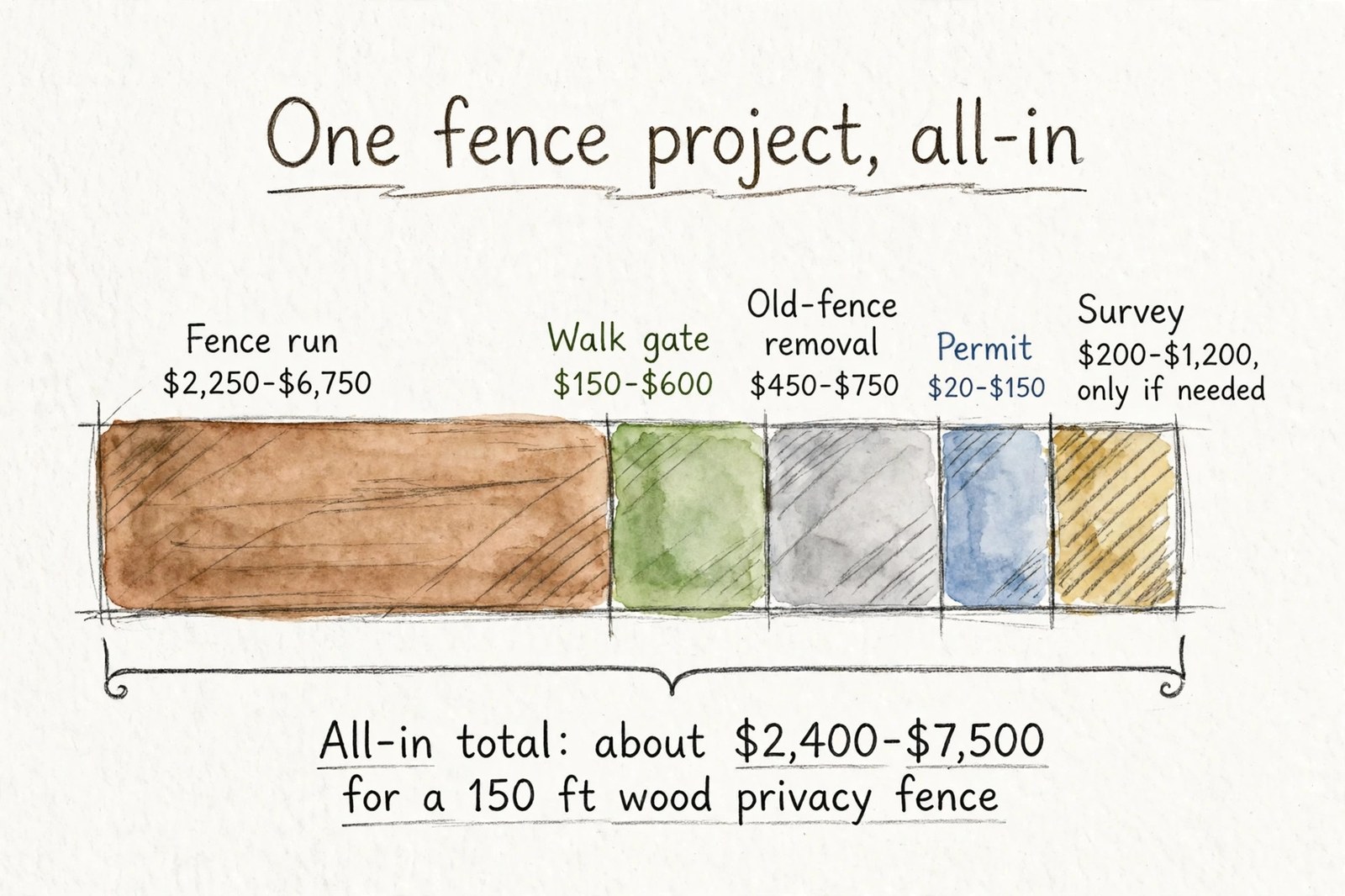
| Standard backyard, about 150 ft, 6 ft wood privacy | $2,250 to $6,750 | 1 walk gate $150 to $600, permit $20 to $150 | About $2,400 to $7,500 |
| Standard backyard, about 150 ft, 4 ft chain-link | $1,250 to $4,250 | 1 walk gate $150 to $600, permit $20 to $150 | About $1,400 to $5,000 |
| Standard backyard, about 150 ft, 6 ft vinyl privacy | $3,750 to $9,000 | 1 walk gate $150 to $600, permit $20 to $150 | About $3,900 to $9,750 |
| Full perimeter, about 400 ft, 6 ft wood privacy | $6,000 to $18,000 | 2 walk gates $300 to $1,200, permit $20 to $150 | About $6,300 to $19,400 |
Fence-run figures come from RemodelCalculators’ reconciled 2026 ranges, which combine the Angi, HomeGuide, and Fixr figures. Gate figures use the same guide’s $150 to $600 walk-gate range, and permit figures its $20 to $150 range. The totals are my arithmetic on those published ranges, rounded to the nearest $100, not quotes.
How much are fences in 2026?
An all-in fence cost is the full price of a finished fence project: the fence run itself, gates, old-fence removal, permits, and any survey or ground work, with labor included. On that basis, HomeAdvisor’s 2026 figures, as reported by BuilderMuse, put the national average fence job at about $3,276, with most projects landing between $1,860 and $4,844. Fixr’s fence installation guide lands higher, at a $4,500 average, but it prices a specific job: 200 linear feet of 4-foot cedar picket fencing with a gate. The two averages describe different jobs, so the gap is honest, not a mistake. Per linear foot, HomeAdvisor gives $6 to $50 installed across all materials, with most homeowners paying about $23 a foot.
For the yard most people actually fence, a standard backyard of about 150 feet, budget $2,400 to $7,500 all-in for a professionally installed 6-foot wood privacy fence with one walk gate and a permit. That is the number to carry into a contractor conversation. The per-foot rate is only the starting point, and the rest of this guide shows where the rest of the money goes.
Before you go further, watch a fence contractor walk through real pricing. This short video from Cascade Fence and Deck covers the factors that move a fence price and shows what wood, vinyl, and ornamental fences run.
Contents
- How much are fences in 2026?
- What a whole fence costs: all-in budgets by yard size
- How to estimate your own fence in five steps
- What drives the price: the cost factors, ranked
- DIY vs hiring a pro for the same fence
- How to cut the bill without a fence that fails early
- Is a fence worth it, or is a hedge (or nothing) the better buy?
- Questions people ask
- Sources
What a whole fence costs: all-in budgets by yard size
For a standard backyard of about 150 feet, budget $2,400 to $7,500 all-in for a professionally installed 6-foot wood privacy fence with one walk gate and a permit. A small 100-foot run lands near $1,700 to $5,300, and a full 400-foot perimeter runs about $6,300 to $19,400 before any old-fence removal. The budget table near the top of this guide builds each total from its parts, so you can see what you are actually paying for.
One quick sense check: HomeBuddy puts the average fence at about $4,200 for 150 linear feet, and HomeAdvisor lists an average of $3,600 for the same length, both inside the $2,400 to $7,500 band above. Averages cluster in the middle because most jobs use common materials on flat ground.
Material is the one choice that moves the run itself. This compact summary is all the per-foot detail this guide needs. For the full breakdown by material, height, and style, see our guide to per-foot prices by material. Per-foot rates by material and height live in that guide; this guide prices whole yards.
| Material, 6 ft privacy unless noted | Installed per linear foot | 150 ft run only |
|---|---|---|
| Chain-link, 4 ft | $8 to $28 | $1,250 to $4,250 |
| Wood privacy, pressure-treated pine | $15 to $45 | $2,250 to $6,750 |
| Vinyl privacy | $25 to $60 | $3,750 to $9,000 |
| Composite privacy | $35 to $95 | $5,250 to $14,250 |
Per-foot figures are from RemodelCalculators. The guides disagree at the edges, so this guide shows the wider band for each material.
What the budgets above leave out is old-fence removal, and it is the line most likely to surprise you. The guides disagree sharply here, so flag it rather than trust one number. HomeAdvisor prices removal at $3 to $5 per linear foot, which is $450 to $750 on a 150-foot run. Fixr puts removal and disposal at $600 to $800 for most fences between 100 and 200 feet, and a full replacement at $3,600 to $7,800. HomeGuide prices removal far higher, at $10 to $20 per foot including disposal, which would be $1,500 to $3,000 on the same 150 feet. Ask each bidder to price tear-out as its own line.
A land survey is the other line that only applies sometimes. If your property lines are clear and marked, skip it. If they are not, budget $200 to $1,200 for a survey, per HomeGuide, or $400 to $1,000 per Fixr.
Large lots follow the same math, just with bigger numbers. HomeGuide prices fencing one acre, about 835 to 900 linear feet depending on shape, at $7,500 to $25,000 in chain-link, $17,000 to $45,000 in wood, and $25,500 to $54,000 in vinyl, fence run only. Fixr’s acre figures run far lower, $836 to $12,540, because its low end is barbed wire and split rail on open ground. Both can be right: an acre of barbed wire and an acre of vinyl privacy are barely the same project.
| Lot size | Fence length | Wood privacy, all in | Chain-link, all in |
|---|---|---|---|
| 1/4 acre | Full perimeter, about 417 ft | $6,400–$19,500 | $3,500–$12,400 |
| 1/4 acre | 3 sides, about 310 ft | $4,800–$14,700 | $2,700–$9,400 |
| 1/2 acre | Full perimeter, about 590 ft | $9,000–$27,300 | $4,900–$17,300 |
| 1/2 acre | 3 sides, about 445 ft | $6,800–$20,800 | $3,700–$13,200 |
| 1 acre | Full perimeter, about 835–900 ft | $12,700–$41,300 | $6,900–$26,000 |
| 1 acre | 3 sides, about 630–675 ft | $9,600–$31,100 | $5,200–$19,700 |
How to estimate your own fence in five steps
Measure the fence line in feet, multiply by the installed per-foot rate for your material, then add one line each for gates, removal, permits, and a survey if you need one. Add 10 percent on top for the surprises every yard hides, and you have a budget you can hold a quote against — or run the same figures through a fence cost calculator.
- Measure the line, not the lot. Walk each side with a tape or a measuring wheel and add the sides together. A fence is priced per linear foot of fence, not per square foot of yard, so the lot size on your deed tells you nothing on its own. Subtract the width of every gate opening, since a 4-foot gate opening is 4 feet of fence you do not buy. Count the posts while you are out there: divide the length by the post spacing and add two. On 200 feet at 8-foot spacing, that is 27 posts.
- Multiply by a per-foot rate. Use the compact table above and pick the middle of the range for planning. A 150-foot wood privacy run at $30 a foot is $4,500. Run the math for two materials if you are choosing between them: the gap between chain-link and vinyl on the same yard is usually several thousand dollars.
- Add the gates. A standard walk gate runs $150 to $600 installed, per RemodelCalculators, or $50 to $400 per Fixr. A driveway gate is a different purchase: $1,000 to $6,000 installed per Fixr, and an automatic opener sits at the top of that range.
- Add removal, if you are replacing. Use $3 to $5 a foot as the planning figure, per HomeAdvisor, and keep HomeGuide’s $10 to $20 a foot in mind as the high case. On 150 feet, that is $450 to $750 at the low end and $1,500 to $3,000 at the high end.
- Add the permit, the survey, and 10 percent. Permits run $20 to $150 where they are required, and a survey runs $200 to $1,200 when the lines are unclear. Then add 10 percent of the whole total for rock, roots, or a rotten post footing nobody could see.
Here is the whole method on one real-shaped job. Take a 150-foot wood privacy fence at a mid-range $30 a foot. The run is $4,500. Add one walk gate at $300, a permit at $60, and removal of the old fence at $4 a foot, which is $600. That totals $5,460. Add 10 percent, $546, and the budget is about $6,000. If one bid is far below that number, check what it left out before you celebrate. A low bid that skips tear-out or uses shallower posts is not a cheaper version of the same fence.
What drives the price: the cost factors, ranked
Material decides the per-foot rate, length decides how many feet you pay for, and height, slope, gates, removal, permits, and local labor rates decide how far the total moves from the simple math. Labor alone is 40 to 60 percent of a typical installed fence, so where you live can matter as much as what you build.
| Cost factor | What it changes | Typical swing |
|---|---|---|
| Material | Sets the per-foot rate for the whole run | $8 to $95 per foot installed across common materials |
| Length | Multiplies every per-foot cost | Each extra 50 ft of wood privacy adds about $750 to $2,250 |
| Height | Taller boards, longer posts, deeper holes, more concrete | Going from 6 ft to 8 ft adds 25 to 35 percent |
| Terrain and slope | Stepped panels, rock digging, grading, slower crew | Grading $500 to $3,000; no guide publishes one slope multiplier |
| Gates | Each gate is its own small build, with heavier posts and hardware | Walk gate $50 to $600; driveway gate $1,000 to $6,000 |
| Old-fence removal | Tear-out, hauling, and disposal, plus concrete footings | $3 to $5 per foot per HomeAdvisor; $10 to $20 per HomeGuide |
| Permit and survey | Paperwork before the first hole is dug | Permit $20 to $150; survey $200 to $1,200 |
| Region and labor | Labor is 40 to 60 percent of the job, so local rates move everything | Same 150 ft wood fence: $2,000 to $5,750 in lower-cost regions, $3,250 to $9,500 in high-cost metros |
Material first, because it is the lever you control most: material choice alone can triple the bill on the same yard.
Height is the quiet multiplier: an 8-foot privacy fence adds about 25 to 35 percent over a 6-foot fence, so check the local height cap before pricing the taller option.
Slope deserves a warning of its own. No major cost guide publishes a single slope multiplier, and none prices a stepped fence against a racked one, as RemodelCalculators points out. What the guides do publish is pieces: grading the ground first runs $500 to $3,000 per HomeGuide, and Angi puts sloped installations at an average of $3,233. Get slope priced as its own line on each bid, and ask whether the crew plans to rack the panels to follow the grade or step them down in level sections.
Region is the factor people underestimate. RemodelCalculators prices the same 150-foot wood privacy fence at $2,000 to $5,750 across much of the South and Midwest, $2,250 to $6,750 at the national average, and $3,250 to $9,500 in high-cost Northeast and West Coast metros. Labor is 40 to 60 percent of an installed fence, per the same guide, so a crew’s hourly rate moves the whole number. Fixr puts labor at $5 to $20 per linear foot for most fence types, $10 to $20 for wood.
Height is the single biggest swing after material: our guide to how tall privacy fences can be walks through the limits by yard, the sightline test, and when 8 feet is worth it.
DIY vs hiring a pro for the same fence
On a standard 150-foot wood privacy fence, doing it yourself cuts the bill roughly in half, because labor is about half the installed price. You trade money for a long weekend of digging, and the posts are where DIY fences usually fail.
| Same job: 150 ft wood privacy, 6 ft | Build it yourself | Hire a pro |
|---|---|---|
| Fence materials | $1,200 to $2,700, at $8 to $18 a foot | $2,250 to $6,750, run only, installed |
| Labor | Your time, plus a sore back | Included, about 40 to 60 percent of the total |
| Tools and consumables | $150 to $700 for auger rental, concrete, and hardware | Included |
| Gate | Hardware and lumber, a few hundred dollars | $150 to $600 installed for a walk gate |
| Stain or paint | Your time plus the stain | $3.50 to $13 per linear foot |
| All-in total | About $1,500 to $3,500 | About $2,400 to $7,500 |
Materials-only figures are from RemodelCalculators, and the stain rate is from Angi. The DIY total assumes you already own the basic tools and the ground is flat and soft.
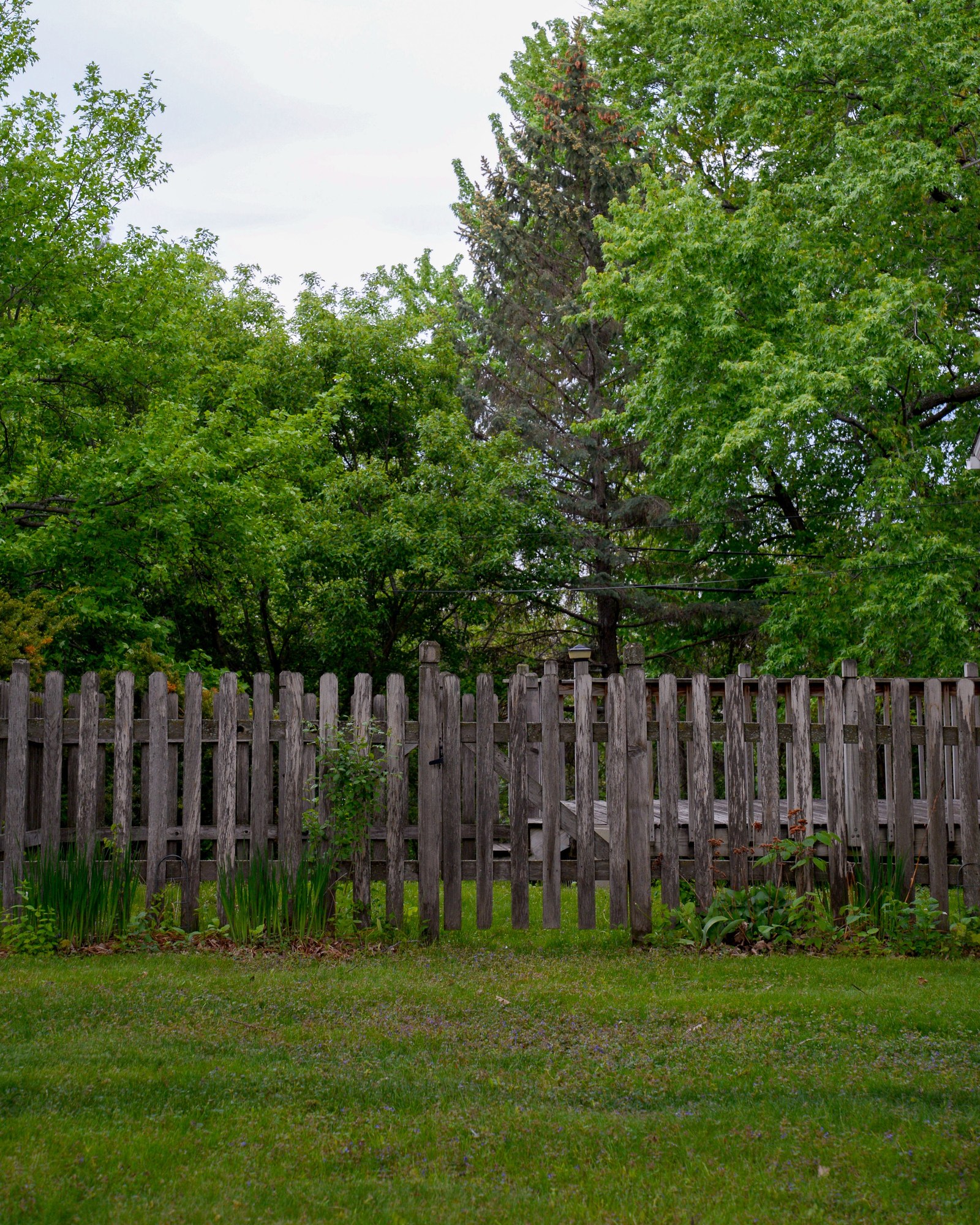
One real receipt shows how big the gap can get. Maker Gray built 200 linear feet of board-on-board cedar fence himself for just under $6,700, about $33.50 a foot, while a local contractor quoted about $18,700, or $93.50 a foot, for the same project. He saved roughly $12,000. His breakdown is worth reading in full: $1,550 for posts and framing lumber, $1,950 for cedar pickets, $1,000 for trim and top cap, $580 for concrete, $370 for hardware, $350 for two gates, $475 for stain, $300 for post saver sleeves, $300 for auger rental, and $80 for old-fence disposal. Two honest notes: his contractor quote sat far above the national guides, so treat it as one premium build rather than the norm.
DIY makes the most sense on straight runs of wood or chain-link on flat, soft ground. Hire out the jobs that punish small mistakes. Vinyl and aluminum panel systems are unforgiving on post spacing, since the panels have to match exact spacing, and ornamental steel usually needs fabrication and welding. Sloped or rocky lots belong to a crew with the right auger. And whatever you decide, call 811 a few days before any digging. 811 is the free national before-you-dig service, and it sends someone to mark buried utilities with paint or flags before work starts. It applies to every dig, even a handful of post holes. Set the posts below the frost line in cold climates, check the permit and any HOA rules before you order materials, and set the corners and ends first, then pull a string line so the run stays straight.
How to cut the bill without a fence that fails early
The honest savings come from building less fence, choosing a cheaper material, and doing the easy parts yourself, not from thinner posts or skipping concrete. A fence with shallow posts is the most expensive fence you will ever own, because you pay for it twice.
Start by fencing less. Most yards only need the backyard enclosed, not the full perimeter. Dropping from 400 feet to 150 feet saves thousands before you change a single material. A 4-foot fence where privacy is not needed costs far less than a 6-foot privacy run on the same line.
Then pick the cheaper material for the job at hand. Pressure-treated pine is the cheapest true privacy fence, and chain-link is the cheapest way to enclose a large area at all. Keep the gate count down, since each one adds $150 to $600 or more. If the old fence has sound posts, ask whether the panels alone can be replaced.
Get three written, itemized bids on the same scope sheet: material and grade, post size and depth, post spacing, gate count and hardware, tear-out and disposal, and who pulls the permit and calls 811. Prices in the same town commonly vary by a third or more, and an itemized bid is the only way to see why. Ask the neighbor about sharing a boundary fence, and check the local rules first.
Do the easy parts yourself. Tear-out and disposal is the simplest saving: Maker Gray paid an $80 dump fee for his old fence, then learned viewers would have taken the old panels for free if he had listed them. Staining is the other one: a pro charges $3.50 to $13 a foot, per Angi, and a weekend with a sprayer or brush does the same job for the price of the stain. What not to cut: post depth, concrete at every post, and gate hardware.
Is a fence worth it, or is a hedge (or nothing) the better buy?
A fence is worth it when you need privacy, a safe place for kids or pets, or a clear boundary, and the value is mostly in daily use rather than resale. Fixr puts the resale return at roughly 50 to 70 percent, so a fence rarely pays for itself at sale alone. Buy it for the years you will use it, not for the closing table.
For the value side of the same question, see whether a fence adds value to a home, including what appraisers credit versus what buyers actually pay.
It is also worth checking whether home insurance covers a fence, so storm damage does not turn a fence you planned to enjoy for years into an unexpected bill.
A hedge is the main alternative, and it trades money for time. HomeGuide prices planting hedges at $10 to $45 per linear foot, which can undercut a wood fence on the same line, but a hedge takes years to fill in, needs regular trimming, and keeps out nobody determined. It suits a front yard where the goal is soft screening, not a dog that digs or a pool that needs a real barrier.
Doing nothing is free and sometimes right. If the yard is only used in summer, if the neighbors are far away, or if the budget is tight this year, a fence can wait. A cheaper boundary still marks the line: split rail runs $6 to $11 a foot installed per Fixr, and an invisible dog fence runs $2 to $7 a foot per HomeGuide, though it contains pets only and gives no privacy at all.
One cost people forget is upkeep, and wood is where it shows. A wood fence wants washing and re-staining every few years, so budget for that from the start. Our guide to how to clean a fence covers the method by material, and if the boards start going green, here is why a wood fence turns green and what to do about it. Vinyl costs more up front and almost nothing after, which is why the lifetime math often favors it even when the quote does not. We will cover privacy fence costs, the cheapest fence types, and a full types-and-cost catalogue in separate guides.
Winter is the other season that changes what a fence has to do. A seasonal snow fence costs little, goes up before the ground freezes, and keeps drifting snow off the driveway. For placement and the 35-times-height rule, see how snow fences work.

Bottom line
Price the fence as a whole project, not a per-foot rate. The $3,276 average hides a wide spread, and the cheapest quote is usually the one that left the gate, the removal, or the permit out.
Questions people ask
For a standard backyard of about 150 feet, budget about $2,400 to $7,500 all in for a professionally installed 6-foot wood privacy fence with one walk gate and a permit. A small backyard of about 100 feet runs about $1,700 to $5,300.
About $2,400 to $7,500 all in for 150 feet of 6-foot wood privacy fence, including one walk gate and a permit. The fence run alone is about $2,250 to $6,750.
A quarter acre has about 417 feet of perimeter. At the published per-foot bands, plus a gate and permit, that is about $6,400 to $19,500 in wood privacy or $3,500 to $12,400 in chain-link. Fencing three sides, about 310 feet, runs about $4,800 to $14,700 in wood privacy.
About $6 to $50 per linear foot installed across all materials, with most homeowners paying about $23 a foot.
Sources
- HomeGuide’s fence installation cost guide
- Fixr’s fence installation cost guide
- BuilderMuse’s fence installation cost guide for 2026, reporting HomeAdvisor data
- RemodelCalculators’ fence cost per foot guide for 2026
- HomeBuddy’s fencing cost guide
- Maker Gray’s cedar fence cost breakdown
- 811, the free national before-you-dig service
- Cascade Fence and Deck’s fence cost video on YouTube
Last updated: November 27, 2026. Prices are 2026 US national averages from the sources above. Local quotes rule, so get at least three written, itemized bids before you commit.
