


You come home after a storm and find half the back fence on the ground. Or a neighbor calls to say a limb came down on your side fence overnight. The first question is not how much a new fence costs. It is whether your home insurance will pay for any of it, and whether filing a claim is even worth doing.
Most fences are covered, but only in a narrow sense. Your policy covers sudden damage from a cause like wind, fire, or a falling tree. It does not cover a fence that wore out slowly or rotted at the posts. The cause matters more than the fence itself, and the payout is usually smaller than people expect, because of deductibles and depreciation.
The short answer: yes, usually, if the cause was sudden
Yes, home insurance usually covers fence damage when a sudden, accidental event caused it, such as a windstorm, fire, lightning, hail, vandalism, or a falling tree. Your fence sits under the other structures part of a standard homeowners policy. It does not pay for gradual wear, rot, termites, flood, or earthquake damage.
That short answer hides three catches: the payout is the repair cost minus your deductible and minus depreciation, unless you have replacement cost coverage; the limit for all detached structures together is often just 10 percent of your dwelling limit; and a small claim can cost you more in the long run than paying out of pocket, because the claim stays on your insurance history.
Before you read further, watch this short explainer from AAA, which covers other structures coverage, sudden versus gradual damage, and the factors that decide a fence claim.
Contents
- The short answer: yes, usually, if the cause was sudden
- Where a fence sits in your policy: Coverage B
- What fence damage is covered
- What is not covered
- How much a fence claim actually pays
- The shared-fence problem
- Your neighbor’s tree fell on your fence
- A car hit your fence
- Should you file a claim or pay out of pocket?
- How to file a fence damage claim
- If your claim is denied or underpaid
- Keeping your fence claim-ready
- Questions people ask
- Sources
Where a fence sits in your policy: Coverage B
Other structures coverage, known as Coverage B, is the part of a standard homeowners policy that pays for structures on your property that are not the house itself, such as a detached garage, a shed, a driveway, and a fence. It is separate from Coverage A, which covers the dwelling, and it has its own limit.
On a standard HO-3 policy, Coverage B is typically 10 percent of your dwelling limit, according to LegalClarity’s guide to Coverage B. A $300,000 home would carry about $30,000, and a $400,000 home about $40,000. GEICO’s fence coverage guide gives the same rule and example, and Kin’s guide to fallen fences agrees.
That 10 percent is a shared pool, not a per-structure limit, and that is the detail people miss. LegalClarity explains that the limit applies to all other structures combined, so a detached garage, a shed, a patio, and a fence all draw on the same $30,000. If a storm damages the garage and the fence in the same event, the two repairs share one pot of money.
One common worry is whether an attached fence counts. It does. GEICO states that fences are covered under Coverage B whether they are attached to the house or freestanding. What matters is the cause of the damage, not how the fence connects to the house.
Coverage B on an HO-3 policy is open-peril coverage, which means it covers damage from any cause except the ones the policy lists as excluded. Check your declarations page for your exact Coverage B limit, since the 10 percent figure is typical, not universal.
What fence damage is covered
A fence claim succeeds when a sudden, accidental event caused the damage and that event is not on the excluded list. Wind, fire, lightning, hail, vandalism, a falling tree, and a vehicle impact are all usually covered, while gradual wear, rot, and flood are not. The table below covers each cause in turn.
| Cause | Usually covered? | What to know |
|---|---|---|
| Windstorm | Yes | Wind damage is the everyday fence claim. Panels blown down and posts snapped at the base are typical sudden damage. |
| Fallen tree or limb | Yes | Covered when the tree or limb hits the fence. File on your own policy, no matter whose tree it was. |
| Fire or lightning | Yes | Fire and lightning are standard covered perils on an HO-3 policy, for the fence as for the house. |
| Hail | Yes | Hail damage to a fence is covered. |
| Vandalism | Yes, with limits | Covered, but get a police report. Vandalism is excluded if the home has been vacant for 60 days or more. |
| Vehicle impact | Yes | Covered, but file on the driver’s auto insurance first when someone else was driving. |
Wind damage is the everyday fence claim, and it is also the one where an adjuster looks hardest at the fence’s condition before the storm. A sound fence blown over by a strong gust is a clear claim.
A fallen tree is the other everyday case. The Insurance Information Institute explains that a tree hitting an insured structure is covered for wind, lightning, and hail, and that you file on your own insurer no matter who owns the tree. The same rule applies to a fence.
What is not covered
Home insurance does not cover a fence that fails from age, neglect, or a cause the policy excludes. A fence leaning because the posts rotted, boards splitting after years with no stain, or damage from flood, earthquake, termites, or poor installation is maintenance or an excluded cause, not an insurable loss.
Wear and tear is the first exclusion, and it is the one that kills most fence claims. Wood rots, metal rusts, paint peels, and boards warp in the sun. Hippo lists neglect, termites, wear and tear, and mold among the things fence coverage does not pay for, and Kin gives the same list, adding rot and flood. LegalClarity adds rust, insects, and rodents, and GEICO adds improper installation, so a fence that failed because it was built wrong is not a claim either.
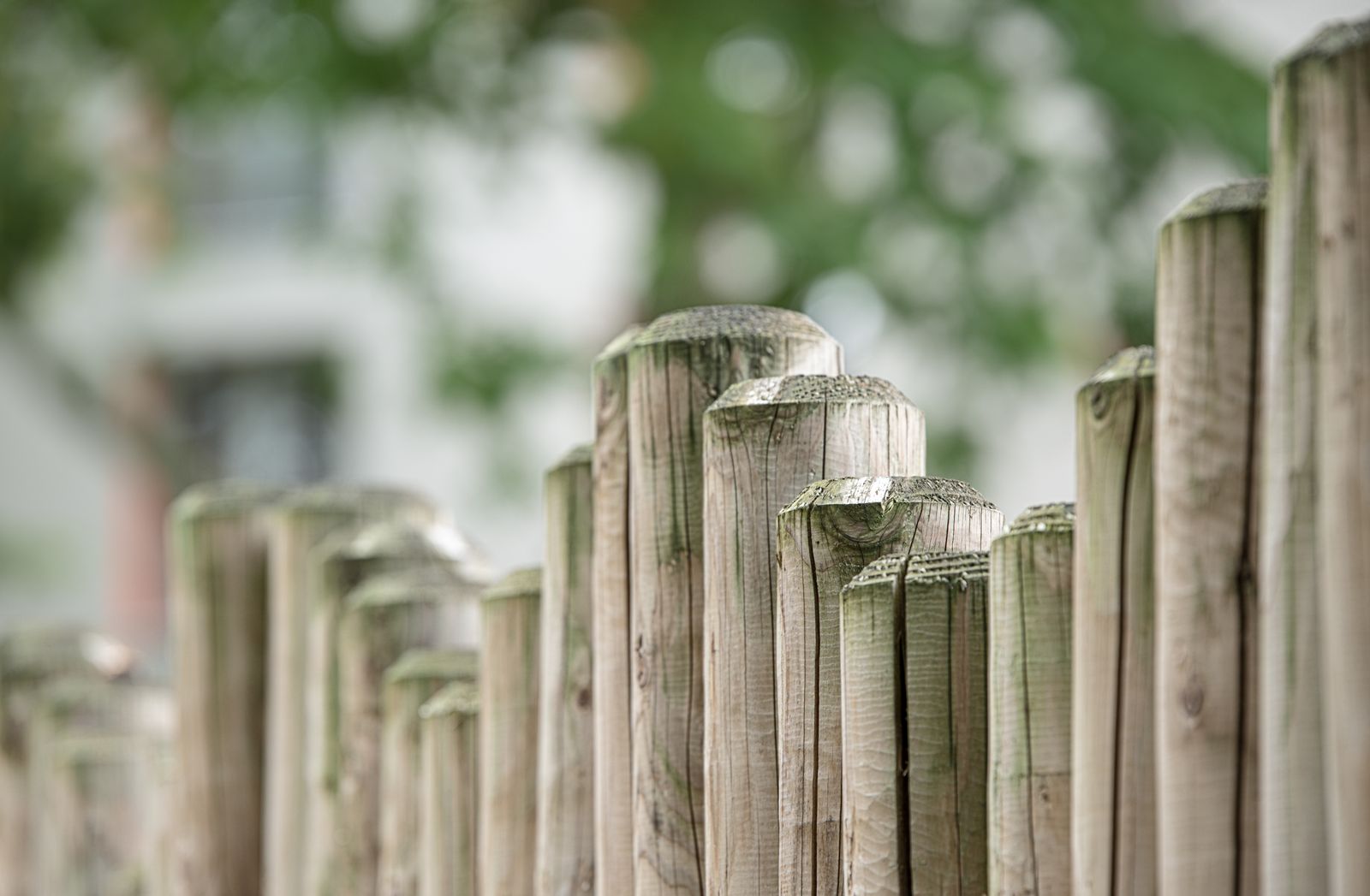
Rotted posts are the single most common reason a fence claim is denied. Fantastic Fence, a licensed California fence contractor, calls rotted posts the number one denial reason, and notes that adjusters check post bases closely. The contractor reports that about 99 percent of the fences it repairs are on wood posts, and the post fails first.
Flood and earthquake are excluded from a standard homeowners policy entirely, and that applies to fences as much as to houses. Flood coverage needs a separate flood policy, and earthquake coverage needs a separate earthquake policy or endorsement. Hippo lists mudslide and sewer backup alongside flood and earthquake as exclusions. LegalClarity notes the same for earth movement, and adds that the weight of ice and water on a fence, and freeze and thaw damage, are not covered. If the fence is used for a business, or the property is rented to someone who does not live there, Coverage B can be lost for that structure. And if the home has been vacant for 60 days or more, vandalism coverage drops away.
How much a fence claim actually pays
Three numbers decide what lands in your bank account: the approved repair cost, your deductible, and depreciation. The payout is the repair cost minus the deductible and minus depreciation, unless your fence is covered on a replacement cost basis. Most fences are settled at actual cash value, so age cuts the payout before the deductible does.
Most fences are settled at actual cash value, or ACV, which is the replacement cost minus depreciation for age and condition. LegalClarity explains that fences are settled at ACV, while buildings like garages are settled at replacement cost. Kin agrees that an ACV payout is typical for fences, though some policies offer a replacement cost option for vinyl or wrought iron fences.
| Fence type | Settlement basis | What that means in practice |
|---|---|---|
| Wood privacy or picket | Actual cash value | Depreciation is subtracted for age and condition, so an old wood fence pays far less than a new one costs. |
| Chain-link | Actual cash value | Depreciation applies, at a rate that depends on the material and its condition. |
| Vinyl | Actual cash value, replacement cost sometimes available | Kin notes a replacement cost option exists for some vinyl fences, so check your policy wording. |
| Wrought iron or ornamental metal | Actual cash value, replacement cost sometimes available | Same as vinyl: replacement cost is an option on some policies, not the default. |
| Detached garage or shed | Replacement cost | Buildings are settled at replacement cost, which is why a fence claim pays differently from a garage claim. |
LegalClarity gives a worked example: a 15-year-old fence with a 20-year expected life might receive only about a quarter of its replacement price.
Fantastic Fence gives a worked illustration from its own repair jobs. A winter storm knocks down 48 feet, six panels, of a 12-year-old shared redwood fence. Replacement runs about $1,920 at roughly $40 a foot. Your half is $960, and after depreciation that falls to about $480. With a $1,000 deductible, the claim pays $0, and the claim still shows on your insurance history. That is their illustration, using their Sacramento pricing, not a national figure.
Here is a second worked example, using our own published national figures. Our guide to what a whole fence project costs puts the national average fence job at about $3,276, and about $23 a foot as the typical rate. A 150-foot wood privacy fence at about $23 a foot is roughly $3,450 new. At 10 years old, with about half its value gone, the ACV is about $1,725. Subtract a $1,000 deductible and about $725 is left. That is arithmetic on published ranges, not a quote. For the full detail, see our guide to per-foot fence prices by material.
Deductibles come in two shapes. Kin reports flat deductibles of $500 to $10,000, and percentage deductibles for wind and hail instead of a flat figure. Kin gives the example of a $300,000 home with a 2 percent wind deductible, which is $6,000 out of pocket before the insurer pays anything. LegalClarity notes one more detail: debris removal gets an extra 5 percent of the Coverage B limit, on top of the limit itself.
The shared-fence problem
A fence on a shared boundary is two fences in insurance terms. Each homeowner files under their own policy for their side, and each policy pays only its own owner’s share, so you cannot claim the whole fence on your policy.
GEICO states the rule plainly: for a shared fence, each homeowner generally files under their own policy for their side. That means two claims, two deductibles, and two depreciation calculations, one for each side.
California has a specific law for this situation, worth knowing as a labelled state example. Fantastic Fence explains that under the California Good Neighbor Fence Act, Civil Code 841, neighbors generally share a boundary fence equally, and the neighbor planning work must give 30 days written notice before the work starts. The Act sets out who pays, not who insures, so each owner still claims their own half on their own policy. Talk to your neighbor before either of you files, and check your own state law before you assume the California rule applies where you live.
Your neighbor’s tree fell on your fence
Your neighbor’s tree fell on your fence, and the first instinct is to call your neighbor and ask for their insurance details. In most cases, that is the wrong first move. You file on your own policy, no matter who owns the tree, and your insurer sorts out the rest.
The Insurance Information Institute states the rule directly: if a tree falls on an insured structure, the damage is covered, and you file a claim with your own insurer no matter who owns the tree. Hippo gives the same advice for fences, and Kin agrees, adding that your insurer may try to recover the money from the neighbor’s insurer if the neighbor was negligent, a process called subrogation. GEICO makes the same point, and adds that a dead or neglected tree can make the neighbor responsible.
Subrogation is the part that can work in your favor. If your insurer recovers the money from the neighbor’s insurer, the Institute notes, it may reimburse your deductible. That is not guaranteed, and it takes time, but it is a real possibility when the neighbor knew the tree was dangerous and did nothing.
Negligence is the one exception to the file-on-your-own-policy rule, and it is narrow. A healthy tree that a storm brings down is nobody’s fault, and your policy pays. A tree that was visibly dead, rotting, or leaning for months, that the neighbor knew about and ignored, is a different matter. A written warning to the neighbor before the fall is the strongest evidence you can have. GEICO notes that when a tree sits on the boundary line, responsibility may be shared, but you still file on your own policy first.
Tree removal has its own caps, and they are small. The Institute puts tree removal at generally up to about $500 to $1,000 when the tree hits an insured structure, while LegalClarity puts it at up to $1,000 in total, with $500 per tree.
A car hit your fence
A car through a fence is a car insurance claim first and a home insurance claim second. The driver’s auto liability insurance is the policy that should pay for the fence it hit, which saves you a deductible and a mark on your home insurance history. Your own homeowners policy is only the fallback.
Kin states the rule clearly: for vehicle damage, file on the driver’s auto insurance first, because that costs you no deductible and avoids a premium hit on your home policy. Hippo gives the same order, and adds that if you hit your own fence yourself, or the driver is uninsured, you fall back to your own homeowners policy, and then the deductible applies and your premium may rise. GEICO agrees, noting that the other driver’s auto insurance usually pays.
Get the police involved, and get the details while they are fresh. GEICO lists the filing steps for vehicle damage as documenting with photos and video, getting itemized written estimates, and filing with a police report if a vehicle was involved. Note the driver’s name, plate, and insurer if you can, and photograph the car and the damage before anything is moved.
A hit-and-run is the hard case, and it is the one where your own policy becomes the fallback. If the driver cannot be found, there is no auto policy to claim against, so the claim goes on your homeowners policy, with your deductible and depreciation applied as usual. File a police report anyway. If your own car hit your own fence, the same fallback applies: your homeowners policy may cover the fence damage, and your auto policy may cover the car.
Should you file a claim or pay out of pocket?
File the claim when the repair cost is clearly above your deductible and the fence is young enough that depreciation leaves real money on the table. Pay it yourself when the repair is near or below your deductible, or when the fence is old enough that depreciation eats the payout.
| Situation | File | Pay yourself |
|---|---|---|
| Storm destroys a new fence, repair $5,000, deductible $1,000 | Yes | No, the payout is large enough to justify a claim. |
| Storm damages an old fence, repair $1,500, deductible $1,000 | Probably not | Yes, depreciation may leave little or nothing after the deductible. |
| Repair cost below your deductible | No | Yes, the insurer pays $0 and the claim still shows on your history. |
| Wind deductible is 2 percent of dwelling value | Only for a large loss | Yes for most fence jobs, since a $6,000 deductible on a $300,000 home swallows them. |
| Neighbor’s tree, neighbor clearly negligent | Yes | No, file and let your insurer pursue subrogation for your deductible. |
| Another driver hit the fence | On their auto policy | No, claim on the driver’s auto insurance first, not your home policy. |
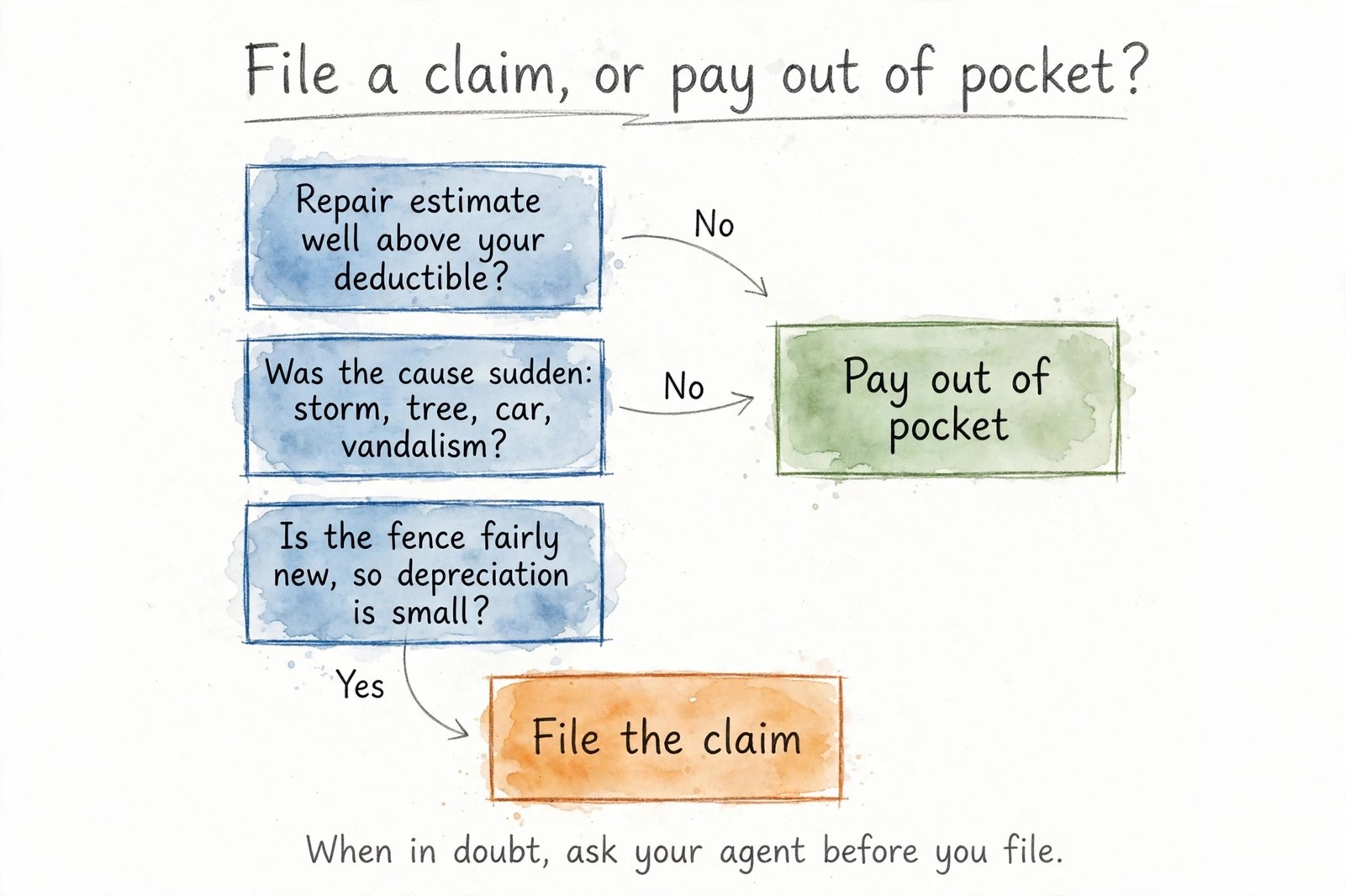
Fantastic Fence reports that fewer than 2 percent of its fence repair and replacement jobs involve any insurance claim at all. That is one contractor’s experience in one region, not a national statistic, but it fits the math in this guide. Remember that a claim that pays $0 still shows on your insurance history.
Hippo gives the same decision rule in simpler form: if the repair cost exceeds your deductible, it may make sense to file, and if it sits below the deductible, pay out of pocket. Depreciation is the second filter, and the claim history is the third. When you are unsure, call your agent and ask, without filing.
How to file a fence damage claim
Filing a fence claim is a short process, but the order matters. Photograph first, clean up second, get written estimates, and keep every receipt from the first phone call to the final invoice. The seven steps below follow the sequence the sources in this guide recommend.
- Make it safe, then stop.
Keep people and pets away from the damaged section, and do not climb on a leaning fence or cut a tree that is resting on it. If a power line is down or tangled in the fence, stay clear and call the utility.
- Photograph everything before you clean up.
Take wide shots of the whole run and close-ups of each broken panel, bent rail, and post base. Adjusters check post bases for rot, so photograph every broken one.
- Get a police report if the cause needs one.
Vandalism and vehicle damage both call for a police report. Kin and GEICO both list the police report among the documents to file.
- Get itemized written estimates.
Ask two or three fence contractors for written, itemized estimates that separate materials, labor, and removal. A single lump-sum number gives an adjuster nothing to check against.
- Check your Coverage B limit, your deductible, and your settlement basis.
Read your declarations page before you call, so you know whether your fence is settled at ACV or replacement cost.
- Call your agent and file.
Give the date, the cause, the photos, the estimates, and the police report if you have one. Ask for the claim number in writing.
- Keep receipts and the final invoice.
Save every receipt, including temporary repairs. On a replacement cost policy, the insurer may pay ACV first and release the withheld depreciation only after the work is done and the invoice is in.
Do the temporary repairs you need to keep the yard safe, and photograph those too, but do not rebuild the fence before the adjuster has seen it, unless your insurer tells you to.
If your claim is denied or underpaid
A denial is not the end of the road, but it is the start of a paper trail. Ask for the denial in writing, with the exact policy language the insurer is relying on, and read that language against your policy yourself.
Compare the adjuster’s estimate line by line against your contractors’ estimates. The gap is often in the line items: post depth, concrete, removal, or gate hardware that one estimate includes and the other leaves out.
California sets out claim timelines in law, worth knowing as a labelled state example. Fantastic Fence notes that in California, an insurer must acknowledge a claim within 15 days, accept or deny it within 40 days of proof of claim, and pay within 30 days of agreement, under Title 10, sections 2695.5 and 2695.7. California also gives at least 12 months to repair on a replacement cost policy, and 36 months after a declared emergency, under Insurance Code 2051.5.
If the insurer will not move, the state insurance department is the next step. Fantastic Fence gives the California Department of Insurance hotline, 800-927-4357, as the example route for a complaint. One line that should never be crossed: never inflate an estimate to cover a deductible. Fantastic Fence states plainly that inflating an estimate to cover a deductible is insurance fraud, under California Penal Code 550.
Keeping your fence claim-ready
The best time to protect a future fence claim is now, while the fence is still standing. An adjuster who sees a well-kept fence is far more likely to treat storm damage as sudden damage, and far less likely to blame rot or neglect. A few simple habits keep the fence in that shape.
Inspect the fence twice a year, once in spring and once in autumn, and fix loose boards and leaning posts promptly. GEICO lists the same habits among its maintenance tips: inspect the fence, repair loose boards promptly, seal or stain wood, and trim overhanging branches.
Seal or stain wood fences on schedule, and keep the bottom of the boards clear of soil and mulch, where moisture sits and rot starts. Our guide to how to clean a fence covers the method by material. Trim overhanging branches before they become a claim, photograph the fence once a year, and save receipts for stain, boards, and contractor work, since they show the fence was maintained.
Privacy fence costs are covered in our separate guide to privacy fence costs. For now, the habit that matters is the simple one: a fence you look after is a fence an insurer is more likely to pay for.
Questions people ask
Yes, when sudden damage from a covered cause, such as a windstorm, fire, or falling tree, destroys the fence. The payout is usually actual cash value, which is the replacement cost minus depreciation, less your deductible, so an old fence may pay far less than a new one costs.
It depends on your Coverage B limit, your deductible, and depreciation. Coverage B is typically 10 percent of your dwelling limit, so a $300,000 home carries about $30,000 for all detached structures combined. A 15-year-old fence with a 20-year expected life might receive only about a quarter of its replacement price, before the deductible.
File on your own policy, no matter who owns the tree. Your insurer may try to recover the money from the neighbor’s insurer if the neighbor was negligent, for example if the tree was dead and you had warned them in writing, and that recovery may reimburse your deductible.
Yes, but each homeowner files under their own policy for their own side, and each policy pays only its owner’s share. In California, the Good Neighbor Fence Act generally splits a boundary fence equally between neighbors, with 30 days written notice before work, but the insurance rule still applies on top of that.
It can. A claim stays on your insurance history, and insurers may raise premiums after a claim, especially for small ones. That is why the guide recommends doing the math first: if the payout after deductible and depreciation is small, paying out of pocket may cost less in the long run than filing.
No. Flood damage is excluded from a standard homeowners policy, and it needs a separate flood policy. The same applies to earthquake damage, which needs separate earthquake coverage, and to mudslide and sewer backup, which are also excluded.
No. A fence that falls over from old age, wear and tear, rot, or termites is not covered, because the damage was gradual, not sudden. A fence with rotted posts is the most common denial reason, so inspect post bases and fix soft posts before they fail.
Sources
- Kin’s guide to fallen fence coverage, used for Coverage B at 10 percent of the dwelling limit, ACV payouts, flat and percentage deductibles, and the neighbor tree, vehicle, and vandalism filing rules.
- The Insurance Information Institute’s guide to fallen trees, used for the file-on-your-own-policy rule, subrogation and deductible reimbursement, and tree removal caps.
- Hippo’s fence coverage guide, used for the sudden and accidental test, the covered perils list, the exclusions, and the file-or-pay decision rule.
- LegalClarity’s Coverage B guide, used for the 10 percent rule, the shared-pool limit, ACV settlement for fences, the 15-year fence example, and the debris removal and tree removal caps.
- GEICO’s fence coverage guide, used for attached versus freestanding fences, the covered perils and exclusions, shared fences, and the filing and maintenance steps.
- Fantastic Fence’s fence insurance guide, used for the under-2-percent claim rate, the $0 worked illustration, rotted posts as the top denial reason, California fence and claim rules, and the fraud warning.
- AAA’s video on fence damage coverage on YouTube, used for the video embed after the short-answer section.
Last updated: November 16, 2026. This guide explains typical US homeowners (HO-3) policies. Your policy may differ, so read your declarations page and confirm with your agent before you file or skip a claim.
