


Yes, stamped concrete is usually cheaper than pavers on install day, by roughly 20 to 40 percent. A basic stamped patio runs about $8 to $15 per square foot installed, while standard pavers run $10 to $25. But that is only the first bill. Stamped concrete needs resealing every two to three years and crack repairs cost real money, while pavers mostly ask for fresh joint sand and the odd lifted unit. Over 10 to 20 years the two totals land close together, and pavers usually last longer. So the cheaper choice depends on how long you plan to stay and how much maintenance you will actually do.
On This Page
- Stamped Concrete vs Pavers at a Glance
- What Stamped Concrete Actually Is
- What Pavers Actually Are
- Upfront Cost: What You Will Pay
- What Pushes the Price Up or Down
- The 10-Year Math: Where the Gap Closes
- Repairs: The Difference That Matters Most
- How Long Each One Lasts
- Looks, Curb Appeal, and Resale
- Patio, Driveway, or Pool Deck: Which Wins Where
- The Decision in One Minute
- DIY or Hire a Pro
- Frequently Asked Questions
- Sources
Stamped Concrete vs Pavers at a Glance
Both give you a hard, good-looking surface that beats plain concrete, and both hold up to weather across the US. The differences sit in the structure, the upkeep, and what happens when something goes wrong.
| Factor | Stamped concrete | Pavers |
|---|---|---|
| What it is | One poured slab, patterned and colored while wet | Individual units laid over a compacted base |
| Installed cost per sq ft | $8–$20 typical; up to $28 for custom work | $10–$30 typical; natural stone $20–$40 |
| 400 sq ft patio, mid-grade | $4,800–$8,000 | $6,000–$10,000 |
| Lifespan, well maintained | About 25–30 years | 30–50+ years |
| Main upkeep | Reseal every 2–3 years | Re-sand joints every 3–5 years |
| Repairs | Patched by a pro; color match is hard | Lift and replace single units, often DIY |
| Weeds | Few, since the surface is continuous | Can sprout in joints without polymeric sand |
| Best for | Big patios on a budget, fast install | Driveways, freeze-thaw climates, long stays |
Cost ranges come from national guides published in 2026, including Angi and contractor cost breakdowns. Local labor moves every number here by a few dollars per square foot.
What Stamped Concrete Actually Is
Stamped concrete is a single slab of ordinary concrete that a crew colors and textures before it sets. They pour the slab, add color through integral pigment or a color hardener, then press large polyurethane stamps into the wet surface to imprint a pattern. Common patterns copy ashlar slate, flagstone, cobblestone, brick, and even wood planks. Once the concrete cures, the crew seals it, which deepens the color and gives it that slightly glossy finish you see on new patios.
The key thing to understand is that it is one continuous piece. There are no joints for weeds to push through and no individual units to shift. That is also its weakness. Concrete shrinks as it cures and moves with the ground, so cracks are a matter of when, not if. Good crews cut control joints to steer cracks along planned lines, but a slab never gets a second chance to look perfect.
What Pavers Actually Are
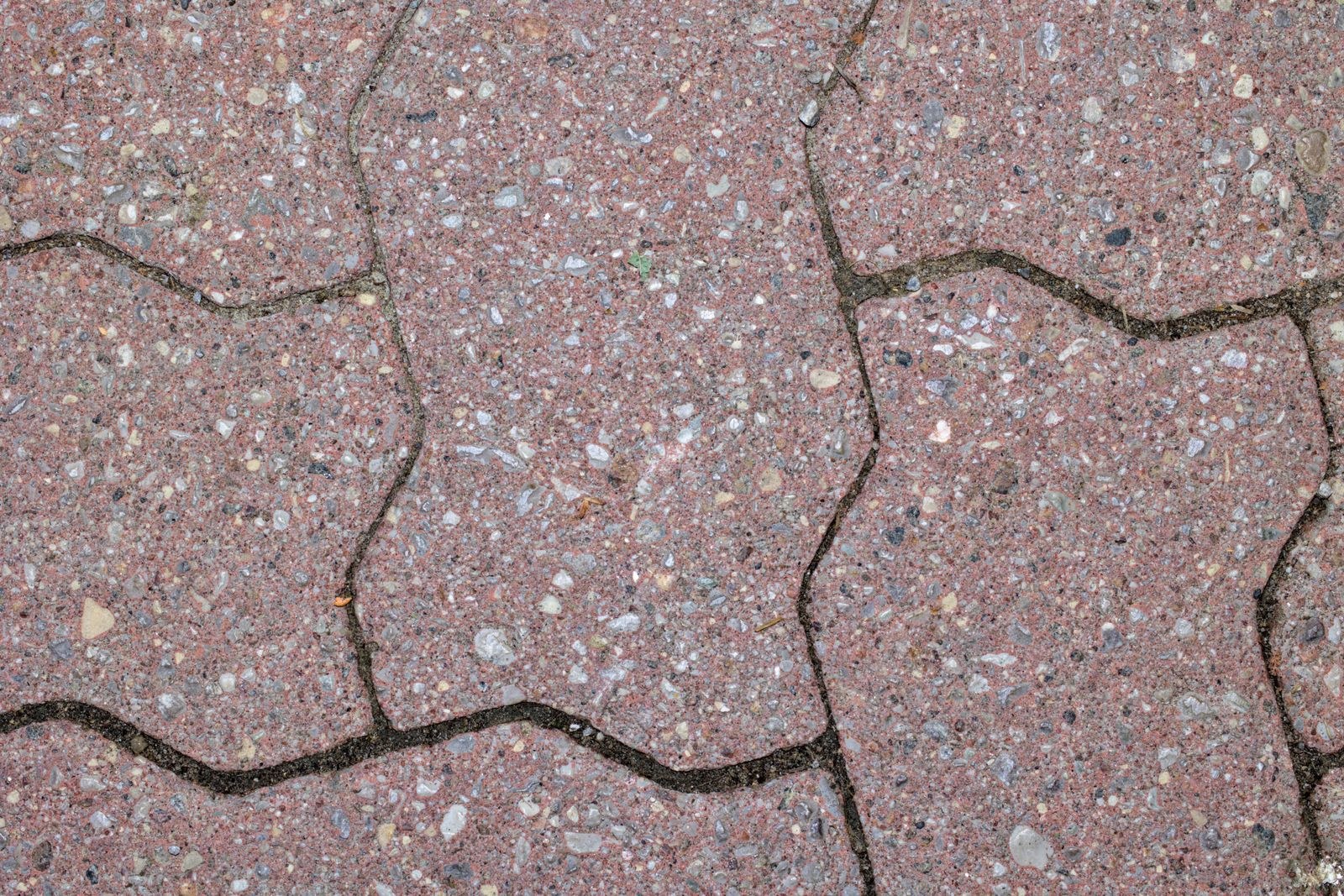
Pavers are individual units, usually concrete, clay brick, or natural stone, laid one at a time over a compacted gravel base and a thin bed of sand. The joints between them get filled with polymeric sand, which hardens and locks the surface together while still letting each unit move a fraction on its own. That flexibility is the whole point. When the ground shifts or freezes, pavers flex instead of cracking.
Our complete guide to laying pavers walks through the base, the bedding layer, and the pattern choices in detail, and it is worth reading before you get quotes, because the base is where most paver jobs succeed or fail. Brick pavers deserve a closer look too if you like the classic look: our guide to brick paver patterns covers herringbone, basketweave, and running bond, and which pattern holds up best under cars.
Upfront Cost: What You Will Pay
This is where stamped concrete earns its reputation. Pouring one slab takes a crew two to three days. Laying pavers takes a week or more for the same area, because every unit gets placed, leveled, and compacted by hand. Labor is the real price driver on pavers, not the material.
Installed cost per square foot, by grade
| Surface and grade | Installed cost per sq ft |
|---|---|
| Stamped concrete, basic single pattern and color | $8–$15 |
| Stamped concrete, multi-color with borders | $12–$20 |
| Stamped concrete, custom or hand-detailed | $18–$28 |
| Concrete pavers, standard | $10–$18 |
| Clay brick pavers | $15–$25 |
| Natural stone pavers (travertine, bluestone) | $20–$40 |
Angi puts both materials at an average of about $12 per square foot, with stamped concrete ranging $8 to $28 and pavers $8 to $25, and notes that in many cases the two cost about the same to install. That average hides the spread, though. A basic stamped patio and a premium stone paver patio are not the same job, and comparing the cheapest stamped quote against the dearest paver quote tells you nothing.
What that means for real projects
| Project | Stamped concrete | Pavers |
|---|---|---|
| 400 sq ft patio, mid-grade | $4,800–$8,000 | $6,000–$10,000 |
| 600 sq ft driveway, mid-grade | $7,200–$12,000 | $9,000–$15,000 |
| 1,000 sq ft patio, premium | $18,000–$24,000 | $25,000–$35,000 |
The 1,000 square foot row comes from a San Diego contractor’s 2026 price breakdown, which found the upfront gap between basic stamped concrete and standard pavers runs roughly $6,000 to $12,000 at that size. On a small 200 square foot walkway, the gap might be a few hundred dollars and barely worth arguing over. On a big driveway, it is the price of a used car.
What Pushes the Price Up or Down
Two quotes for the “same” patio can land thousands apart, and usually both are honest. The difference is scope.
| Price driver | How it moves the cost |
|---|---|
| Pattern complexity | One stamp pattern in one color is the base price. Multiple colors, borders, and hand-detailed medallions push stamped concrete toward paver prices. |
| Base and site prep | A paver job needs 6 to 8 inches of compacted base. Bad soil, a slope, or poor access adds excavation and hauling on either material. |
| Demolition | Tearing out an old slab or driveway adds $2 to $5 per square foot before the new surface starts. |
| Drainage and grading | Water has to go somewhere. Re-grading, a drain, or a dry well is a separate line item and skipping it causes the failures that cost real money later. |
| Region and season | Labor rates vary widely by market, and concrete crews charge more in peak season. Get three quotes and compare the scope line by line, not just the total. |
| Sealer and finish | Stamped concrete quotes should include the initial sealing. If one quote leaves it out, it is not actually cheaper. |
One honest warning: a bid 30 percent below the others is not a bargain. That gap is coming out of the base material, the concrete mix, or the sealer, and you will pay for it in year three.
The 10-Year Math: Where the Gap Closes
Install day is the wrong place to stop comparing. A surface you live with for decades has a running cost, and the two materials run very different tabs.
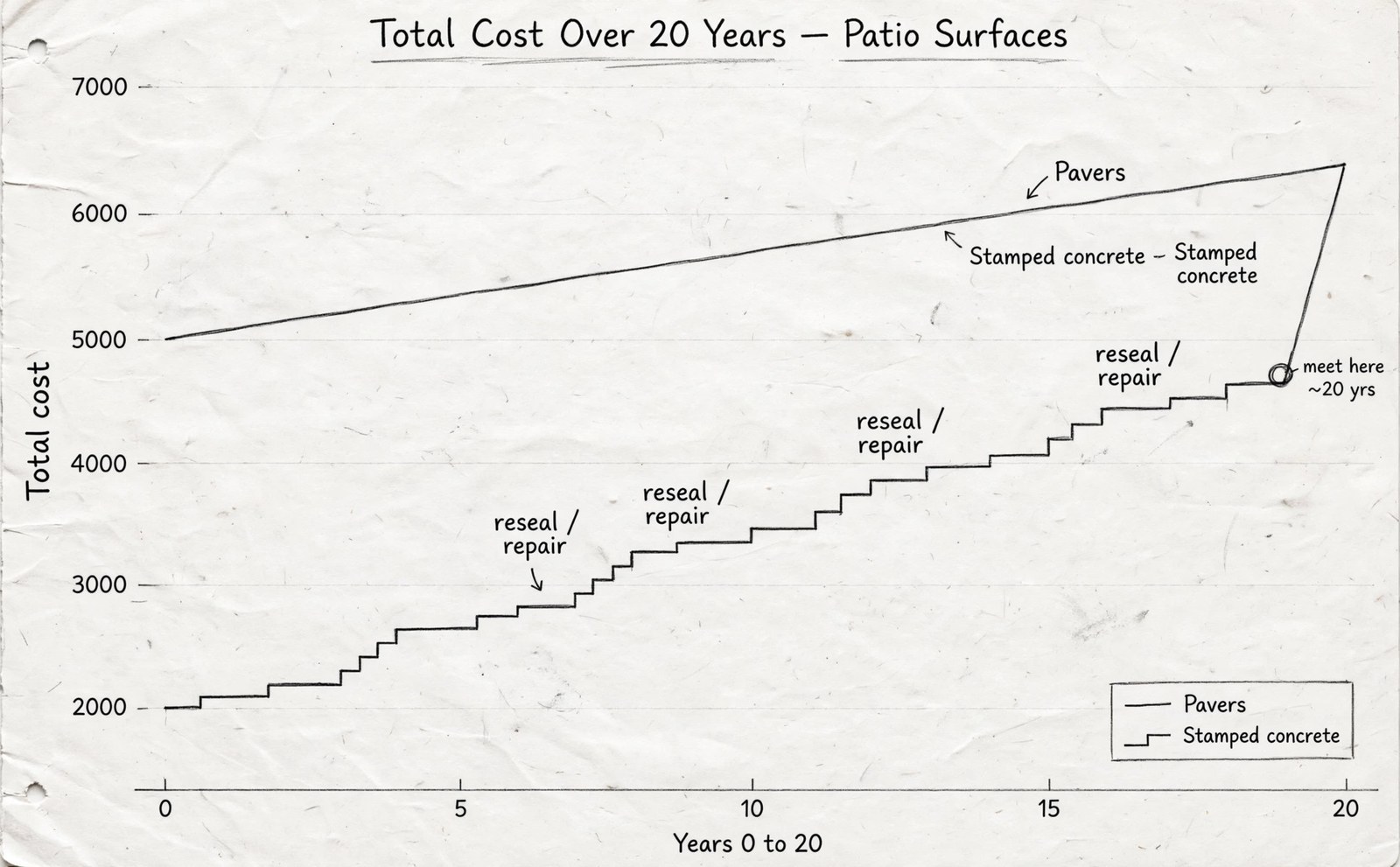
Stamped concrete lives or dies by its sealer. Concrete Network notes that most contractors recommend resealing every 2 to 5 years, with harsh freeze-thaw climates on the 2 to 3 year end of that range and mild climates stretching to 3 to 5 years. Resealing also restores the color, which fades as the sealer wears. Skip it and the surface turns dull, soaks up stains, and cracks sooner.
Pavers ask for less. The joints need fresh polymeric sand every 3 to 5 years, and a settled area occasionally needs lifting and re-leveling. There is no sealer schedule to keep, unless you choose to seal pavers for color, which is optional.
10-year total for a 400 sq ft patio, mid-grade (estimates)
| Cost over 10 years | Stamped concrete | Pavers |
|---|---|---|
| Install | $4,800–$8,000 | $6,000–$10,000 |
| Resealing (3–4 rounds at $1–$2 per sq ft) | $1,200–$3,200 | $0 (optional) |
| Joint sand refresh (2 rounds) | $0 | $300–$800 |
| Crack or patch repair allowance | $300–$1,500 | $150–$400 (reset a few units) |
| 10-year total | $6,300–$12,700 | $6,450–$11,200 |
These are planning estimates built from published per-square-foot rates, not quotes, and your climate and habits move them. But the shape of the answer is consistent across the guides I read: stamped concrete starts cheaper, pavers catch up somewhere between year 10 and year 20, and after that pavers pull ahead because they keep going while a stamped slab ages out. A San Diego contractor’s 2026 breakdown reached the same conclusion on a 1,000 square foot patio, putting the 10-year total cost of ownership at nearly identical figures for both materials once resealing and crack repairs were counted.
Repairs: The Difference That Matters Most
If there is one section to read twice, it is this one. Repairs are where the two materials stop looking alike.
A cracked stamped slab needs a professional. The crew cuts out the damaged section or patches it, then tries to match a color that has been fading in the sun for years. Angi is blunt about this: matching colors during repairs is difficult, and the patch usually stays visible. A hairline crack can be filled and sealed, but a settled or heaved section means breaking concrete out and pouring again.
A paver repair is a Saturday job. You pry up the damaged units, fix the base underneath, and drop in replacements. Spare pavers from the original batch match perfectly, which is why every good installer tells you to keep a few extras. If a pipe runs under the patio and needs work, pavers lift out and go back. Stamped concrete gets a saw cut and a scar.
That repairability is also why pavers suit driveways. Cars load the same wheel tracks thousands of times. A paver driveway settles in those tracks eventually, and the fix is lifting a patch, adding bedding sand, and relaying it. A stamped driveway that settles cracks, and the fix costs far more.
None of this means stamped concrete is fragile. A well built slab handles normal foot traffic and patio furniture for decades. It means the repair bill, when it comes, is bigger and uglier.
How Long Each One Lasts
Angi puts the lifespan of stamped concrete at about 25 years and pavers at 50 years or more with proper maintenance. Other guides land in the same area: 25 to 30 years for stamped, 30 to 50-plus for pavers. The gap comes from the same structural difference. A slab is one piece, so one failure shows everywhere. Pavers are hundreds of pieces, so failures stay local.
Climate tilts the answer. Freeze-thaw cycles are the hardest test for any outdoor surface, because water gets into tiny openings, freezes, expands, and pries things apart. Pavers flex through that cycle. A stamped slab needs a good mix, proper air entrainment, control joints, and a sealer kept up to date, and even then it is more exposed. In hot, stable climates the lifespan gap shrinks a lot.
A few day-to-day differences worth knowing:
- Weeds. Stamped concrete wins here. A continuous slab gives weeds nowhere to grow. Pavers rely on polymeric sand in the joints, and if the sand washes out, weeds move in. Keeping up with joint sand is the main recurring chore on a paver surface.
- Slip. A sealed stamped surface can get slick when wet, especially with a glossy sealer. Ask for a non-slip additive in the sealer if the surface sits by a pool or on a slope. Pavers are naturally textured and grip better in the wet.
- Heat. Both get hot in direct sun, and dark colors get hotter. Light colors help more than the material choice does.
- Stains. Oil and rust stain both. Stamped concrete hides stains worse once the sealer wears thin, because the stain soaks into the slab. A stained paver just gets swapped out.
Keeping a stamped slab clean is simple work: sweep it, wash it with a garden hose or a low-pressure wash, and reseal on schedule. Our concrete cleaning guide covers the washing side, including the pressure settings that clean without chewing up the surface. If a crack does show up, our concrete crack repair guide explains which cracks are cosmetic, which ones need attention, and when to call a pro.
Looks, Curb Appeal, and Resale
Stamped concrete photographs beautifully on day one. The patterns are crisp, the colors are rich, and from a few steps back it genuinely reads as stone or brick. Up close, the pattern repeats in a way real stone never does, and the control joints cut across the design. Most visitors never notice. You will, after a year.
Pavers look like what they are: individual pieces of stone, brick, or concrete. The color runs all the way through each unit instead of sitting on the surface, so it holds up better over time. The pattern options are wider, and a border course in a contrasting color gives a finished look that stamped concrete copies but never quite matches.
On resale, buyers treat both as a plus over plain concrete or bare dirt, and appraisers in some markets value pavers higher. That is a soft advantage, not a guarantee, and it matters most on a driveway, which buyers see first. A stained, cracked stamped driveway hurts curb appeal. A clean paver driveway helps it. The condition of the surface matters more than which one you picked.
Patio, Driveway, or Pool Deck: Which Wins Where
| Application | Better pick | Why |
|---|---|---|
| Small patio, tight budget | Stamped concrete | Lowest cost per square foot, fast install, and the surface is easy to live with |
| Large patio, staying 15+ years | Pavers | The long-run math and lifespan favor pavers once you pass a decade |
| Driveway | Pavers | Wheel-track settling is fixable unit by unit; a cracked slab is not |
| Pool deck | Pavers | Better wet traction and no glossy sealer to get slick |
| Walkway or front path | Either | Small area, so the price gap is small; pick the look you prefer |
| Over an existing slab | Pavers (overlay) | Pavers can go over sound concrete, which saves demolition |
| Over buried utilities | Pavers | Lift, repair the pipe, relay. A slab means a saw cut and a scar |
That overlay row is worth a pause. If you already have a sound concrete slab, laying pavers over concrete can skip the demolition bill entirely. Our guide to pavers over concrete explains when an overlay works and when the old slab is too far gone to build on. And if your project is a driveway, our concrete driveway maintenance guide covers what the surface underneath needs to stay sound in the first place.
The Decision in One Minute
Choose stamped concrete if:
- Your budget is fixed and the upfront price is the deciding factor
- The project is a patio or walkway, not a driveway
- You plan to sell within 5 to 10 years
- You will keep up with resealing every 2 to 3 years
- You love a specific stone or slate look and want it fast
Choose pavers if:
- You plan to stay 15 years or longer
- The project is a driveway or a pool deck
- You live where winters freeze and thaw hard
- You want repairs to be cheap, invisible, and sometimes DIY
- There are buried pipes or cables under the area
If you are still torn, get three quotes for each material on your actual project, with the same scope, and compare the 10-year totals, not the first-day prices. The quotes will tell you more than any guide can.
DIY or Hire a Pro
Stamped concrete is not a DIY job. The stamping window is short: the concrete has to be firm enough to hold an imprint and soft enough to take one, and that window can close in under an hour on a warm day. The stamps are heavy, the color work takes practice, and a mistake is permanent. Hire a crew with stamped work in their portfolio, and ask to see a patio they poured at least three years ago.
Pavers are DIY-able for a small patio if you are patient and own a plate compactor or can rent one. The work is slow rather than skilled, and mistakes can be undone one unit at a time. A driveway is different: the base has to carry cars, the compaction has to be right, and the pattern has to lock. For driveways, hire a pro, or at least hire one for the base.
Safety notes, whichever route you take: wet concrete is caustic and burns skin, so wear gloves, boots, and eye protection around a pour. Cutting pavers or concrete throws silica dust, so wear a proper respirator and cut wet where you can. Keep kids and pets off a fresh slab for at least a few days, and off sealer until it has cured.
Frequently Asked Questions
Usually, yes, upfront. Stamped concrete typically costs $8 to $20 per square foot installed, while pavers run $10 to $30. But resealing every 2 to 3 years and the higher cost of crack repairs close the gap over 10 to 20 years, so pavers often cost the same or less over the full life of the surface.
On a mid-grade patio, expect to save roughly 20 to 40 percent upfront. On a 400 square foot patio that works out to about $1,200 to $2,000. On a 1,000 square foot patio, the gap runs $6,000 to $12,000. The saving shrinks on small projects and grows on big ones.
Yes. Stamped concrete is a single slab, so it cracks as the ground moves and the concrete shrinks. Pavers are individual units that flex with small movements instead of cracking. Control joints and a good base reduce cracking in stamped concrete, but they do not eliminate it.
Stamped concrete lasts about 25 to 30 years with regular resealing. Pavers last 30 to 50 years or more with basic maintenance. The difference comes down to repairs: a paver surface can be fixed one unit at a time for decades, while a slab eventually reaches a point where patching stops making sense.
Every 2 to 3 years in harsh climates with freeze-thaw cycles, and every 3 to 5 years in mild climates. Concrete Network gives the general range as 2 to 5 years depending on the sealer, traffic, and exposure. The water-bead test tells you when it is due: sprinkle water on the surface, and if it soaks in instead of beading, it is time.
They are if you plan to stay put, the surface is a driveway, or you live in a freeze-thaw climate. The extra money buys a longer life, cheaper repairs, and a surface that can be fixed invisibly. If you plan to sell within a few years, stamped concrete usually gives you the better return on the money.
Yes, if the stamped slab is sound, level, and draining well. It works the same way as a paver overlay on plain concrete. If the slab is cracked, heaved, or holding water, fix the slab first or tear it out, because pavers laid over a failing base fail with it.
Sources
- Angi compares stamped concrete and pavers on cost, lifespan, maintenance, and repairs, and puts both at an average of about $12 per square foot installed.
- Install-It-Direct publishes 2026 San Diego installed costs for stamped concrete and pavers, plus a 10-year total cost comparison.
- Concrete Network explains how often to reseal concrete and the signs that resealing is due.
- FixUpFirst lists 2026 patio installation costs by material, including stamped concrete at $10–$20 and pavers at $10–$25 per square foot.
- The Concrete Calculator’s patio cost guide breaks down stamped concrete finishes and compares them with basic pavers.
- Hunker compares stamped concrete and pavers on durability, lifespan, and cost.
- The Honest Reviewers compare pavers and concrete on cost, lifespan, and repairability.
Last updated: November 6, 2026

2 Comments
Pingback: Can You Put Pavers Over Concrete? Overlay Guide
Pingback: How to Lay Pavers: Complete DIY Installation Guide - Home Exterior Lab