

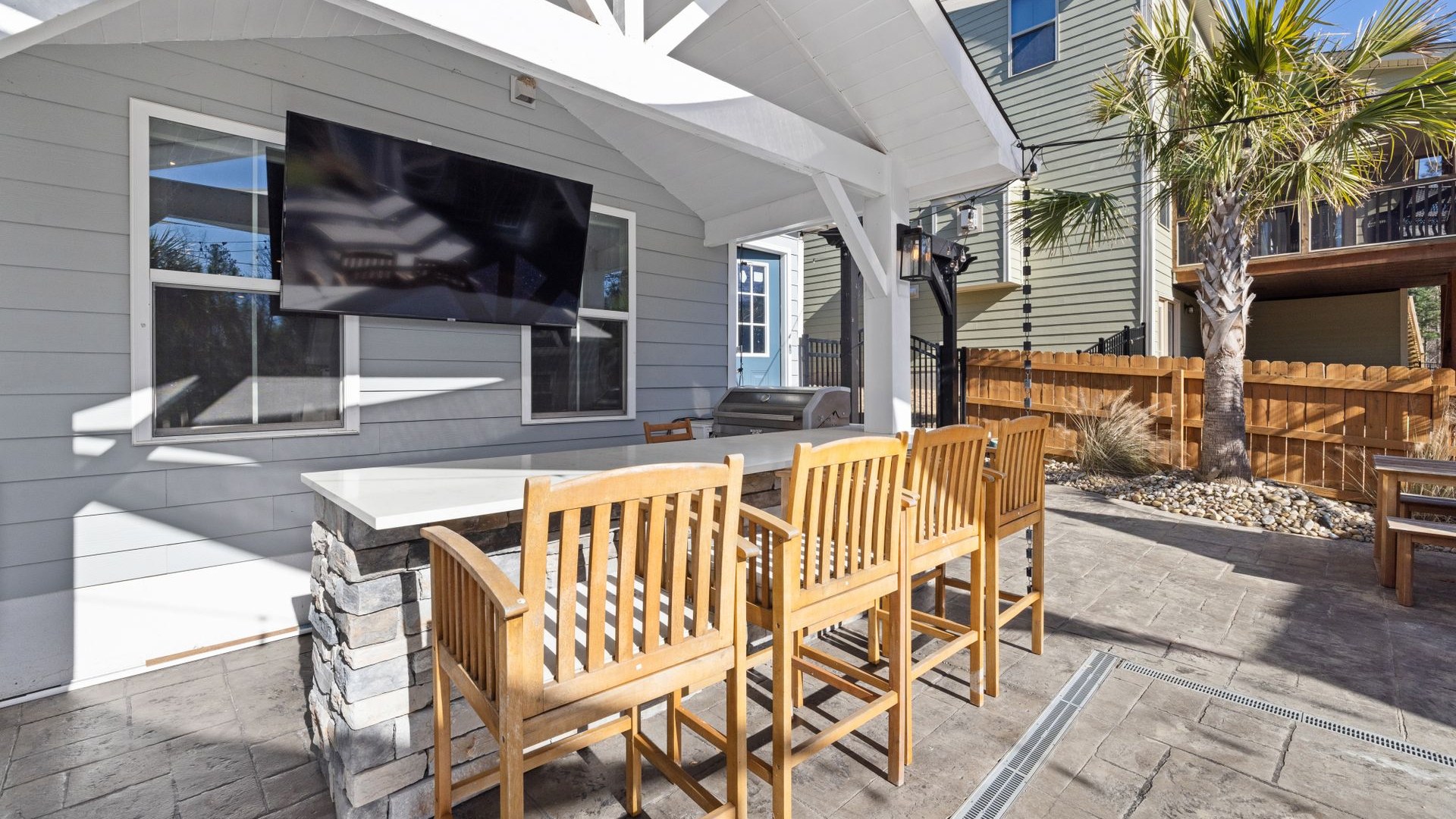
A paver patio is an outdoor floor made of individual units, concrete, clay brick, or natural stone, set side by side on a compacted base with sand or fine gravel in the joints. The pattern sets the mood, the color ties the patio to the house, and one good border can make a modest paver look like a planned design. These patio pavers ideas stay on the design side: patterns, materials, colors, borders, and layouts.
Last updated: November 20, 2026
Three things to remember. Pick the pattern by how the patio gets used, not by which sample looks prettiest in your hand. Match the color to the house, not to the furniture. And always give the patio a border: it is the cheapest design upgrade in this whole project.
Before you choose a pattern, it helps to start with planning the patio itself: its size, spot, materials, and base, so the design you pick actually fits how you will use it. If the look you want is modern specifically, our guide to designing a modern patio covers zones, materials, shade, and lighting beyond the patterns here. If shade is part of the layout, compare covered patio structures before the paver field and post positions are set.
At a glance
- Seven patterns covered: herringbone, running bond, basketweave, stack bond, ashlar, and more, each with its own look and strength.
- Materials: concrete, clay brick, natural stone, and porcelain.
- Three rules: pick the pattern by how the patio gets used, match the color to the house rather than the furniture, and always give the patio a border.
Contents
- planning the patio itself
- Pick a pattern with the pattern picker
- Seven patterns, up close
- Materials: what each one brings to the look
- Color ideas that match the house
- Borders and edging
- Small patio ideas
- Modern or rustic?
- Pair the pavers with the rest of the yard
- Permeable pavers and planted joints
- What ages well, and what looks dated
- What it costs, in plain words
- Keeping the look
- Design is yours. The base is where a pro earns the fee.
- Frequently asked questions
- Sources
Start with how the patio gets used
The best paver patio ideas start with the furniture, not the paver sample. A four-chair dining table needs about 10 by 10 feet once chairs pull out, six chairs want closer to 12 by 14 feet, and a lounge pair fits in 8 by 10 feet while a sectional near a fire feature needs nearer 12 by 16 feet. Those are the rough footprints Re-Design works from in its paver patio guide, and they match what I have seen in real yards: patios fail when the furniture plan comes last.
So sketch the zones before you shop: table, lounge corner, grill. No pattern fixes a patio that is two feet too narrow. Decide too whether the patio is one room or several. A dining zone and a lounge zone, split by a change of pattern or color, feel like two rooms. Techo-Bloc calls this defining your spaces, and a contrasting paver around the dining area works like a rug, marking the zone without a wall.
Pick a pattern with the pattern picker
Of all the patio pavers ideas here, the pattern matters most. A paver pattern is the layout the individual units are set in, and it does two jobs at once: it sets the look of the patio, and it decides how the surface handles weight and movement. Herringbone locks each paver against its neighbors on two axes, which is why Belgard calls the 45-degree herringbone the strongest and most traditional option for surfaces that take traffic. Running bond is calmer and cheaper to lay, and the right pick depends on the patio, not on a ranking.
| Your patio | Best patterns | Why it works | Watch for |
|---|---|---|---|
| Small square patio, under about 12 by 12 feet | Basketweave, 45-degree herringbone | The small field shows off the detail | Keep the chairs simple |
| Long narrow patio or side yard | Running bond, stack bond | Long joints pull the eye along the space | Run joints toward the destination |
| Large open patio, dining plus lounge | Ashlar or modular, herringbone with a border | Mixed sizes stop a big field looking flat | One pattern per zone |
| Dining zone, daily use | 45-degree or 90-degree herringbone | The interlock resists chairs dragged across it | More edge cutting, so budget for waste |
| Traditional or colonial house | Basketweave, running bond in brick | Both read as old-house details | Basketweave needs a true 2 to 1 paver ratio |
| Modern house, clean lines | Stack bond, large-format grid | Straight lines echo the architecture | Shows every spacing error; base must be flat |
| Curved or round patio | Circular or fan, ashlar | Radial layouts suit curves | A circle kit keeps rings even |
Two rules sit behind the table. First, never run three patterns on one patio: two work when they mark genuinely different zones, split by a plain band, while three usually reads as leftover stock. Second, the pattern should support the furniture, not compete with it.

Seven patterns, up close
Herringbone
The strongest common layout: no joint line runs straight across the surface, so each paver locks its neighbors, though every edge needs angled cuts.
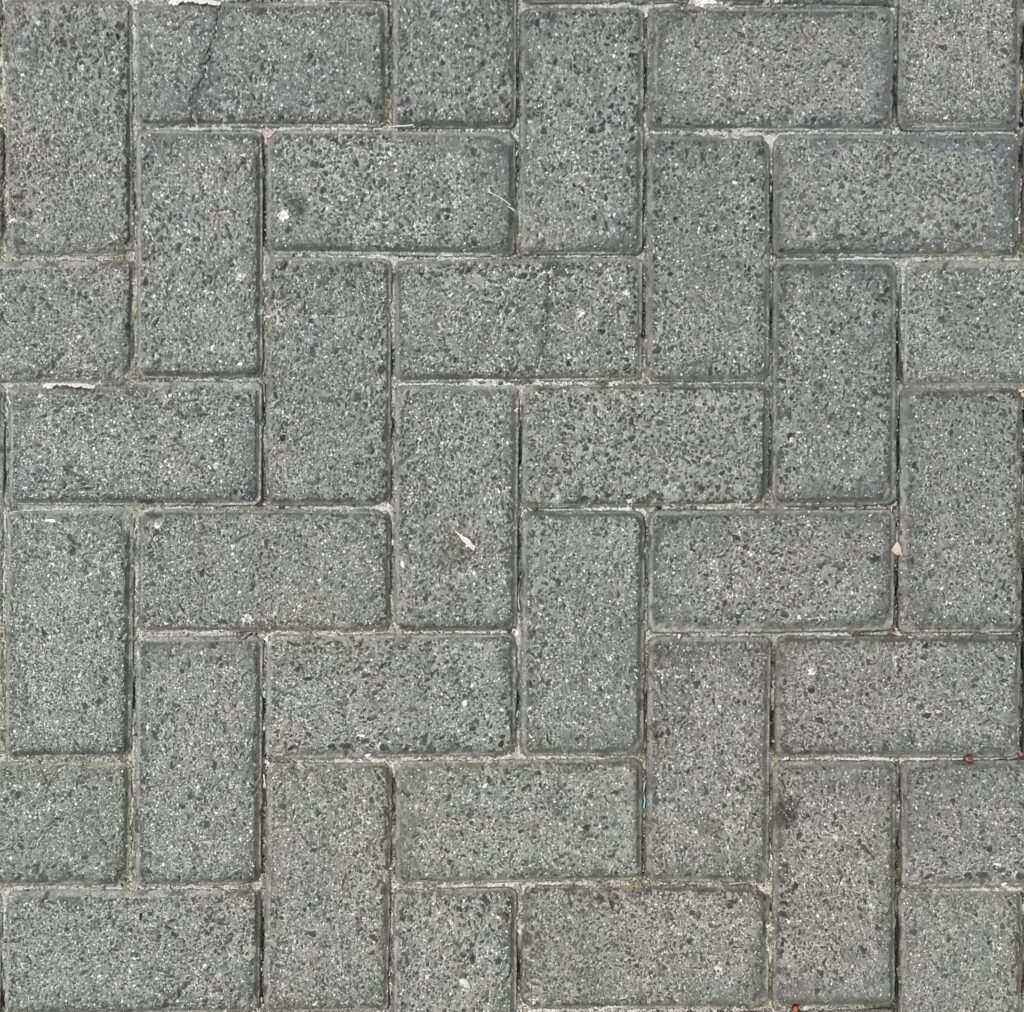
Running bond
The simplest and cheapest to lay, but its straight joint lines can creep under heavy load, so it belongs on patios and walkways, not where cars turn.
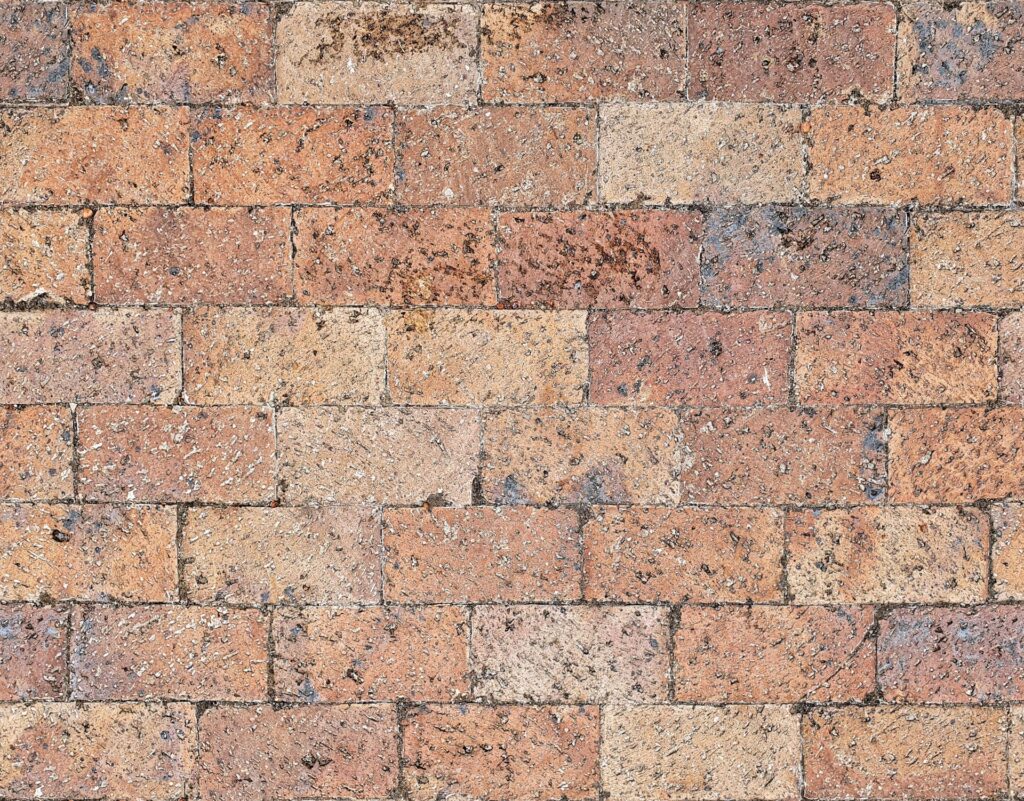
Basketweave
A traditional woven look for cottages and small courtyards, kept to foot traffic, needing pavers in a true 2 to 1 ratio.
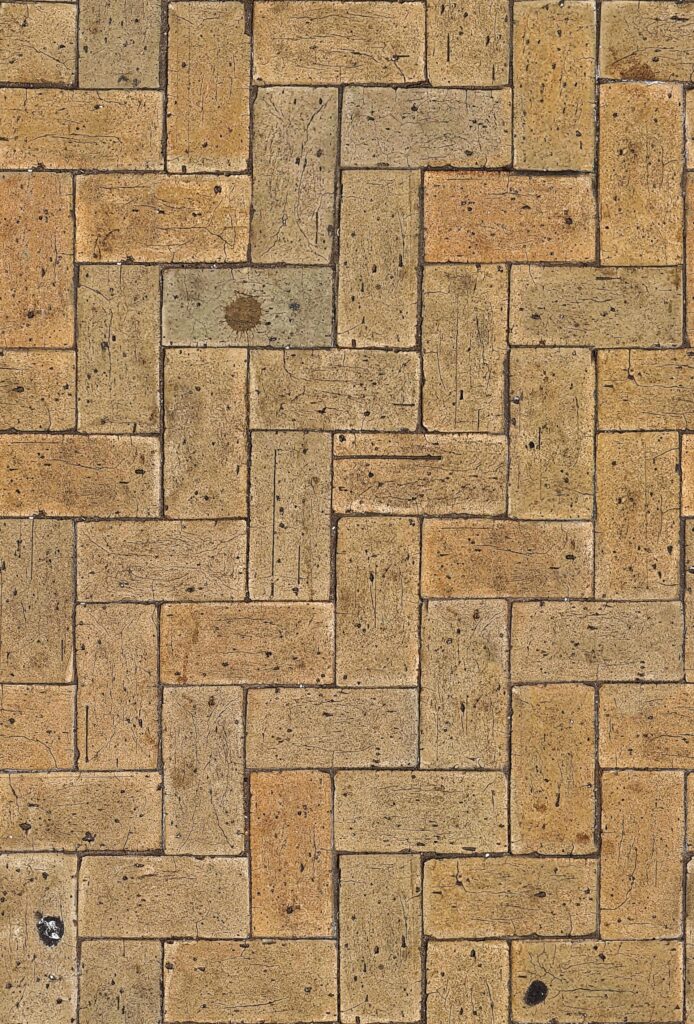
Stack bond
The most modern-looking grid, best with large-format slabs, but it shows every spacing error, so the base must be flat.
Ashlar, or random modular
Mixed sizes in a repeating module that reads as natural stone; Belgard notes it is gaining popularity and handles heavier traffic too.
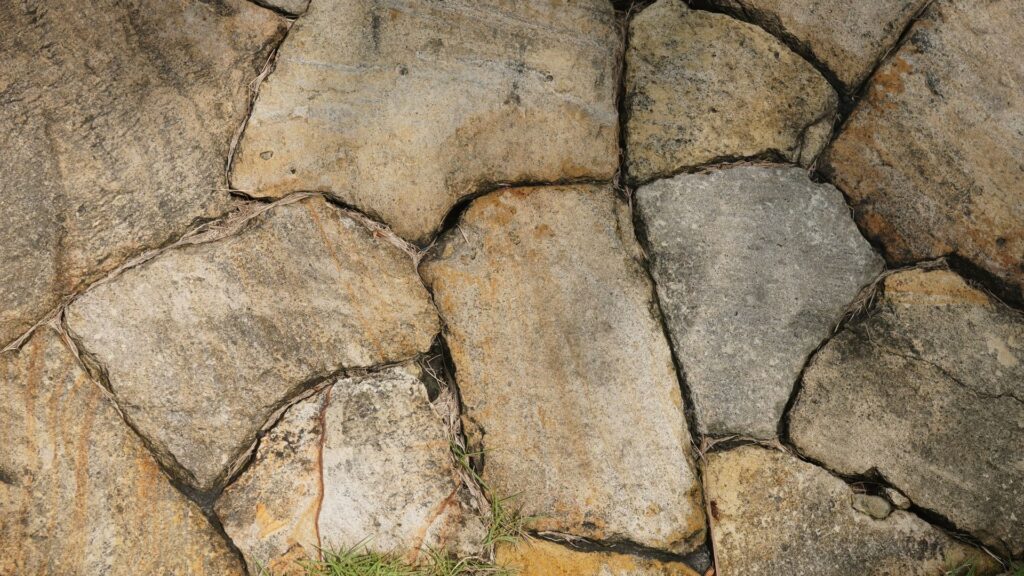
Checkerboard
Two colors in a grid, best in restrained palettes: three shades of gray look calm, while high-contrast black and white feels loud after a year.
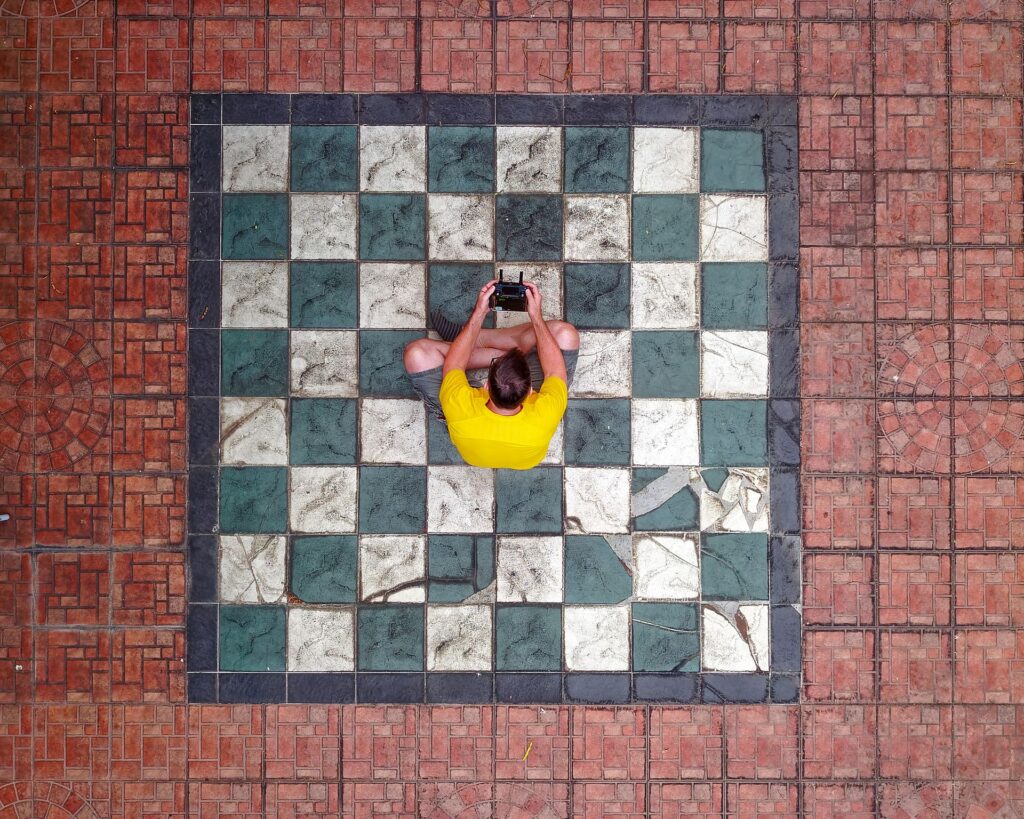
Circular, or fan
Pavers radiating from a center point, usually around a fire pit; a classic focal point that needs a circle kit or careful cutting.
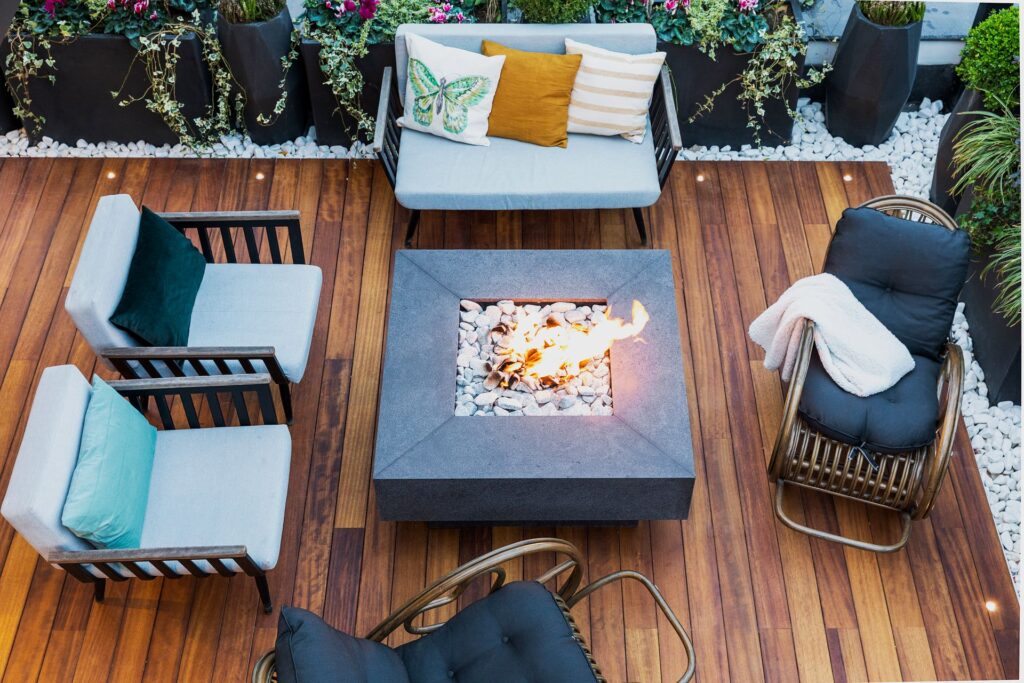
Materials: what each one brings to the look
Material is the second big choice, and it matters as much as pattern. Concrete pavers are the workhorse, molded in many shapes, colors, and textures at the friendliest price. Clay brick brings warmth and a patina that improves with age, natural stone brings variation no mold can copy, and porcelain brings a crisp, modern face that needs a solid base.
| Material | Look and feel | Best for | Upkeep notes |
|---|---|---|---|
| Concrete pavers | Huge range of shapes, colors, textures | Most patios, most budgets, most house styles | Reseal every few years; efflorescence fades |
| Clay brick | Warm reds and earth tones, classic patina | Traditional, colonial, cottage houses | Tough and colorfast; moss in damp shade |
| Travertine | Ivory to gold, soft and warm | Pool decks, sunny patios, Mediterranean houses | Porous, so a penetrating sealer helps |
| Bluestone | Blue-gray, crisp and cool | Modern and traditional houses; formal patios | Dense and durable; dark tones show dust |
| Limestone | Muted beige and soft pink, quiet | Contemporary layouts, light-colored yards | Softer stone, avoid harsh acidic cleaners |
| Flagstone | Irregular shapes, earthy browns to grays | Rustic and cottage yards | Irregular joints need attention; suits planted joints |
| Porcelain slabs | Large, smooth, precise | Ultra-modern patios | Needs a rigid base; chips are hard to hide |
If the budget only stretches to one upgrade, spend it on the material you will touch and see every day, not on a rare shape. A well-made concrete paver in the right color beats a premium stone in the wrong color every time. One honest alternative: stamped concrete can mimic pavers at a lower installed cost. The trade is repairability, since a cracked paver swaps out in minutes while stamped concrete needs patching, and our comparison of stamped concrete that mimics pavers lays out that trade in full.
Color ideas that match the house
Color is where most paver patios go wrong, and the fix is simple: match the paver to the house, not to the catalog photo. Belgard notes that current trends lean toward paver colors that tie in with the roof, either in the main field or in the border, and that is a good rule because the roof is the biggest color block on the property. A gray roof pulls toward gray and charcoal pavers, a brown roof toward tan and warm brown, and red brick toward warm tans and creams, not more red.
| House style and color | Paver colors that work | Border idea |
|---|---|---|
| Gray or white siding, gray roof | Cool grays, charcoal, bluestone tones | Charcoal soldier course |
| Warm brick, brown roof | Tan, buff, chestnut brown, warm cream | Dark brown border |
| Red brick house | Warm tan, cream, light gray blends | Cream or gray border, not red |
| Blue or blue-gray siding | Gray blends with a warm undertone | Charcoal or navy-gray border |
| Stucco, Mediterranean or coastal | Travertine ivory, sand, warm beige | Terracotta or merlot accent |
| Modern, black windows and trim | Large-format light gray, pale concrete | Onyx black border, used sparingly |
Three practical notes. First, joint sand color matters: tan pavers with tan joints blur into one beige mat, while charcoal pavers with bright white sand can look striped, so keep the joint color within a shade or two of the paver body. Second, dark pavers get hot in full sun, so save onyx black for borders and accents. Third, always look at samples outside, in morning, noon, and damp light: gray can look blue beside warm brick. That viewing habit comes from Re-Design, and it has saved more patios than any pattern choice. Warm tones are having a moment, too: Techo-Bloc’s current mosaic guide leans into warm browns, chestnut, merlot, and cream.
Borders and edging
A border is a single course of pavers around the edge of the patio, usually laid in a different color, a different pattern, or both. The classic version is the soldier course, a row of rectangular pavers set with their long side facing out, running around the perimeter like a frame. It is the difference between a paved area and a paved area that looks designed, and it hides the cut edges of a field pattern, which is where a patio without a border looks roughest.
Belgard’s guidance is to build the border from the same paver in a different color or laying pattern, or from a contrasting shape, texture, and color entirely. A double border suits a large patio and a formal house. On a budget, the border is where to spend first: a 6 to 8 inch border can make inexpensive concrete pavers look intentional. Plan the border before the field, because the border sets the finished size and the field fills what is left.
Small patio ideas
A small patio is not a failed patio. Use larger pavers, not smaller ones: a 24 by 24 inch slab reads calmer than a field of small units, because fewer joints mean less visual noise. Run the pattern on a diagonal, or angle the field 45 degrees to the house, which makes the eye travel farther. Keep to one pattern and one main color, with the interest coming from a single border or accent.
Light colors help, and so does a clean edge. A pale gray or warm cream field with a charcoal border looks bigger than a dark field with no border, because the border defines the room while the light field reflects the sky. Planted joints, low thyme or corsican mint between wide-set slabs, soften the edges. And keep the furniture light: two slim lounge chairs and a small table fit a 10 by 10 foot patio, while a bulky sectional swallows it. These small patio pavers ideas all point the same way: fewer elements, bigger units, and one clear border.
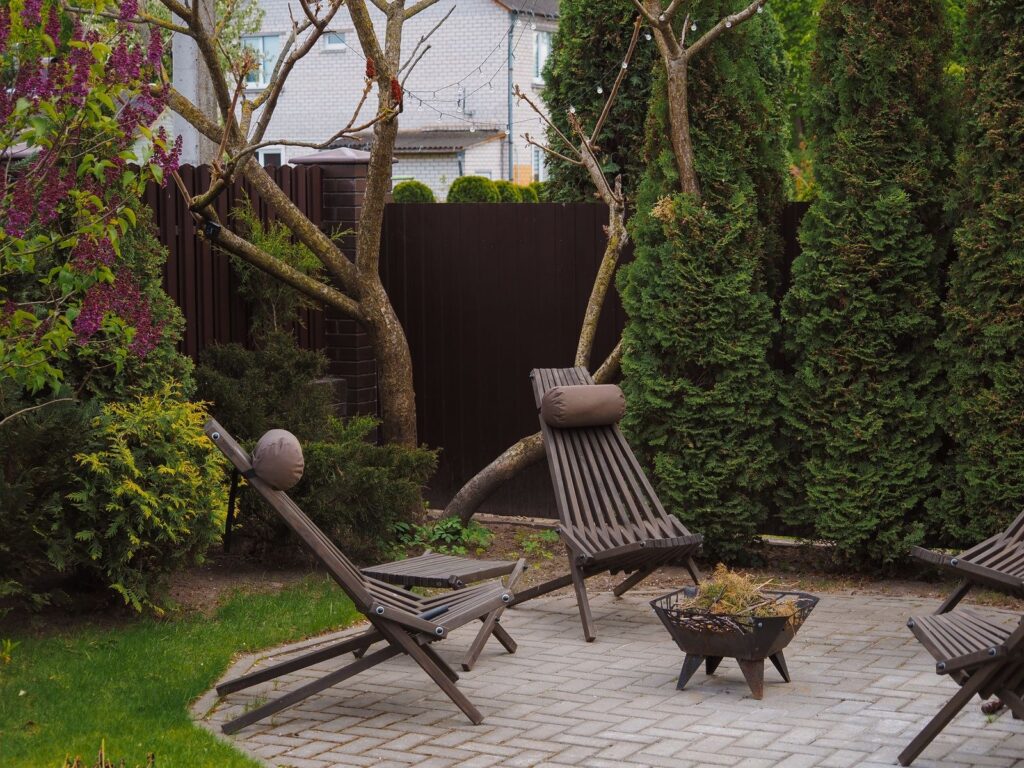
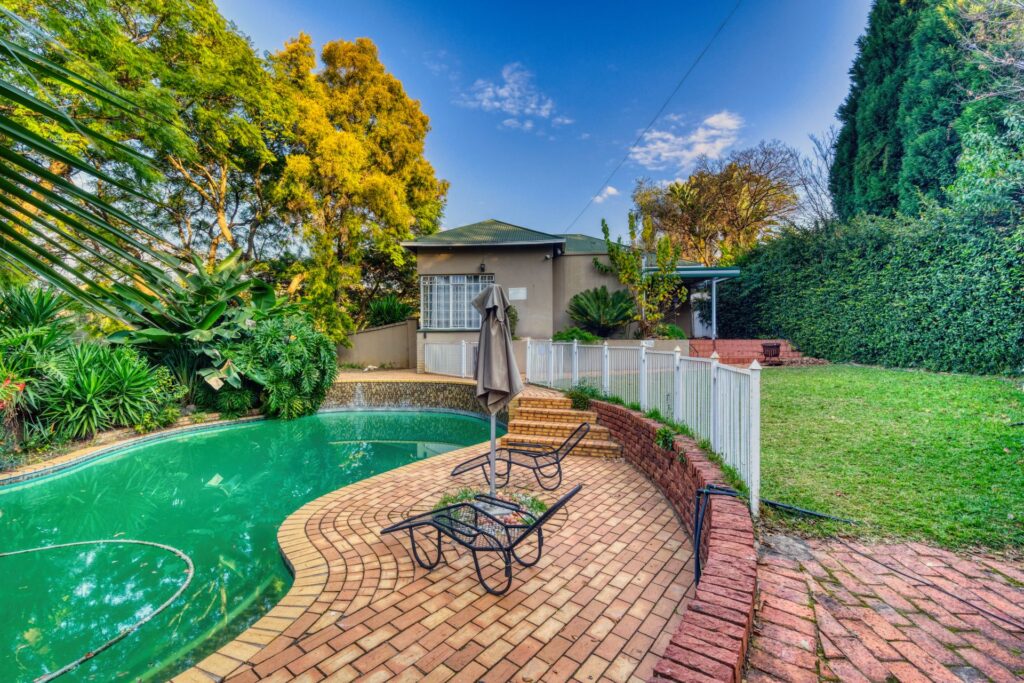
The photo above shows the idea in one frame: a small curved paver patio, lounge chairs, and a fire bowl. If your yard is tight, copy the shape.
Modern or rustic?
Most paver patios land in one of two directions, and picking one early saves a lot of second-guessing. The modern direction uses large-format slabs, stack bond or a large grid, a restrained palette of grays, and a single strong border, with low, simple furniture. It suits houses with clean lines and black window frames, and it ages well because there is so little in it to date. Techo-Bloc’s 2026 ideas lean this way in places: checkerboard in three shades of gray, and small pavers used to draw a precise motif on a small patio. The common thread is restraint: one idea, done cleanly.
The rustic direction uses brick or natural stone, herringbone or basketweave, warm tans and reds, and planting between the joints. It suits cottages, farmhouses, and colonial houses, and it forgives wear better, because a little moss or a softened edge reads as character, not damage. Neither direction is better. The wrong choice is mixing them without a plan: a rustic brick basketweave next to ultra-modern black furniture, or a crisp porcelain grid under a wrought-iron bistro set. Pick the direction that matches the house, then let the furniture follow.
Pair the pavers with the rest of the yard
A patio rarely stands alone. A fire pit wants a circular or square zone of its own, with enough room for chairs to pull back without their legs leaving the pavers. An outdoor kitchen wants a hard, level, grease-tolerant surface, which usually means concrete or porcelain rather than soft limestone. A dining table wants a flat field with tight joints, so chair legs do not catch, and a clear walking line from the back door to the grill, at least three feet wide. Use a contrasting paver to mark the dining area, like a rug under the table, and a quieter field for the lounge corner. Think about shade before the pavers go down, too: a pergola planned later still needs its posts to land somewhere, and a post landing in the middle of a herringbone field is a headache that a little planning avoids. A round paver inlay or a circle kit under the fire pit gives the whole patio a center. Keep the chairs on the pavers, not half on and half off, and leave room for people to walk behind a seated person. That circulation space is what separates a patio that photographs well from a patio that hosts well.
The same thinking applies at the front of the house, where our front porch pavers ideas show how to carry one pattern from the porch to the walkway.
Permeable pavers and planted joints
Permeable pavers are a design choice as much as a drainage choice. The University of Maryland Extension defines them plainly: permeable pavers let water filter through open voids in the surface down to a washed gravel reservoir, where it slowly soaks into the soil or leaves through an underdrain, treating water quality along the way. On a patio, that means no puddles after a storm and less runoff heading for the neighbor’s yard. They look much like regular pavers, with slightly wider joints filled with small stone instead of sand. Belgard recommends sticking to ashlar or herringbone for permeable installs, because the wider joints give running bond and basketweave more room to shift. The joints can clog with silt, so a periodic sweep and rinse keep them draining, and check local rules first, since some towns require permeable surfaces on new patios.
Planted joints are the softer cousin: wide-set slabs with thyme, corsican mint, or another low groundcover between them turn a patio into a garden floor. They suit rustic and cottage yards, need sun and occasional trimming, and belong on a lounge patio, not under a dining table, where chair legs and dropped food make plants a nuisance.
What ages well, and what looks dated
This is the part the catalogs skip, so here is my honest read after years of watching patios age. What ages well: warm gray and tan blends that sit quietly against the house; classic red brick in herringbone or running bond; large-format grids with a single border; natural stone that gains a patina instead of fading; and simple two-color palettes where the border does the talking. These choices look good in year one and year ten, because they lean on proportion and material, not novelty.
What dates fast: high-contrast black-and-white checkerboard across a whole patio; busy multi-color blends with four or five tones fighting in one field; tiny pavers spread over a large patio, which looks fussy at scale; faux-wood pavers as the main field, which never quite fools the eye; and bright accent colors chosen from a screen instead of from the house. None of these are bad products. They are just loud choices, and loud choices age in public. The safest test I know is the five-year test: picture the patio in five years, with a faded cushion and a stained joint or two. If the design still looks calm, it will age well.
What it costs, in plain words
Nobody can quote your patio from a web page, and I will not invent numbers here. What I can do is lay out what drives the cost, so you can read a quote with open eyes. Material is the first driver: manufactured concrete pavers usually sit at the friendlier end, clay brick a step above, and natural stone and porcelain at the premium end, with the gap coming from quarrying, cutting, and transport. Pattern is the second driver: a 45-degree herringbone costs more in labor than running bond, because every edge needs an angled cut and the waste runs higher, and a circular layout costs more still. Size and shape come third: curves, circles, and inlays need more cutting than a straight rectangle. Borders, steps, and a seat wall add cost, but they also add the finished look, so they are usually money well spent. Finally, site conditions matter: a tight gate, a long carry from the truck, a slope that needs grading, or a base that needs extra depth all show up in the price. Get the design right before you get quotes, because changing the pattern after the base is in costs far more than changing it on paper. Once you have settled on a design, a paver patio cost calculator will price that design for your size and material. And when two quotes differ, ask what pattern, what paver, and what base depth each one assumes. A cheap quote on a thin base is not a bargain; it is a repair bill with a delay.
Keeping the look
A paver patio keeps its looks with modest care. Sweep it, rinse it, and pull weeds from the joints before they set seed. A sealer deepens the color and slows stains from grease and leaves; it is usually applied after the patio has cured for a couple of months, then refreshed every few years. Sealing is optional, but it is the closest thing to a refresh button a patio has, and our guide to sealing patio pavers walks through the timing and the product choice. For routine cleaning, including stains and efflorescence, our guide to cleaning patio pavers covers what works and what to avoid. The one habit that matters most is the simplest: do not let leaves sit wet on the pavers for weeks, because tannin stains are the hardest marks to lift.
Design is yours. The base is where a pro earns the fee.
Here is the honest split. Choosing the pattern, the material, the color, and the layout is your call, and it is the fun part. Any homeowner can do it well with a few samples and an afternoon of looking. The work under the pavers is different: the base depth, the compaction, the slope away from the house, and the edge restraint decide whether the patio stays flat for twenty years or starts rocking in two. A patio should shed water away from the house at a gentle fall, roughly an eighth to a quarter inch per foot, and that slope has to be built into the base, not wished into the pavers.
That is why I suggest splitting the job this way: design it yourself, then get a pro for the base and the laying unless the patio is small, flat, and simple. Our full guide to laying pavers covers the base, the bedding, and the joint sand, and our guide to building a whole patio from pavers takes the project end to end, including patterns and edge cuts. Curves, circles, or cuts around existing trees and steps are also pro territory, and our notes on cutting pavers to fit explain why those cuts are the hardest part of the job. A good installer will also tell you when your favorite pattern is wrong for your site, and that conversation is worth more than any sample board.
Frequently asked questions
For most patios, running bond or ashlar. Running bond is the simplest and cheapest to lay, and it suits narrow and rectangular patios. Ashlar suits large patios, since mixed sizes stop a big field looking flat. Herringbone is the strongest interlock, so pick it for a dining zone that takes daily chair traffic.
Cool grays, charcoal, and bluestone tones, with a charcoal border for definition. Match the paver to the roof color first, then to the siding. View samples outside in morning, noon, and damp light, since gray can look blue beside warm brick.
Large-format pavers, often 24 by 24 inches, with one pattern and one main color. Fewer joints mean less visual noise, so the space reads calmer and bigger. A diagonal layout or a 45-degree angle to the house helps too.
Sealing is optional but worth doing. A penetrating sealer deepens the color, slows stains from grease and leaves, and helps against efflorescence. Apply it after the patio has cured for a couple of months, then refresh it every few years.
Yes, when they mark genuinely different zones, such as a herringbone dining area and a running-bond lounge, split by a plain band. Three patterns on one patio usually look like leftover stock, so stop at two.
Permeable pavers let rain filter through wide joints into a gravel reservoir below, where it soaks into the soil or leaves through an underdrain. They stop puddles and cut runoff, and they suit wet yards or places where local rules limit hard surfaces. Use ashlar or herringbone, and keep the joints clear of silt.
