

A temporary fence is a freestanding, portable barrier made of linked panels, mesh, or barricades that marks off an area for weeks or months, then comes down without leaving post holes or concrete footings behind. Most jobs use galvanized steel chain-link panels, usually 6 feet high and 10 or 12 feet long, dropped into weighted feet and locked together with clamps. No digging, no concrete, no permanent change to the ground. That is the whole appeal: a real fence, on a rental clock.
Last updated: November 21, 2026

Three things to remember. Rent by the month, not by the day, because monthly rates run far cheaper per foot than daily ones. Match the fence to the job, since plastic mesh marks a line and steel panels guard a site, and mixing those two up is the most common mistake. And check your city before you order, because permits, heights, and sidewalk rules are local, and the rental company will not check them for you.
Contents
- What is a temporary fence?
- Types of temporary fences, compared
- Which fence for which job
- How much do temporary fences cost?
- Rent or buy: the break-even point
- How to install temporary fence panels
- Keeping a temporary fence upright in wind
- Permits, OSHA, and local rules
- Temporary fences around pools
- Where temporary fences get used
- DIY or hire a pro?
- Mistakes to avoid
- Frequently asked questions
- Sources
What is a temporary fence?
A temporary fence is a portable barrier system that secures an area for a limited time, usually days to months, without digging post holes or pouring concrete footings. The panels are freestanding and self-supporting, held upright by counter-weighted feet and joined with couplers or clamps that lock one panel to the next. When the job ends, the crew unclamps the panels, stacks them on a truck, and the ground looks much as it did before.
Five parts make up most systems. The panel is the fence itself, a steel frame filled with chain-link or welded wire mesh. The base, also called a foot or stand, is a heavy block, often concrete or recycled rubber, with slots the panel legs drop into. The coupler or clamp joins two panels at the top. The gate is a panel built to swing, sized for people or vehicles. And the ballast, usually sandbags or bolt-on braces, keeps the line standing when the wind picks up.
Standard panels run 6 feet high and 12 feet long, with 10-foot lengths common too, and 4-foot and 8-foot heights sold for shorter or taller jobs. I have watched a two-person crew fence a whole suburban lot in a morning with panels like these, and I have also seen a single homeowner ring a small renovation area in an afternoon. The speed is the point. A permanent fence takes days of digging and setting posts. A temporary one goes up as fast as you can carry panels.
Types of temporary fences, compared
There is no single best temporary fence, only the right one for the risk you are guarding against. A fence that stops a curious child from wandering onto a building site is a different tool from a fence that keeps a festival crowd in its lane. The table below compares the main types on the facts that matter: what they are made of, how tall they stand, what they are good at, and what they cost to rent.
| Type | Material | Typical height | Best use | Rough rental cost |
|---|---|---|---|---|
| Chain-link panels | Galvanized steel frame, woven wire mesh | 6 ft | Construction sites, renovations, general security | $20-$50 per 6 x 12 ft panel, per month |
| Welded wire panels | Galvanized steel frame, welded mesh | 6 ft | Events, retail sites, places where looks matter | $20-$70 per panel, per month |
| Anti-climb security panels | Heavy steel frame, narrow mesh aperture | 6-8 ft | High-theft sites, equipment yards, vacant lots | $25-$87 per panel, per month |
| Privacy-screened panels | Chain-link panel plus mesh windscreen fabric | 6 ft | Street-facing sites, dust and view control | $25-$80 per panel, per month |
| Plastic mesh fence | High-density polyethylene, orange or green | 4 ft | Marking hazards, tree protection, detours | $15-$37 per 50 ft roll, per month |
| Crowd-control barricades | Steel tube frame, interlocking feet | About 3.5 ft | Queues, concert lines, parades, pedestrian lanes | $5-$20 per barricade, per day |
Welded wire panels cost a little more and look a lot tidier, because the mesh is a tight, even grid instead of a diamond weave. Rental companies push them for sites the public can see, like a storefront remodel or a downtown event. Anti-climb panels take the same idea further, with a mesh too narrow to get a toehold in, and they are the pick when theft is the worry rather than looks.
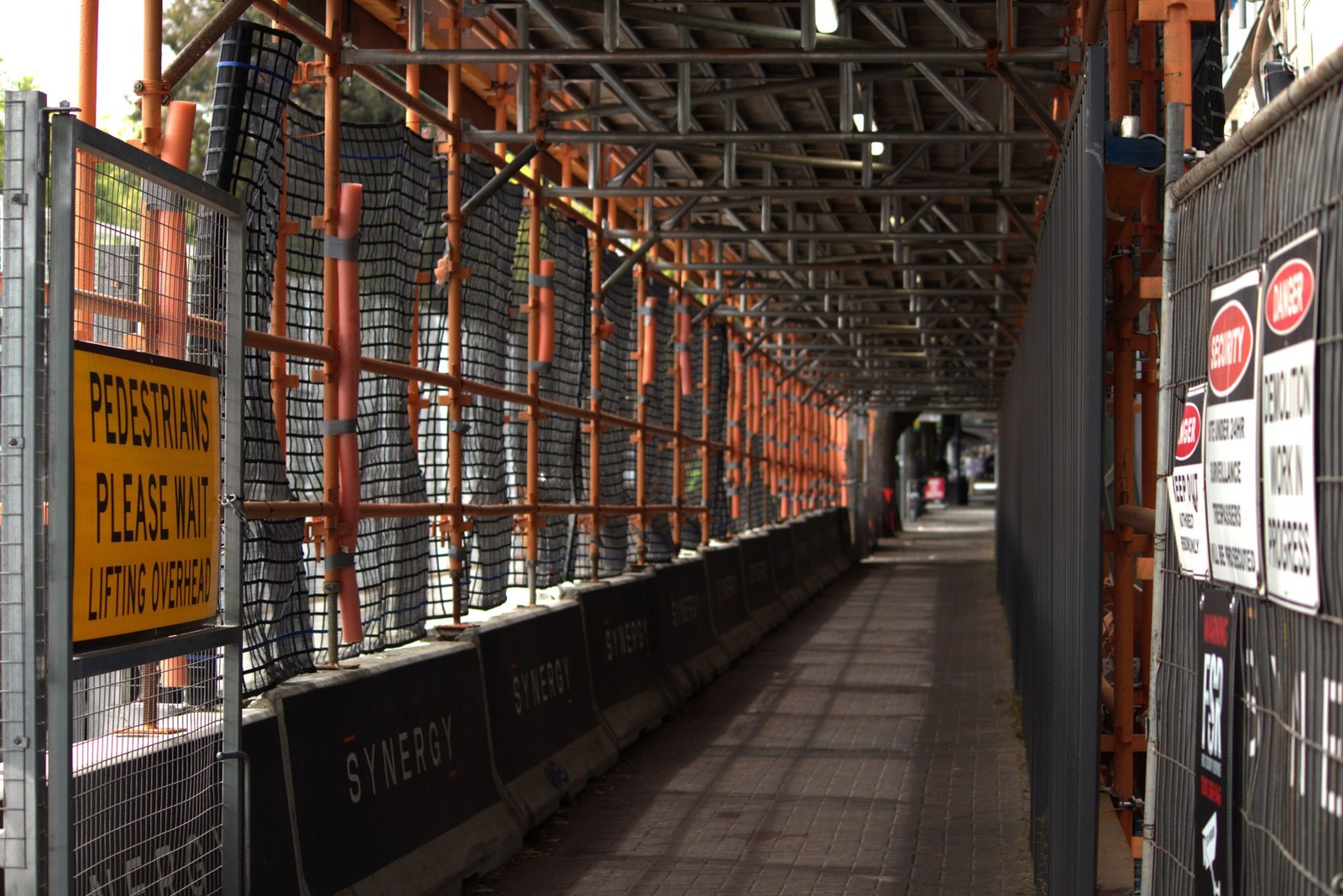
Privacy screen is not a fence on its own. It is fabric tied to chain-link panels to block the view and cut dust, and it adds $40 to $70 per panel in most guides. It changes the physics of the fence, because a screened panel catches wind like a sail, so any quote that adds screen should also add ballast.
Plastic mesh and barricades sit at the light end of the range. Orange mesh on T-posts marks a hazard or a boundary, and that is all it does. It will not stop a person, a dog, or a thief. Barricades guide crowds; they do not secure a site. Both have their place, and both get misused when someone buys a visual barrier and expects security from it.
Which fence for which job
Pick the fence by the job, not by the price list. Start with the risk, then match the tool. A fence that is too light for the job fails when it matters, and a fence that is heavier than the job needs wastes money every month it stands.
| Job | Pick this | Why it fits |
|---|---|---|
| Home renovation, a few weeks | Chain-link panels | Real security for tools and materials, up in an afternoon, gone when the work ends |
| Construction site, months long | Chain-link or welded wire panels, plus gates | Durable, lockable, easy to move as the work shifts across the site |
| Outdoor event or festival | Crowd-control barricades, panels for backstage | Barricades steer people, panels guard the areas that need real security |
| Pool work or a new pool barrier | Removable mesh pool fence, or panels with a self-closing gate | Pool rules are strict on height, gaps, and gates, so the fence has to meet them |
| Protecting a garden bed or new planting | Plastic mesh on posts | Cheap, visible, and enough to keep feet and pets off fresh work |
| Vacant lot or storage yard | Anti-climb security panels | Climb resistance and height matter more than looks when nobody is watching the site |
| Road work or a sidewalk detour | Water-filled barriers or barricades | Built to sit on pavement, visible to drivers, and heavy enough to stay put |
How much do temporary fences cost?
Basic temporary chain-link panels rent for about $1 to $3.50 per linear foot per month, before delivery, setup, gates, and add-ons. A standard 60-foot perimeter runs $150 to $500 a month, with most projects averaging around $350 including delivery and basic installation. Small jobs cost more per foot than big ones, because the truck and the crew cost the same whether they set five panels or fifty.
| Project size | Typical first-month cost | What it usually covers |
|---|---|---|
| 50 linear ft | $300-$800+ | Small repair zone, dumpster enclosure, short event area |
| 100 linear ft | $500-$1,200+ | Small construction site, backyard work area, temporary pool barrier |
| 250 linear ft | $900-$2,500+ | Small commercial site, demolition zone, festival boundary |
| 500 linear ft | $1,500-$4,000+ | Larger construction site, storage yard, big event perimeter |
| 1,000 linear ft | $3,000-$6,000+ | Large construction site, industrial project, staging area |
The panel rate is only the base. Delivery and pickup run $150 to $600 or more depending on distance, and setup and removal run $200 to $1,000 or more depending on length, slope, and how much hand-carrying the site needs. Rental guides list the common add-ons plainly: a pedestrian gate runs $100 to $300 a month, a vehicle gate $200 to $500 a month, sandbags $3 to $8 each per month, and a privacy screen $35 to $70 per panel per month. Some companies fold delivery and setup into the quote and others list them separately, so ask for one all-in monthly number before you compare two bids.
A worked example keeps the math honest. One rental guide prices 120 linear feet of chain-link at $2 a foot for a month, which is $240 for the fence itself, then adds $250 for delivery and pickup, $250 for setup and removal, and $150 for bases, clamps, and sandbags, for a total near $890. Your numbers will differ by region, but the shape holds: the fence is often less than half the bill, and delivery plus labor is the rest.
If the job turns permanent, the math changes completely. Run the numbers on our fence cost calculator to see what a permanent fence would cost for the same run, and compare that against a year of rental before you sign a long agreement. For the full picture on permanent pricing, see what a permanent fence costs per foot and how much fences cost as a whole project.
Rent or buy: the break-even point
Buying looks cheap until you count the whole kit. A new galvanized 6 by 12 foot panel sells for $100 to $150, against $20 to $50 a month to rent the same panel, so the purchase price equals somewhere between 2 and 7.5 months of rent. That is the break-even band, and it is the only number you need to decide.
| Time you need the fence | Rent, one panel | Buy, one panel | Cheaper choice |
|---|---|---|---|
| 1 month | $20-$50 | $100-$150 | Rent |
| 3 months | $60-$150 | $100-$150 | About even |
| 6 months | $120-$300 | $100-$150 | Buy, if you reuse the panels |
| 12 months | $240-$600 | $100-$150 | Buy, by a wide margin |

So the rule is simple. One short job, rent. A long project, or repeat use across several sites a year, buy. Contractors who fence a new site every few months are the classic buyers, and a homeowner with one renovation is the classic renter. Owning also means paying for bases, clamps, sandbags, a truck and trailer, and a dry place to store it all, while a rental folds that into one monthly figure and takes the panels back when you are done.
How to install temporary fence panels
Installing temporary fence panels is straightforward, and a small crew can fence a typical lot in a few hours. The work is carrying and clamping, not digging, and the only skill that matters is keeping the line straight and the bases level. The video below shows how a rental crew paces the job, with real time estimates by crew size and fence length.
SONCO’s install guide puts numbers on the pace: a two-person crew can set 250 to 750 feet of fence in 1 to 3 hours, while a run over 2,000 feet takes around 7 to 8 hours, and a four-person crew covers 500 to 1,500 feet in 1 to 3 hours. Your ground and your gates will move those numbers, but they are a fair planning guide.
- Measure and mark the line.
Walk the perimeter with a tape and mark corners, gate spots, and anything the fence has to dodge, like trees and dumpsters. Count panels by dividing the length by the panel width, then add one spare panel and two spare clamps.
- Stage the gear.
Set the bases along the marked line first, one per panel joint, with a base at each corner and each gate post. Keep the clamps, sandbags, and braces near the start so nobody walks back for them.
- Set the first panel.
Drop one leg of the panel into the slot of the first base, then set a second base for the other leg. The panel should stand on its own now, though it will wobble until it is joined to the next one.
- Add panels one at a time.
Drop the next panel into the shared base, then set a fresh base at its far end. Work down the line in order.
- Clamp every joint.
Fit a coupler or clamp across the top of each joint where two panels meet, and tighten it firmly. On taller panels, add a second clamp at mid-height.
- Hang the gates.
Set gate panels on their own posts with hinges and a latch, and test the swing before you move on. A gate that drags on the ground will never latch right.
- Brace and ballast.
Add sandbags to the bases on open or windy ground, and fit diagonal braces on long straight runs and at corners. Then walk the whole line, push each panel gently, and fix anything that moves.
Keeping a temporary fence upright in wind
Wind is the thing that knocks temporary fences down, and it does it most often on the first stormy night after installation. A panel fence is a wall, and a wall catches wind. The checklist below is the short version of what rental crews do on exposed sites.
- Ballast every base on open ground. One or two sandbags per base is the usual starting point, more on corners and on the windward side.
- Brace long straight runs. A diagonal brace every few panels stops a whole line from folding like dominoes.
- Treat privacy screen as a sail. Screen roughly doubles the wind load on a panel, so add ballast and braces with it, or take the screen down before a storm.
- Anchor the corners. Corners take the wind from two directions, so they get the heaviest bases and the first braces.
- Check the line after storms. Walk it, re-seat any base that shifted, and re-tighten any clamp that worked loose.
- Keep material off the fence. Never lean lumber, ladders, or spoil piles against panels. The extra weight bends frames and pulls bases out of line.
Permits, OSHA, and local rules
There is no single federal rule that says when a temporary fence is required or how tall it must be. OSHA does not require perimeter security fencing on a job site, and the rules that do apply come from a mix of OSHA standards, the model building code, and your city or county. That mix is why the first call should be to your local building department, not to the rental company.
OSHA’s construction rules still shape how a site fence is used. OSHA’s fall-protection rules set guardrail standards that matter wherever a fence doubles as a guardrail: the top edge sits 42 inches above the walking surface, give or take 3 inches, and the rail must hold a 200-pound force at the top edge without failing. Midrails and screens must hold 150 pounds, and openings in a guardrail system must be no more than 19 inches wide. These numbers govern guardrails around edges and holes, not the fence around the whole site, but a site fence that also guards a drop needs to meet them.
Excavations get their own attention. OSHA’s excavation standard, 29 CFR 1926.651, requires barricading or guarding around open trenches and excavations, and a temporary fence is the usual way to do it. If your job opens a trench near a sidewalk, the fence is not optional, and it has to stay up until the trench is filled.
Local rules fill in the rest. Many cities require a permit for fencing over 6 feet tall, for fencing that blocks a sidewalk or a public right of way, or for fencing that stays up more than 30 to 90 days. Permit fees run $25 to $500 or more depending on the city and the scope. The model building code most US cities build from, the International Building Code, covers pedestrian protection during construction in Chapter 33, and cities enforce it in their own way. A fence that reaches into the street or closes a sidewalk usually needs a separate right-of-way permit, and the city can stop work if the protection is not in place before construction starts.
Temporary fences around pools
Pool barriers follow stricter rules than any other temporary fence, because the risk is a child reaching water alone. The Consumer Product Safety Commission’s barrier guidelines say a pool barrier should stand at least 48 inches above grade, measured on the side away from the pool, with 5 feet or higher preferable, and some states and towns require 60 inches. The gap at the bottom must be no more than 4 inches above a solid surface, and no more than 2 inches over grass or gravel. No opening anywhere in the barrier should let a 4-inch sphere pass through, and chain-link mesh must be no larger than 1-1/4 inches unless slats close the openings to 1-3/4 inches.
Gates are the weak point, and the CPSC says so plainly: a gate that fails to close and latch completely is the weak link in the strongest fence. Gates should open outward, away from the pool, close and latch by themselves, and put the latch release at least 54 inches above the bottom of the gate, out of a small child’s reach. A fence that completely surrounds the pool beats one that uses the house as the fourth side, and the CPSC notes that a four-sided isolation fence cuts a child’s drowning risk sharply compared with property-line fencing alone.
Removable mesh pool fences are a separate product from rental chain-link panels. They are built to the ASTM F1918 standard, they lock into sleeves in the pool deck, and they stand at least 48 inches high. A standard rental panel can serve as a temporary pool barrier during construction or repair, but only if it meets the same height, gap, and gate rules, and only if the gate hardware self-closes and self-latches. If you are unsure, ask your building department what it accepts before you order, because pool code is enforced at inspection, not at delivery.
One note on the numbers: the CPSC guidelines are guidance, not a mandatory federal standard, though many states and towns have written them into local code. For a permanent pool fence, aluminum pool fences are the usual pick, because they meet pool code, resist rust, and need almost no upkeep.
Where temporary fences get used
Construction sites are the biggest use, and the pattern is easy to see on any street with a remodel going on. The fence goes up before the first truck arrives, it keeps the public out of the work area, it keeps tools and materials from walking off overnight, and it moves as the work shifts across the site. A small residential remodel might need 100 to 200 feet of fence for the first month, while a commercial job can need 500 to 1,000 feet a month for the length of the build.
Events are the second big use. Festivals, concerts, races, and fairs use barricades for queues and pedestrian lanes, chain-link panels for backstage and vendor areas, and privacy screen where the work should stay out of sight. Event pricing runs by the day or the weekend rather than the month.
Home projects fill the gap between those two. A new driveway, a roof tear-off, a pool repair, or a big tree removal all leave a yard open and messy for a week or two, and a short run of panels keeps kids, pets, and passersby out of the work. The same panels guard a vacant lot between tenants or a utility dig in the street. For planting beds and new grass, plastic mesh is enough, and if the bed sits near a permanent fence, see our guide to choosing a garden fence for the long-term version of the same job.
DIY or hire a pro?
A short run on flat ground is a fair DIY job. If you can carry a panel, you can set a fence: drop the legs in the bases, clamp the joints, hang the gate, and add sandbags. Rental companies often offer customer pickup at a lower rate, which suits a homeowner with a truck and a free afternoon.
The line is simple. Under about 100 feet, flat ground, no public walkway: do it yourself and save the install fee. Over that, or anywhere the fence guards the public: pay for the install and ask for the all-in monthly number in writing.
Mistakes to avoid
Most temporary fence failures come from the same short list, and all of them are avoidable. Read it before you order, because fixing these after delivery costs a second trip.
- Skipping the ballast. Bases alone hold a panel on a calm day. Wind needs sandbags or braces, and a fence with neither will be on the ground after the first storm.
- Adding privacy screen without extra weight. Screen turns a panel into a sail. Every screened run needs more ballast, more braces, or both.
- Putting the gate in the wrong place. Gates go where trucks and crews actually enter, not where the line looks tidy.
- Forgetting the permit. A fence over 6 feet, a fence on a sidewalk, or a fence up for months can all need a permit. The fine costs more than the permit did.
- Leaving gaps at corners and slopes. Corners and grade changes are where panels gap and people slip through. Walk the line and look for daylight at the bottom.
- Ignoring the return date. Late returns trigger extensions at premium rates. Mark the pickup date on the calendar the day the fence goes up.
Frequently asked questions
Basic chain-link panels rent for about $1 to $3.50 per linear foot per month, or $20 to $50 per 6 by 12 foot panel per month. A 60-foot perimeter runs $150 to $500 a month, averaging around $350 with delivery and basic installation. Delivery, setup, gates, and sandbags sit on top of the panel rate.
Most companies rent from one day to several years, with a 28-day minimum common on monthly agreements, then month-to-month billing after that. Long construction projects commonly rent for 6 to 18 months, and longer rentals usually cost less per day than short ones.
It depends on your city. Many require a permit for fencing over 6 feet tall, fencing that blocks a sidewalk or public right of way, or fencing up for more than 30 to 90 days. Permit fees run $25 to $500 or more. Call your local building department before you order.
Yes, for a short run on flat ground. Panels drop into weighted bases and clamp together with no digging. Larger jobs, slopes, and sites next to public walkways are better left to the rental crew, which usually charges $100 to $300 for installation.
Most rental panels are 6 feet high and 10 or 12 feet long. Four-foot and 8-foot heights are sold for shorter or taller jobs, and crowd-control barricades stand about 3.5 feet high.
It can, but only if it meets pool barrier rules: at least 48 inches high, no gap bigger than 4 inches at the bottom, no opening a 4-inch sphere can pass through, and a gate that closes and latches by itself. Removable mesh pool fences built to the ASTM F1918 standard are made for this job, and your building department decides what it accepts.
Sources
- OSHA’s fall protection systems criteria, 29 CFR 1926.502, for guardrail heights and strength rules
- The CPSC’s Safety Barrier Guidelines for Residential Pools, Publication 362, for pool barrier heights, gaps, and gate rules
- SiteRento’s temporary fence rental cost guide, for per-panel rates, delivery and installation costs, and permit notes
- ThePricer’s temporary fence rental cost guide, for per-foot rates, project-size totals, and the worked 120-foot example
- Metal Buildings’ temporary fence rental cost guide, for Fixr’s buy prices and the rent-versus-buy break-even math
- SONCO’s temporary fence installation rates video, for crew-size install time estimates
