

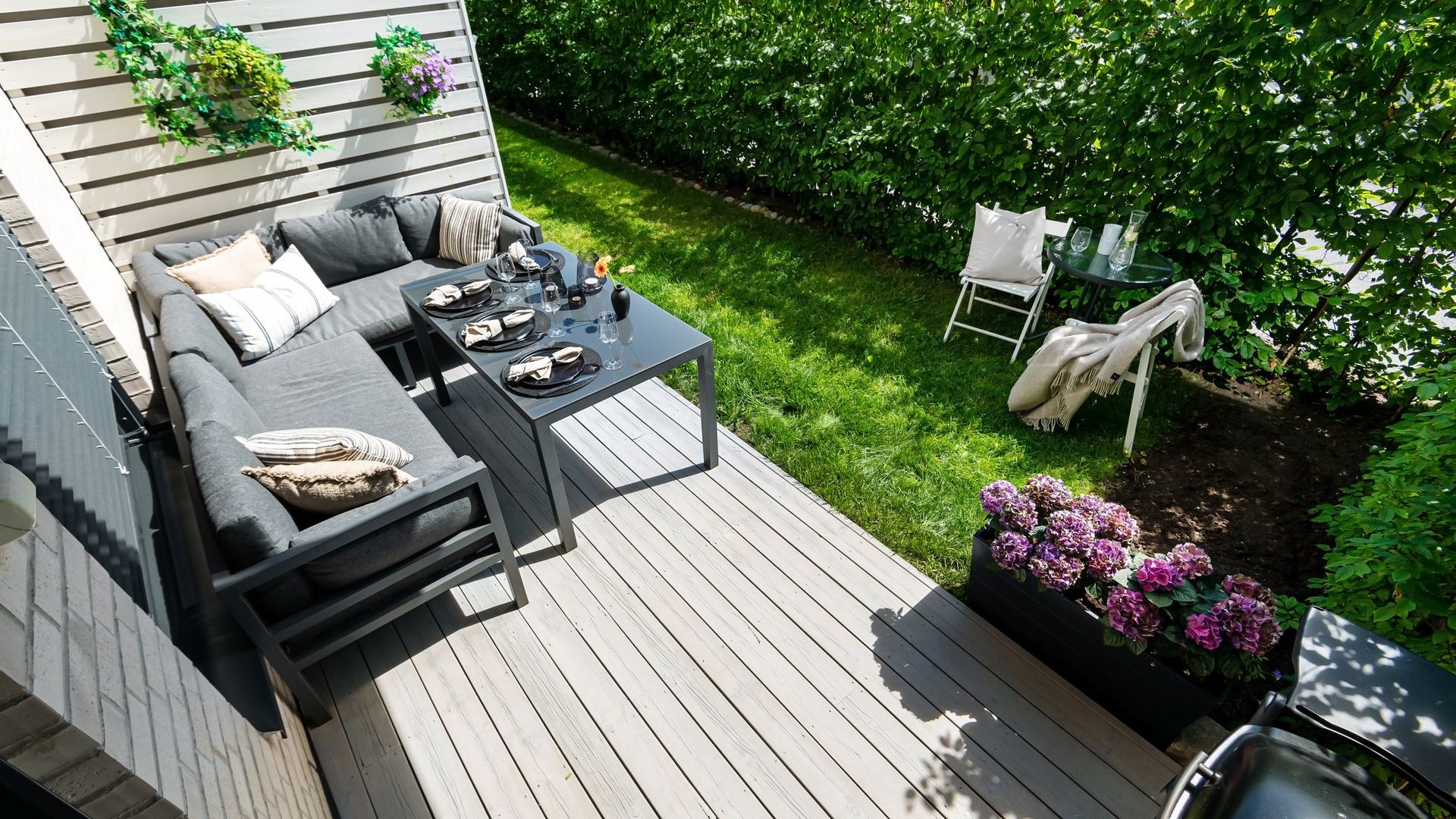
Patios modernos is Spanish for modern patios, and it is the phrase a lot of people type when they start dreaming about one. Whatever language you searched in, the goal is the same: a patio that looks clean and calm, works for real life, and still looks good in five years. This guide walks through what makes a patio read as modern, how to lay it out in zones, which materials hold up, and what it costs, so you can plan the whole thing before you spend a dollar on pavers.
The short answer: a modern patio is defined by one calm surface, large-format materials, and clear zones for dining, lounging, and cooking, with shade and lighting planned from the start rather than added later. Start with how you will use the space, size each zone for the people and furniture it has to hold, pick a material that fits your climate and your patience for upkeep, and keep the palette to two or three colors. Get those bones right and the furniture almost picks itself.
Last updated: November 24, 2026
Contents
- What “modern” actually means for a patio
- Plan the zones before you pick a single material
- Modern patio materials, compared side by side
- Color and pattern: the calm palette rule
- Shade that fits the style
- Lighting after dark
- Fire features and focal points
- Furniture and planting that soften the lines
- What a modern patio costs
- Build it yourself or hire a pro?
- Five mistakes that date a patio fast
- Frequently asked questions
- Sources
What “modern” actually means for a patio
A modern patio is an outdoor room built on straight lines, large surfaces, and restraint. Where a traditional patio might mix brick, fussy patterns, and a different chair for every seat, a modern one uses one main surface, a small palette of two or three colors, and furniture with simple shapes. Nothing shouts. The whole space reads as one calm plane that connects the house to the yard.
That look is not just taste. It comes from a few practical choices that keep showing up in the best modern patios. Large-format pavers or slabs mean fewer joints and less visual clutter. A single material running from the back door to the far edge makes a small yard feel bigger. And furniture sits low and modular, so the seating can shift from a quiet coffee for two to a full table for ten without a redesign.
Modern does not mean cold, and it does not mean gray on gray. The warmest modern patios I have seen pair pale stone with teak, or charcoal pavers with terracotta pots and olive-green cushions. Two or three materials, repeated with intent, is the sweet spot. If everything matches, the space feels like a showroom. If nothing matches, it feels like a yard sale.
Plan the zones before you pick a single material
Most patios fail at the layout stage, not the material stage. A modern patio works when it is planned as a set of zones, each sized for what actually happens there: a dining zone near the house, a lounge zone a few steps away, and a cooking zone off to one side. Sketch those zones first, then choose the surface. If you pick the paver before you know where the table goes, you will end up with a beautiful slab that fits nothing.

Size each zone for the people and the furniture, not for the yard. Landscape architect Paul Maue gives a rule of thumb that This Old House repeats in its patio guide: allow about 25 square feet per person for a seat and room to move. A dining table for six needs roughly 150 to 200 square feet once you count the chairs pulled out, and a lounge corner with a sofa and two chairs wants at least 100. Our patio planning guide walks through sizing and spot selection in more detail if you are starting from a blank yard.
| Zone | What it holds | Rough size to plan for |
|---|---|---|
| Dining | Table for 4 to 6, chairs pulled out, room to walk behind them | 150 to 200 sq ft |
| Lounge | Low sofa or sectional, two chairs, coffee table, fire feature | 100 to 150 sq ft |
| Cooking | Grill or outdoor kitchen run, prep counter, landing space | 60 to 100 sq ft |
| Passage | Clear walkways between zones and to the garden | 3 to 4 ft wide |
Three layout habits separate good modern patios from cramped ones. First, put dining closest to the kitchen door so nobody carries a hot tray across the whole yard. Second, let the lounge zone sit a little farther out, where the view is better and the cooking smoke drifts away from seated guests. Third, leave one edge open to planting instead of walling the patio in on all four sides. A band of ornamental grasses or a low hedge along that edge does more for the modern look than any single piece of furniture, because it blurs the hard line where the patio ends.
Small yards need zones too, just smaller ones. A 10 by 12 foot patio can still hold a bistro table for two and a pair of lounge chairs if you skip the full dining set and let one zone do double duty. The mistake is trying to fit all three zones at full size into a small space. Pick the two you will actually use and give them room to breathe.
Modern patio materials, compared side by side
The modern look starts with the floor, and the floor sets the budget, the upkeep, and how long the patio stays flat. Large-format concrete pavers and porcelain pavers are the two materials that define the style right now: big pieces, tight joints, and clean edges. Poured concrete with a smooth or lightly broomed finish is the budget route to the same look, and natural stone works when the pieces are cut large and laid in a simple running bond. Small brick patterns and busy cobble read as traditional, not modern, no matter what color you pick. Stamped concrete is the one exception worth pricing separately: it can mimic stone or brick for less, and our comparison of stamped concrete vs pavers lays out where it wins and where it cracks.

Thickness and base matter more than brand. Belgard, one of the biggest paver makers in the US, specifies at least 60 mm, about 2 3/8 inches, of thickness for patio pavers, with at least 4 inches of compacted base under a patio and a 1 inch bed of concrete sand, according to the Belgard specifications gathered by Muthler Landscaping. Porcelain pavers are a different animal: they are only 20 mm thick, fired above 2,240 degrees Fahrenheit, and come in slabs as large as 24 by 48 inches, which is why they look so seamless. They need a proper support system underneath, so read the install guide for the product you buy rather than treating them like concrete pavers.
| Material | Modern look | Upkeep | Best for |
|---|---|---|---|
| Large-format concrete pavers | Clean modular lines, many colors | Sweep, wash, re-sand joints now and then | Most budgets, freeze-thaw climates |
| Porcelain pavers | Seamless slabs, stone or wood looks | Very low, household cleaners work | High-end look, stain-prone spots |
| Poured concrete | Smooth, one continuous plane | Seal every few years, watch for cracks | Big areas on a budget |
| Natural stone, large cut | Warm, one-of-a-kind texture | Seal, watch for uneven settling | Homes where stone already appears |
| Ground-level composite decking | Warm wood look, no staining | Wash, no sealing or staining | Sloped spots, wood-look lovers |
Two practical notes before you fall in love with a sample. First, look at full-size pieces in daylight, wet and dry, because printed catalogs and small chips lie about color. Second, if your patio will ever hold a car or a hot tub, say so before you buy: large-format slabs are rated for foot traffic, and driveway use has its own thickness rules. A patio slab is not a driveway slab.
Sealing is a choice, not a requirement. Belgard says to wait a year before sealing concrete pavers, if you seal at all, so any efflorescence, that white haze on new pavers, can come out first. Our guide to how to seal patio pavers covers the tradeoffs in detail. Porcelain barely needs sealing at all, and it takes household cleaners and deicing salt without complaint, which is part of why it has become the low-maintenance pick for modern patios.
Color and pattern: the calm palette rule
Color is where modern patios most often go wrong. The palette should be small: one main surface color, one darker or lighter accent, and plants for the third color. Warm grays, pale limestone tones, and soft charcoal are the workhorses. The current shift, away from the stark cool grays of a few years ago, is toward warm earth tones: terracotta, warm taupe, sage, and muted mustard in cushions, pots, and throws, while the hard surface stays quiet.
Pattern should be just as quiet. A running bond or a simple stacked layout in one paver size reads as modern. Mixing three sizes in an ashlar pattern can look great too, but it needs a steady hand and a bigger area to breathe. What dates a patio fast is a busy border in a clashing color, a medallion in the middle, or four different materials fighting for attention. If you want a border, make it one course of the same paver in a darker shade, and let it frame the space instead of decorating it. Our roundup of patio paver ideas shows how a single border course can define zones without adding clutter.
One more thing about color: test it against your house, not against a catalog. A pale paver that looks crisp next to white siding can wash out against red brick, and a charcoal slab can turn a north-facing patio into a dark slab. Lay a few full-size samples where the patio will go and look at them in morning and evening light before you order a pallet.
Shade that fits the style
A modern patio without shade is a patio you only use before 10 in the morning. The shade structure is also the biggest visual element after the floor, so it has to match the style. Slim aluminum pergolas with louvered roofs are the current default: the louvers tilt to block sun or let rain through, and the frame stays thin enough to disappear against the house. A cantilever umbrella works for a small dining zone and costs far less, while a simple shade sail suits renters and tight budgets.
Place shade over the zone that needs it most, which is usually dining. People will sit in full sun for ten minutes and then move inside. A pergola over the table, with the lounge zone half-shaded by the same structure, covers most afternoons. If the patio faces west, add a retractable side screen or a row of tall planters on that edge. Low sun from the side is what makes a west-facing patio unusable at dinner time, and a roof alone will not fix it.
Smart pergolas with app-controlled louvers, lighting, and heaters are showing up in a lot of 2026 design roundups, and they are genuinely useful, but they are not a requirement for the look. A fixed pergola with a simple fabric panel does the same job for shade. Spend the money on the frame and the footing first: a pergola that wobbles in a storm is worse than no pergola at all.
Lighting after dark
Lighting is what turns a modern patio from a daytime space into an evening room, and it works best in layers. Start with one soft ambient layer, usually string lights or a few warm downlights under the pergola, then add task light where people cook and eat, and finish with a few accent lights on a tree, a wall, or a water feature. One harsh floodlight over the whole patio kills the mood and the modern look in one stroke.

Warm light, around 2700K, flatters stone, wood, and skin, and it is the safe choice for almost every patio. Path lights along the walkway and step lights on any level change are safety items first and decoration second. String lights deserve their reputation: hung in a gentle catenary curve between two posts or from the pergola beam, they give a whole patio a warm ceiling for the price of one fixture. Keep the bulbs dimmable if you can, since a patio that is too bright feels like a parking lot.
Plan the wiring before the pavers go down. Running a low-voltage line under a finished patio is a miserable job, and extension cords across a walkway are a trip hazard. If the patio already exists, solar path lights and battery candles will get you most of the way, but a proper low-voltage transformer and buried cable is the fix that lasts.
Fire features and focal points
Every good patio needs one thing to look at, and for a modern patio that is usually a fire feature. A low, round gas fire pit in the middle of the lounge zone gives people a reason to sit in a circle and talk, and it extends the season by a month or two on each end. A linear fire table fits a long sectional better, and a full outdoor fireplace makes a statement on a large patio, though it costs far more and needs a proper footing and chimney.
Keep clearances conservative. A fire feature should sit well clear of the pergola, the house wall, overhanging branches, and anything flammable, and you should follow the clearance in the manufacturer’s instructions and your local code rather than guessing. Wood-burning pits throw sparks, so a screen is cheap insurance, and gas units need a shutoff you can reach without leaning over the flame. Never put a fire feature under a wood pergola or a fabric sail, and never leave any fire burning unattended.
If fire does not suit your yard, a water feature or a single sculptural plant can hold the same role. A simple corten steel water bowl or one well-chosen multi-stem tree in a raised bed gives the eye somewhere to land without adding clutter. The rule is one focal point per zone, not one per square foot.
Furniture and planting that soften the lines
Modern patio furniture works best when it is low, modular, and made from materials that can stay outside. Powder-coated aluminum frames, teak, and all-weather wicker hold up, and solution-dyed acrylic cushions resist sun and rain far better than cotton. A modular sectional that splits into two loveseats is worth more than a fixed sofa, because the same pieces can host a crowd on Saturday and a quiet coffee on Tuesday.
Buy the seating after the zones are set, not before. Measure the lounge zone, then buy furniture that leaves at least 18 inches of walkway around it. Deep seats, around 24 inches, invite lounging, while dining chairs should be upright enough to eat in. An outdoor rug under the lounge set defines the zone and softens the hard surface underfoot, but pick one rated for outdoor use, since an indoor rug will hold water and grow mildew.
Planting is what keeps a modern patio from feeling like a showroom floor. Ornamental grasses, in tall planters or a border bed, give movement and soften straight edges without blocking the view. A few large planters in concrete or corten steel beat a dozen small pots, which read as clutter. Water the planting bed well in its first season, since new plants beside a hot stone patio dry out fast.
What a modern patio costs
Material cost per square foot is the honest starting point, and the range is wide. The figures below come from 2024 reports by Angi, as published in the This Old House patio guide, and they cover materials only, before labor, base work, and features like pergolas or kitchens.
| Material | Cost per square foot, materials only |
|---|---|
| Poured concrete | $2 to $15 |
| Concrete pavers | $8 to $15 |
| Brick | $10 to $20 |
| Natural stone | $15 to $50 |
| Wood decking | $30 to $60 |
Installed totals run well above the material numbers, because the base, the edge restraint, the labor, and the site work add up fast. As one regional example, Muthler Landscaping reports its own fixed-price paver patios in central Pennsylvania at about $47 to $53 per square foot installed, with premium lines adding roughly 15 percent. Your price will differ by region, access, and how much digging the site needs, so get two or three local quotes and compare them line by line. If paver math is where your budget lives, our paver patio cost calculator can turn your patio size into a material estimate before you call anyone.
Porcelain pavers sit at the top of the material range, and a louvered pergola or an outdoor kitchen can cost as much as the patio itself, so set the budget in layers. The patio floor is layer one. Shade is layer two. Furniture, lighting, and fire are layer three, and they can wait a season if the budget runs short. A patio with a great floor and no furniture yet still looks finished.
Build it yourself or hire a pro?
The line between DIY and pro work on a modern patio comes down to size, material, and how flat the result has to be. A small dry-laid paver patio, say under 200 square feet, with a simple running bond, is a realistic weekend project for a fit homeowner with a plate compactor and a patient helper. A large poured concrete slab, a mortared stone patio, or anything with an outdoor kitchen, gas line, or electrical work belongs to a pro. Concrete starts hardening the moment water hits it, and there is no learning curve on a live pour.
This Old House puts the same split in plain terms: tackle it yourself if you have experience with similar projects, the design is simple, the patio is small, and you have the tools and the time. Hire a pro if you have little experience, the design is large or complex, you are using difficult materials like concrete, or you want a warranty. Our guide to how to make a patio with pavers walks through the dry-laid process step by step if you decide to do the floor yourself.
If you hire out, vet the contractor the same way you would for any exterior job. Ask for local references and a portfolio of recent patios, ask how deep the base will be and what it is made of, and get the base depth and the edge restraint in writing. A contractor who cannot tell you the base depth is a contractor who will not build a patio that stays flat. And whatever route you take, call 811 before you dig.
Five mistakes that date a patio fast
The first mistake is building too small. A patio that fits the table but not the chairs, or the sofa but not the walkway, gets used less every year. When in doubt, add a foot on each side. The extra pavers cost little compared to the cost of extending a finished patio later.
The second is ignoring slope and drainage. A patio must slope away from the house, about 1/8 inch per foot, so water runs off instead of pooling against the foundation. That is the rule This Old House gives in its patio guide, and Belgard’s own install guide calls for a 1 to 2 percent slope. If water sits on your patio after rain, the slope is wrong, and no amount of sealing will fix it. Our guide to patio cleaning by surface type covers what standing water does to each material over time.
The third is a busy pattern. Four paver sizes, two border colors, and a medallion might have looked rich in the catalog, but on the ground it reads as noise. One size, one pattern, one border course, and let the furniture and plants do the talking.
The fourth is forgetting light and power until the patio is finished. A patio with no lighting gets used half as much, and a patio with no outlet near the cooking zone means extension cords across the walkway. Plan one outlet and one low-voltage lighting run before the base goes in.
The fifth is skipping the edge restraint. Dry-laid pavers spread sideways over time if nothing holds the edge, and the whole field starts to wander within a couple of seasons. A proper edge restraint, spiked into the compacted base, is cheap insurance and the first thing a good installer checks.
Frequently asked questions
Clean straight lines, large-format surfaces with few joints, a small palette of two or three colors, and furniture with simple shapes. One main material, clear zones for dining and lounging, and shade and lighting planned from the start do more for the modern look than any single product.
Materials alone run about $2 to $15 per square foot for poured concrete, $8 to $15 for concrete pavers, and $15 to $50 for natural stone, based on 2024 Angi figures published by This Old House. Installed totals are higher once base work, edge restraint, and labor are added, and features like a louvered pergola or an outdoor kitchen can cost as much as the patio itself.
Large-format concrete pavers are the best all-round pick for most homes: clean lines, many colors, and good freeze-thaw performance. Porcelain pavers look more seamless and need the least upkeep, but they cost more and need the right support system. Poured concrete is the budget route to the same clean look.
Allow about 25 square feet per person for a seat and room to move. A dining table for six needs roughly 150 to 200 square feet with chairs pulled out, and a lounge corner with a sofa and two chairs wants at least 100. When in doubt, add a foot on each side rather than building too small.
Not always. Concrete pavers can be sealed, but Belgard advises waiting a year so efflorescence can clear first. Porcelain pavers barely need sealing at all. Sealing helps with stains from food and oil, but it will not fix a bad base or a drainage problem.
Often, yes. A pressure wash and a fresh joint sand, a simple outdoor rug, low modular seating, and one or two large planters can change the feel of a sound patio a lot. If the surface is cracked, heaved, or draining toward the house, though, those are base problems, and styling will not fix them.
Add one warm material, like teak or warm wood, and let plants do the softening. Ornamental grasses, a few large planters, warm-toned cushions, and warm 2700K lighting take the edge off pale stone and charcoal pavers without breaking the modern style.
Sources
- This Old House, All About Patios: patio sizing, the 25 square feet per person rule, material costs from 2024 Angi reports, slope and drainage guidance, and the DIY versus pro split.
- Muthler Landscaping, Belgard Pavers: Belgard specifications from the Technical Resource Guide, including 60 mm paver thickness, base and sand depths, porcelain paver sizes, and installed price ranges.
- Houzz Ideas, 100 Inspiring Backyard and Garden Ideas That Turn Any Ordinary Yard Into a Private Retreat: design showcase used for the video embed, covering pergolas, fire features, paths, and planting.
