


Last updated: November 28, 2026
A roof cleaning service is a professional crew that removes algae, moss, lichen, and built-up grime from your roof using low-pressure washing and roof-safe cleaning solutions, then rinses gently so the shingles, tiles, or metal keep their protective surface. Most jobs take half a day to a full day, and a standard single-story home in the US typically costs $350 to $650, with larger or steeper roofs running $650 to $950. The method matters more than the price: on asphalt shingles, the only manufacturer-approved approach is a gentle chemical treatment at low pressure, never a pressure washer.
Short answer: a roof cleaning service treats and rinses your roof at low pressure, usually costs $350 to $950 depending on size and height, and is worth hiring when you can see black algae streaks, green patches, or moss from the ground. Vet the company on three things before you book: proof of insurance, a written quote that names the method and the pressure, and a guarantee against early regrowth.
Contents
- What a roof cleaning service actually does
- What roof cleaning costs in 2026
- What a good quote includes
- How to vet a roof cleaning company
- The method question: soft wash or pressure wash
- What happens on the day of the job
- Roof cleaning service vs DIY
- When a cleaning is the wrong call
- How often to book, and how long it lasts
- Questions people ask
- Sources
What a roof cleaning service actually does
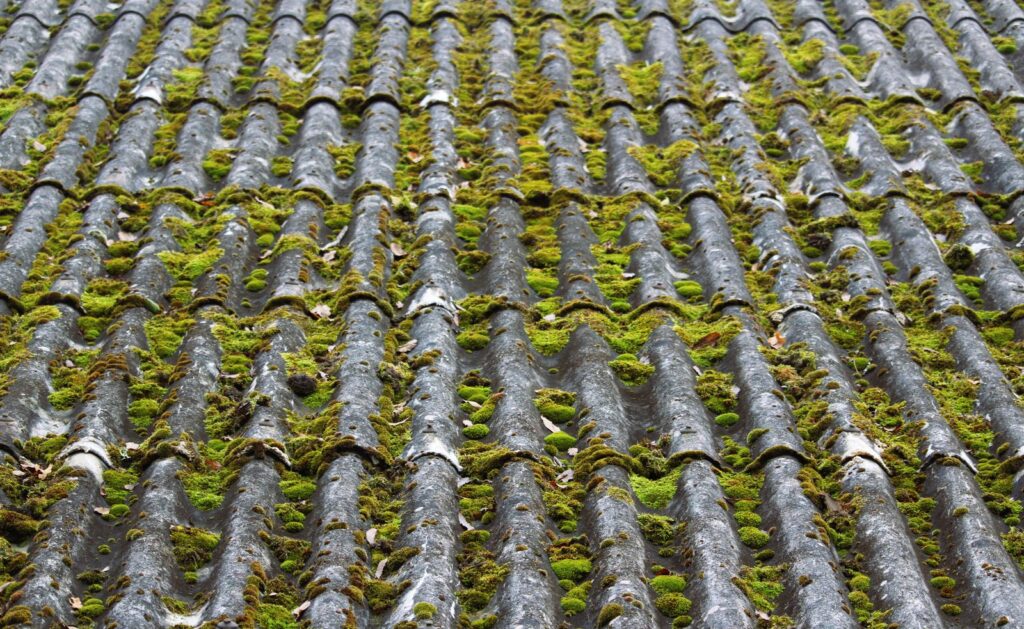
A roof cleaning service treats the living growth on your roof and washes away the loose dirt, so water sheds the way it should and the roof looks cared for again. The black streaks running down most shingle roofs are not dirt. They are a blue-green algae called Gloeocapsa magma, which feeds on the limestone filler in asphalt shingles. The Asphalt Roofing Manufacturers Association says it is probably the most common cause of roof discoloration, and that it shows most on light-colored roofs. Moss is a different problem: it holds water against the surface and can lift or curl the leading edges of shingles, which raises the risk of blow-off in wind.
A proper service covers five things. If a quote skips one of them, ask why before you sign.
| Step | What it means | Why it matters |
|---|---|---|
| Inspection | The crew walks the roof or studies it from a ladder and notes the material, pitch, damage, and growth | A quote written without looking at the roof is a guess |
| Debris removal | Leaves, twigs, and clumps of moss are cleared by hand or blown off, and gutters are flushed | Debris traps moisture and blocks drainage |
| Treatment | A roof-safe cleaning solution is applied at low pressure and left to dwell | The chemistry kills algae, moss, and lichen at the root |
| Gentle rinse | The roof is rinsed from ridge to eave with low-pressure water, or left for rain to finish | High pressure strips granules and cracks tile |
| Plant and property protection | Shrubs are wetted down before and after, runoff is diverted where possible | Cleaning solutions can burn landscaping |
That treatment step is the whole job, in a sense. A soft wash kills the growth so it fades over the following days and weeks. A pressure washer only knocks the top layer loose and leaves the roots alive, which is why the streaks come back fast after a bad wash. Our complete roof cleaning guide walks through each method in more depth, with photos of what each kind of growth looks like.
What roof cleaning costs in 2026
Roof cleaning prices in the US cluster in a fairly tight band once you compare like with like. The published local price lists below come from working cleaning companies, not national averages, so treat them as the going rate in real markets rather than a promise for your street. Your quote will sit higher if the roof is steep, two stories, heavily overgrown, or hard to reach.
| Market and source | Typical price | What it covers |
|---|---|---|
| San Antonio, TX price guide | $250 to $800, most jobs $300 to $450 | Soft wash, standard residential roof |
| Fort Lauderdale, FL price list | $350 to $500 standard roof; $500 to $750 large or two-story | Full soft wash, gutter flush included |
| Raleigh, NC pricing | $425 to $650 ranch or bungalow; $650 to $950 larger or steep-pitch | Soft wash roof cleaning, written quote after a walk-through |
| Jacksonville, FL pricing guide | $0.20 to $0.45 per sq ft | Roof soft wash, from $350 |
Read the table this way: a standard single-story home usually lands between $350 and $650, and a larger or two-story home between $650 and $950. Per square foot, soft washing typically runs $0.20 to $0.60. A quote far below $300 for a full roof should make you ask what is missing: insurance, plant protection, and a biocide treatment all cost the company money. A quote above $1,000 for a standard home needs a clear reason, such as a very steep pitch or heavy moss that needs hand removal.
Two add-ons show up often: a biocide treatment after cleaning, which slows regrowth and usually adds $100 to $250 on its own, and a bundled gutter cleaning, typically $50 to $100 extra. Our guide to cleaning roof and gutters together explains when bundling saves real money and when it just pads the bill.
What moves the price up or down
Roof size is the main driver, and it is measured in roof square feet, not the footprint of the house, so a steep pitch costs more than a shallow one of the same footprint. Roof material matters too: tile and cedar take longer and need more care than asphalt shingles. Heavy moss costs more than light algae because it has to be removed by hand before the treatment goes on. Access is the quiet price driver: a roof the crew can reach from a driveway prices very differently from one boxed in by trees, fences, and a slope.
For the per-square-foot detail behind those totals, see what a soft wash roof cleaning cost works out to by roof size and material.
What a good quote includes
A written quote is the clearest sign of a serious company. Verbal prices leave too much room for argument later, especially if something goes wrong. Ask for the quote in writing, and check it against this list. Two quotes are only comparable when they cover the same scope.
| Item | What to look for |
|---|---|
| Roof area | The square footage being quoted, so you can compare per-foot prices |
| Cleaning method | Named in plain words: soft wash, low-pressure rinse, or manual removal plus treatment |
| Pressure figure | Low pressure, ideally under 100 PSI, stated on the quote for shingle roofs |
| Treatment product | The type of solution, such as a diluted sodium hypochlorite mix or a biocide |
| Plant protection | How shrubs and lawns will be protected, and what happens if plants are damaged |
| Gutter and debris handling | Whether gutters are flushed and debris is removed from the property |
| Insurance | Proof of liability insurance and workers compensation, current and in the company name |
| Guarantee | What the company promises if streaks return quickly, and for how long |
A fixed price after an on-site look is the norm for a standard roof. If the company quotes from satellite photos alone, expect a clause that lets the price change once they see the roof up close. That is not automatically a red flag, but it should be stated plainly, not buried.
How to vet a roof cleaning company
Hiring a roof cleaning service is a trust decision. The crew works on the most expensive part of your house, out of your sight, with chemicals and water. The vetting takes twenty minutes and saves most of the regret stories. Work through these checks before you book.
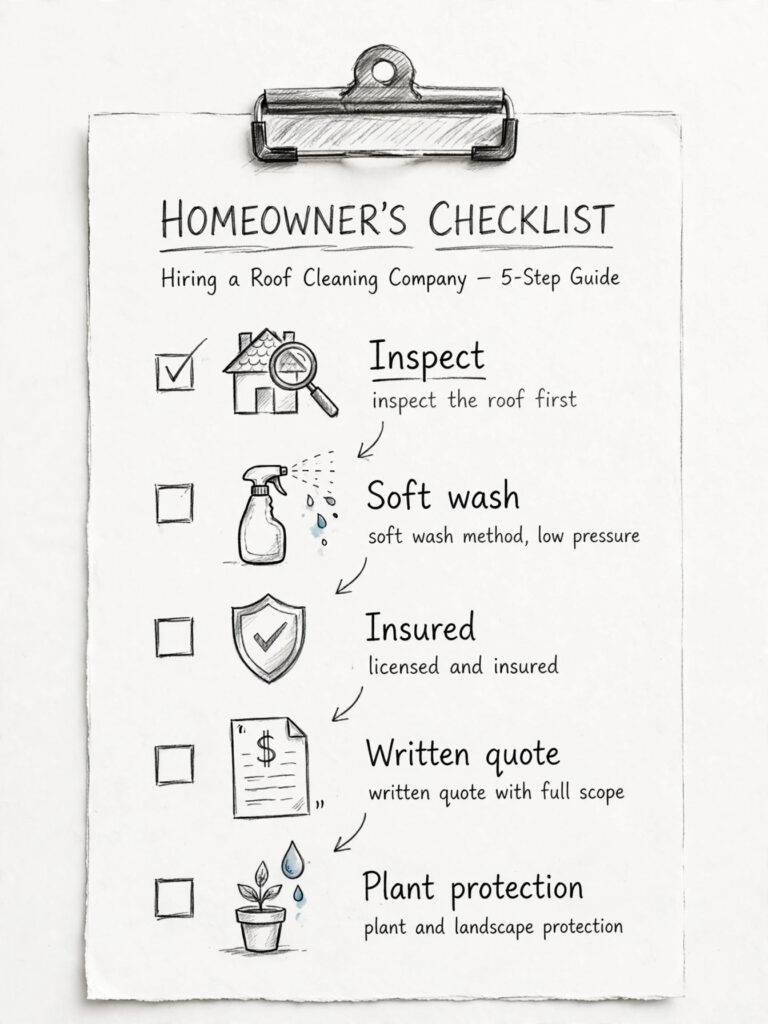
Ask for proof of insurance, and read it. Liability insurance covers damage to your property, and workers compensation covers an injured worker. Check the dates and the company name on the certificate. A company that hesitates here is telling you something. If a worker is hurt on your roof and the company has no cover, the claim can land on your homeowner policy.
Ask what method they use, and listen for the word pressure. On asphalt shingles, the correct answer is a low-pressure chemical treatment, usually called a soft wash. If the company plans to pressure wash your shingles, thank them and move on. The Asphalt Roofing Manufacturers Association is blunt about this: high-pressure washing systems are likely to damage asphalt roofing and should not be used to remove algae or for any other purpose. GAF, the largest US shingle maker, says the same in its technical bulletin on algae staining, warning that power washing may dislodge granules and lead to premature shingle failure.
Read recent reviews, and read the bad ones first. Look for mentions of damaged plants, stained siding, streaks that returned in a month, or a crew that left debris in the gutters. A pattern of the same complaint matters more than one glowing five-star review. Check whether the company replies to complaints, and how.
Get three quotes, and compare scope, not just price. Three written quotes show you the real market rate for your roof, and they expose the outliers. The cheapest quote usually skips something on the list above.
Ask who actually does the work. Some companies sell the job and send a subcontractor crew you never meet. That is not always bad, but you should know before the day, and the insurance and guarantee should cover the crew that shows up, not just the company that sold it.
Get the guarantee in writing. A typical guarantee covers regrowth for one to two years on a soft wash, though the exact term varies by company and climate. What matters is that it is written on the quote, with a clear answer to what happens if the streaks come back early: a free re-treatment, a partial refund, or nothing.
Red flags that should stop the booking
| Red flag | What it usually means |
|---|---|
| Pressure washing offered for asphalt shingles | The crew either does not know or does not follow manufacturer guidance |
| No insurance certificate, or an expired one | You carry the risk if something goes wrong |
| Quote given without seeing the roof, with no caveat | The price is likely to grow on the day |
| Full payment demanded up front | Standard practice is a deposit or payment on completion |
| No plant protection mentioned | Runoff damage to shrubs and lawn is a common complaint |
| Door-to-door pitch with a today-only discount | Pressure tactics, and no time to check reviews or insurance |
| No written guarantee | The company will not stand behind the result |
The vetting questions above overlap with the questions worth asking any exterior cleaning crew. If you are also hiring for gutters, our guide to questions to ask a gutter cleaning company covers the same ground
for that trade, and several of the questions transfer directly.
If the roof also has a flat or low-slope section, the drains there need their own attention: a roof drain cleaning service clears the strainer, bowl and pipe so standing water can leave the roof.
The method question: soft wash or pressure wash
This is the one technical question worth understanding before you hire anyone, because it decides whether the cleaning helps your roof or shortens its life. The short version: soft wash for shingles, always, and pressure only on a few hard surfaces, carefully, and never on asphalt.
A soft wash applies a cleaning solution at low pressure, close to a garden hose, lets it sit long enough to kill algae, moss, and lichen, then rinses gently or leaves rain to finish the job. The Asphalt Roofing Manufacturers Association describes a 50:50 mix of laundry-strength liquid chlorine bleach and water for asphalt roofs, left for 15 to 20 minutes, then rinsed thoroughly with low-pressure water, with no scrubbing and no pressure washer. GAF gives a gentler homeowner recipe in its technical bulletin: 4 gallons of water, 1 gallon of bleach, and 1 cup of TSP or a phosphate-free substitute, applied with a garden sprayer, left up to 20 minutes, then rinsed at low pressure, with shrubs protected. Either way, the chemical does the work, not force.
A pressure washer cleans by force, and force is the problem. The granules on an asphalt shingle are its sun protection, and once they are blasted off they do not grow back. GAF warns that power washing may dislodge granules and lead to premature shingle failure, and ARMA says it is likely to damage asphalt roofing. The streaks also come back faster after pressure washing, because the roots of the algae survive while the visible growth is knocked loose.
Tile, metal, and concrete roofs tolerate more pressure than shingles, but the same rule applies in softer form: low pressure with chemistry beats high pressure on its own, and a good crew adjusts the method to the material instead of using one setting for every roof. Our soft wash versus pressure wash comparison for roofs breaks this down material by material.
What happens on the day of the job
A standard roof cleaning follows the same rhythm on most homes. Knowing the sequence helps you spot a crew that is cutting corners, since a skipped step is easy to miss from the ground.
- Walk-through and setup. The crew leader walks the property with you, confirms the scope and the price, and notes anything fragile: skylights, solar panels, and plants right under the eaves. Shrubs below the roofline are wetted down.
- Debris removal. Loose leaves, twigs, and heavy moss are cleared by hand or with a blower, working from the ridge down. Gutters are cleared so the rinse water has somewhere to go.
- Plant protection. Shrubs and lawns under the drip line are soaked with clean water before the solution goes on, and again after.
- Solution application. The cleaning mix is sprayed on at low pressure, starting low on the slope and working in even passes.
- Dwell time. The solution sits for 15 to 20 minutes, the window the manufacturers specify, so it can kill the growth instead of just bleaching the color out of it.
- Gentle rinse. The roof is rinsed with low-pressure water, working downward, and the siding, gutters, and plants that caught runoff are rinsed too.
- Final check. The crew leader walks the roofline with you, points out anything they found, such as a cracked tile or a lifted shingle, and confirms the gutters are clear and the yard is tidy.
Do not expect the roof to look new the moment the crew leaves. Algae fades over days and weeks as rain washes the dead growth away, and moss loosens over time rather than vanishing on the day. Take dated photos before the job and again two weeks later, so you can judge the result fairly and have a record if the guarantee ever matters.
Roof cleaning service vs DIY
Cleaning your own roof can save a few hundred dollars, and for a small single-story roof with light staining it is a reasonable weekend job if you are steady on a ladder and follow the manufacturer recipe. The trade-off is safety and reach. Roofs are slippery when wet, and ARMA warns that cleaning can make a roof slippery and recommends that only trained professionals work on one.
| Factor | Professional service | DIY |
|---|---|---|
| Cost | $350 to $950 for a standard home | $40 to $150 in materials and rental gear, plus your time |
| Safety | Crew carries fall protection, insurance, and experience on slopes | You carry the risk, and wet shingles are slick |
| Method | Soft wash system, correct dilution, even coverage | Garden sprayer works for light algae, but coverage is uneven |
| Result | Even treatment, plant protection, gutters flushed | Good on a small, walkable roof, patchy on a steep one |
| Time | Half a day to a full day, done for you | A full weekend for most first-timers, including setup and cleanup |
| Guarantee | Written, usually one to two years against regrowth | None, and a mistake is yours to fix |
Hire a pro when the roof is two stories or steep, when moss is thick enough to need hand removal, when you have tile or cedar that needs a careful hand, or when you simply do not want to be on a wet slope. DIY only when the roof is single-story, walkable, lightly stained, and you have a helper, a stable ladder, and proper eye and skin protection. If you find cracked tiles, lifted shingles, or soft spots while you are up there, stop and call a roofer before anyone cleans anything.
When a cleaning is the wrong call
A cleaning fixes growth and grime. It does not fix a failing roof, and a good company will tell you so instead of taking the job. Book a roofing inspection first, not a cleaning, if you see any of these:
- Active leaks, water stains on ceilings, or daylight through the roof boards
- Shingles that are curling, cupping, missing, or shedding granules in the gutters
- Soft or spongy spots underfoot, sagging between rafters, or a dip in the ridge line
- A roof past its expected service life, where cleaning is cosmetic spending on a replacement candidate
- Storm damage, such as lifted flashing, cracked tiles, or hail marks, that needs an insurance claim
A cleaning can also wait if the roof is only lightly dusty with no growth at all. A rinse with plain water at low pressure handles that, and paying for a full chemical treatment adds nothing. The right test is simple: if you can see black streaks, green patches, or moss clumps from the ground, a cleaning will help. A seasonal roof maintenance checklist helps you judge the timing year by year, so you book the cleaning when it earns its keep.
How often to book, and how long it lasts
Most roofs in the US need a professional cleaning every two to three years, and the exact interval depends on shade, tree cover, and humidity. A roof under heavy tree cover in a humid climate can grow visible streaks in two years, while a sunny, open roof in a dry climate can go four or five. After a soft wash, the visible result typically lasts two to four years, since the treatment kills the growth at the root and it takes time to re-establish. Pressure washing leaves the roots alive, so streaks often return within a season.
If you want the full schedule behind that timing, our roof maintenance plan lays out the year-round calendar.
Between cleanings, a few small habits stretch the interval. Keep overhanging branches trimmed so the roof dries faster after rain, keep gutters clear so water does not back up onto the eaves, and clear leaves off the roof each autumn before they mat down and hold moisture. Zinc or copper strips near the ridge can slow algae regrowth, since rainwater carries trace metals down the slope, though they work best as a supplement to cleaning, not a replacement for it.
Booking frequency is really a maintenance question: the roof maintenance schedule in our homeowner guide sets the inspection rhythm the bookings should follow.
Questions people ask
A standard single-story home in the US typically costs $350 to $650, and a larger or two-story home $650 to $950. Per square foot, soft washing runs $0.20 to $0.60. The final price depends on roof size, pitch, material, how much growth has built up, and access.
Yes, when the roof has visible algae streaks, moss, or lichen. Cleaning removes growth that traps moisture, restores the roof’s appearance, and costs a fraction of a replacement, which runs into five figures. It is not worth it for a roof with no growth, or for a roof that needs replacing rather than cleaning.
Most residential jobs take half a day to a full day, roughly 4 to 8 hours for a standard home. Heavy moss, a steep pitch, or a large roof can stretch the job to two days. The algae itself fades over the following days and weeks as rain washes the dead growth away.
A proper soft wash will not. The method uses low pressure and a diluted cleaning solution, which is exactly what the shingle makers specify. Pressure washing is the method that damages shingles, by stripping the protective granules, and it can void the warranty. Ask the company what pressure they use before you book.
No, not on asphalt shingles. Both the Asphalt Roofing Manufacturers Association and GAF warn against it, and the damage is hard to see from the ground until the granules are already gone. A garden sprayer with the manufacturer recipe handles light algae on a walkable single-story roof, but steep or two-story roofs belong to a pro.
Check three things: a current liability insurance certificate in the company name, recent reviews that mention roof jobs specifically, and a written quote that names the method, the pressure, and the guarantee. A legitimate company answers the method question plainly and welcomes the insurance question.
It helps to be home for the walk-through at the start and the final check at the end, but you do not need to watch the whole job. Make sure the crew can reach an outdoor water tap and a power outlet, move cars out of the driveway, and keep pets indoors while the solution is being applied.
Sources
- The Asphalt Roofing Manufacturers Association technical bulletin on algae discoloration of roofs, which describes the 50:50 bleach-and-water treatment, the 15 to 20 minute dwell, and the warning never to use a pressure washer on asphalt shingles.
- GAF technical advisory bulletin TAB-R-102 on blue-green algae staining, which gives the 4 gallons of water, 1 gallon of bleach, and 1 cup of TSP recipe, and warns that power washing may dislodge granules and lead to premature shingle failure.
- GAF guide to fighting algae and keeping a roof stain free, which reports the Association’s finding that there is no scientific evidence algae itself damages asphalt shingles.
- A San Antonio roof cleaning price guide, which reports $250 to $800 per job, most homes $300 to $450, and soft washing at $0.20 to $0.60 per square foot.
- A Fort Lauderdale roof cleaning price list, which reports $350 to $500 for a standard roof and $500 to $750 for a large or two-story roof, with gutter flushing included.
- A Raleigh roof cleaning pricing page, which reports $425 to $650 for ranches and bungalows and $650 to $950 for larger or steep-pitch roofs.
- A Jacksonville pricing guide, which reports roof soft washing at $0.20 to $0.45 per square foot.
