


A flat roof has no pitch to help it. When rain falls on a pitched roof, gravity pulls the water down the slope, into the gutters, and out through the downspouts. On a flat or low-slope roof, that help does not exist. The water has to find a drain set right into the roof surface, and if that drain is blocked, the water just sits there. A roof drain cleaning service exists for exactly that problem: a crew comes out, clears every drain on the roof, checks the parts around it, and leaves you with proof the water can move again.
Short answer: A roof drain cleaning service clears leaves, granules, silt, and growth from the drains built into a flat or low-slope roof, including the strainer, the drain bowl, and the pipe below it. For a single home, a standard visit usually runs somewhere around $110 to $275 per drain, and a commercial building visit often lands between $200 and $1,200 depending on roof size and drain count. Book it once a year before your rainy season, and twice a year if trees hang over the roof. The rest of this guide covers what a proper visit includes, the signs you need one now, what moves the price, and how to tell a careful company from a sloppy one.
Contents
- What a roof drain cleaning service actually does
- Roof drain or gutter: which one do you have?
- Signs your roof drains need cleaning now
- What a proper service visit should include
- How often should roof drains be cleaned?
- What does a roof drain cleaning service cost?
- How to vet a roof drain cleaning company
- Can you clean a roof drain yourself?
- When cleaning is not enough: clean, repair, or replace
- Questions people ask
- Sources
What a roof drain cleaning service actually does
A roof drain cleaning service clears the drainage points on a flat or low-slope roof so rainwater can leave the roof instead of pooling on it. The crew works from the roof surface down: they lift each strainer, pull out the debris packed around it, clean the drain bowl underneath, and confirm water flows freely into the pipe below. Where the blockage runs deeper, the job extends into the internal downspout with a snake or a camera, and that is usually priced as a separate step.
This is not the same job as a roof cleaning. A roof cleaning service washes the roof surface itself, removing algae, moss, and stains from shingles or membrane. Drain cleaning is narrower and more functional. It does not care how the roof looks. It cares whether water can get off it. If you are weighing the two, our guide to hiring a roof cleaning service covers the surface-cleaning side, while this one stays with the drains.
The reason drains matter so much on a flat roof comes down to slope, or the lack of it. The National Roofing Contractors Association recommends a minimum slope of 1/4 inch per foot so water moves toward the drains, and even then the roof only drains slowly. The same association defines ponding as water that is still standing 48 hours after the rain stops, and that 48-hour mark is the line most manufacturers and building codes use too. A drain that is half blocked can look fine on a dry day and still fail in a real storm, because the water arrives faster than the narrowed opening can pass it along. One commercial roofing crew puts it well: a partial clog is more dangerous than a full one, since a full clog shows itself in the first storm while a partial clog drains just fast enough to keep everyone comfortable until the heavy rain arrives.
Roof drain or gutter: which one do you have?
A roof drain is not a gutter. A gutter hangs along the edge of a pitched roof and catches water as it runs off the slope. A roof drain sits in the roof surface itself, usually at the lowest point of a flat or low-slope section, and feeds rainwater straight into a pipe that runs down through the building. Many homes have both: pitched sections with gutters, and a flat section, an addition, a garage, or a porch roof, with its own drains.
If you are not sure which system your roof uses, the table below sorts out the parts you are likely to see.
| Drainage part | Where it sits | What it does | What goes wrong with it |
|---|---|---|---|
| Interior roof drain | Set into the lowest point of a flat or low-slope roof | Carries rainwater into a pipe that runs down through the building to the storm system | Debris packs into the bowl, granules settle in the pipe, the clamping ring corrodes and lets water slip past the membrane |
| Strainer or dome | Over the drain opening, on the roof surface | Keeps leaves, twigs, and large debris out of the pipe | Goes missing, cracks, or gets buried under a mat of wet leaves so water cannot reach the drain at all |
| Scupper | An opening through the parapet wall at the roof edge | Lets water spill off the roof edge into a downspout on the outside wall | Gets blocked by debris or by cables run through it, and then the roof has no escape route at all |
| Overflow drain or overflow scupper | Set slightly higher than the primary drain, often about 2 inches above the low point | Acts as the backup: it only takes water when the primary drain fails and the level rises | Never gets checked because it looks dry, so nobody notices it is blocked until the primary drain fails too |
| Internal downspout (leader) | Inside the building, below the drain | Carries water from the drain to the storm sewer or to grade | Clogs deep inside where nobody can see it, and needs snaking or a camera to clear |
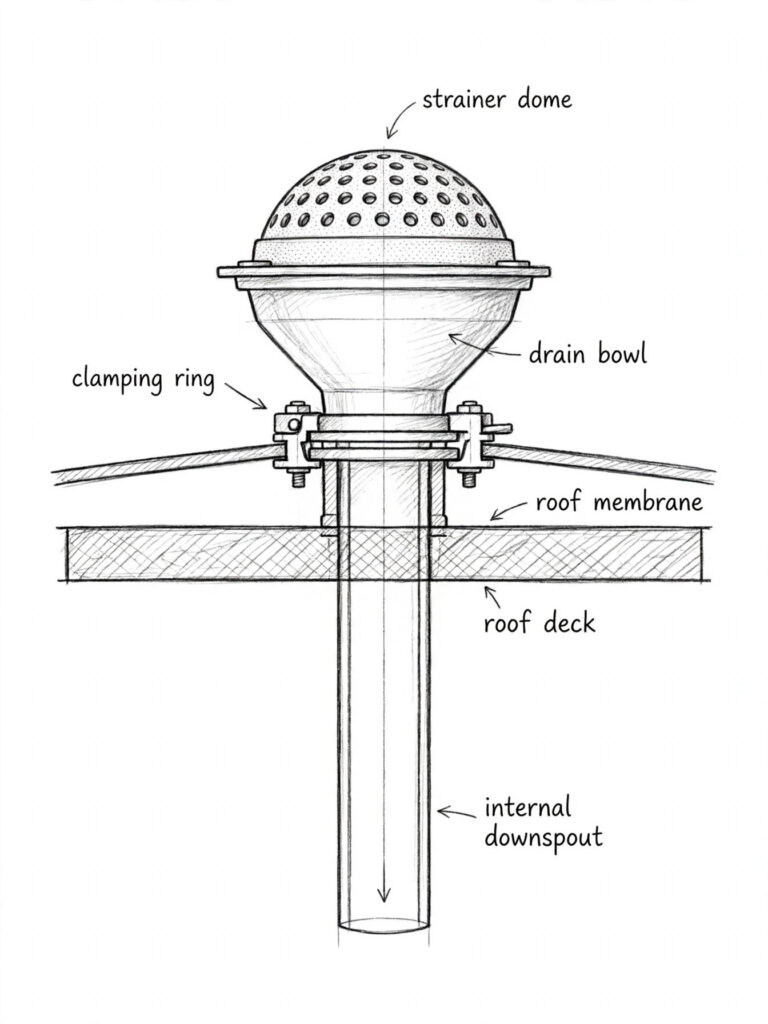
The American Society of Home Inspectors makes a useful point about scuppers: a good setup has primary scuppers at the level of the membrane and secondary scuppers about 2 inches above the low point, so the backup only works when the water actually rises. If water is pouring out of a scupper during an ordinary storm, that is not the system working. That is the backup telling you the primary drain already failed.
Signs your roof drains need cleaning now
You do not need to climb onto the roof to spot most drain trouble. The signs show up from the ground, from the rooms below, and from the roof edge if you can see it from a window. Check the list below after the next heavy rain, and treat anything in the “act now” column as a same-week call.
| What you see | What it usually means | How urgent it is |
|---|---|---|
| Water still standing on the roof 48 hours after rain | A drain is blocked, undersized, or sitting at a high point instead of the low point | Act now: this is ponding by the industry definition, and it shortens membrane life |
| A dark ring or tide line around a drain | Water has been rising to the same level and draining slowly, leaving mineral deposits behind | Book a visit soon: a partial blockage is one storm away from a full one |
| Green algae or moss growing in a ring around a drain | That spot stays wet long after the rest of the roof dries | Book a visit soon: the drain is clearing slowly, and growth will keep narrowing it |
| A ceiling stain directly below a drain location | Water is getting past the drain or the flashing around it | Act now: the leak is already inside the building |
| Water spilling from a scupper during a normal storm | The primary drain has failed and the backup is doing the work | Act now: the backup is your last line, and it may be blocked too |
| Leaves or debris matted over the strainer dome | The drain can only take a fraction of its normal flow | Book a visit soon, or clear the surface debris yourself if you can do it safely from a ladder |
| A drain that gurgles, or drains much slower than the others | A partial blockage in the bowl or the pipe below | Book a visit soon: this is the classic early warning |
One sign people miss is the stain that appears and then dries. A ceiling stain under a drain that only shows up after big storms and fades in dry weather still counts. Water travels along decking and insulation before it comes through, so the stain is rarely right under the entry point, and by the time it shows, the water has already been inside for a while. If your roof has a flat section and a stain has appeared below it, get the drains checked before you start opening ceilings.
Ponding deserves a number, because the weight adds up fast. Water weighs about 5.2 pounds per square foot for every inch of depth, so a pond 2 inches deep over a 1,000-square-foot area is more than 10,000 pounds of extra load sitting on the structure. That weight pushes the deck down a little further, which makes the low spot deeper, which holds more water next time. It is a slow cycle, and a clear drain is the cheapest way to break it.
What a proper service visit should include
This is the part most service pages skip, and it is the part that separates a real visit from a quick sweep. A proper roof drain cleaning service should cover every drain on the roof, not just the one you pointed at, and it should leave you with something in writing. Use this checklist when you compare quotes. If a company cannot say yes to most of it, keep looking.
- Every strainer lifted and cleaned. The crew removes each dome or grate, clears the debris trapped underneath it, and checks that the strainer is not cracked, corroded, or missing. A strainer that is gone is worse than a dirty one, because oversized debris can then drop straight into the pipe.
- Every drain bowl cleaned out. Below the strainer sits the bowl, where sediment, roofing granules, and biological growth collect. A good crew clears the bowl by hand and with a brush, then flushes it with water to confirm it flows freely into the pipe below. On a modified bitumen roof, granule buildup in the bowl is nearly universal after fifteen years or so, so this step matters more on older roofs.
- The clamping ring and flashing checked. The ring that holds the membrane to the drain body can corrode and lose its grip, letting water seep between the membrane and the drain. That leak often gets blamed on the membrane itself. A careful crew checks the ring is seated and the membrane is not pulling away from the drain.
- Scuppers and overflow drains checked too. The backup system only helps if it is clear. The crew should confirm the scupper openings are open and that nothing, cables included, is run through them in a way that blocks flow.
- The roof surface cleared around each drain. Debris does not stay where it lands. Wind and the slope of the roof push it toward the drains, so a visit that only clears the drain itself leaves the next clog sitting three feet away. The crew should clear the membrane around each drain and along the parapet edges.
- A flow test on every drain. After cleaning, water should be run through each drain to confirm it actually drains. A drain that looks clean and still drains slowly has a blockage deeper down, and that is worth knowing before the next storm.
- Before and after photos of each drain, with a short written report. This is the single best marker of a professional outfit. Each drain gets photographed before and after, pinned to a simple map of the roof, with a note on what was found and what still needs attention. You can file it, forward it to an owner or an insurer, and compare it with the next visit. The better commercial crews have been doing this for years, and there is no good reason a residential crew cannot do the same.
- A note on anything that is not a cleaning job. A corroded drain body, a failed clamping ring, or a drain that sits higher than the surrounding membrane are repair jobs, not cleaning jobs. A straight company tells you that on the spot instead of charging you for a cleaning that cannot fix it.
Ask for the report before you book. If a company says it does not provide one, that tells you something about how the visit will go.
How often should roof drains be cleaned?
Once a year is the minimum for most roofs, scheduled before the rainy season starts. That timing matters: the work that prevents a bad winter happens before the rain arrives, not in December when it is already coming down. Properties with mature trees nearby usually need two visits a year, once before leaf drop and once after it. Commercial roofs with large areas and many drains are often put on a quarterly schedule, with an extra check after any major storm.
| Roof situation | Suggested schedule | Why |
|---|---|---|
| Flat or low-slope roof, few trees nearby | Once a year, before the rainy season | Leaves and granules build up slowly, and one good clearing holds for the year |
| Trees overhanging or close to the roof | Twice a year, spring and fall | A single autumn storm can drop enough leaves to block every drain at once |
| Commercial roof with many drains | Quarterly, plus after major storms | One blocked drain can pond water across a whole roof section, and storms can block a drain that was clear last week |
| After any major storm, any roof | Within 24 hours, a quick check | Windblown debris moves fast, and the next rainfall will compound the problem |
| Roof with a history of ponding | Quarterly until the cause is fixed | The drain is only part of the story, and regular checks show whether the ponding is getting better or worse |
If your roof already has a maintenance plan, drain cleaning should sit inside it rather than beside it. Our roof maintenance guide lays out a year-round schedule for the whole roof, and drain clearing is one of the cheapest items on it. A quarterly drain visit on a commercial roof typically runs a few hundred dollars, which is a small number next to the cost of a membrane that failed early because water sat on it for years.
What does a roof drain cleaning service cost?
There is no single price for this work, because the job changes a lot with the roof. A single drain on an easy-access home roof is a different visit from a dozen drains on a three-story commercial building. Treat every number below as a planning range drawn from local service pages and trade guides, not a quote. The only number that counts is the one a company gives you after looking at your roof.
| Service | Typical range | What moves it |
|---|---|---|
| Single residential roof drain, surface clearing | Roughly $110 to $275 | Roof access, drain count, how much debris is packed in |
| Multiple drains, one residential visit | Roughly $185 to $395 | Number of drains, roof size, whether the pipe below needs work |
| Commercial roof drain clearing visit | Roughly $200 to $400 | Roof area, drain count, debris load |
| Single commercial building clean-off with drain clearing | Roughly $600 to $1,200 | Building size, number of drains, how much debris the roof holds |
| Camera inspection of the drain line | Roughly $175 to $300 | Usually recommended if a drain has overflowed more than once |
| Mechanical snaking of a blocked downspout | Roughly $300 to $800 | Pipe access, how deep the blockage sits |
| Hydro-jetting a severe blockage | Roughly $500 to $1,200 | Pipe condition, grease or root intrusion, access |
| Emergency visit after an overflow | Roughly $195 to $425 | After-hours timing, how much water is already inside |
| Annual pre-season maintenance visit | Roughly $95 to $210 per visit | Scheduled in advance, routine work, no emergency |
Four things move the price more than anything else. The first is access: a roof that needs a tall ladder, a hatch, or a lift costs more to work on than one with a simple stairwell hatch. The second is drain count, since each drain is its own job. The third is depth: a surface clearing is quick, while a blockage deep in the internal pipe needs a snake or a camera and sometimes a plumber rather than a roofer. The fourth is timing. A scheduled visit before the rainy season is the cheapest version of this service. An emergency call in the middle of a storm, with water already coming through a ceiling, is the most expensive, and it is also the visit you could have avoided.
Get the quote in writing, and ask what it includes. A low number that covers only the strainer is not cheaper than a higher number that covers the bowl, the flow test, and the photos. If two quotes look far apart, the difference is usually in that scope, not in the hourly rate.
How to vet a roof drain cleaning company
Most of the companies that do this work are local, and the best way to judge them is by the questions they ask before they quote. A company that quotes a flat price without asking how many drains you have, how high the roof is, or when it was last cleared is guessing. Here is what to look for, and what should make you pause.
| Green flag | Red flag |
|---|---|
| Asks how many drains the roof has and how to reach the roof before quoting | Gives a firm price over the phone with no questions about the roof |
| Licensed and insured, and willing to show proof | Cannot show insurance, or says it is not needed for “just a cleaning” |
| Includes before and after photos and a written report in the price | No photos, no report, and no record of what was done |
| Checks scuppers and overflow drains, not just the main drains | Only touches the drain you pointed at and leaves the rest |
| Tells you plainly when a drain needs repair, not another cleaning | Keeps selling cleanings for a drain that is corroded or sitting too high |
| Explains what the visit does not cover, like membrane repair | Claims the cleaning will fix a leak it has not looked at |
| Has reviews that mention flat roofs specifically, not just gutters | Reviews are all about gutter cleaning on pitched roofs |
| Offers a maintenance schedule and a reminder, without pressure | Pushes a yearly contract before the first visit is done |
Two checks are worth doing yourself. First, ask whether the company does this work on flat roofs regularly or whether it is mainly a gutter company that takes drain jobs on the side. The skills overlap but they are not the same, and a gutter crew may not know to check the clamping ring or the overflow scupper. Second, ask who does the work on the roof: the person you spoke to, or a subcontractor you will never meet. Neither answer is wrong, but you should know which one it is.
If you also need the gutters and downspouts on the pitched sections of the same house looked at, that is a related but separate job. Our guides to downspout cleaning and the signs of a clogged downspout cover that side, and a good company will be clear about which parts of your roof each price covers.
Can you clean a roof drain yourself?
For a single-story home with safe roof access, clearing surface debris from a strainer is a job many owners do themselves. Lift the strainer, pull out the leaves and silt by hand, clear the membrane around the drain, and run a hose into the bowl to confirm the water flows away. If the water drains freely and the strainer goes back on snugly, that is often the whole job.
Stop there if any of the following apply. Call a pro if the strainer will not lift without force, if the drain still drains slowly after the surface is clear, if you can see corrosion on the drain body or the clamping ring, or if the blockage is below the bowl where you cannot see it. Do not drive a stick, a screwdriver, or a plumbing snake down the drain from the roof. You can puncture the membrane around the drain bowl, push the blockage deeper, or damage a pipe joint you cannot see, and any of those turns a cheap cleaning into a repair.
Safety is the real boundary, and it is worth being blunt about. A flat roof looks safe because it is flat, but it is still a roof, and a fall from one hurts just as much as a fall from a pitched one. Stay off the roof entirely if it is wet, icy, or windy, if the roof is more than one story up and you have no safe access, or if you are not steady on a ladder. A professional crew carries fall protection, knows where the soft spots and skylights are, and works in pairs. If getting to the drain means leaning over a parapet edge or stepping onto a membrane you are not sure will hold you, that is the moment to hire it out. The same goes for any roof with a membrane you do not recognize: some membranes puncture easily under foot traffic, and a single misplaced step can open a leak that costs far more than the cleaning would have.
When cleaning is not enough: clean, repair, or replace
Most drain trouble is a cleaning job. Some of it is not, and the difference matters because paying for repeated cleanings on a drain that needs replacing wastes money and leaves the roof exposed. Use this table as a rough guide, and get a roofer’s opinion before you spend on the bigger items.
| Condition | Right response | Why |
|---|---|---|
| Leaves and silt around the strainer, drain flows well after clearing | Clean, then keep to a yearly schedule | The system works, it just needs maintenance |
| Drain bowl full of granules or sediment, slow flow that clears with flushing | Clean the bowl and flush, check the strainer is intact | Granule wash is normal on older membranes and builds up over time |
| Missing or cracked strainer dome | Replace the strainer, usually a small part | Without it, oversized debris drops straight into the pipe and the next blockage is deeper |
| Clamping ring corroded, membrane pulling away from the drain | Repair: replace the ring and reseal the membrane at the drain | Water is seeping past the drain, and cleaning will not stop it |
| Cast iron drain body cracked or corroded through | Replace the drain, roughly $800 to $2,500 installed depending on size and membrane work | A cracked body leaks inside the building, and patching it rarely holds |
| Drain sitting higher than the surrounding membrane | Rebuild the low point or lower the drain | Water cannot flow uphill, so the drain will never clear its area no matter how clean it is |
| Ponding returns after every rain even with clean drains | Professional drainage evaluation, possibly an added drain or tapered insulation | The problem is slope or capacity, not debris, and it needs a design fix |
A drain that is over twenty years old deserves a closer look during any re-roof. Replacing it while the membrane is already open adds little cost, while replacing it later means cutting into a finished roof. If your roofer suggests replacing the drains as part of a re-roof, that is usually sound advice rather than an upsell.
Roof drain work also sits next to general roof care. If your drains keep clogging because the roof surface is shedding granules or the membrane is aging, the drains are telling you something about the roof itself. Our roof cleaning guide covers what surface cleaning can and cannot do for a membrane roof, and our roof gutter cleaning guide covers the edge drainage on the pitched sections of the same house.
Questions people ask
What is a roof drain cleaning service?
A roof drain cleaning service clears the drains built into a flat or low-slope roof. The crew lifts each strainer, clears the debris from the drain bowl, checks the clamping ring and flashing, confirms water flows freely into the pipe below, and usually leaves before and after photos with a short report.
How much does roof drain cleaning cost?
A single residential drain usually runs somewhere around $110 to $275 for a surface clearing, and a commercial roof visit often lands between $200 and $400. Deeper work costs more: snaking a blocked internal pipe can run $300 to $800, and hydro-jetting a severe blockage can run $500 to $1,200. Every price varies with roof access, drain count, and how deep the blockage sits, so treat these as planning ranges and get a written quote after someone has looked at your roof.
How often should roof drains be cleaned?
At least once a year, before the rainy season. Roofs with trees nearby usually need two visits a year, and commercial roofs with many drains are often cleaned quarterly. Add a check within a day after any major storm, since windblown debris can block a drain that was clear the week before.
What is the difference between a roof drain and a gutter?
A gutter hangs along the edge of a pitched roof and catches water running off the slope. A roof drain sits in the surface of a flat or low-slope roof and feeds water into a pipe that runs down through the building. A house can have both, on different sections of the roof.
How do I know if my roof drain is clogged?
Water standing on the roof 48 hours after rain is the clearest sign. Other signs are a dark tide line around the drain, algae growing in a ring near it, a ceiling stain below the drain, water spilling from a scupper during a normal storm, or a drain that gurgles and drains slower than the others.
Can I clean a roof drain myself?
You can clear surface debris from a strainer on a single-story roof with safe access. Lift the strainer, remove the leaves and silt by hand, and run a hose into the bowl to confirm flow. Leave it to a pro if the strainer will not lift, the drain still drains slowly after clearing, you see corrosion, or the blockage is below the bowl. Never force tools down the drain, and stay off the roof entirely when it is wet, windy, or more than one story up without safe access.
Does roof drain cleaning replace a roof inspection?
No. A cleaning crew clears drains and documents what it finds, but it does not replace the annual inspection a licensed roofer performs, which is often what keeps a membrane warranty in force. Think of drain cleaning as the maintenance between inspections, not a substitute for them.
A roof drain cleaning service clears the drains built into a flat or low-slope roof. The crew lifts each strainer, clears the debris from the drain bowl, checks the clamping ring and flashing, confirms water flows freely into the pipe below, and usually leaves before and after photos with a short report.
A single residential drain usually runs somewhere around $110 to $275 for a surface clearing, and a commercial roof visit often lands between $200 and $400. Deeper work costs more: snaking a blocked internal pipe can run $300 to $800, and hydro-jetting a severe blockage can run $500 to $1,200. Every price varies with roof access, drain count, and how deep the blockage sits, so treat these as planning ranges and get a written quote after someone has looked at your roof.
At least once a year, before the rainy season. Roofs with trees nearby usually need two visits a year, and commercial roofs with many drains are often cleaned quarterly. Add a check within a day after any major storm, since windblown debris can block a drain that was clear the week before.
A gutter hangs along the edge of a pitched roof and catches water running off the slope. A roof drain sits in the surface of a flat or low-slope roof and feeds water into a pipe that runs down through the building. A house can have both, on different sections of the roof.
Water standing on the roof 48 hours after rain is the clearest sign. Other signs are a dark tide line around the drain, algae growing in a ring near it, a ceiling stain below the drain, water spilling from a scupper during a normal storm, or a drain that gurgles and drains slower than the others.
You can clear surface debris from a strainer on a single-story roof with safe access. Lift the strainer, remove the leaves and silt by hand, and run a hose into the bowl to confirm flow. Leave it to a pro if the strainer will not lift, the drain still drains slowly after clearing, you see corrosion, or the blockage is below the bowl. Never force tools down the drain, and stay off the roof entirely when it is wet, windy, or more than one story up without safe access.
No. A cleaning crew clears drains and documents what it finds, but it does not replace the annual inspection a licensed roofer performs, which is often what keeps a membrane warranty in force. Think of drain cleaning as the maintenance between inspections, not a substitute for them.
Sources
- American Society of Home Inspectors: Flat Roof Drainage: how interior drains, strainers, and scuppers work, why ponding happens, and how secondary scuppers are set about 2 inches above the low point.
- Flat Roof Report: Blocked Roof Drains on Commercial Roofs: drain anatomy, blockage causes, clearing methods, replacement costs, and the quarterly inspection schedule.
- Flat Roof Report: Ponding Water on Flat Roofs: the NRCA 48-hour ponding definition, the 1/4-inch-per-foot slope recommendation, water weight per square foot, and severity assessment.
- RueVac Property Services: Commercial Roof Clean-Offs and Drain Cleaning: what a full service visit includes, before and after photo reporting, overflow scuppers as backup drainage, and single-building price ranges.
Last updated: November 11, 2026
