
Last updated: October 31, 2026
Soft wash roof cleaning is a low-pressure way to clean a roof, where a cleaning solution does the work and gentle water rinses it away, instead of a high-pressure jet blasting the surface clean. If your roof has black streaks, green patches, or crusty lichen, the method you pick matters more than the machine you rent, because the wrong one can strip the very surface that protects your shingles.
Most homeowners face this choice once, when a contractor quotes a wash or a neighbor mentions a pressure washer in the garage. The two methods sound like versions of the same job. They are not. One kills the growth that causes the stains. The other knocks the visible part off and leaves the rest alive underneath. This article compares them head to head, by roof material, by stain type, and by what each one costs you over time, so you can spot a bad quote before anyone climbs a ladder.
Contents
- What Soft Washing a Roof Actually Means
- Why Pressure Washing Damages Most Roofs
- Soft Wash vs Pressure Wash: The Comparison
- Which Method Suits Your Roof Material
- What Each Method Does to Each Kind of Growth
- How a Proper Soft Wash Runs, Step by Step
- What a Soft Wash Costs, and What It Saves
- When Pressure Washing a Roof Is Ever Acceptable
- DIY or Hire a Pro for a Soft Wash
- Questions to Ask Before You Book
- Frequently Asked Questions
- Sources
What Soft Washing a Roof Actually Means
Soft washing a roof means applying a diluted cleaning solution at low pressure, letting it sit long enough to kill algae, moss, and lichen, then rinsing gently or letting rain finish the job. The pressure is close to a garden hose, not a pressure washer. The chemistry does the cleaning, the water only carries it on and washes it off.
That distinction is the whole argument in one sentence. A pressure washer cleans by force. A soft wash cleans by killing what is growing. On a roof, force is the problem, because shingles, tiles, and coatings are built to shed rain falling straight down, not to resist a jet driven sideways or upward into their laps.
The solutions used are usually built around diluted sodium hypochlorite, the active ingredient in household bleach, mixed with water and a surfactant, a soap-like additive that helps the mix cling to a slope instead of sheeting straight off. The Asphalt Roofing Manufacturers Association describes a 50:50 mix of laundry-strength liquid chlorine bleach and water for asphalt roofs, left for 15 to 20 minutes, then rinsed thoroughly with low-pressure water. GAF gives a gentler homeowner recipe in its technical bulletin: 4 gallons of water, 1 gallon of bleach, and 1 cup of TSP or a phosphate-free substitute, applied with a garden sprayer, left up to 20 minutes, then rinsed at low pressure. Your shingle maker’s instructions come first if they differ from either one, and stronger is not better. A mix that is too strong risks plant damage and surface harm without cleaning any faster.
One more thing the name hides: a soft wash is not instant. Algae fades over days and weeks as rain washes the dead growth away, and moss loosens over time rather than vanishing on the day. If a contractor promises a roof that looks brand new before they pack up, ask what they plan to scrub or blast to get there.
Why Pressure Washing Damages Most Roofs
Pressure washing a roof means driving water at hundreds or thousands of pounds per square inch across a surface that was never designed to take it. On asphalt shingles, that jet strips the mineral granules that shield the asphalt from sunlight, and it can lift shingle edges and drive water under the laps. Once granules are gone, they do not grow back, and the shingle ages faster in that spot.
The manufacturers say this plainly, and it is worth quoting them rather than taking a cleaner’s word for it. The Asphalt Roofing Manufacturers Association warns never to use a pressure washer on an asphalt shingle roof, because it causes granule loss and very likely premature failure of the roof system. GAF’s bulletin on blue-green algae staining says the same in its own words: do not power wash shingles, since it may dislodge granules and lead to premature shingle failure. That is not a preference or a sales line. It is the guidance from the people who make the shingles, and it is the reason a pressure-washed shingle roof can look clean in photographs and still be worse off a year later.
The damage is not limited to shingles. High pressure can crack brittle tile, chip coatings on metal, and force water under laps and flashings on almost any roof. It can also drive water into the deck and attic, where the leak may not show up until long after the crew has left. And because the jet only removes the visible growth, the roots and spores underneath survive, so the stains come back faster on a surface that is now rougher and holds water longer.
There is one honest exception, covered below: a few hard surfaces can take careful pressure, but a roof is rarely one of them, and asphalt shingles never are.
Soft Wash vs Pressure Wash: The Comparison
Soft washing and pressure washing differ in pressure, in what does the cleaning, in what they remove, and in how long the result lasts. The table below puts the two side by side so the trade-off is visible at a glance.
| Soft wash | Pressure wash | |
|---|---|---|
| Pressure | Low, roughly garden-hose level (often under 100 to 500 PSI depending on the rig) | High, commonly 1,300 to 4,000 PSI on a standard machine |
| What does the cleaning | Diluted cleaning solution that kills algae, moss, and lichen | Water force that strips surface material |
| What it removes | Growth at the root, plus the staining it causes | Visible dirt and growth on the surface only |
| Risk to asphalt shingles | Low when done to manufacturer guidance | Granule loss, lifted edges, water driven under laps |
| How long it stays clean | Commonly a few years before regrowth shows, depending on shade and climate | Often months, since roots and spores survive |
| Plant and runoff risk | Real, and must be managed with pre-wetting and rinsing | Lower chemical risk, higher surface-damage risk |
| Best for | Shingle, tile, metal, and cedar roofs in careful hands | Concrete, brick, and other hard flat surfaces |
Read that table with one caution: the exact PSI numbers vary by machine and nozzle, and no single number makes a method safe. A wide fan tip at a distance is gentler than a pinpoint jet up close, but neither turns a pressure washer into a soft wash. What makes a soft wash safe is the combination of low pressure and a solution that kills growth, not any one pressure reading on a gauge.
Which Method Suits Your Roof Material
The right method depends on the roof in front of you, not on the equipment a contractor happens to own. Work through this table before you agree to anything.
| Roof material | Verdict | Why |
|---|---|---|
| Asphalt shingles | Soft wash only | Granules strip under pressure, and both ARMA and GAF advise against power washing |
| Clay or concrete tile | Soft wash first | Pressure can crack brittle tile and disturb mortar at ridges and valleys |
| Metal roofing | Soft wash first | Pressure can damage coatings and force water under laps and flashings, especially on older roofs |
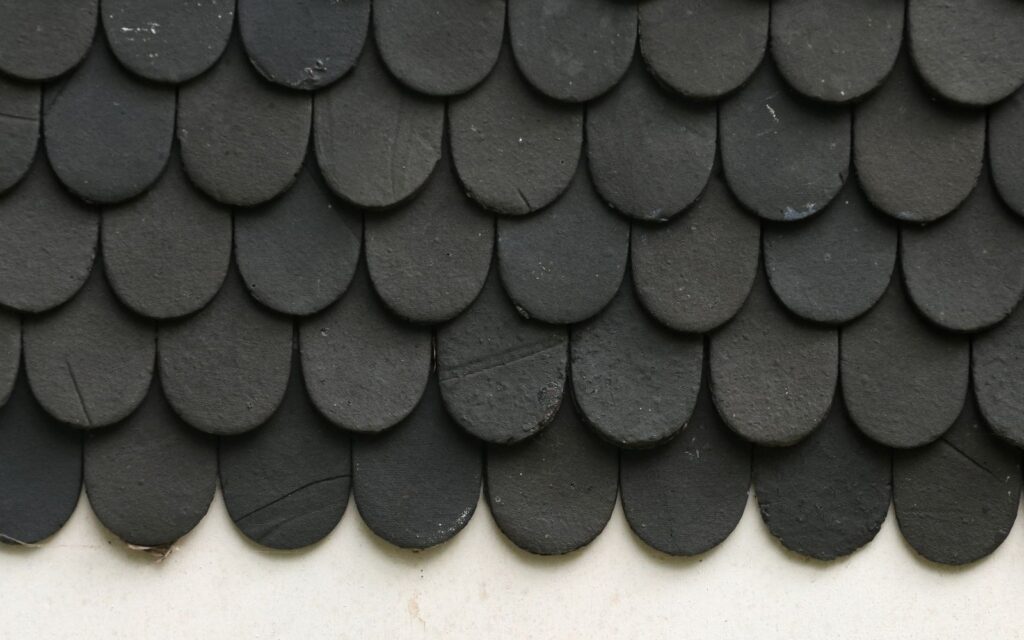
| Cedar shakes and shingles | Soft wash or gentle oxygen-bleach treatment, in careful hands | Pressure splinters wood grain and drives water into the shakes |
| Flat or low-slope membrane roofs | Soft wash or manufacturer-approved low-pressure cleaning | High pressure can damage seams and coatings; follow the membrane maker’s instructions |
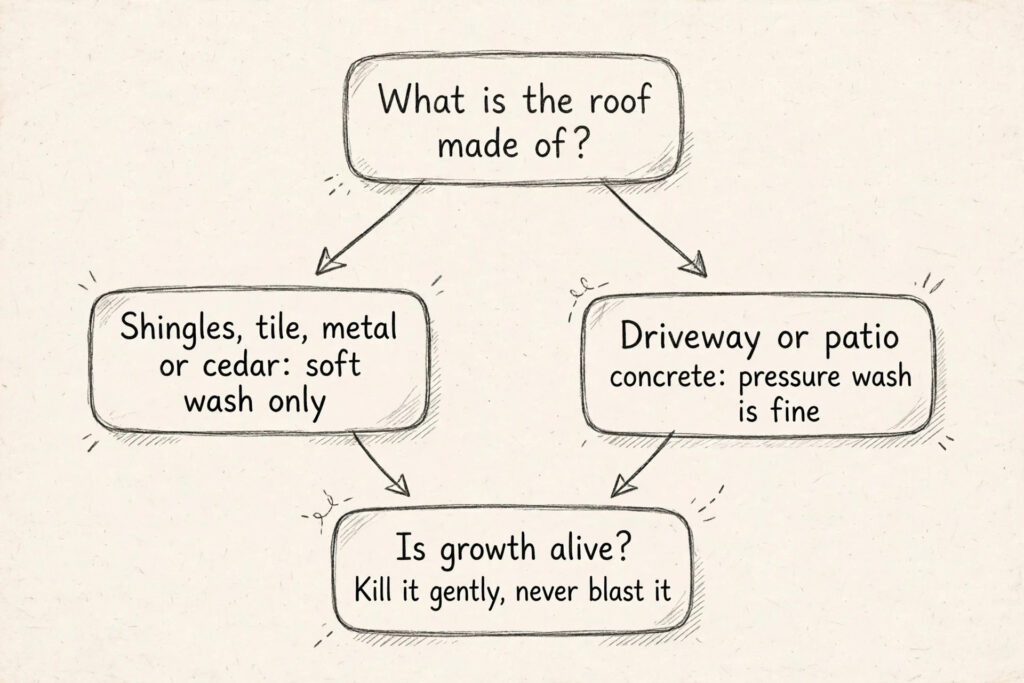
| Concrete driveway or patio (not a roof) | Pressure washing is fine | Hard, flat surfaces are built to take it, which is why the same machine is right there and wrong on the roof |
If a contractor tells you every roof gets the same treatment, that is a red flag, not a selling point. A crew that soft washes shingles and still pressure washes a concrete driveway is using each tool where it belongs. A crew that pressure washes everything is using one tool for every job.
What Each Method Does to Each Kind of Growth
Not all roof stains are the same problem, and the two methods handle them very differently. Black streaks are usually algae called Gloeocapsa magma, a blue-green organism that feeds on the limestone filler in asphalt shingles and spreads through airborne spores. A soft wash kills it, and the streaks fade over the following weeks. A pressure wash blasts the dark sheath off the surface and leaves the organism alive underneath, so the streaks return, often within months.
Moss is a tougher customer. It grows in thick tufts that hold water against the roof and can lift shingle edges, and ARMA notes it can cause leaks in severe cases. A soft wash kills moss, which then loosens and can be cleared gently once dead and dry. Pressure washing live moss tears at the tufts and the shingles under them at the same time, which is why moss should be killed first, never blasted off while it is still gripping the roof.
Lichen is the most patient problem of all. It grips the surface in flat, crusty patches, and scraping it off takes granules or finish with it. A soft wash treatment kills it, but the dead patches may sit visibly for weeks before rain and time carry them away. Anyone who promises instant lichen removal is planning to scrape, and scraping is exactly what the manufacturers warn against.
Debris alone, leaves and twigs with no growth underneath, needs neither method. A blower or gentle hand removal, working downward, clears it without chemicals or pressure. Using a pressure washer on a debris problem is like using a hammer to dust a shelf.
How a Proper Soft Wash Runs, Step by Step
A proper soft wash follows a sequence, and you can use it to judge a quote or a crew. If steps are missing, ask why before work starts.
- Inspect first, from the ground and then up close. Look for cracked, curled, or missing shingles, damaged flashing, and soft spots. A wash does not fix a failing roof, and cleaning over active damage can push water into places it should not go.
- Clear loose debris by hand or blower, working downward so nothing is driven under shingle edges. Check the gutters and downspouts at the same time, since wash runoff ends up there.
- Protect the plants. Wet down shrubs, grass, and garden beds before any solution goes on, and plan to rinse them again afterward. ARMA and GAF both stress this, and a crew that skips it is cutting a corner that your landscaping pays for.
- Apply the solution at low pressure, starting low on the slope and working in even passes, so coverage is uniform and no section is soaked twice while another is missed.
- Let it dwell. For the ARMA mix, that is 15 to 20 minutes, and the solution should not be allowed to dry completely on the roof, since dried solution is harder to rinse fully.
- Rinse gently with low-pressure water, again working downward, and rinse siding, gutters, and plants that caught runoff. Some crews leave part of the rinse to rain; either way, no strong jet should touch the shingles at any point.
- Check the gutters and downspouts after the rinse. Dead growth and granules wash down, and a clogged downspout after a roof wash is a common, avoidable follow-up problem.
- Wait for the result. Algae fades over days and weeks, moss loosens over time, and lichen takes longest. Judge the job after a few rains, not on the afternoon it was done.
For a fuller picture of roof cleaning as a whole, including safety, frequency, and cost factors, our complete roof cleaning guide covers the ground this comparison deliberately skips.
What a Soft Wash Costs, and What It Saves
Cost is where the comparison gets honest, because a pressure wash often looks cheaper on the quote and costs more over the life of the roof. Published contractor guides put a professional soft wash for an average home in the range of a few hundred dollars, varying with roof size, pitch, stories, and how heavy the growth is. Steep, tall, or heavily moss-covered roofs cost more, and tile roofs often cost more than shingles. Get written quotes that name the method, not just a price, since a cheap pressure wash and a proper soft wash are not the same service at different prices.
The saving is not in the day rate. It is in what you do not pay for later. A soft wash result commonly lasts a few years before regrowth shows, while a pressure-washed roof often shows regrowth within months, because the roots survived. That means fewer repeat visits, and it means you are not paying, in granule loss and shortened shingle life, for a clean look that fades fast. Set against a full roof replacement, which runs into five figures, a wash every few years that preserves the shingles is cheap maintenance, not a luxury.
Two cost traps are worth naming. The first is a quote that is far below the rest with no method named: it is often a pressure wash dressed up as a roof clean. The second is an upsell that claims a wash will fix leaks, curling shingles, or a roof at the end of its life. A wash cleans. It does not repair, and any crew that sells it as a repair is selling something else under a cleaning name.
When Pressure Washing a Roof Is Ever Acceptable
Pressure washing a roof is acceptable only in narrow cases, and asphalt shingles are never one of them. Some contractors use controlled pressure on hard surfaces like concrete tile or certain metal roofs, with wide fan tips, low settings, and careful technique, and some manufacturers allow limited pressure on specific products. Even there, the burden of proof sits with the contractor: ask which manufacturer guidance allows it for your exact roof, and ask to see it in writing.
A second narrow case is rinsing, not cleaning. A low-pressure rinse after a chemical treatment is part of a soft wash, not a pressure wash by another name. The difference is intent and force: a rinse carries solution and dead growth away, while a pressure wash uses force to strip the surface. If you cannot tell which one a crew is doing, ask them to explain it before they start, and walk away if the answer is a shrug.
For everything else, the rule is simple. If the surface is a roof and the growth is living, kill it gently. Save the pressure washer for the driveway, where it belongs.
DIY or Hire a Pro for a Soft Wash
A soft wash sits on the boundary between a careful DIY job and a job worth hiring out, and the deciding factor is usually the roof itself, not the chemicals. A single-story roof with a gentle slope, safe ladder access, and light algae staining is a job a careful homeowner can do from a ladder with a garden sprayer, following the GAF or ARMA mix, with eye protection, gloves, and a helper on the ground. A steep, tall, or multi-story roof, a roof with moss, or any roof you cannot reach without walking on it, is a hire-out job. Wet, treated shingles are slick, and most roof cleaning injuries come from falls, not from the solution.
If you do it yourself, work on a dry, calm day, never mix bleach with ammonia or acids, and never work alone with a sprayer on a roof. Keep the solution off plants by pre-wetting them, and rinse everything that caught runoff. If you hire it out, ask the questions in our guide to questions to ask before hiring a cleaning company, including the method they will use, the mix they will apply, and how they protect landscaping. A good answer names soft washing without being prompted. A bad answer is “we pressure wash everything” or a refusal to say.
Either way, check the gutters after the wash. If the gutters are due as well, see our guide to cleaning the roof and gutters together before booking, so the roof is washed first and the gutters are cleaned after. Our gutter maintenance guide explains the routine, and our guide to how often gutters need cleaning helps you set the follow-up, since wash runoff and dead growth end up in the gutters and downspouts. If a downspout backs up after a wash, our guide to signs of a clogged downspout shows what to check first.
Questions to Ask Before You Book
Use these five questions on any quote, and treat vague answers as answers.
- What method will you use on my roof, in your own words? You want to hear low-pressure chemical treatment, not a brand name or a machine model.
- What solution will you apply, and at what strength? A crew that cannot name its mix has not thought about your roof or your plants.
- How will you protect my landscaping, siding, and gutters from runoff? Pre-wetting, controlled rinsing, and a gutter check should all be mentioned.
- What will the roof look like in two weeks, and in two years? Honest crews set expectations about gradual fading and regrowth, not instant perfection.
- What does your quote exclude? Damage found during inspection, gutter cleaning, and follow-up treatments should be named, not discovered later.
If a contractor cannot answer the first question clearly, do not let them on the roof. The method is the job, and everything else is detail.
Frequently Asked Questions
Yes, for almost every residential roof. Soft washing kills algae, moss, and lichen at low pressure without stripping shingle granules, while pressure washing removes only the visible growth and can damage shingles, tile, and coatings. Both ARMA and GAF advise against power washing asphalt shingles.
No, not safely as a cleaning method. Even lower pressure settings can dislodge granules and drive water under shingle laps, and manufacturers advise against power washing shingles outright. A low-pressure rinse after a chemical treatment is part of a soft wash, not a pressure wash.
Commonly a few years before regrowth shows, depending on shade, tree cover, and climate. North-facing and heavily shaded slopes regrow first. A pressure-washed roof often shows regrowth within months, because the growth underneath was never killed.
It kills all three, but on different timetables. Algae fades over days and weeks, moss loosens over time once dead, and lichen takes longest to wash away after treatment. None of them should be scraped or blasted off while alive.
Done to manufacturer guidance, it should not. Power washing is the method manufacturers warn against, and damage from it can affect warranty coverage. Keep the contractor’s written method statement and your shingle maker’s cleaning guidance together, and ask the contractor to confirm in writing that their method follows it.
On a low, easily reached roof with light algae, yes, using a garden sprayer and the GAF or ARMA mix, with eye and skin protection and a helper on the ground. On a steep, tall, or moss-covered roof, hire a pro. Falls are the main risk, and a wet treated roof is slicker than it looks.
Because a soft wash kills growth rather than blasting it off, and dead algae, moss, and lichen fade and wash away over days and weeks with rain. Judge the result after a few rains. If stains are unchanged after several weeks, ask the contractor about a follow-up treatment rather than a stronger method.
The Bottom Line
Soft wash wins for roofs because it treats the cause, not the symptom, and it does so without stripping the surface it is meant to protect. Pressure washing wins on driveways and patios, where force is safe and growth has nowhere to hide. Put each tool where it belongs, and the roof lasts longer, the stains stay away longer, and the quote you accept is for a cleaning, not a gamble.
Sources
- Asphalt Roofing Manufacturers Association guidance on algae and moss prevention and cleaning for asphalt roofing systems, including the 50:50 bleach and water mix, the 15 to 20 minute dwell, the low-pressure rinse, and the warning against pressure washers.
- GAF technical bulletin TAB-R-102 on blue-green algae staining of shingled roof surfaces, including the 4 gallons of water, 1 gallon of bleach, and 1 cup of TSP recipe, the garden sprayer application, and the warning not to power wash shingles.

4 Comments
Pingback: Roof Cleaning Guide: Methods, Safety & When to Hire
Pingback: Should You Clean Roof and Gutters Together? Bundling Guide
Pingback: Preventative Roof Maintenance Checklist by Season - Home Exterior Lab
Pingback: Roof Maintenance Guide for Homeowners