

Last updated: November 28, 2026
A gutter full of wet leaves looks like a small job until you stand under it with the wrong tool in your hand. A scoop that fits a 5-inch gutter will not fit a 6-inch one, a leaf blower moves dry leaves fine and smears wet ones into paste, and a pressure washer on a ladder is a fall waiting to happen. The tools are cheap, mostly, but picking the right ones is what decides whether the job takes an hour or a whole Saturday, and whether you do it from the ground or from the top of a ladder.
Short answer: Rain gutter cleaning tools fall into two groups: ground tools that keep you off a ladder (a telescoping hose wand, a leaf blower gutter kit, a wet/dry vacuum kit, or tongs on a pole) and ladder tools for a closer clean (a plastic gutter scoop, a bucket, a garden hose, and a stable extension ladder with a stabilizer). For most single-story homes, a scoop, a bucket, gloves, and a hose wand cover the whole job. Two-story homes and heavy, wet debris call for a vacuum kit or a pro. The rest of this guide compares each tool, shows what it costs, and helps you pick the kit that fits your house.
Contents
- What gutter cleaning tools actually are
- The first decision: ground or ladder
- Ground tools, one by one
- Ladder tools for a closer clean
- Downspout tools: clearing the outlet and the pipe
- Safety gear that counts as tools
- Pick your kit: what fits your house
- What the kit costs
- Tools and habits to skip
- Using the kit: a sensible order
- DIY or hire a pro
- Questions people ask
- Sources
What gutter cleaning tools actually are
Rain gutter cleaning tools are the hand tools, pole attachments, and powered kits that remove leaves, needles, grit, and sludge from gutters and downspouts, plus the safety gear that makes the work survivable. Nobody needs all of them. The job has three parts, and each part has its own tool: lift the loose debris out of the trough, flush the grit that is left, and test the downspout to prove water can get away. A tool earns its place if it does one of those three things well. A tool that does none of them, like a generic garden trowel with a sharp steel edge, is worse than no tool at all, because it can gouge an aluminum gutter while it works.
Think in terms of a kit, not a single purchase. The cheapest complete kit, a plastic scoop, a bucket, gloves, and a hose, runs under twenty dollars and handles a single-story home with light debris. The most expensive, a dedicated gutter vacuum with carbon poles and a camera head, runs into the hundreds and is really a pro setup. Most homes sit between those two ends, and the middle of the range is where the good buys live. Our gutter maintenance guide covers the job itself, timing, and inspection, while this page stays with the equipment: what each tool does, where it beats the alternatives, and where it falls short.
One thing to settle before buying anything is the size of your gutters. Most homes have 5-inch gutters, larger roofs and heavy-rain areas often have 6-inch ones, and scoops and tongs are shaped to match one width or the other. A scoop made for a 5-inch trough rattles around uselessly in a 6-inch gutter and misses the corners. Measure the width across the top of the trough before you order, and if you are unsure whether your gutters are sized right for the roof at all, our gutter size calculator runs the numbers from roof area and rainfall.
The first decision: ground or ladder
Every gutter cleaning tool works from one of two places, the ground or a ladder, and that choice matters more than any brand name. Ground tools are safer and slower, and you work half blind, feeling for debris you cannot see. Ladder tools are faster and more thorough, and they put you at height, which is where nearly every serious injury in this job comes from. The table below is the honest trade, so you can decide before you spend anything.
| Approach | How it works | Best for | Weak spot | Typical cost |
|---|---|---|---|---|
| Ground tools | Poles, wands, and vacuum kits reach the gutter from the lawn | Single-story homes, light dry debris, anyone who dislikes ladders | Packed sludge, downspout plugs, and anything you need to see up close | Low to high, depending on the kit |
| Ladder tools | Scoop, bucket, and hose used from an extension ladder | Wet or packed debris, inspection, clearing downspout outlets by hand | Fall risk, slow repositioning, needs a spotter and solid footing | Low, mostly the ladder itself |
| Mixed approach | Ground tools for the long runs, ladder for outlets and problem spots | Most homes, and the approach most careful homeowners settle on | Costs a little more, since you buy both sets | Moderate |
Here is the rule I use. If the gutter is on a single story, the ground is flat, and the debris is leaves from this season, ground tools can do the whole job. If the gutter is on a second story, the roof is steep, the ground slopes, or the debris has been sitting long enough to turn to sludge, the ladder is where the real cleaning happens, and that is also where you should think hard about hiring the job out instead. The tool reviews below follow the same split, so start with the group that matches your house and skip the rest until you need it.
Ground tools, one by one
Ground tools exist for one reason: they keep your feet on the lawn. Four designs dominate the market, and they are not interchangeable. Each one removes debris in a different way, and each one fails on a different kind of mess. Knowing which failure belongs to which tool is what stops you buying the wrong one twice.
Telescoping hose wand
A telescoping hose wand is a rigid tube that screws onto a garden hose and ends in a curved nozzle that hooks over the gutter lip. You stand on the ground, extend the pole, and spray water along the trough. The Orbit telescoping wand, the one most testers keep coming back to, extends from 40 to 70 inches, which covers a single-story gutter and not much more. As a final rinse after the solids are out, it is the best tool in this group. As a primary cleaning method, it is a poor one: water turns dry leaves into slurry and washes that slurry straight into the downspout, where it can set into a plug that is harder to clear than the leaves were. Buy one for rinsing and flow testing, not for the cleaning itself. Bob Vila’s tested roundup of gutter cleaners rates the Orbit wand as a strong runner-up for exactly this role, simple, cheap, and best used after the debris is already out.
Leaf blower gutter kit
A leaf blower gutter kit is a set of curved tubes that clips onto a leaf blower and aims the air stream up into the trough. On bone-dry leaves in an open gutter, it clears a run in minutes, and it is the fastest ground tool there is. On anything wet, it fails completely: wet leaves do not move, they smear, and what the blower does shift tends to travel along the gutter and lodge over the downspout outlet, turning a spread-out problem into a single hard plug. It also throws dust and old debris into the air, so wear glasses and a mask, and warn anyone nearby. A blower kit makes sense if your gutters fill with dry leaves every fall and you clean them often. If you clean once a year and the debris is already matted, skip it. This Old House’s gutter tool picks name a cordless blower as their leaf blower choice, while noting that a scoop beats it on heavy buildup every time.
Wet/dry vacuum gutter kit
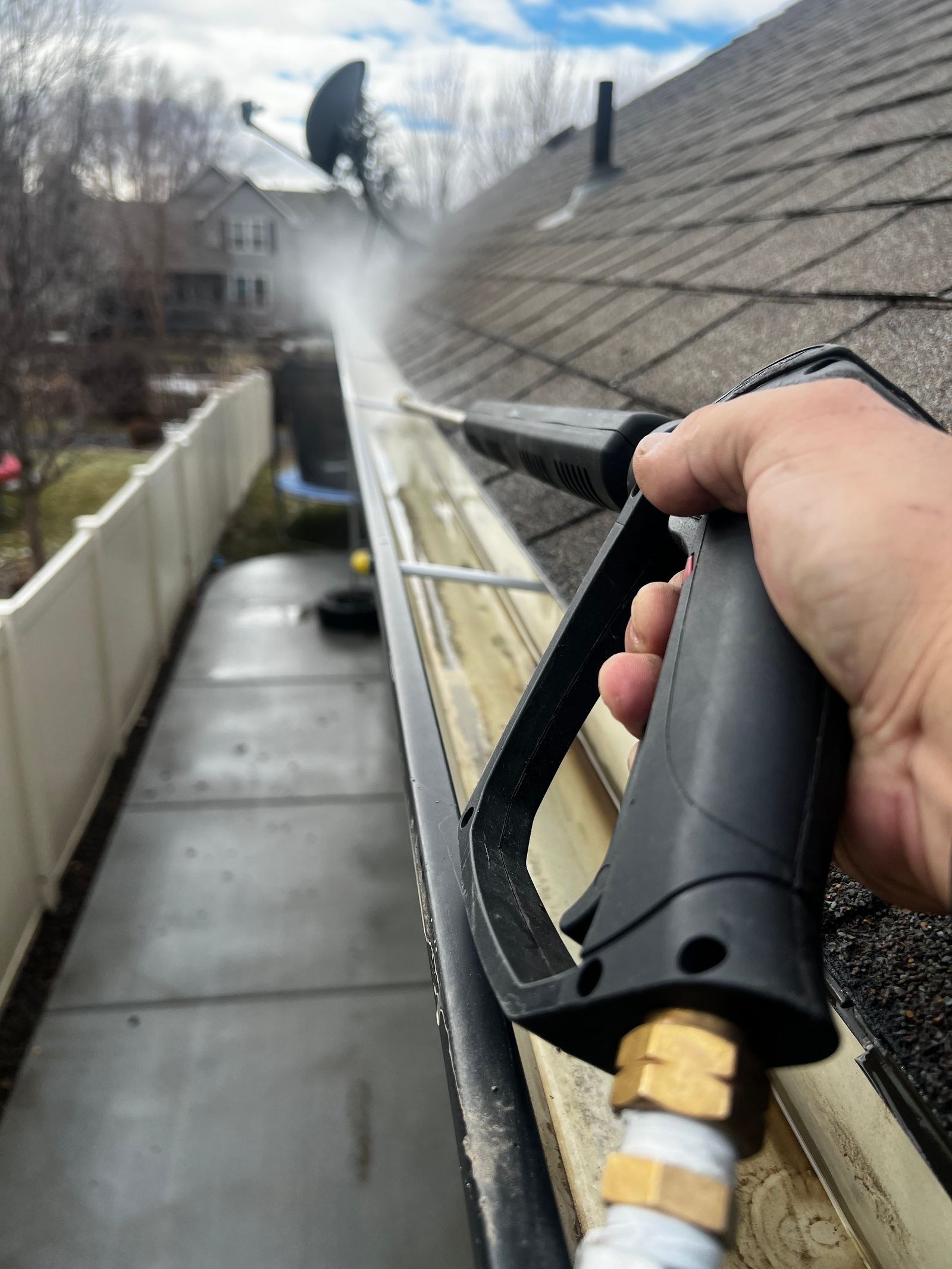
A wet/dry vacuum gutter kit is a set of interlocking poles and a curved nozzle that connects to a shop vacuum, so the debris is sucked out of the gutter instead of pushed along it. It handles dry and wet debris, it contains the mess in a bin instead of dropping it on the lawn, and it is the only ground tool that genuinely copes with a gutter that has not been touched in a year or two. The trade is weight and cost: the poles get heavy at full extension, the vacuum itself is bulky to drag around the house, and a good kit costs several times what a wand does. Dedicated gutter vacuums with carbon poles and camera heads go further and cost far more, and those are pro equipment in practice. For a homeowner with two-story gutters and heavy tree cover, though, a shop-vac kit is the most capable ground option you can buy, and it is the one I would pick if I could only own one powered tool for this job.
Tongs and scoops on a pole
Gutter tongs are spring-loaded jaws on the end of a pole, closed by a cord or trigger at the bottom, that grab a handful of leaves and lift it out of the trough. A scoop on a pole does the same job by dragging debris toward you. Both are cheap, mechanical, and surprisingly effective on a single-story home with light debris. Their limit is precision: you are working blind unless you add a camera, you lift a handful at a time, and on a long run the work is slow. They are also the only ground tool that physically removes debris instead of moving it or washing it along, which is why they pair so well with a hose wand. Tongs first, wand second, and the gutter is genuinely clean instead of just rearranged. Bob Vila’s testing found a tong-style tool the best overall ground option for exactly this reason, though it needs an extension pole of its own and it collects debris in one spot rather than removing it from the roofline entirely.
Ladder tools for a closer clean
Ladder work is where gutter cleaning is at its most thorough, because you can see the trough, feel the sludge, and clear the outlet with your hands. It is also where the job gets dangerous, so the tools in this group include the ladder itself and the gear that keeps it steady. Nothing here is exotic. The whole kit fits in a bucket.
The gutter scoop
A gutter scoop is a small plastic shovel shaped to match the curve of the gutter trough, and it is the single most useful tool in this job. This Old House calls it the best tool for most gutters, and the reasoning is simple: it is cheap, it fits the channel, it lifts wet and dry debris alike, and it does not damage the gutter. Pick a flexible plastic scoop over a metal trowel. A steel edge can scratch through the coating on an aluminum gutter and start corrosion, and it can crack a vinyl gutter in cold weather. The Amerimax Gutter Getter, the scoop most testers recommend, costs a few dollars and has a flexible tip that follows the trough. Buy two, since they are easy to drop and hard to find in a leaf pile.
Bucket, gloves, and hose
A bucket with a hook hangs from the ladder and holds what the scoop lifts out, which keeps both hands free and the debris off the lawn. A five-gallon bucket works, and a hook or a short length of wire is all it takes to hang it. Heavy work gloves are not optional: gutters hide sharp screw tips, torn metal edges, and things you do not want to touch bare-handed. The garden hose comes last, for rinsing the grit out and testing the flow. Work from the end away from the downspout toward it, so the debris you push along does not pack into the outlet before you get there. Then run water from the high end and watch it come out of the downspout at the bottom. If the flow is slow or stops, the downspout needs its own tools, which is the next section.
The ladder and the stabilizer
The ladder is a tool, and it deserves the same care as the scoop. Use an extension ladder tall enough that you can work with the gutter at chest height, never a stepladder, which can tip sideways. A ladder stabilizer, also called a standoff, is a wide bar that rests against the wall or roof instead of the gutter, so the ladder never presses on the trough itself. It costs little and it changes the job completely: the ladder stops wobbling, the gutter stops bending, and you can reach sideways a short distance without the whole setup shifting. Buy the stabilizer before you buy any powered gutter tool. It is the cheapest safety upgrade in this entire guide.
Downspout tools: clearing the outlet and the pipe
A gutter can look clean while the downspout is still blocked, and the first heavy rain will prove it. Downspouts clog where the pipe meets the gutter, at elbows, and at the underground bend at the bottom. Three tools cover those spots, and they work in a strict order: clear the outlet from above, clear the pipe from below, and only then flush with water.
Start at the top. With the gutter clear, reach into the outlet and pull out the plug of leaves and grit by hand or with the scoop. If the blockage is deeper, work from the bottom instead: feed a garden hose up into the outlet at ground level and let the water pressure work back up the pipe. That direction matters, because flushing from the top drives a plug deeper into the pipe, while working from the bottom pushes it back toward you. For a stubborn plug, a drain auger or a plumber’s snake, the same coiled tool used on household drains, can be fed up the downspout from the ground to break the blockage apart. Take the downspout apart at a joint before you force anything: a disassembled section is easy to clear and easy to put back, while a snake pushed too hard can dent a thin aluminum pipe. Our downspout cleaning guide walks through the full sequence, and our guide to signs of a clogged downspout shows what to look for before you start.
One warning from the extension services is worth repeating here. North Carolina State University Extension advises that downspout water should be carried at least 10 feet downhill and away from the house, and that gutters should be cleaned, inspected, and repaired regularly. A clean downspout that dumps water next to the foundation has only moved the problem, so check the discharge point as part of the same job.
Safety gear that counts as tools
Safety gear is not an accessory to this job, it is part of the toolkit, and the ladder rules below are not suggestions. They come from OSHA’s ladder standards, 29 CFR 1910.23 and 1926.1053, and its Portable Ladder Safety QuickCard. The same rules appear in every credible ladder guide because they are the difference between a routine Saturday job and a fall.
| Rule | What it means in practice |
|---|---|
| 4-to-1 angle | Set the ladder base one foot out from the wall for every four feet of height to the gutter. A 16-foot reach means the feet sit about four feet out. |
| Three feet above | The side rails should extend at least three feet above the gutter or landing, so you have a handhold when you step on or off. |
| Three points of contact | Two hands and a foot, or two feet and a hand, on the ladder whenever you climb. Carry nothing in your hands while climbing. |
| Stable, level footing | Firm, level ground only. Never set a ladder on boxes, blocks, or soft soil, and never move it with someone on it. |
| Inspect before use | Check rails, rungs, locks, and feet before every climb. Tag out and retire any ladder with a cracked rail or a bent rung. |
| Stay centered | Keep your belt buckle between the rails. Climb down and move the ladder instead of leaning sideways to reach. |
Gloves, safety glasses, and sturdy shoes with grip complete the kit. Glasses matter more than most people expect: a leaf blower kit or a hose wand at full pressure throws grit and old debris straight down at your face. A spotter is the last piece of gear and the most underrated. Someone holding the base of the ladder, handing tools up, and calling for help if something goes wrong is worth more than any stabilizer. Never work on a ladder alone if you can avoid it, and never work on one in wind, rain, or icy conditions. Bayshore Safety’s summary of the OSHA ladder rules lays out the same standards with the regulation numbers, and it is worth a read before your first climb.
Pick your kit: what fits your house
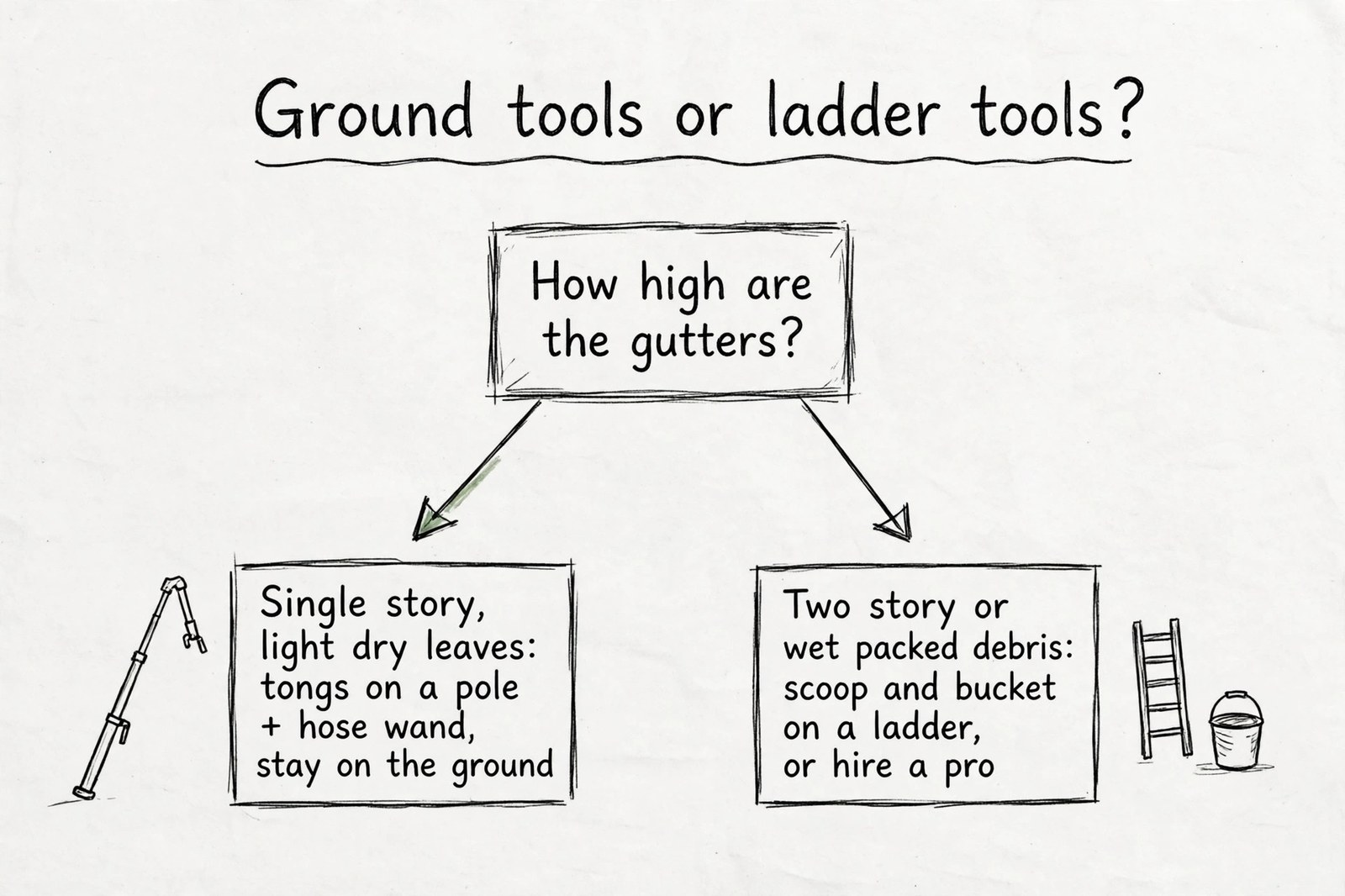
The right kit follows from three facts about your house: how high the gutters are, what fills them, and how often you clean them. Match those three facts to the table below and buy only what the row calls for. The diagram below the table shows the same decision as a simple flow, ground tools on one side and ladder tools on the other, so you can see at a glance where your house lands.
| Your house | Debris | Your kit | Why this one |
|---|---|---|---|
| Single story, easy access | Light dry leaves | Scoop, bucket, gloves, hose | Cheapest kit that does the job properly, and you can see what you are doing |
| Single story, you dislike ladders | Light dry leaves | Tongs on a pole plus a hose wand | Nothing to climb, debris lifted out rather than washed along |
| Single story, heavy trees | Wet leaves, needles, sludge | Scoop and bucket on a ladder, plus a hose wand for the rinse | Only hands and a scoop shift packed, wet debris reliably |
| Two story, light debris | Dry leaves | Leaf blower kit or wet/dry vac kit from the ground | Reach without climbing, and dry debris moves easily |
| Two story, heavy debris | Wet, packed, or long neglected | Wet/dry vac kit, or hire a pro | Ground tools struggle with sludge at height, and ladder work at two stories is a different risk level |
| Any height, gutter guards fitted | Fine needles and silt under the guards | Soft brush on a pole, hose wand, and a scoop for the outlets | Guards keep out big leaves but let fine debris through, which needs brushing, not scooping |
If you have gutter guards, read our guide on whether gutter guards are worth it before buying more tools for them. Guards change the debris problem rather than removing it, and the tools that fit a guarded gutter are different from the ones that fit an open trough. And if your gutters are on a second story and have not been cleaned in years, the honest answer is often to hire the first clean out and buy tools for the maintenance cleans after that. Our guide to gutter cleaning cost shows what that first professional visit usually runs, and our roof cleaning service guide covers the cases where the roof itself needs attention at the same time.
What the kit costs
Prices move with the season and the store, so treat these as rough ranges, not quotes. The pattern matters more than any single number: the hand tools are nearly free, the powered ground tools cost as much as a small appliance, and the ladder is the big purchase if you do not already own one.
| Tool | Rough cost range | Notes |
|---|---|---|
| Plastic gutter scoop | About $4 (Amerimax 8300, Home Depot) | Buy two. The flexible tip matters more than the brand. |
| Bucket with hook | About $4 (5-gal bucket; hook sold separately) | Any five-gallon bucket works. A hook keeps both hands free. |
| Work gloves and safety glasses | Low | Heavy gloves, not thin garden gloves. Glasses are for blower and wand work. |
| Telescoping hose wand | About $23 (Orbit 58543) | Best as a rinse tool, not a primary cleaner. |
| Tongs on a pole | $28–$34 (Gutter Sense head; pole sold separately) | Needs a pole of its own unless one is included. |
| Leaf blower gutter kit | About $60 (Worx WA4096 kit; blower sold separately) | Only if you already own a compatible blower. Dry leaves only. |
| Wet/dry vacuum gutter kit | About $28 (Craftsman kit; wet/dry vac sold separately) | Poles plus kit, vacuum not always included. The most capable ground option. |
| Extension ladder plus stabilizer | $249–$329 (24-ft aluminum ladder) + $62–$111 (stabilizer) | The stabilizer is cheap and worth buying first. Check the duty rating on the label. |
| Drain auger or plumber’s snake | $10–$40 (hand-held / 25-ft drum auger) | Only needed if your downspouts plug regularly. |
Overall kit range $3–$100 (9 products tested) — Bob Vila, The Best Gutter Cleaners, Tested and Reviewed
One cost that does not show up in any tool list is the cleaning itself. Bob Vila’s testers considered more than two dozen products and found the usable price range ran from about three dollars for a scoop to about a hundred for the powered kits, which matches what you will see in a store. If your total tool spend is creeping past the cost of one professional cleaning, stop and compare: for a two-story home, a single pro visit can be the cheaper first step, and then the hand tools cover every maintenance clean after it.
Prices are US retail listings checked November 2026 and will drift — the ladder sits outside that $3–$100 tool range at $249–$329, plus $62–$111 for a stabilizer.
Tools and habits to skip
Some tools look like shortcuts and behave like hazards. The list below is short, because each entry has hurt someone or wrecked a gutter, and each one shows up in stores every fall.
A pressure washer on a ladder. Never use one up a ladder. The recoil from the jet, the hose pulling at your balance, and the spray bouncing back off the gutter add up to a fall risk that no cleaning result justifies. Pressure washer gutter kits exist, but they belong on the ground, on a telescoping lance, and even then they are best kept for compacted silt that a hose cannot shift. If you are already on a ladder, a scoop and a hose do the job better.
A metal trowel or garden spade in the trough. Steel edges scratch aluminum coatings and crack vinyl in cold weather. A plastic scoop is shaped for the channel and costs less than the trowel. Keep the metal tools in the garden bed where they belong.
Flushing before scooping. Running water into a gutter full of leaves does not clean it. It makes slurry, and slurry finds the downspout and sets there. Scoop first, flush second, and test the downspout last. Every time.
A leaf blower on wet debris. Wet leaves do not blow, they smear, and the blower pushes the mess toward the outlet where it packs into a plug. If the debris is wet, put the blower away and pick up the scoop.
A gutter cleaning robot as a first purchase. Robots exist, and they can work on a straight, open run, but they need ladder access to place, they struggle with corners and guards, and they cost more than a full hand-tool kit. They are a curiosity for most homes, not a starting point.
Using the kit: a sensible order
The tools only work if they are used in the right order. This is not a full cleaning guide, that is our gutter maintenance guide, but the sequence below is the order the tools are built for, and skipping a step is how a simple job turns into a blocked downspout.
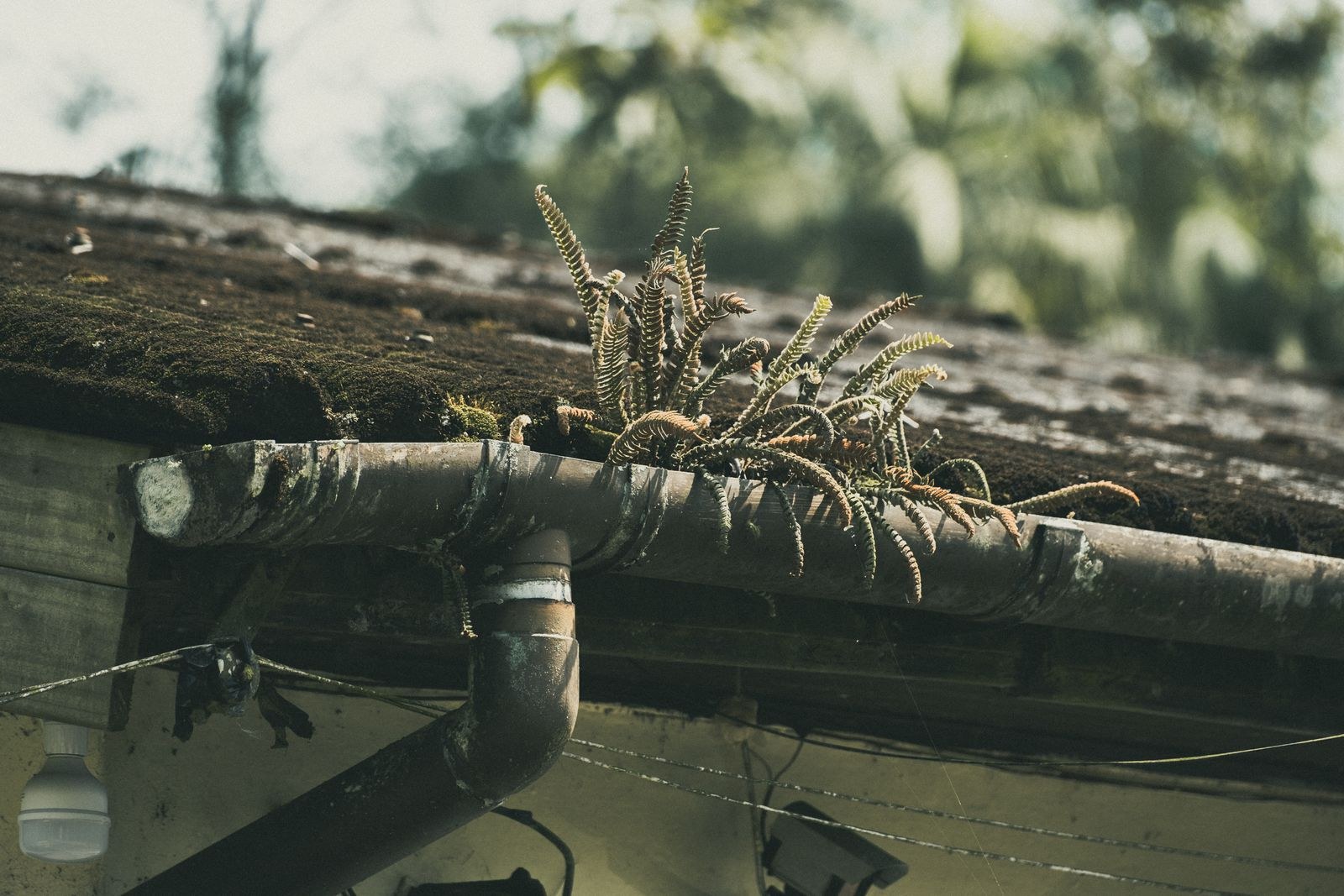
- Walk the house first. Look for overflow stains on the fascia, sagging runs, and plants growing out of the trough. Those tell you where the worst debris sits and whether anything is damaged.
- Set the ladder, or set up the ground kit. Ladder at 4 to 1, stabilizer on, spotter in place. Or poles locked, vacuum bin empty, hose connected.
- Lift the solids out. Scoop or tongs, working toward the downspout, debris into the bucket or onto a tarp. Do not push debris along the trough.
- Clear the outlet by hand. Pull the plug out of the downspout opening before any water goes in.
- Flush and test. Hose wand or garden hose from the high end, watch the water leave the downspout at the bottom. Slow flow means the downspout needs the auger.
- Check the discharge. Water should run away from the foundation, not pool beside it. Clear the outlet at the bottom if it is buried or blocked.
The video below shows the common gutter cleaning tools in use, so you can see the scoop, the wand, and the vacuum kit before you buy any of them.
The same order applies overhead: our guide to roof cleaning methods covers what is safe for shingles and what to refuse.
DIY or hire a pro
The tools in this guide cover most homes, but they do not cover every situation, and knowing where your kit ends is part of owning it. Hire the job out when the gutters sit above a second story, when the roof is steep or the ground below slopes, when the debris has been sitting long enough to grow plants, or when the ladder work makes you uneasy for any reason. Unease is a good reason on its own. A pro crew brings a vacuum system, a camera, and insurance, and the visit also covers the inspection that a scoop cannot do: loose hangers, failed seams, and fascia rot behind the trough. If the roof and gutters need attention together, our guide on cleaning roof and gutters together explains when bundling the two jobs saves money, and our roof maintenance plan puts the gutter cleaning into a year-round schedule so it stops being an emergency. Cleaning twice a year, in spring and again in fall after most leaves drop, is the baseline the extension services recommend, and homes under heavy trees need a third pass.
Tools are only half the job: our roof maintenance routine covers the inspection that tells you when to clean at all.
Questions people ask
A plastic gutter scoop is the best tool for most gutters, because it fits the trough, lifts wet and dry debris, and costs a few dollars. If you want to stay on the ground, tongs on a pole are the best ground option, followed by a hose wand for the rinse. The best tool depends on your house height and the debris, not on the brand.
Yes, on a single-story home with light debris. Tongs or a scoop on a telescoping pole lift the leaves out, a hose wand rinses the grit, and a wet/dry vacuum kit handles heavier buildup, all from the ground. Ground tools struggle with packed sludge and downspout plugs, and they cannot reach a two-story gutter reliably, so a ladder or a pro is still needed for those jobs.
A telescoping pole with a scoop or tong head, a hose wand for rinsing, and a bucket or tarp for the debris. A leaf blower gutter kit works for dry leaves only, and a wet/dry vacuum kit is the strongest ground option for wet or heavy debris. Gloves and safety glasses belong in the kit too.
Only for dry, loose leaves. A blower with a gutter attachment clears a dry gutter fast, but it cannot move wet or matted debris, and it tends to push debris toward the downspout outlet where it forms a plug. Scoop the wet material out first, and use the blower only on dry days.
No. A garden hose with a spray nozzle, used after scooping, handles the rinse and the flow test on most homes. A pressure washer is useful only for compacted silt, and it should only be used from the ground on a telescoping lance, never from a ladder.
A basic hand kit, scoop, bucket, gloves, and hose, costs well under twenty dollars. A hose wand or tongs on a pole adds a modest amount, and a wet/dry vacuum kit or a leaf blower kit costs as much as a small appliance. An extension ladder and stabilizer are the biggest purchase if you do not already own them.
Hire a pro when the gutters are above a second story, the roof is steep, the ground slopes, the debris is packed or growing plants, or the ladder work makes you uneasy. A pro visit also covers the inspection, loose hangers, failed seams, and fascia rot, that hand tools cannot do from the ground.
Sources
- Bob Vila, The Best Gutter Cleaners of 2026, Tested and Reviewed
- This Old House, 5 Best Gutter Cleaning Tools
- Bob Vila, How to Clean Gutters: 5 Effective Ways to Get the Job Done
- LeafFilter, Gutter Cleaning: The Ultimate Guide for Homeowners
- Bayshore Safety, OSHA Ladder Requirements: Inspection, Angle and the 3-Point Rule
- North Carolina State University Extension, Moisture Control and Prevention Guide: Gutter Management
