

Most vinyl siding lasts 20 to 40 years. Budget panels in a rough climate can start failing around year 15, while thick premium siding on a well-built house in a mild climate can still be doing its job at 50, and in some cases past 60. The number your house gets depends on three things: the quality of the panel itself, how carefully it was hung, and what your weather does to it year after year.
If you are new to the material itself, start with our primer on what vinyl siding actually is before you worry about how long it survives. The short version: it is a PVC-based cladding that sheds water, never needs paint, and fails slowly from sun and temperature cycling rather than all at once.
Contents
- The short answer: 20 to 40 years
- What “lifespan” actually means for vinyl siding
- Lifespan by panel quality
- Installation quality: the decade you never see
- Climate: where your house stands matters as much as what is on it
- Eight signs your siding is done
- When replacement starts making sense
- How to get the long end of the range
- Does painting buy you more years?
- Repair or replace: how to decide
- What the “lifetime warranty” actually promises
- Frequently asked questions
- Sources
The short answer: 20 to 40 years
Twenty to forty years is the honest working range for vinyl siding on a typical American house. Expect the low end if the panels are thin builder-grade stock, the installation was rushed, or the house bakes in desert sun or freezes hard every winter. Expect the high end, and sometimes beyond, with thick premium panels, careful installation, and a gentle climate. Two houses sided in the same year can be twenty years apart in remaining life, and the difference is almost never luck. It comes down to panel thickness, UV stabilizers, nailing, and weather, in that order.
What “lifespan” actually means for vinyl siding
Vinyl siding does not have a single expiration date the way a water heater does. Its lifespan is the period during which it keeps doing three jobs: shedding water, staying attached in wind, and looking close enough to new that you would not replace it on appearance. It usually stops doing the third job years before it stops doing the first two, which is why a manufacturer can claim a lifetime of service while a contractor replaces 25-year-old panels every week. When this guide says 20 to 40 years, it means functional life: the point where brittleness, fading, or warping makes replacement the sensible call.
Lifespan by panel quality
Not all vinyl siding is the same plastic. Panels are sold in grades that differ mainly in thickness and in how much UV protection is mixed into the compound, and the grade you have is the single biggest predictor of how long it lasts. Thin panels go brittle and fade early. Thick ones carry more stabilizer and more material to sacrifice to the sun.
| Grade | Typical thickness | Realistic lifespan | What usually ends it |
|---|---|---|---|
| Builder grade | around 0.040 in | 15 to 25 years | Fading, cracking in cold snaps, blow-offs in wind |
| Standard / mid grade | 0.042 to 0.044 in | 20 to 30 years | Gradual chalking, brittle corners, storm damage |
| Premium | 0.046 in and up | 30 to 40 years | Slow UV wear; often outlives the owner’s plans |
| Premium + mild climate + steady care | 0.046 in and up | 40 to 60 years | Cosmetic aging long before structural failure |
Thickness numbers matter because the UV stabilizers live in the outer capstock layer, and a thicker panel from a serious manufacturer carries more titanium dioxide, the white pigment that blocks ultraviolet light, in that layer. Alside’s Charter Oak line, for example, is built at 0.046 inches with a titanium dioxide shield against UV degradation and is laboratory tested to Category 5 hurricane-force winds, the kind of over-engineering that shows up as extra decades on the wall. If you are shopping, look for the certification mark from the Vinyl Siding Institute’s certification program, which verifies that a product meets the ASTM D3679 standard for weatherability, wind load, and impact resistance. That label is the closest thing the industry has to a guarantee that the panel matches its brochure. One more note on grade: color behaves like a grade change, since dark colors absorb more heat and heat accelerates every aging process in PVC. In hot climates, lighter colors are a longevity decision, not just a style preference.
Installation quality: the decade you never see
A great panel hung badly will die young, and a mediocre panel hung well can surprise you. Installation decides whether the siding can do the one thing vinyl must do constantly: move. PVC expands and contracts far more than wood or metal with temperature swings, so every panel has to hang loose on its nails and float in its trim channels. The nailing details are covered in our guide to how vinyl siding should be installed, and they are worth reading even if you will never pick up a hammer, because most early failures trace back to this step.
The classic installation kills look like this. Nails driven tight pin the panel to the wall, so summer expansion has nowhere to go and the panel buckles into waves. Panels cut without an expansion gap at the trim slam into the J-channel on the first hot July and stay bowed. Courses nailed out of level leave locks half-engaged, and the first real windstorm starts peeling them. None of this shows up on day one. It shows up in year eight, when the homeowner blames the material and the material is innocent. If your siding is under 15 years old and already wavy or popping loose in wind, suspect the installation before the panel. A contractor can often re-hang the worst walls without a full replacement.
Climate: where your house stands matters as much as what is on it
Sunlight is the main killer. Ultraviolet radiation breaks the polymer chains in PVC, a process called photodegradation, and the visible evidence is chalking, that white powdery film that rubs off on your hand. Once the outer UV-resistant layer is gone, the core degrades faster, the panel loses flexibility, and cracks follow. Heat makes every part of this worse, and freeze-thaw cycling adds its own punishment by working the panels through expansion and contraction hundreds of times a year.
| Climate | Main stress on the siding | What it does to the timeline |
|---|---|---|
| Hot sun belt (AZ, TX, FL, SoCal) | Intense UV + heat | Shaves years off; fading and warping arrive early, dark colors suffer most |
| Cold north (MN, WI, New England) | Freeze-thaw + brittle cold | Panels go brittle; winter impacts crack what summer would have shrugged off |
| Coastal | Salt air + hurricane wind | Demands high wind ratings; salt film needs rinsing or it holds moisture |
| Hail belt (CO, KS, OK, TX panhandle) | Impact | Brittle older panels shatter; premium impact-modified panels hold up better |
| Mild marine / temperate (PNW, coastal CA) | Moisture + mildew | Longest-lived zone; watch for algae and trapped moisture, not UV |
Two practical takeaways fall out of that table. First, the south and west faces of any house age roughly twice as fast as the north face, because they take the UV load, so always start your inspection on the sunny side. Second, coastal buyers should treat the wind rating as a lifespan feature, not just a storm feature: a panel rated for high wind stays attached, and attached panels keep water out, which is what the whole timeline depends on.
Eight signs your siding is done
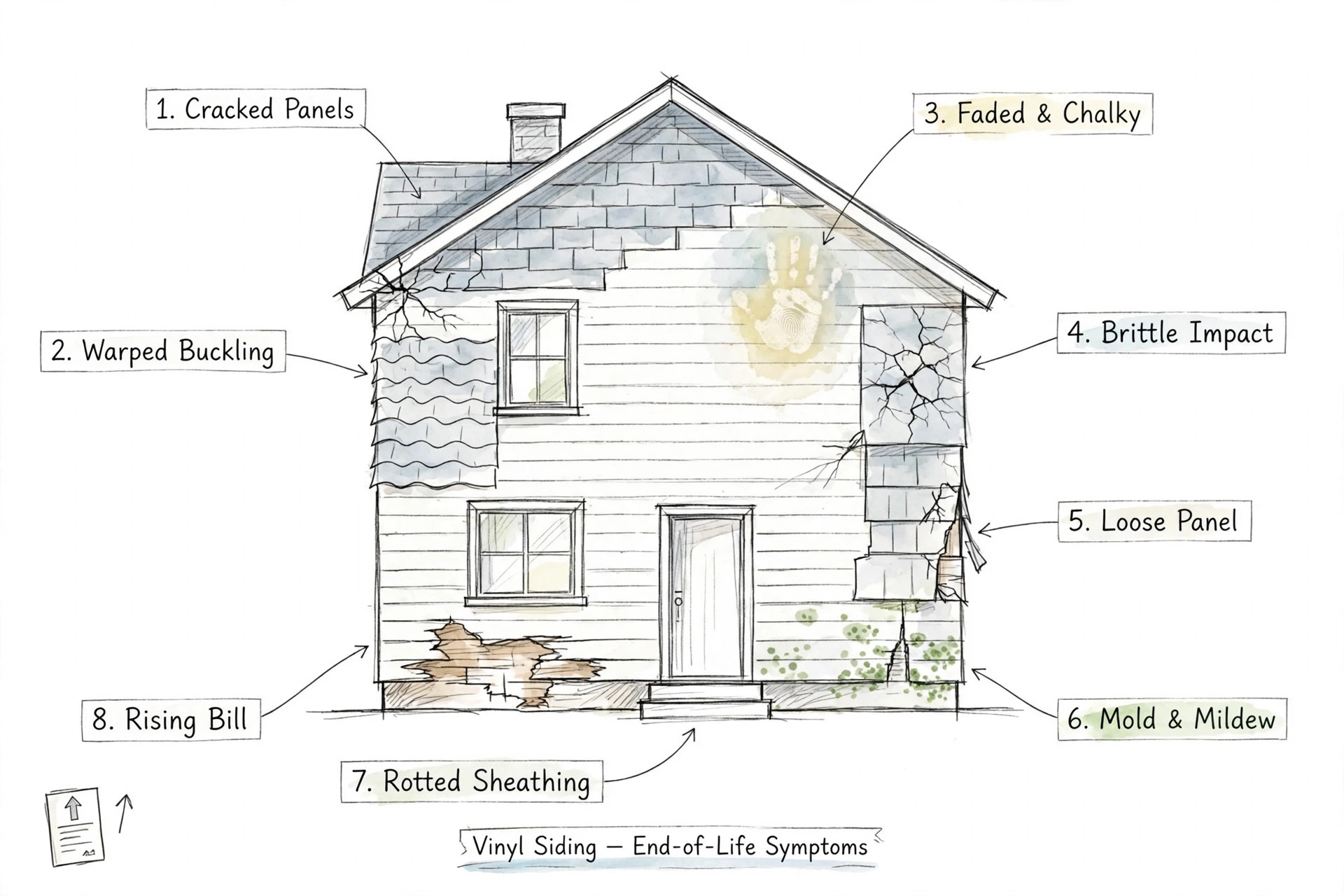
Siding rarely fails everywhere at once. It fails in a pattern, and learning the pattern tells you whether you are looking at a repair or a replacement. Work through this list on your own house once a year, sunny side first.
1. Widespread cracking. A cracked panel or two after a hailstorm is just damage. Cracks spreading across whole walls, appearing without any impact, mean the plasticizers have migrated out of the PVC and the material has gone brittle. Brittle siding will not survive the next storm intact.
2. Warping and buckling. Wavy panels that were flat last year signal that the material can no longer handle its own thermal movement, or that it was nailed too tight to move from the start. Buckled panels open gaps that let wind-driven rain behind the cladding.
3. Heavy chalking. Run your bare hand firmly across a dry panel. A light dusting is normal oxidation. A heavy white residue that coats your palm means the UV stabilizers are depleted and the protective capstock is breaking down. This ten-second test is the most reliable field check for end of life.
4. Fading you can see from the street. Some fade is cosmetic. Uniform, obvious fading across whole elevations means the color system has given up, and the same UV exposure that killed the color has been working on the polymer underneath.
5. Loose or missing panels. Panels that rattle, shift, or pop out of their locks in ordinary wind have lost their grip on the wall. The interlock depends on the panel holding its shape, and deformed panels do not lock.
6. Mold or mildew behind the panels. Surface mildew washes off. Growth underneath, visible when you lift a loose panel or around failed seams, means the weather barrier has been breached and moisture is living in the wall.
7. Soft or rotted sheathing. If a screwdriver presses into the sheathing behind a damaged panel and it gives, the failure has moved past the siding into the structure. At that point you are repairing a wall, not replacing siding.
8. Repair bills that keep coming. When you are fixing something every year, add up three years of repairs. If they approach half the price of replacement, the siding is telling you it is done in the language of money.
The sketch below maps all eight onto one house so you can see where each symptom tends to show up. Sun-bleached chalking and fading concentrate on the south and west walls, warping shows near tight trim, and moisture damage hides low on the wall and behind loose panels.
If you are seeing three or more of these at once on siding older than 20 years, skip the repair quotes and get replacement numbers. One or two on younger siding usually means repair.
When replacement starts making sense
The video below from Aspen Home Improvement walks through how long house siding lasts across materials and the wear signs that drive the replacement decision, which pairs well with the symptom list above.
How to get the long end of the range
Vinyl is sold as maintenance-free, which is true in the sense that you will never scrape and repaint it. It is not care-free. A small annual routine is the difference between the 20-year outcome and the 40-year outcome, and none of it takes more than a weekend a year.
1. Wash it once a year. Dirt, pollen, and mildew hold moisture against the surface and feed the algae that stains shaded walls. A garden hose, a soft brush, and mild detergent handle it. Keep pressure washers on a low setting and the spray angled down, or skip the machine entirely and soft wash. Our comparison of soft washing versus pressure washing shows which surfaces want which method and why siding is firmly in the soft-wash camp.
2. Inspect every spring, sunny side first. Walk the south and west walls looking for the eight signs above. Check around windows, doors, and corners, where movement concentrates and installers cut corners. Catching a loose panel in April beats discovering rot in October.
3. Fix small damage the season you find it. A cracked panel is a twenty-minute, one-panel repair when the surrounding material is healthy. Left alone, it is a water inlet that rots sheathing all summer. Vinyl panels are designed to unlock and replace individually, which is one of the material’s genuine advantages.
4. Keep plants and mulch off the siding. Bushes rubbing the wall abrade the finish and trap moisture. Keep a few inches of clearance and keep mulch below the bottom course, not piled against it.
5. Keep gutters working. Overflowing gutters sheet water down the siding instead of away from it, and constant wetting is what grows the mildew that never quite washes off. If your gutters are undersized for your roof, our gutter sizing notes in the tools section are worth a look before the next rainy season.
6. Know the difference between dirt and dying. This one saves more replacements than any other. A chalky white film can be simple oxidation that washes off, or it can be the death rattle of the capstock. Our guide to why vinyl siding looks chalky walks through a simple test that tells the two apart, so you do not replace siding that only needed cleaning.
Do this routine and you are doing more than most homeowners ever do. The NAHB’s researchers put it plainly in their housing-component study: maintenance quality is one of the biggest variables in how long any exterior material lasts, and siding is no exception.
Does painting buy you more years?
Painting faded vinyl is the most common life-extension move, and it works, with limits. A quality acrylic paint job on structurally sound siding refreshes the appearance and adds a sacrificial UV layer over the old capstock, which can buy roughly a decade. It does not restore brittleness or fix warping, and painting over failing panels just hides the symptoms while the wall underneath keeps deteriorating.
Paint only when the siding is solid: no widespread cracking, no buckling, no moisture behind it. And use paint made for vinyl, in a color no darker than the original, because dark paint absorbs the heat that warps panels. The full method, including the prep that decides whether the paint sticks, is in our guide to painting vinyl siding. If you go ahead, run your wall measurements through our paint coverage calculator before buying, since underestimating by a gallon is how touch-up mismatches happen.
As a rule of thumb: paint siding that looks tired but tests solid. Replace siding that is tired all the way through.
Repair or replace: how to decide
One damaged wall does not condemn the whole house. The decision comes down to how widespread the damage is, how old the siding is, and whether water has already gotten behind it. Contractors use rough thresholds, and they are worth knowing before anyone gives you a quote.
| Situation | Sensible call |
|---|---|
| A few cracked or storm-damaged panels, rest of the house solid | Repair: swap the panels |
| Fading or chalking on the sunny side only, panels still flexible | Repair or paint; monitor yearly |
| Damage across 25 to 30 percent or more of the wall area | Replace: patching at this scale costs nearly as much and looks pieced together |
| Siding over 20 years old with three or more end-of-life signs | Replace |
| Confirmed moisture or rot in the sheathing | Replace, plus wall repair |
| Three years of repair bills approaching half the replacement price | Replace |
Get the age question answered first if you can. Check with the previous owner, look for a building permit on file, or ask a contractor to identify the product line from the nailing hem stamp. A 12-year-old premium installation with one bad wall is a repair. A 28-year-old builder-grade job with chalk on every elevation is a replacement wearing a repair costume.
What the “lifetime warranty” actually promises
Almost every major vinyl siding line carries a “lifetime limited warranty,” and the phrase causes more confusion than any other in the industry. It does not promise your siding will last your lifetime. It promises the manufacturer will stand behind the product against manufacturing defects, things like delamination or excessive warping from a bad extrusion batch, for as long as you own the home. Fading beyond a small measured threshold is sometimes covered, as with Alside’s fade protection, but normal weathering is not.
Read the fine print and three patterns show up everywhere. First, the warranty covers defects, not aging: a panel that chalks and fades after 25 years of sun has not suffered a manufacturing defect, it has lived a full life outdoors. Second, coverage usually requires installation exactly to the manufacturer’s specs, which is another reason installation quality matters. Third, the warranty transfers to the next buyer when you sell, but typically in prorated form, meaning the payout shrinks with the siding’s age. CertainTeed’s warranty documents describe exactly this structure: lifetime, non-prorated, and transferable for the original owner, prorated once transferred, covering defects in material and workmanship with SureStart protection handling labor and materials in the first years.
Here is the honest contrast. The NAHB’s 2007 Study of Life Expectancy of Home Components lists vinyl siding as “Lifetime” in its siding table, with the narrative that outside materials “will last as long the house exists.” That is the industry’s optimistic, warranty-flavored number. The number contractors actually see in the field, the point where brittleness and fading force replacement, is 20 to 40 years. Both can be true at once: the plastic endures far longer than the good looks do, and you replace siding for the looks and the brittleness, not because the PVC vanished. Treat the warranty as what it is: insurance against a bad batch, not a promise about your walls in 2050.
Frequently asked questions
About 20 to 40 years on a typical house. Thin builder-grade panels in harsh climates can fail near year 15, while thick premium panels with good installation and steady care can reach 40 to 60 years in mild climates.
Ultraviolet sunlight is the main killer. UV breaks down the PVC polymer, which shows up first as chalking and fading, then as brittleness and cracking. Heat, freeze-thaw cycling, hail impact, and poor installation all shorten the timeline.
Look for widespread cracking, warping or buckling, heavy chalking that coats your palm, fading visible from the street, loose panels, or moisture behind the siding. Three or more of these on siding over 20 years old means replacement is the sensible call.
Most major brands offer a lifetime limited warranty, but it covers manufacturing defects, not aging or weathering. Coverage usually requires installation to spec and transfers to a new owner in prorated form, so read the terms before counting on it.
Yes, on solid siding. A quality acrylic paint job over structurally sound panels can add roughly a decade by refreshing UV protection. It will not fix brittleness, warping, or moisture damage, so test the panels before you paint.
Fiber cement generally lasts longer, typically 30 to 50 years against vinyl’s 20 to 40, and it resists impact and fire better. Vinyl wins on cost and maintenance since it never needs painting. Premium vinyl in a mild climate narrows the gap considerably.
Sources
The claims in this guide come from the pages actually opened during research: the NAHB’s 2007 Study of Life Expectancy of Home Components (vinyl siding listed as “Lifetime” in the siding table, with maintenance quality flagged as a key variable), the Vinyl Siding Institute’s product certification program page (ASTM D3679 testing for weatherability, wind load, and impact resistance), Alside’s Charter Oak product page (0.046-inch panels, titanium dioxide UV shield, Category 5 wind testing, lifetime limited transferable warranties), and Engineer Fix’s guide to vinyl lifespans (photodegradation mechanism, UV stabilizer function, plasticizer migration and brittleness).

1 Comment
Pingback: What Is Vinyl Siding? Types, Materials & Protection Guide