


Short answer: your downspouts should release roof water at least 4 to 6 feet from the foundation wall. If you want the number most building pros actually aim for, it is 8 to 10 feet. Buried drain lines should carry the water 10 feet or more out. Those numbers come from real building science guidance, not from habit, and this guide walks through where each one applies, how to measure it, and the grading mistake that can undo a perfectly good extension.
What the Building Science Actually Says
Four to six feet is the minimum. Eight to ten feet is the goal. Ten feet or more is where buried lines should end.
The U.S. Department of Energy’s building science guidance puts it plainly: install gutters and downspouts that terminate at least 5 feet away from the foundation, or terminate them to an underground catchment system at least 10 feet away from the foundation. University of Minnesota Extension is a touch more lenient on the minimum, recommending that extensions discharge water at least 4 feet beyond the wall, while treating longer runs as plainly better.
ENERGY STAR’s new-homes water management requirements land in the same place: discharge onto sloping final grade at least 5 feet from the foundation, or to an underground catchment at least 10 feet from the foundation.
One thing to notice: none of these sources say 2 feet, 3 feet, or “just past the mulch bed.” If your downspouts currently end at the foundation with a short elbow and a prayer, you are well short of every published benchmark.
Why a Few Feet Make Such a Difference
A roof is a water-collection machine, and the numbers are startling once you see them. University of Minnesota Extension notes that in a 1-inch rain, about 1,250 gallons of water fall on the roof of a 2,000-square-foot house. Your gutters gather that sheet of water and each downspout pours its share out in one concentrated spot. That is the whole problem and the whole point: a downspout takes hundreds of gallons that would have spread across the roof and dumps them in a single location.
Minnesota Extension makes a point I quote to anyone who will listen: a downspout without an extender or splash block is worse than no downspout at all, because it deposits the huge volume of roof water in a single concentrated location near the basement. Without gutters, at least the water spreads out along the drip line. With a downspout and no extension, you have built a fire hose aimed at your foundation.
What happens next is slow and unglamorous. The soil beside the foundation saturates. Saturated soil pushes water against the wall (the hydrostatic pressure you hear foundation contractors talk about), and water finds its way through hairline cracks, porous concrete, and the joint where the wall meets the footing. In clay soils it can also wick upward through the ground itself; UMN Extension’s capillary-rise figures run from a few inches in gravel to 12 to 20 feet in clay. Distance is how you break that cycle: you put the water where the soil around your foundation never has to deal with it.
Measure From the Right Spot
When guidance says “4 feet from the house,” it means 4 feet from the outside face of the foundation wall, not from the siding, not from the gutter, and not from the downspout elbow. The discharge point is where the water actually hits the ground. An extension that starts at the wall and runs 4 feet is doing its job; a downspout that ends 4 feet from the siding but only 2 feet from the foundation wall (on a house with a deep overhang) is not.
Walk outside with a tape measure and check each outlet. Note where the water lands, then measure back to the foundation. Most people overestimate this distance by a wide margin. A splash block that looks generous from the porch is often 2 feet long.
Pick Your Distance: A Table for Real Houses
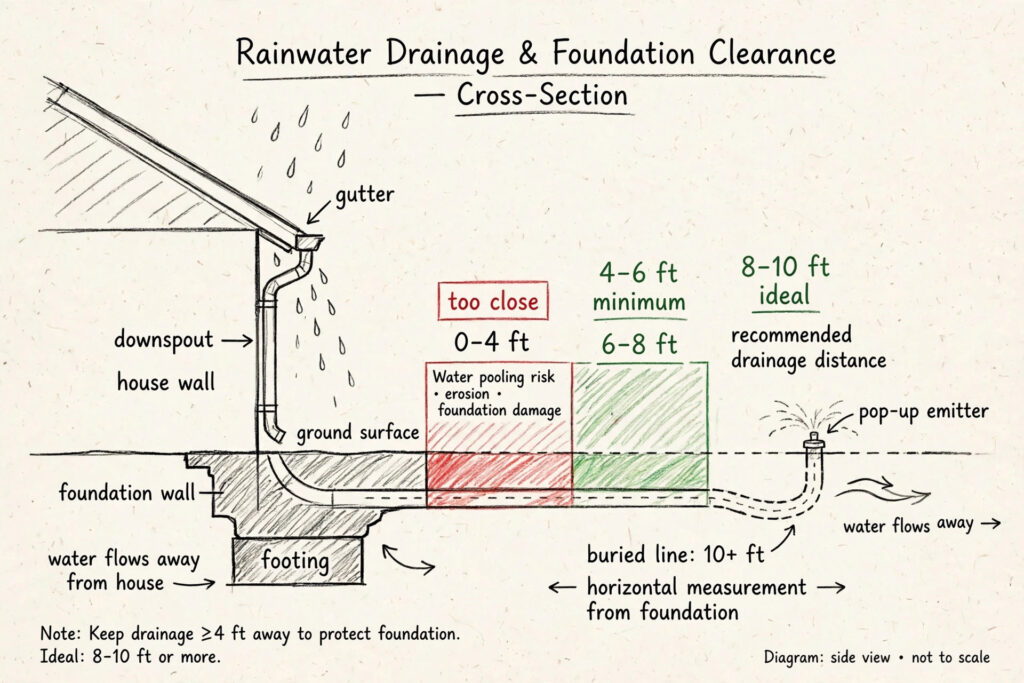
Not every house needs the same number. Use this table to find yours.
| Your situation | Recommended discharge distance | Why |
|---|---|---|
| No basement, sandy or loamy soil, yard already slopes away from the house | 4 to 6 feet | Free-draining soil and good grading do half the work; the UMN 4-foot minimum applies here |
| Basement or finished crawlspace, average soil | 6 to 10 feet | Below-grade living space raises the stakes; the DOE 5-foot minimum is the floor, not the target |
| Clay soil, high water table, or heavy-rain region | 8 to 10 feet at minimum; buried line preferred | Clay holds water against the wall for days; surface discharge often cannot keep up |
| Buried downspout drain line | 10 feet or more from the foundation | Matches DOE guidance and ENERGY STAR’s 10-foot catchment rule; NC State Extension’s gutter guidance likewise wants underground discharge well clear of the house |
| Downspout outlets near a neighbor’s lot line or a public sidewalk | As far as grading allows, and never onto the neighbor’s property | Local rules often govern this; more below |
If you remember one row, remember the second one. Most American houses with basements and ordinary soil land in the 6-to-10-foot band, and 8 feet is a comfortable target that satisfies every source cited here.
The Part Everyone Misses: Grading at the Outlet
Here is the uncomfortable truth that separates decent advice from advice that actually works: distance means nothing if the ground at the discharge point slopes back toward the house. A 10-foot extension onto a back-sloped yard just builds a bigger puddle closer to your neighbor’s fence. The water still comes home.
Every authoritative source pairs discharge distance with grading, and the grading numbers are specific. University of Minnesota Extension says to place earth around the house so it slopes away from the foundation wall a minimum of 1 inch per foot for at least 6 feet. Environmental Protection’s rundown of EPA’s moisture-control tips calls for grading that slopes down and away at 1/2 inch to 1 inch per linear foot. EPA’s school building guidance says the same thing more simply: make sure the ground next to the building slopes away from the foundation.
So the real rule has two halves: carry the water 4 to 10 feet out, and land it on ground that keeps falling away from the house. Check the second half with a 6-foot level and a tape measure. Set the level on the ground at the discharge point, lift the house-side end until the bubble centers, and measure the gap underneath. If you cannot get roughly 6 inches of fall over the first 10 feet, the grading needs work before the extension can do its job. (That 6-inches-over-10-feet figure is the commonly cited 5 percent slope; the UMN 1-inch-per-foot rule is stricter and better.) Even at the right distance, a discharge point can still pond: see why water pools at the end of a downspout for the full diagnosis. If the discharge area stays soggy for days even with the right distance, the problem may run deeper than the downspout: see the causes of soggy ground after rain, which walks through the nine most common culprits.
Also check what the water crosses on its way out. Flower beds piled high against the foundation, edging stones, and walkways can all dam the flow and send it sideways along the wall. I have seen 8-foot extensions defeated by a 4-inch landscape timber. And when a downspout outlet lands on a sloped, mulched bed, that concentrated flow can strip the mulch clean off — see why mulch keeps washing off a sloped bed and what to consider before you re-mulch.
Your Soil Changes the Answer
Soil type decides how forgiving a short discharge distance is.
Sandy soil drains fast. Water from a 4-to-6-foot extension percolates down quickly instead of sitting against the wall. The risk here is erosion: concentrated discharge can carve a channel in loose sand, so a splash block or a short bed of gravel at the outlet is worth adding.
Loam (the crumbly garden soil most suburbs have) is the middle case. The standard 6-to-10-foot guidance fits it well.
Clay soil is the hard case. It absorbs water slowly, holds it for days, and swells and shrinks with moisture changes. In clay, a surface extension at 6 feet can still leave the soil near the foundation saturated after a big storm, because the water has nowhere to go. This is the situation where buried drain lines carrying water 10-plus feet out, or all the way to a daylight outlet downhill, earn their keep. Remember those UMN capillary figures: moisture can wick upward through clay 12 to 20 feet. You are not just fighting puddles; you are fighting the soil’s memory of every storm.
If you do not know your soil, do the squeeze test. Grab a handful of damp soil from near a downspout outlet and squeeze it. If it falls apart, you have sand. If it holds a loose ball that crumbles when poked, loam. If it holds a tight ball or ribbons between your fingers, clay, and you should lean toward the longer distances in the table.
The Ways to Get Water Out There
You have more options than the accordion tube from the hardware store. Each has a place.
| Method | Typical reach | Best for | Watch out for |
|---|---|---|---|
| Concrete or plastic splash block | 2 to 3 feet | A stopgap on well-graded sandy soil | Too short to meet any published minimum on its own; shifts with mowing and frost |
| Flexible accordion extension | 4 to 6 feet | Quick, cheap fix; renters and tight budgets | Kinks, crushes underfoot, clogs with debris, and tends to wander off its aim over winter |
| Rigid metal or vinyl extension | 4 to 8 feet, cut to length | A durable surface option that stays where you put it | A tripping and mowing hazard; still surface discharge, so grading must cooperate |
| Buried solid pipe to a pop-up emitter or daylight outlet | 10 feet to as far as your lot allows | Clay soil, basements, finished look, cold climates | Needs continuous downhill slope with no bellies; needs occasional flushing, and Environmental Protection’s EPA tips suggest testing underground drains with a hose |
| Dry well (buried pit of stone that disperses water underground) | Set back 10+ feet from the foundation | Lots where surface discharge has nowhere good to go | Useless in heavy clay unless engineered; can clog with silt over the years |
| Rain barrel at the downspout | Captures the first 50+ gallons | Garden watering, reducing peak flow | The overflow still needs a legal discharge point 5+ feet out; a full barrel in a storm is just a detour |
A note on buried pipe, since it is the most common upgrade people ask about: use smooth-wall solid pipe, not the flexible corrugated stuff, for the buried run. Corrugated pipe’s ridges catch debris and silt, and it is miserable to snake clean. Give the pipe a steady downhill fall from the downspout to the outlet with no low spots where water can sit, and put a leaf screen or filter at the downspout inlet so you are not burying next year’s clog. Flush it with a hose once a year; if water backs up out of the inlet during the flush, you have a blockage to clear before the next storm does it for you.
Where the Water Should Not Go
Getting water away from your foundation is only half the job. It has to land somewhere legal and sensible.
Not onto the neighbor’s lot. Concentrating your roof water and sending it across the property line is the fastest way to meet your neighbor’s lawyer. Most municipalities prohibit directing drainage onto adjacent properties. Aim your discharge to disperse on your own ground.
Not across sidewalks, driveways, or public walkways, at least not where it will freeze. A downspout that sheets water across a walk in November builds a skating rink by December. Route around hardscapes or bury the line beneath them.
Not over a septic drain field. Saturating the field with roof water can shorten its life and, in some jurisdictions, violates health codes.
Not into the sanitary sewer (unless your municipality explicitly allows combined connections, which most no longer do). Many cities require downspouts to be disconnected from sewers precisely because storm surges overwhelm treatment plants and back sewage into basements. If your downspouts currently tie into a clay tile that vanishes into the ground, it is worth finding out where it goes before you assume it is a storm line.
Not into your foundation drain or sump pit. Roof water and foundation drainage are separate systems for a reason. ENERGY STAR’s catchment rule specifies an underground system “not connected to the foundation drain system” for exactly this reason: dumping thousands of gallons of roof water into the perimeter drain overwhelms the one system protecting your basement from groundwater.
When in doubt, call your city’s building or public works department before trenching. A five-minute call beats a stop-work order.
Cold Climates Need a Winter Plan
If your winters freeze hard, downspout extensions need seasonal attention. A surface extension full of ice is a blocked pipe: water backs up, freezes in the downspout, and the resulting ice can split seams or push gutters off the fascia. Detachable accordion extensions exist partly for this reason; many cold-climate homeowners pull them off in late fall and re-seat them in spring so snowmelt and plows do not destroy them.
Buried lines avoid most of this, but only if they drain fully between storms. A buried pipe with a belly that holds water will freeze into a solid plug. That is another argument for smooth-wall pipe with honest slope and for keeping the outlet (a pop-up emitter or daylight end) clear of leaves and snow.
And keep discharge off walkways, as noted above. Winter turns a minor grading flaw into a liability problem.
How to Check Your Setup This Weekend
You can audit every downspout on the house in under an hour, and the best time is during steady rain.
- Walk the perimeter in the rain (from the ground, no ladder needed). At each downspout, note where the water lands and which way it flows from there. Mark any outlet whose water ponds within a few feet of the wall or runs back toward the foundation.
- Measure the discharge points with a tape measure, from the foundation wall to where water hits the ground. Write down each number. Anything under 4 feet goes on the fix list; anything under 8 feet on a house with a basement deserves a hard look.
- Check the grading at each outlet with a level, as described above. Note any outlet where the ground falls toward the house.
- On a dry day, hose-test buried lines. Environmental Protection’s EPA tips recommend testing underground drains with a hose to make sure they work. Run water into the downspout inlet and watch the outlet. Strong, steady flow is good. Gurgling, slow drainage, or water backing up out of the inlet means a clog or a crushed section.
- Look for the telltale signs of chronic mis-discharge: erosion channels or displaced mulch below outlets, green staining on the foundation, efflorescence (white mineral crust) on basement walls, or a musty corner in the basement that never quite dries.
If you are doing this audit because you already have basement moisture, fix the downspouts and grading first. University of Minnesota Extension’s recommended order of operations puts evaluating and correcting gutters, downspouts, and surface grading before any interior drainage work, noting that these corrections alone may solve the problem. It is the cheapest fix with the highest odds, and skipping it to buy a bigger dehumidifier is putting the cart before the horse.
DIY or Call a Pro?
| Task | DIY? | Notes |
|---|---|---|
| Adding a splash block or accordion extension | Yes | Ten minutes and a utility knife; re-check aim each spring |
| Cutting and fitting a rigid extension | Yes | Basic tools; keep the outlet aimed at ground that slopes away |
| Re-seating or replacing extensions each season | Yes | Part of the spring routine, like cleaning the gutters (see our gutter maintenance guide) |
| Trenching and burying a short drain line | Maybe | Fine for a straight 10-foot run in soft soil; call 811 before you dig, every time |
| Regrading around the foundation | Usually a pro | Getting slope right over a whole perimeter, without burying siding or directing water at a neighbor, is skilled work |
| Dry well or long buried system | Pro | Sizing, soil percolation, and setback rules are beyond guesswork |
| Tying into a storm sewer or curb outlet | Pro, with permits | Your city has opinions about this; get them in writing first |
| Anything involving a ladder above the first story | Pro | Extension work at the downspout is ground-level; gutter work is not |
One safety note that applies to all of it: call 811 (the national call-before-you-dig number) before any trenching, even a shallow one. Buried utilities do not care that your trench is only 8 inches deep.
Frequently Asked Questions
How far should downspouts drain from the house?
At least 4 to 6 feet from the foundation wall, with 8 to 10 feet as the practical target for most homes. Buried drain lines should discharge 10 feet or more out. The ground at the discharge point must slope away from the house, or the distance does not help.
Is 3 feet of extension enough?
No. Three feet lands inside the zone where soil saturation presses directly against the foundation, and it falls short of every published benchmark (4 feet per UMN Extension, 5 feet per DOE and ENERGY STAR). If 3 feet is all your lot allows, a buried line that carries water farther is the answer, not acceptance.
Should downspouts drain toward the street?
Only if your local rules allow it and the path does not cross a sidewalk where water will freeze or a neighbor’s property. Many homeowners daylight buried lines near the curb or into an approved storm connection, but permits and setback rules vary by municipality, so check before trenching.
Can I just use a splash block and call it done?
A splash block alone is rarely enough. Most are 2 to 3 feet long, which does not reach the 4-foot minimum, and they do nothing about grading. They work as a supplement: an extension that gets the water out, landing on a splash block that spreads it so it does not erode a hole.
How far should a buried downspout drain go?
At least 10 feet from the foundation, per DOE building science guidance and ENERGY STAR’s catchment rule, and it should daylight downhill or into a dispersal feature like a pop-up emitter or dry well. Keep the line sloped with no low spots, and keep it separate from the foundation drain system.
My yard already slopes away from the house. Do I still need extensions?
Yes, at least to the 4-foot minimum. Good grading handles rain that falls on the lawn; it does not handle hundreds of gallons poured into one spot by a downspout. The concentrated discharge still needs to start its journey well clear of the wall.
What if my neighbor’s downspout drains toward my house?
Start with a conversation; most people have no idea their discharge is the problem. Document the flow path with photos during rain. On your side, make sure your grading sheds the water and consider a shallow swale along the property line. If it continues, your municipality’s stormwater or code enforcement office is the next call, since most codes prohibit directing drainage onto neighboring properties.
Sources
- U.S. Department of Energy, Building Science Education: “Stormwater Gutters Downspouts.” Recommends gutters and downspouts terminating at least 5 feet from the foundation, or to an underground catchment system at least 10 feet from foundations. DOE Building Science Education: Stormwater Gutters Downspouts
- University of Minnesota Extension: “Moisture in basements: causes and solutions.” Recommends downspout extensions discharging at least 4 feet beyond the wall; grading at least 1 inch per foot for 6 feet; notes ~1,250 gallons of roof water per inch of rain on a 2,000 sq ft house. UMN Extension: Moisture in Basements, Causes and Solutions
- ENERGY STAR Single-Family New Homes, National Water Management System Builder Requirements (Rev. 13): discharge on sloping final grade ≥ 5 ft from foundation, or to underground catchment ≥ 10 ft from foundation. ENERGY STAR Water Management System Builder Requirements (PDF)
- U.S. EPA, “Moisture Control” (Indoor Air Quality Design Tools for Schools): ground next to the building must slope away from the foundation. EPA Moisture Control: Indoor Air Quality Design Tools for Schools
- U.S. EPA moisture-control tips (via Environmental Protection): grade 1/2 to 1 inch per linear foot away from the house; downspout water discharging at least a few feet from the foundation; test underground drains with a hose. Environmental Protection: Tips on Remodeling and Indoor Air Quality, Controlling Moisture
Related on Home Exterior Lab: our gutter maintenance guide covers the twice-yearly routine that keeps downspouts flowing, and our guide to why gutters overflow in heavy rain helps you diagnose problems upstream of the discharge point.

11 Comments
Pingback: Gutter Maintenance Guide for Homeowners | Home Exterior Lab
Pingback: Why Gutters Overflow in Heavy Rain: Causes & Fixes | Home Exterior Lab
Pingback: Exterior House Cleaning Guide by Surface | Home Exterior Lab
Pingback: Soft Washing vs Pressure Washing: Surface Guide | Home Exterior Lab
Pingback: Wood Deck Maintenance: Inspect, Clean & Protect | Home Exterior Lab
Pingback: Why Does Water Pool on My Driveway? Causes and Fixes
Pingback: How Often Should Gutters Be Cleaned? (Full Schedule)
Pingback: Water Pooling at Downspout: 7 Causes & How to Diagnose
Pingback: 7 Signs Your Downspout Is Clogged (and What to Check First)
Pingback: Why Mulch Washes Away on a Slope: Causes & Fixes
Pingback: Fall Exterior Home Maintenance Checklist: 35 Tasks Before Winter