


Last updated: November 25, 2026
A yard fence is a barrier built around part or all of a yard to control who and what can cross the line, and the right fence for a yard is the one that matches the job first: privacy, a dog, kids, a pool, a street-facing boundary, or a slope. Material comes second. Most fence regret starts with shopping by material, then discovering the fence cannot do the one job it was bought for.
This guide works the other way round. Start with what your yard needs the fence to do, rule out the styles that cannot do it, and the shortlist gets short fast. Heights, gaps, gates, and slope details do more work than brand names here, so those get the attention.
Contents
- Start with the job, not the material
- Yards that need privacy
- Yards with dogs
- Yards with kids and pools
- Front yard versus back yard
- Sloped yards
- Small yards and large lots
- Gates: the part that fails first
- Rules to check before you order
- What moves the price
- DIY or hire a pro
- Keeping a yard fence working
- Frequently asked questions
- Sources
Start with the job, not the material
The job decides the fence, because most materials are ruled out by a single need. Privacy rules out every open fence. A pool rules out anything climbable. A digging dog rules out any fence with a loose bottom edge. Name the job in one sentence before you look at a single sample, and half the catalogue falls away on its own.
Use the table as a first pass. It matches common yard jobs to the fence families that can actually do them, plus the detail that usually decides whether the fence works once it is up.
| Yard job | Fences that fit | Detail that decides it | Common miss |
|---|---|---|---|
| Privacy from neighbours | Solid wood, vinyl privacy panels, composite | Sightline height where people sit and stand | Boards that shrink and open gaps in the first dry summer |
| Keeping a dog in | Solid panels, tight pickets, chain link with a dig barrier | Height for jumpers, a sealed bottom edge for diggers | Benches and woodpiles left against the fence as launch pads |
| Kids around a pool | Ornamental aluminum or steel, solid panels, pool mesh | At least 48 inches tall, no footholds, a self-latching gate | A gate that does not close and latch every time |
| Front yard boundary | Picket, ornamental metal, low split rail | Local front-yard height limit | Expecting privacy from a fence the rules cap at waist height |
| Large lot, boundary only | Chain link, split rail with wire mesh | Cost per foot over a long run | Paying privacy-fence prices for a line nobody needs screened |
| Sloped yard | Wood boards, chain link, rackable panels | Gaps under stepped panels | Triangular gaps a small dog walks straight through |
Two questions finish the shortlist. Will you refinish the fence on schedule? If the honest answer is no, wood is a poor pick no matter how good it looks on day one. And how long will you stay? Premium materials pay back slowly, so a short stay usually favours the cheaper fence that still does the job.
Yards that need privacy
Privacy means blocking sightlines, so a privacy fence has to be solid, tall enough at the spots where people actually sit and stand, and free of gaps that open up as the material moves. Only solid wood, vinyl privacy panels, and composite deliver that. Open fences with privacy slats woven in are a patch: they cut the view, but they still leak light and sightlines at an angle.
Height does the obvious work, but placement does the subtle work. A 6-foot fence on flat ground blocks a neighbour standing at the same level. The same fence on the low side of a slope may leave a raised patio next door looking straight over it. Before you order, have someone hold a board or a sheet of cardboard at the height you are considering while you stand and sit where you spend time. It takes five minutes and it settles arguments that drawings never do. The height rules by material and situation are covered in our guide to privacy fence height.
Board layout decides whether the privacy lasts. A standard side-by-side board fence develops see-through gaps as boards shrink in their first dry summer. Board-on-board construction overlaps each board with the next, so the wall stays solid as the wood moves. A shadowbox fence alternates pickets on both sides of the rails: it looks finished from both yards and lets some air through, which helps in windy spots, but at an angle you can see through it. Pick board-on-board when the view really has to go, and shadowbox when a softer screen is enough and the neighbour’s side matters too. Before you choose boards or panels, compare privacy fence types.
Wood is usually the cheapest route to real privacy, and the catch is upkeep: stain or seal on a cycle, or the fence greys, warps, and ages early. Vinyl costs more up front and asks for a wash now and then. Composite sits above both on price and aims at a wood look without the refinishing. The cost side of that choice, by material, is in our privacy fence cost guide, and the lifespan side is in our guide to how long wood fences last.
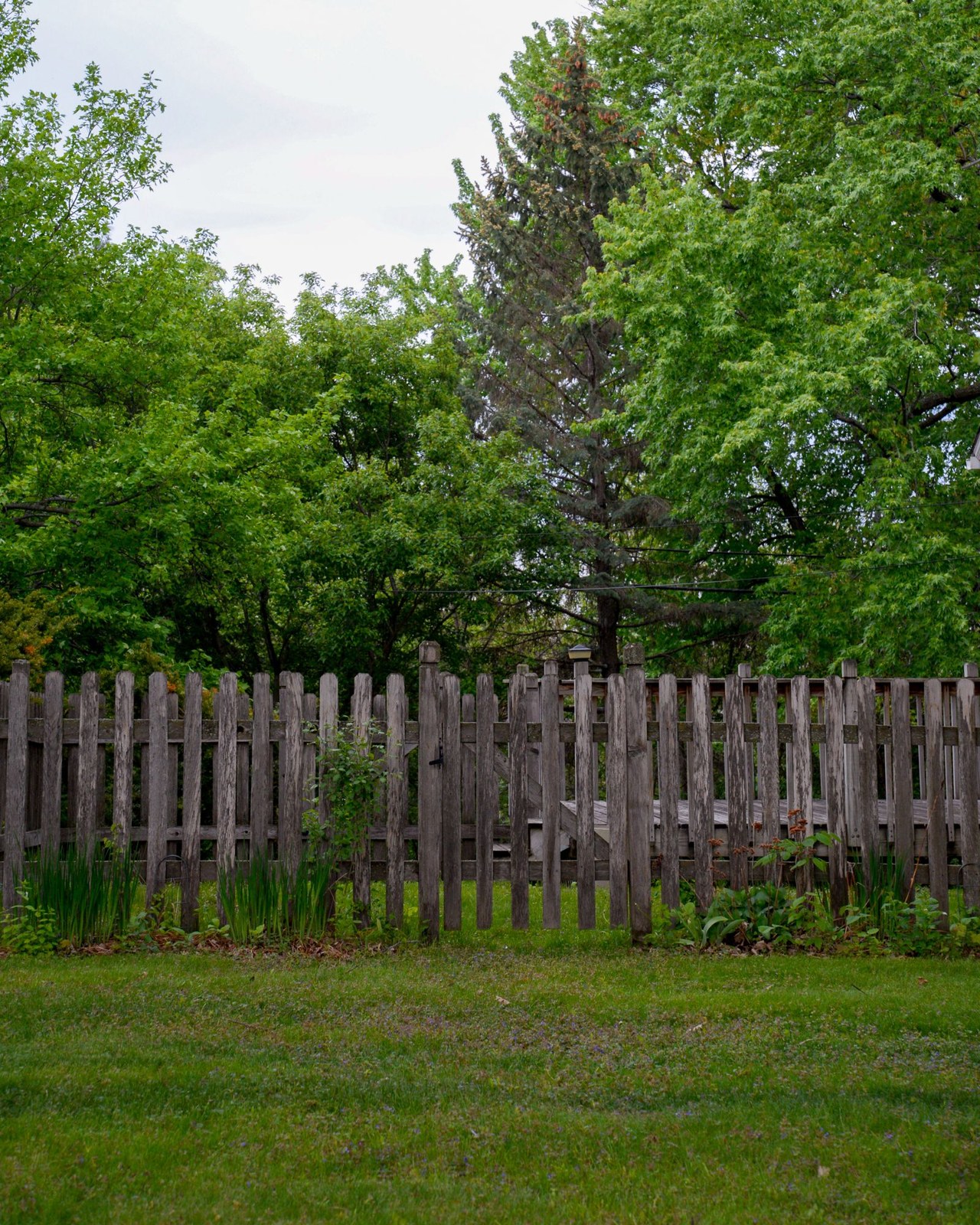
Yards with dogs
A dog fence works when it blocks the four ways a dog gets out: over the top, through the gaps, under the bottom edge, and out the gate. Height alone handles only the first one. The right fence depends on how your dog behaves at a boundary, not on breed charts, so watch your dog at the fence line before you buy anything.
Jumpers and climbers need height and a face with no footholds. A solid panel gives a climber nothing to grip, while chain link mesh works like a ladder for a dog that climbs. Diggers need the opposite end of the fence handled: the bottom edge. The American Kennel Club recommends a dig-proof barrier of metal, cement, or large rocks set one to two feet below the fence line, and removing anything near the fence, such as lawn furniture or a woodpile, that helps a dog get over or past it. Small dogs and puppies need tight spacing, since a gap that looks too narrow to a person can be plenty for a small dog.
Solid fencing has a side benefit that owners notice fast: a dog that cannot see the street often barks and lunges less. If your dog patrols the fence line reacting to every passerby through an open fence, blocking the view can calm the behaviour as well as contain the dog. That is a behaviour observation, not a guarantee, and a dog with a strong escape history still needs the height, the bottom barrier, and a gate latch it cannot work.
Be honest about the limits. No fence contains a dog that is left alone outside all day with nothing to do, and determined escape artists test fences until they find the weak point. Walk the line after storms and after the ground shifts in spring, check the bottom edge at corners and gates first, and fix small gaps before the dog finds them. Cats are a different problem entirely: most yard fences will not contain a cat without a purpose-built top, so do not buy a dog fence expecting it to hold a cat.
Yards with kids and pools
A pool fence is a safety barrier, not a style choice, and it has to stop a young child from getting over, under, or through it. The U.S. Consumer Product Safety Commission’s barrier guidelines put the top of a pool barrier at least 48 inches above the ground on the side facing away from the pool, with 5 feet or higher preferable, and note that some states and towns require 60 inches. Openings should be too small for a 4-inch sphere to pass through, the gap at the bottom should not exceed 4 inches, and handholds and footholds should be eliminated.
Those rules shape the material choice. Vertical pickets with no horizontal rails on the outside give a child nothing to climb, which is why ornamental aluminum and steel are common pool fences. Chain link needs care: the guidelines limit mesh openings, and the mesh still offers toeholds, so check your local code before using it around a pool. Whatever the material, move chairs, planters, grills, and storage boxes away from the barrier, since anything a child can stand on shortens the fence.
The gate is where pool barriers fail. The same guidelines call for a gate that opens away from the pool and closes and latches by itself, every time, from any position. Test yours the way an inspector would: open it partway, let go, and watch it latch. If it needs a push, it is not doing its job. Local pool codes set the binding rules and they vary, so confirm the height, gap, and gate requirements with your building department before you order, and treat the fence as one layer of protection alongside supervision, never a replacement for it. The pool-code basics for the most common pool material are in our aluminum fences guide.
For a yard with kids but no pool, the fence job is simpler: keep toddlers in and keep the gate latched. A 4-foot fence with tight spacing and a latch a small child cannot reach handles most family yards, and the same gap discipline applies: check the bottom edge on slopes and the space under the gate.
Front yard versus back yard
Front and back yards ask different things of a fence. A back yard fence works for privacy and containment, so it is usually taller and more solid. A front yard fence is seen from the street every day, so it does curb-appeal work: it marks the boundary, frames the house, and sets the tone before anyone reaches the door.
Rules draw the line between them. Many towns cap front-yard fences lower than back-yard fences, often around 3 to 4 feet, while allowing 6 feet or more at the back. A front fence at that height cannot give privacy, and no material fixes that. If privacy at the front is the goal, planting usually does the job better than a fence the rules keep short. Check your local height limit and setback before you fall for a style, since front-yard rules are the most common reason a chosen fence has to be rethought.
Open styles suit the front: picket fences, ornamental metal, and low split rail all mark the line without hiding the house. A picket fence in wood or vinyl fits traditional houses, and the style options are covered in our guide to wooden fence styles. For picket tops, spacing, and front-yard heights across wood, vinyl, and aluminum, see our picket fences guide. Ornamental aluminum gives the iron look with no rust to manage. Solid privacy fencing at the front, where rules allow it at all, can make a house look closed off, so most streets read better with something open.
Resale follows the same logic. A fence that matches the neighbourhood and is kept in good repair reads as a plus, while a tired fence or one that clashes with the street reads as a project the buyer has to fund. The detail is in our guide to whether fences add value.
Sloped yards
A sloped yard changes how a fence is built, because panels are made to sit level and the ground is not. There are two standard answers. Stepped panels stay level and drop in steps down the slope, which leaves triangular gaps under each panel. Racked panels angle to follow the ground, so the bottom edge stays close to the soil and the gaps close.
The gap question decides it for most yards. If the fence has to contain a dog or a toddler, stepped panels leave openings at exactly the wrong place, and racked panels or boards cut to follow the grade are the safer build. If the fence is a boundary or a privacy screen on a slope with no containment job, stepped panels look tidy and the gaps matter less, though they still collect leaves and look unfinished from the low side.

Material follows from the slope. Wood boards and chain link follow grade smoothly, since each board or the mesh itself can track the ground. Rigid vinyl and composite panels step down in visible increments unless the panel is made to rack, so ask how much slope a panel system can follow before you order. Also measure height from the downhill side: a fence that stands 6 feet tall on the high side of a slope can be well over the limit, or well under the privacy line, on the low side. Height limits are usually measured from grade, and on a slope the grade is not one number.
Slopes also move water. A fence line across a slope catches runoff and debris, so leave the bottom edge a small clearance where the fence has no containment job, and expect to clear leaves from the uphill side after storms. Where the fence must stay tight to the ground for a dog, a gravel strip along the base keeps mud off the boards and slows the rot that starts at the bottom rail.
Small yards and large lots
Yard size changes the maths in opposite directions. In a small yard the runs are short, so the total price gap between a basic fence and a premium one shrinks, and better materials become easier to justify. The risk in a small yard is enclosure: a tall solid fence on every side can make a modest yard feel like a room with the roof off. A shadowbox or semi-privacy style, or a solid fence only on the side that needs screening, keeps light and air moving while still blocking the view that matters.
In a large lot the run is long, so cost per foot dominates everything. A privacy material around a whole acreage perimeter turns into a very large number for screening nobody may need. The usual answer is to split the job: privacy fencing near the house and patio where people sit, and a cheaper boundary fence, such as chain link or split rail with wire mesh, around the rest. Split rail alone marks a line but contains nothing, so add mesh where dogs or kids are part of the picture.
Gate placement matters more as yards grow. Every extra walk through the house to reach the far side of a fence is a daily tax, and gates are cheaper to add during the build than after. Put a gate where the mower, the wheelbarrow, and the trash bins actually travel, not where the drawing looks symmetrical.
Gates: the part that fails first
Gates fail before fences do, because a gate is a moving part hung on posts that shift with the seasons. Most gate trouble is sag: the gate drops, the latch misses, and people start leaving it unlatched, which quietly cancels the fence. A steel gate frame, properly set posts, and hinges rated for the gate’s weight prevent most of it.
Size the gate for the job. A walk gate handles people and a mower. Anything wider, such as a riding mower, a trailer, or a delivery, needs a double gate or a wider single gate, and widening later means new posts. Decide the widest thing that will ever pass through, then add room to spare.
The latch has to match the household. With a dog, the latch should be one the dog cannot lift or nose open, and a self-closing hinge keeps the gate from standing open after someone passes with full hands. Around a pool, the gate rules from the pool section apply in full: self-closing, self-latching, opening away from the water. Check the latch the way you check the fence: monthly, and after any storm that moves the ground.
Rules to check before you order
Four checks come before any order, and each one can change the fence. Height limits and setbacks are set locally and differ for front and back yards. Permits are required in many towns, sometimes only above a certain height. Homeowner associations often set their own rules on height, material, and colour, and they can be stricter than the town. And the property line decides where the fence may stand at all: a fence built on the wrong side of the line can have to come down, so confirm the line with a survey or the recorded plat when there is any doubt, and talk to the neighbour before the posts go in.
The fifth check is underground. Fence post holes go deep enough to meet buried gas, water, and electric lines. The Greater Houston Builders Association notes that fence builders are required to contact 811 at least 48 hours before installing a fence, and that the locate request covers posthole digging and shallow hand digging, not just large excavation. The call is free, the lines get marked, and it is the cheapest insurance on the whole project.
Do these checks in order: line, rules, then style. A fence chosen before the height limit is known is a guess, and rework after the posts are set costs more than every check on this list combined.
What moves the price
Fence pricing is driven by length, height, material, gates, and ground conditions, in roughly that order. Length is the multiplier on everything else, which is why splitting a large lot into a privacy zone and a boundary zone saves real money. Height adds material and post depth. Gates cost more per foot than fence, and each one adds hardware and labour. Rocky soil, roots, slopes, and removing an old fence all add time that shows up in the quote.
Material sets the range within those drivers: chain link usually lands lowest, wood in the middle, and vinyl, composite, and ornamental metal higher, with the gap narrowing once wood’s refinishing cycle is counted over the years you will own it. The per-foot numbers by material, and what a full project usually includes, are in our fence cost guide. Get two written quotes on the same scope, with gates, removal, and post setting spelled out, since quotes that hide those items are not comparable.
DIY or hire a pro
A straight run on flat ground, in wood or chain link, with no pool code attached, is a fair DIY project for someone comfortable setting posts plumb and digging to the frost line. The posts decide the fence: posts set shallow or out of line telegraph through every panel, and fixing them later means rebuilding.
Hire a pro when the yard slopes hard, when the fence is a pool barrier that has to pass inspection, when the run is long, or when the gate is wide and heavy. A pro also carries the locate, permit, and inspection steps as routine. Whoever digs, the 811 call comes first, and eye protection and care with posthole diggers and saws are not optional.
Keeping a yard fence working
A fence keeps working when its weak points get attention: the bottom edge, the gate, and the finish. Walk the line twice a year. Look for gaps opening under panels, boards loosening, posts starting to lean, and a gate latch that no longer catches cleanly. Small fixes at that stage cost an afternoon; left alone, they become the escape route or the sagging gate.
Cleaning is the other half. Dirt, algae, and mildew build up fastest on shaded runs, and a gentle wash keeps wood and vinyl looking right without stripping the finish. The methods by material are in our fence cleaning guide, and if green staining is the problem, our guide to why wood fences turn green explains the causes before you scrub. Wood fences also need their stain or seal renewed on schedule; vinyl and metal mostly need the wash and the walk.
Frequently asked questions
The best fence for a yard is the one that matches the yard’s main job. Solid wood or vinyl suits privacy, a solid panel with a sealed bottom edge suits most dogs, ornamental metal suits pools and front yards, and chain link or split rail with mesh suits large boundaries.
Most back-yard privacy and dog fences stand 6 feet tall, front-yard fences are often capped at 3 to 4 feet by local rules, and pool barriers must be at least 48 inches with 5 feet or more preferable. Your local height limit is the binding number, so check it first.
A fence tall enough for the dog’s jumping, with tight gaps, a bottom edge the dog cannot dig under, and a latch it cannot work. Solid panels help climbers and reactive dogs, since they remove footholds and block the view of the street.
Yes. Racked panels angle to follow the slope and keep the bottom edge close to the ground, while stepped panels stay level and leave triangular gaps underneath. Choose racked panels or grade-following boards when the fence must contain a dog or child.
Many towns require a permit for fences, sometimes only above a set height, and homeowner associations may add their own approvals. Check with your building department and association before ordering, and contact 811 before digging post holes.
Chain link is usually the lowest-cost way to enclose a large area, and split rail with wire mesh costs similarly while looking more rural. On a long run, cost per foot matters more than any other number.
Only where local rules and the neighbour allow it, and only once the line is confirmed. Many towns require a small setback, and a fence built over the line can have to be moved, so verify the boundary before building.
Sources
- The American Kennel Club’s guide to dog fence types covers matching fence height, strength, and bottom barriers to a dog’s behaviour, including the one-to-two-foot dig barrier.
- The U.S. Consumer Product Safety Commission’s safety barrier guidelines for residential pools set out the 48-inch minimum height, opening sizes, bottom clearance, and self-closing, self-latching gate guidance.
- The Greater Houston Builders Association’s note on contacting 811 before building a fence explains the 48-hour locate request for fence post digging.
