


Last updated: November 2, 2026

Downspout cleaning is the job of clearing leaves, seed pods, grit, and compacted sludge out of the vertical pipe that carries rainwater from your gutter to the ground, so water flows freely from the roof to a safe discharge point instead of backing up and spilling over the gutter edge. A downspout is not a storage pipe. It is a drain, and when it stops draining, the gutter above it stops working too, no matter how clean the gutter itself looks.
Most people find out the hard way. Rain starts, the gutter fills, and water sheets over the edge right above the downspout while the pipe itself stays quiet. I have cleared enough of these to know the pattern: the clog is usually small, often a fist-sized ball of wet leaves wedged in a bend, and the fix is usually simpler than the mess it causes. This guide walks through the tools, the order of work, and the method that fits each kind of clog, plus the ground-level options if you would rather not climb a ladder at all. If you are still figuring out whether the pipe is blocked in the first place, read our signs of a clogged downspout first. That diagnosis takes about two minutes. This guide is the fix.
Contents
- Know the pipe: where clogs actually form
- Tools you need, and tools you can skip
- Before you start: the safety calls that matter
- The step sequence: clean a downspout from top to bottom
- Which method fits which clog
- Cleaning from the ground: without a ladder
- When the blockage is underground
- Mistakes that turn a small clog into a repair
- DIY or hire it out
- Keeping downspouts clear through the year
- Frequently asked questions
- Sources
Know the pipe: where clogs actually form
A downspout clogs where water has to change direction or squeeze through a narrower opening, not in a straight open run. Leaves wash off the roof, ride along the gutter, and drop into the pipe, where they snag at the first bend. Grit and shingle granules settle where flow slows. Over a season or two, that debris mats down into a plug that water cannot push past.
Learn the five spots before you pick up a tool. Checking them in order, top to bottom, saves you from taking apart a pipe that was never the problem.
| Part of the downspout | What it does | Why it clogs |
|---|---|---|
| Gutter drop outlet | The opening where the gutter feeds into the pipe | Leaves mat across it like a lid, especially after the first heavy leaf fall |
| Top elbow | The bend just below the gutter that turns the pipe against the wall | The sharp turn catches twigs and seed pods that slide straight through the outlet |
| Vertical pipe and joints | The straight run down the wall, joined in sections | Debris snags at overlapping joints and at any offset section that jogs around trim |
| Bottom elbow | The bend at the base that turns water away from the wall | Compacted sludge and grit settle here, where flow slows and turns again |
| Extension or underground drain | The piece that carries water away from the foundation | A crushed, disconnected, or silted extension blocks the whole pipe from below |
Two details from that table decide most jobs. First, a clog at the outlet or top elbow is a five-minute job once you can reach the gutter. Second, a clog at the bottom elbow or in the extension can make a perfectly clear upper pipe look blocked, because water has nowhere to go. Start at the bottom when the outlet looks clear, and start at the top when the gutter is full of leaves. Either way, do not assume the clog is in the middle of the pipe. It almost never is.
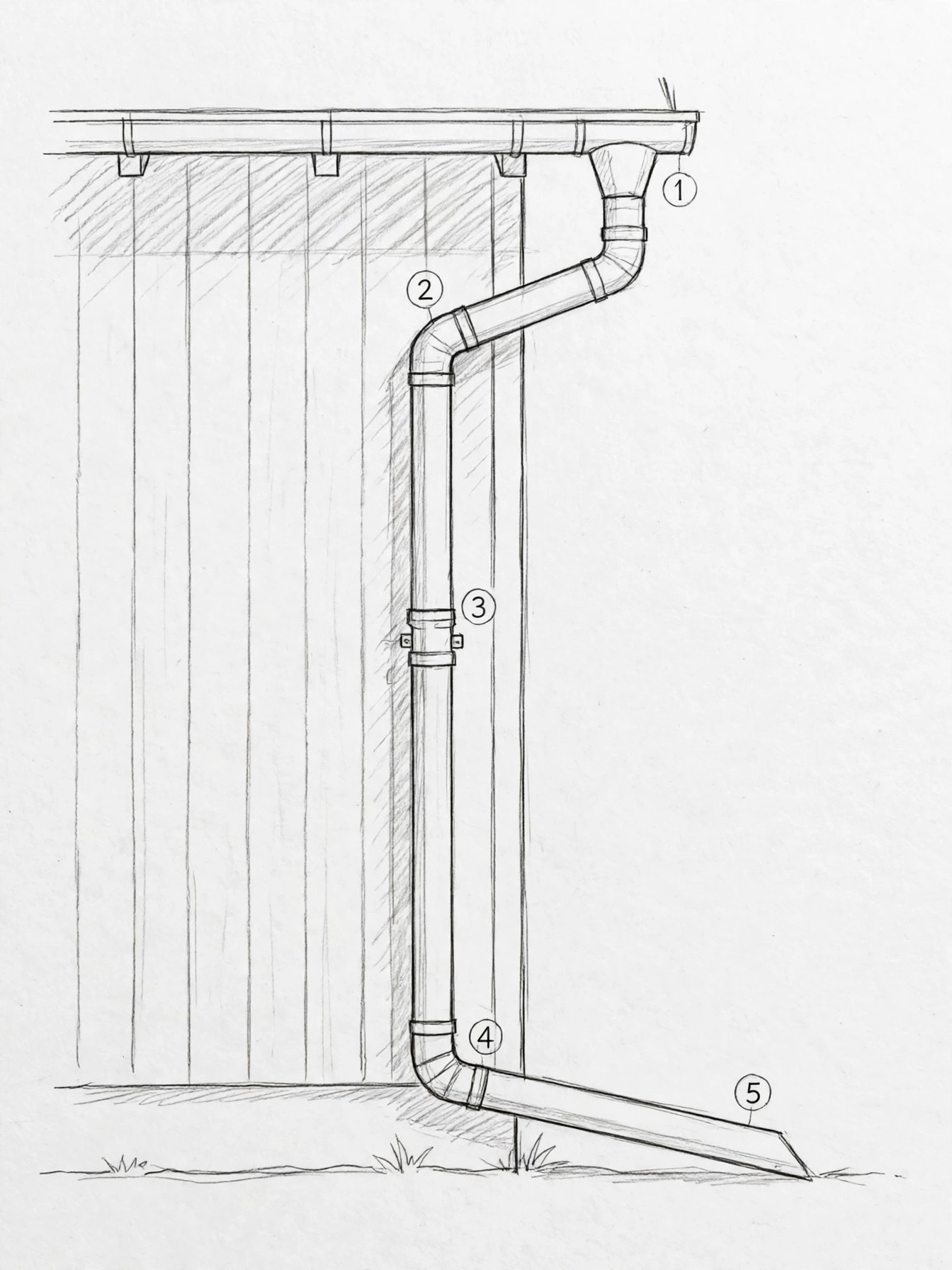
Tools you need, and tools you can skip
You do not need a specialist kit for most downspouts. A garden hose handles routine cleaning, a hand auger handles compacted clogs, and everything else is for the cases where those two fall short. West Virginia University Extension advises starting with heavy gloves, eye protection, a bucket, a scoop, and a pistol-grip hose nozzle, plus a sturdy ladder on level ground. That list is still the right core, and it keeps the job simple.
| Tool | What it does | When you reach for it |
|---|---|---|
| Garden hose with pistol-grip nozzle | Flushes loose debris and tests flow | First step, every time, and the final flush |
| Work gloves and safety glasses | Protect hands from sharp metal edges and eyes from falling debris | Every job, no exceptions |
| Gutter scoop or small trowel, bucket | Clears the gutter run feeding the downspout | Before any flush, so loose leaves do not feed the clog |
| Hand-crank drain auger (plumber’s snake) | Breaks up compacted debris inside the pipe | When a hose flush backs up instead of flowing through |
| Telescoping pole with a nozzle attachment | Reaches the top elbow from the ground | When you would rather not climb, and the clog is near the top |
| Wet/dry vacuum | Pulls loose debris and grit out from the bottom | For a clog at the bottom elbow, or for a dry, loose blockage |
| Screwdriver, pliers, replacement screws | Opens screwed elbows and refits them after cleaning | When an elbow has to come off to clear it |
| Extension pipe and splash block | Carries discharge clear of the foundation | When the extension is missing, crushed, or too short |
What to skip, at least at first. A pressure washer is not a first tool for a downspout. It can split seams, force water behind siding, and pack a loose clog into a tight plug. A leaf blower is worse: it drives dry debris deeper into the pipe and hides how bad the clog really is. An electric auger is overkill for a residential downspout and can kink or dent a thin pipe if it catches. Start with the hose. If the hose does not move it, use the hand auger. If neither works, take the elbow apart. That order clears most clogs without creating a repair.
Before you start: the safety calls that matter
Make the safety calls before you pick up a tool, not halfway up a ladder. Most downspout work is low-risk when you stay on the ground and keep the ladder out of it, and most injuries come from rushing the reach, not from the clog itself.
First, decide whether you need the ladder at all. If the clog is at the bottom elbow, in the extension, or in the lower pipe, you can usually clear it from the ground with a hose, an auger, or a vacuum. Only climb when the clog is at the outlet or top elbow and no ground-level tool can reach it. When you do climb, use a sturdy extension ladder on level ground, set it at the 4-to-1 angle the University of Arizona ladder safety quick reference describes, keep three points of contact, and have someone hold the base. Do not lean sideways off the ladder to reach the gutter, and do not stand on the top two rungs.
Second, look up before you set the ladder. Keep the ladder, the pole, and the hose clear of overhead power lines, and never work on a downspout that touches a service line. If the downspout runs close to a line, or the roof is steep, wet, or two stories up, that is a professional job, not a ladder job.
Third, pick dry, calm weather and wear the gloves and glasses from the tool list. Wet leaves are slippery, metal edges cut, and debris falling from a gutter lands in eyes more often than people expect. A dry day, firm footing, and no rush will clear more clogs safely than any extra tool.
The step sequence: clean a downspout from top to bottom
The order matters more than the force. Work from the top down, and use the gentlest method that works. Most clogs clear at the hose step, and you only need the auger or the elbow work when the easy methods fail.
- Clear the gutter feeding the downspout. Scoop leaves and debris out of the gutter run above the outlet before you touch the pipe. A clean gutter stops fresh debris washing straight back into a pipe you have just cleared, and it shows you whether the outlet itself is blocked.
- Test with the hose. Put the hose into the top of the downspout, or into the outlet if you are working from the ground, and run water at full pressure. Watch the bottom outlet. Strong, steady flow means the pipe is clear. Water backing up, or only trickling out, means a clog is still in there, and the height of the backup hints at how far down it sits.
- Find the clog by tapping. Tap the pipe lightly from top to bottom with your knuckles. A clear pipe rings hollow. A blocked section sounds dull and solid. Mark that spot with tape. That mark tells you where to aim the auger and saves you from working on a clear section.
- Break it up with the auger. Feed a hand-crank auger into the pipe from the bottom, turning it slowly as you push. When the cable meets resistance, work it back and forth to break the clog apart, then pull it out. The clog often comes out on the cable, or breaks into pieces that the next flush carries away. West Virginia University Extension gives the same advice in short form: if a full-pressure hose flush does not clear the blockage, a plumber’s snake is the next step.
- Flush again, and watch the outlet. Run the hose from the top again and watch the bottom. The water should run strong and steady, with no debris coming out in clumps. If it still backs up, repeat the auger step. Two or three rounds are normal for a compacted clog.
- Take the bottom elbow apart if you have to. If the clog sits in the bottom elbow and the auger cannot reach it, remove the screws holding the elbow, pull it off, and clear it by hand. Check the elbow for cracks while you have it off, then refit it with the same screws. If a screw is rusted or stripped, replace it with a stainless screw of the same size.
- Confirm the discharge point. Walk to the outlet and check where the water lands. It should run clear of the foundation through an extension or into a working drain, not pool at the corner of the house. Our guide on how far downspouts should drain from the house covers the distance rule and the grading at the outlet, and it is the right next check once the pipe itself is clear. If water still pools at the outlet even with a clear pipe, read why water pools at the end of a downspout before you blame the downspout again.

Which method fits which clog
Match the method to the clog, not the other way round. The wrong tool wastes time at best and damages the pipe at worst, and the right tool usually clears the clog on the first try.
| Clog | Best first method | Why it works |
|---|---|---|
| Loose leaves and seed pods | Hose flush from the top | Water carries light debris straight through |
| Compacted leaves and sludge | Hand auger from the bottom | The cable breaks the plug apart without forcing it tighter |
| Grit, sand, and shingle granules | Remove the bottom elbow by hand | Heavy material settles low and will not flush uphill |
| Buried discharge pipe | Wet/dry vacuum, then a drain bladder | Suction and pressure reach a section you cannot see or open |
| Frozen or winter blockage | Warm water, slowly | Heat melts ice without cracking the pipe |
| Roots in the pipe | Auger, then a professional assessment | An auger clears the root mass but not the entry point |
Two warnings from that table are worth repeating. Do not use a pressure washer as a first method, and do not force an electric auger through a thin residential pipe. Both can turn a simple clog into a cracked joint or a split seam, and the repair costs more than the cleaning ever would.
Cleaning from the ground: without a ladder
Not every downspout needs a ladder. If the clog is low, or the top elbow is within reach of a pole, you can clear it with both feet on the ground, and you should.
- Telescoping pole flush. Attach a nozzle to a telescoping pole, aim it into the top of the downspout, and run water down the pipe. The pole gives you the reach of a ladder without the fall risk, and it works best for a clog at the outlet or top elbow.
- Wet/dry vacuum from the bottom. Put the vacuum hose into the bottom outlet and pull debris out of the lower pipe and the bottom elbow. This works best for light, dry clogs and for grit that settles at the base.
- Drain bladder from the bottom. Insert a drain bladder into the bottom outlet, connect the hose, and let the bladder expand and push water upward into the clog. The pressure breaks the clog apart from below, and the debris washes out of the top or down into the outlet.
- Hose from the bottom, as a last resort. A hose nozzle aimed up into the bottom outlet can push a light clog upward and out of the top. Use this only when the gutter above is already clean, because it can push debris back into the gutter.
Ground-level work has a limit. If the clog sits in the top elbow of a two-story house, or the pipe is crushed, you will need ladder access or a professional. Do not stretch a pole beyond its safe length, and do not stand on a chair or a bin to gain height. The ground is safe only when your feet stay on it.
When the blockage is underground
Sometimes the vertical pipe is clear and the problem is lower down. A downspout often ends in a short extension, a splash block, or a buried pipe that runs to a drain, a soakaway, or the street. The vertical pipe can be spotless while the extension is crushed, silted, or root-filled, and the symptom is the same: water backs up or the gutter overflows even though the visible pipe is clean.
Test the extension first. Disconnect it if you can, flush it separately, and check that it is not crushed by a vehicle, a heavy object, or soil that has settled over it. If the extension is a buried pipe, look for the tell-tale signs: water pooling at the outlet, a soggy patch over the buried run, or roots growing into the pipe through a joint.
If the buried pipe is the problem, the fix depends on how bad it is. A silted pipe can sometimes be cleared with a wet/dry vacuum or a drain bladder from the outlet. A crushed, collapsed, or root-filled pipe cannot be cleared from the surface, and digging it up on a guess usually costs more than a camera inspection. A professional with a drain camera can show you exactly where the blockage sits and whether the pipe needs clearing, repair, or replacement. Do not keep flushing a buried pipe that will not drain. The water has to go somewhere, and it usually goes back toward the foundation.
Mistakes that turn a small clog into a repair
Most downspout damage happens during cleaning, not during the clog itself. Avoid these five mistakes, and the pipe will usually outlast the clog.
- Starting at the top with a pressure washer. High pressure packs a loose clog tighter and can force water into wall cavities or split a seam. Start with a hose, not a jet.
- Forcing an electric auger through a thin pipe. Electric augers are strong enough to kink or crack residential downspout pipe, especially at a joint. Use a hand auger and work it gently.
- Disconnecting the downspout and leaving it disconnected. An open joint dumps water straight at the foundation. If you take an elbow off, refit it before you finish, even if the pipe is clear.
- Ignoring the discharge extension. A clear vertical pipe that ends in a blocked extension is still a blocked system. Check the extension every time, not just the pipe.
- Cleaning the downspout and leaving the gutter full. The next rain washes gutter debris straight back into the clean pipe. Clear the gutter first, then the pipe, then test both together.
DIY or hire it out
DIY is reasonable when the clog is accessible, the house is one story, and you can work safely from the ground or a stable ladder. A professional is the right call when the job goes beyond that, and the table below is the line I use.
| DIY is reasonable when | Call a pro when |
|---|---|
| Single-story home, clog at the outlet, top elbow, or bottom elbow | Two or more stories, or a steep or wet roof |
| Ladder footing is firm and level, with a spotter if needed | Power lines run close to the downspout |
| Gutters and brackets are sound, with no sagging or pulling away | Gutters sag, pull from the fascia, or need refitting |
| You have time for a test-and-flush cycle after clearing | Water damage shows inside, or the foundation stays wet |
If you are deciding whether to clean the roof and gutters together, do that job in the same visit if you can. A clean gutter above a blocked downspout will fill again quickly, and a clean downspout below a full gutter will clog again quickly. The two jobs belong together, and a professional will usually price them as one visit, not two.
You need a pro when the blockage is underground, when the pipe is crushed or disconnected, or when water has already damaged the wall or foundation. Those are not cleaning jobs any more. They are repairs, and they need the right tools and the right diagnosis first.
Keeping downspouts clear through the year
A downspout that clogs once a year is telling you something about the roof above it, not just about the pipe. The fix is usually in the routine, not in a better tool.
- Clean twice a year, spring and autumn. That is the schedule most guides recommend, and it matches the leaf fall and the seed drop. A spring clean clears winter debris, and an autumn clean clears the leaf fall before winter rain arrives.
- Fit a strainer at the outlet. A simple mesh strainer stops leaves from entering the pipe in the first place, and it is easier to clean than a blocked elbow. Check the strainer at the same time as the gutter.
- Trim branches over the roof. Branches hanging over the gutter are the main debris source for most homes. Cutting them back reduces the leaf load more than any guard or strainer.
- Check after big storms. Heavy rain and wind dump debris fast. A quick look at the outlets after a storm catches a new clog before it becomes a blockage.
- Think about guards, with eyes open. Gutter guards cut the debris entering the system, but they do not remove the need to check the outlets and the extensions. Our guide on whether gutter guards are worth it weighs the cost against the cleaning they actually save.
- Fold it into the wider routine. Downspouts are one part of the gutter system, and the system is one part of the roof. Our gutter maintenance guide puts the whole routine in order, our guide on how often to clean your gutters sets the schedule, and our broader roof maintenance guide covers the roof work that keeps gutters and downspouts clear in the first place.
Frequently asked questions
Start with a garden hose on full pressure from the top. If water backs up, use a hand auger to break up the clog, then flush again. For a low clog, a drain bladder from the bottom works well and needs no ladder. Confirm the pipe is clear by watching for strong, continuous flow at the outlet for at least a minute.
Use a telescoping wand to flush from below, or a drain bladder inserted into the bottom outlet to push water pressure upward into the clog. Both methods work from the ground. A compacted clog at the top elbow may still need ladder access, since bottom-up pressure may not reach it with enough force.
Plan on roughly 20 to 40 minutes per pipe for a normal clog, including testing and the final flush. A bottom elbow that has to come off, or a gutter that also needs a full clean, adds time. The testing and tapping usually take longer than the clearing itself.
You can, but it is usually overkill and it carries a real risk: high pressure can force water into wall cavities and damage thin pipe at bends. A garden hose plus a hand auger clears almost every residential clog without that risk, so reach for the pressure washer last, not first.
Repeat clogs usually mean the debris source has not changed: overhanging branches, no outlet strainer, a narrow pipe on a heavy-leaf side of the house, or a buried extension that is itself blocked. Fix the source, fit a strainer, and check the outlet after storms, and the interval between clogs usually stretches out fast.
Yes. A clean downspout backs up again at once if the gutter above it is still full, and a clean gutter cannot drain through a blocked downspout. Clean the gutter run first, then test and clear the downspout, then flush the whole run as one system.
Call a pro when the house is two or more stories with no safe ladder placement, when the blockage sits in a buried drain, when the pipe is crushed or full of roots, or when water damage already shows inside the house. Those cases need equipment or repair work beyond a routine cleaning.

2 Comments
Pingback: 7 Signs Your Downspout Is Clogged (and What to Check First)
Pingback: Gutter Maintenance Guide for Homeowners