


Last updated: October 31, 2026
Yes, for most homes, cleaning the roof and gutters together is the smarter move. The roof sheds everything into the gutters, so a roof cleaned on its own refills the gutters below it, and gutters cleaned on their own fill right back up at the next rain if the roof above them is still dirty. One visit, roof first and gutters second, breaks that loop instead of repeating it.
That short answer hides a few real decisions, though. Bundling saves money only when both jobs are actually due, the order of work matters more than the discount, and there are homes where separate visits make more sense. This guide walks through the whole decision: what a combined visit covers, when it pays, when it does not, how often to book it, and what to ask before a crew climbs a ladder at your house.
Contents
- What a Combined Roof and Gutter Cleaning Covers
- Why the Roof and Gutters Act as One System
- The Order That Matters: Roof First, Gutters Second
- Bundle or Book Separately? A Decision Table
- Where the Savings Really Come From
- How Often to Clean Both Together
- When Separate Visits Make More Sense
- Doing It Yourself vs Hiring a Crew
- What to Ask Before You Book a Combined Visit
- Frequently Asked Questions
- Sources
What a Combined Roof and Gutter Cleaning Covers
Roof and gutter cleaning, as a combined service, means clearing debris and growth from the roof surface and then clearing, flushing, and checking the gutter system that catches everything the roof sheds, all in a single visit. It is one drainage job done top to bottom, not two unrelated chores that happen to share a ladder.
A proper combined visit covers five parts, and a quote that skips one of them is worth questioning. The roof surface itself gets loose debris blown or brushed off, and moss, algae, or lichen gets treated rather than blasted. Valleys get cleared, because that is where debris collects deepest and where water concentrates. The gutters get scooped by hand, not just blown out, so compacted muck at the bottom comes out too. Downspouts get flushed with water to prove they run clear, which is the only test that counts. And the ground below gets cleaned up, because a crew that leaves your beds full of roof grit has only moved the mess.
| Part of the job | What gets done | Why it matters in a combined visit |
|---|---|---|
| Roof surface | Loose debris removed, growth treated with a low-pressure wash | Stops the roof from shedding new debris into freshly cleaned gutters |
| Roof valleys | Packed leaves and needles cleared by hand | Valleys feed the heaviest debris straight into the gutter below |
| Gutters | Scooped by hand, then rinsed | Removes both old buildup and the debris the roof clean just washed down |
| Downspouts | Flushed with water end to end | A clear gutter above a blocked downspout still overflows |
| Ground cleanup | Debris collected from beds, lawn, and paths | Roof debris has to go somewhere, and your garden is not the place |
If you want the deeper version of the roof half of this job, our complete roof cleaning guide covers methods, safety, and when to hire, and it is the pillar this bundling guide sits under. The point here is narrower: how the two halves fit together, and whether booking them together is right for your house.
Why the Roof and Gutters Act as One System
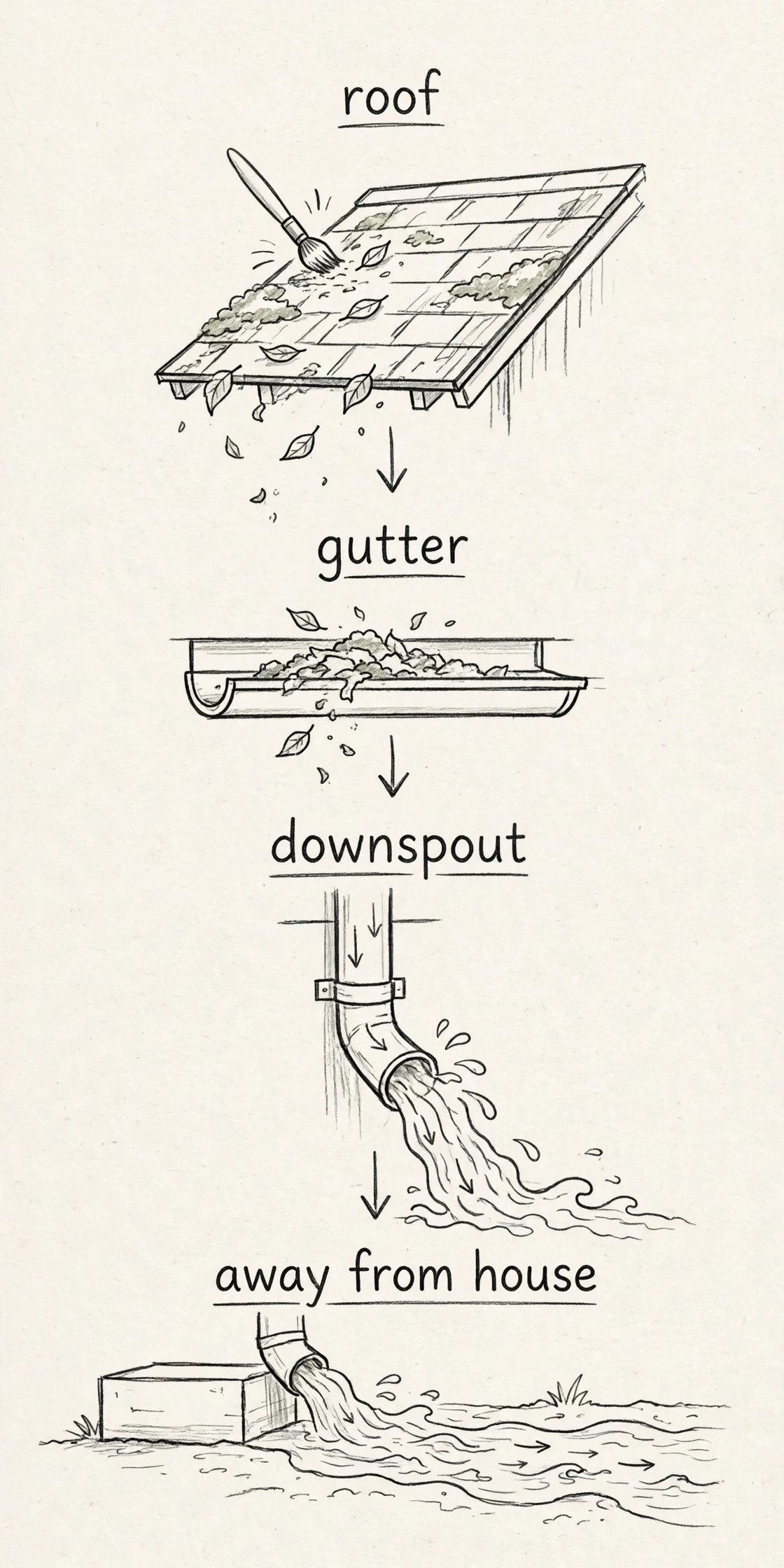
Your roof and gutters are a single water-moving system, not two separate features. Rain lands on the roof, runs down the slope, drops into the gutter, and travels through the downspout away from the house, and anything that interrupts that path at any point puts water where it does not belong.
That shared path is why cleaning one half and ignoring the other so often disappoints. Leaves, needles, moss, and shingle granules all start on the roof and end up in the gutter. Clean the gutters in October and leave a mossy roof above them, and the first hard rain carries a fresh load down into the troughs you just paid to empty. Clean the roof and skip the gutters, and the loosened moss and grit settle into the gutter and harden there, sometimes worse than before, because roof-cleaning runoff is wet, heavy, and sticky.
The failure runs in the other direction too. A clogged gutter lets water back up against the roof edge, where it can rot fascia boards, soak soffits, and creep under the first course of shingles. In cold climates that standing water feeds ice dams at the eaves. So a dirty gutter can damage the roof just as surely as a dirty roof can fill a gutter. Treating them as one system is not a sales line. It is how water actually moves across your house.
The Order That Matters: Roof First, Gutters Second
When both jobs happen in one visit, the order is fixed: roof first, gutters second, downspouts last. Any crew that offers to do it the other way around is either planning a second gutter clean or does not understand the job.
The reason is simple gravity. Roof cleaning dislodges material, and all of it travels downhill into the gutter. If the gutters are cleaned first, the roof work refills them before the crew leaves, and you have paid for a gutter clean that lasted an hour. Done in the right order, the gutter clean picks up both the old buildup and the fresh debris from the roof, and the final flush proves the whole path runs clear.
A typical combined visit runs in this sequence:
- Walk the property and inspect the roof from the ground and the ladder, noting moss, damaged shingles, and sagging gutter sections before any water flows.
- Clear loose debris from the roof surface and valleys by hand or blower, working from the ridge down so nothing gets pushed uphill.
- Treat roof growth with a low-pressure wash, which kills moss and algae at the root instead of blasting it off. Our comparison of soft wash vs pressure wash for roofs explains why the gentle method wins on most roofs.
- Scoop the gutters by hand, including the debris the roof work just washed down, and check hangers and seams while the troughs are empty.
- Flush every downspout with water until it runs clear at the outlet, and clear any blockage found on the spot.
- Clean up the ground below, and walk the system once more to confirm water has a clear path from ridge to outlet.
That final flush deserves emphasis, because it is the step most often skipped. A gutter can look clean from the ladder and still sit above a blocked downspout elbow. Water is the test. If it does not run freely out of the bottom, the job is not done, no matter how tidy the troughs look.
Bundle or Book Separately? A Decision Table
Most homes benefit from bundling, but not every home, and not every year. Use this table to place your house before you call anyone. If two or more rows in the “bundle” column describe your home, a combined visit is probably the right call. If the “separate” column fits better, split the jobs and spend the savings elsewhere.
| Your situation | Bundle them | Book separately |
|---|---|---|
| Both roof and gutters are due | Yes, this is the classic case | |
| Roof has visible moss or algae, gutters overflow in rain | Yes, both halves are feeding each other | |
| Heavy tree cover over the roof | Yes, debris volume makes the shared visit efficient | |
| One-story home, easy ladder access | Yes, one setup covers both jobs cheaply | |
| Roof was washed last year, gutters are full now | Yes, gutter-only visit; the roof does not need redoing | |
| Gutter guards installed and working | Yes, gutter work is lighter and may need a different crew | |
| Roof damage or a leak needs a roofer, not a cleaner | Yes, repair first, cleaning after, and not by the same crew | |
| Steep, tall, or complex roof | Yes, if one insured crew can safely do both | Yes, if the roof needs a roofing specialist and the gutters do not |
The steep-roof row is the judgment call. A single crew that is insured and equipped for roof work can handle both halves well, and that is often the best outcome. But if the roof needs a specialist, for example a tile roof with cracked pieces or a roof under warranty with strict rules about who walks on it, let the specialist handle the roof and book a gutter crew separately. Forcing one company to do work outside its skill set is how roofs get damaged.
Where the Savings Really Come From
Bundling saves money, but the saving comes from shared setup, not from a discount on the cleaning itself. A crew that visits once pays for travel once, sets ladders and safety gear once, and walks the property once. Booked separately, you pay those fixed costs twice, and the second visit also repeats the inspection and the ground cleanup. That is the whole economics of the bundle, and any honest quote reflects it.
How large is that saving in practice? It varies by market, house size, and roof complexity, so treat any single number with care. As a sense of scale, some companies advertise package savings in the range of 10 to 15 percent off the separate prices, and one Knoxville company’s published package deals show 5 to 10 percent for a basic bundle and 10 to 15 percent for a fuller one, rising to 20 percent only for a whole-property package that adds windows, siding, and driveways. A Vancouver company advertising a roof and gutter cleaning combo quotes the same 10 to 15 percent range for the pair. Those are advertised package rates from two local companies, not a national average, but they agree on the shape of it: a real but modest saving, roughly a tenth to a sixth off, not half price.
| Cost factor | Separate visits | Bundled visit |
|---|---|---|
| Travel and scheduling | Paid twice | Paid once |
| Ladder and safety setup | Set up twice | Set up once |
| Inspection of the roofline | Repeated on each visit | Done once, covers both jobs |
| Ground cleanup | Two cleanups | One cleanup |
| Actual cleaning labor | Same total work | Same total work, slightly faster in sequence |
| Risk of rework | High: roof debris refills clean gutters | Low: gutters cleaned after the roof |
Two warnings belong here. First, a bundle discount that looks too large deserves a second look. If a quote is far below every other quote for the same two jobs, something is being skipped, usually the downspout flush, the valley clearing, or the ground cleanup. Second, the saving disappears if one half of the job was not due. Paying for a roof wash a year early to “save” 10 percent on a bundle costs more than booking the gutters alone now and the roof when it actually needs it.
How Often to Clean Both Together
Gutters and roofs run on different clocks, and that mismatch is the reason bundling is a decision rather than a default. Gutters fill fast and need attention often. Roofs grow slowly and need a full wash rarely. The trick is to sync the two schedules at the visit where they overlap, and let the gutters run alone in between.
West Virginia University Extension advises cleaning rain gutters at least twice a year, and more often for homes exposed to severe storms. That twice-a-year rhythm is the gutter baseline for most homes. A full roof wash, by contrast, is typically a job measured in years, not seasons, unless moss is aggressive in your climate. So the sensible pattern for most homes is a combined visit once a year, plus a gutter-only visit at the other end of the year.
| Your home | Combined visit | Gutter-only visits |
|---|---|---|
| Average home, light tree cover | Once a year, late spring or early fall | Once more a year, opposite season |
| Heavy tree cover, pines or oaks overhead | Once a year, after leaf fall | One or two more a year, as debris demands |
| Wet, shaded climate with moss pressure | Once a year, with a moss treatment | Twice a year, spring and fall |
| Dry climate, few trees | Every two to three years, or when growth shows | Once a year, or after big storms |
| Gutter guards installed | When the roof needs it, guards checked at the same visit | As needed, often once a year for guard cleaning |
Timing within the year matters as well. Late spring clears winter debris and lets a moss treatment work through dry weather. Early fall clears the roof and gutters before the wettest months, which is the better choice if you only book one visit a year. Either way, book before the rainy season, not during it, because a crew cannot safely work a wet roof and a gutter full of standing water tells you nothing about how it drains. Our guide to how often gutters need cleaning covers the gutter side of the schedule in more detail, including the signs that mean “now” rather than “next season”.
When Separate Visits Make More Sense
Bundling is the default, not the rule. There are five situations where splitting the jobs is the better call, and recognizing them saves more than any package discount.
First, when only one half is due. A roof washed last year does not need washing again because the gutters are full, and gutters cleaned two months ago do not need redoing because the roof is mossy. Second, when the roof needs repair rather than cleaning. A leak, lifted shingles, or storm damage belongs to a roofing contractor, and cleaning crews should not be walking a damaged roof to reach the gutters. Third, when gutter guards change the job. Guards cut gutter debris sharply, so the gutter half becomes a lighter check-and-rinse visit that may not justify a full roof crew’s day rate. Fourth, when the roof is under a warranty that restricts who may walk on it or which treatments may be used. A cleaner who ignores those terms can void coverage, and that risk dwarfs a bundle saving. Fifth, when the two jobs need different specialists, for example a tile roof that needs a tile-experienced crew and simple aluminum gutters that any gutter company can handle.
There is also a timing case worth naming. After a major storm, gutters may need emergency clearing while the roof needs an insurance inspection first. Clear the gutters so water can drain, then deal with the roof through the proper channel. Bundling a storm response with a routine roof wash muddles both jobs.
Doing It Yourself vs Hiring a Crew
A combined visit doubles the height exposure of a gutter-only job, because it adds roof work to ladder work, and that changes the DIY calculation. Gutter cleaning from a ladder is a job many homeowners handle safely on a single-story home. Roof work is a different category, and the safety guidance from the professionals is blunt about it.
West Virginia University Extension’s gutter safety guidance covers the ladder basics well: a sturdy ladder on level ground, gloves and eye protection, never stepping on the top two rungs of a step ladder, and never working in a storm or when ice is possible. It also states plainly never to crawl out onto a roof, calling it extremely dangerous. The National Roofing Contractors Association goes further, advising homeowners to inspect a roof from ground level only and to leave roof work itself to a professional roofing contractor, because the risk of falling is too great without proper safety systems.
That gives a clean DIY boundary for a combined job. If your home is single-story, the ground is level, and you are comfortable on a ladder, the gutter half is reasonable DIY. The roof half, anything that involves walking the roof, treating growth on a slope, or clearing valleys from above, belongs to a crew with fall protection and insurance. The honest middle path is to clean the gutters yourself and hire out the roof, then sync the two so the roof crew comes first and you follow with the gutters, or simply let one crew do both and spend the afternoon on something safer.
For a two-story home, a steep roof, a roofline near power lines, or any home where the ladder footing is soft or sloped, hire the whole visit out. The money saved by DIY disappears the first time a ladder shifts, and a combined visit is exactly the job where a crew’s insurance and equipment earn their price.
What to Ask Before You Book a Combined Visit
A combined quote should answer these questions before you sign it. If a company cannot answer one clearly, that is information too.
- Is the gutter clean done after the roof work in the same visit, and is the downspout flush included in the price?
- What method will you use on the roof, and is it a low-pressure wash rather than a high-pressure blast?
- Are valleys, downspouts, and ground cleanup included, or priced as extras?
- Are you insured for roof work specifically, and can you show proof before the visit?
- Will you flag damage you find, such as lifted shingles, sagging sections, or separated seams, and put it in writing?
- What happens if moss grows back quickly: is there a retreatment guarantee, and what does it cover?
- Does the work comply with my roof warranty, and will you confirm that with the manufacturer if needed?
Those questions overlap with the hiring questions in our guide to questions to ask a gutter cleaning company, which is worth reading before any gutter booking, bundled or not. The theme is the same in both guides: a good company welcomes specific questions, because specific questions are how it shows its work.
Frequently Asked Questions
Usually, yes, by a modest amount. One visit means one trip, one ladder setup, and one cleanup, and companies that publish package rates typically advertise savings around 10 to 15 percent off the separate prices. The saving is real but small, so do not let it pull a roof wash forward a year early. A discount on work that was not due yet is not a saving.
After, always. Roof cleaning washes debris downhill into the gutters, so gutters cleaned first get refilled by the roof work itself. The correct sequence is roof first, gutters second, downspouts flushed last, with a final water test proving the whole path runs clear.
For most homes, once a year as a combined visit, plus one gutter-only visit in the opposite season. Gutters generally need cleaning at least twice a year, while a full roof wash is typically a job measured in years unless moss is aggressive in your climate. Homes under heavy tree cover may need the gutter half more often.
Yes, and it is a sensible split for a single-story home with level ground and a comfortable ladder setup. Just keep the order right: let the roof crew go first, then clean the gutters after, so the roof debris does not undo your work. For a two-story home, a steep roof, or a roofline near power lines, hire the whole visit out.
No, but they change it. Guards cut the debris that reaches the gutter, so the gutter half becomes a lighter inspection and rinse rather than a full scoop-out. Keep the combined visit for the roof schedule, and have the crew check the guards, the outlets, and the downspouts while they are there. A guard that has failed silently is worse than no guard at all, because it hides the blockage.
Late spring or early fall, booked before the rainy season. Late spring clears winter debris and gives a moss treatment dry weather to work. Early fall clears everything before the wettest months, which is the better single-visit choice if you only book once a year. Avoid booking during wet or icy weather, when roof work is unsafe and drainage cannot be tested properly.
Sources
Only sources actually opened during research are listed here. Figures from company pages are their advertised package rates, not national averages, and are described that way in the text.
- West Virginia University Extension: Gutter Safety, by Wayne Lundstrom and Mark Fullen, on ladder setup, protective gear, and cleaning gutters at least twice a year.
- National Roofing Contractors Association: guidance on roof inspection safety, advising ground-level inspection by homeowners and professional inspection after severe weather.
- Shine City Pressure Washing: Roof and Gutter Cleaning Combo, describing a combined visit sequence and advertising 10 to 15 percent off separate prices.
- Billy Goat Gutter Cleaning: Package Deals, publishing 5 to 10 percent savings for a basic bundle, 10 to 15 percent for a complete bundle, and up to 20 percent for a whole-property package.

4 Comments
Pingback: Preventative Roof Maintenance Checklist by Season - Home Exterior Lab
Pingback: Roof Maintenance Guide for Homeowners
Pingback: How to Clean Downspouts: Tools and Technique
Pingback: Roof Cleaning Guide: Methods, Safety & When to Hire