

Most wood decks last 15 to 25 years, but that single number hides the real story. A pressure-treated pine deck that is cleaned and resealed on schedule can outlive a neglected cedar deck by a decade, and the boards under your feet usually wear out years before the frame underneath them does. The wood species sets the ceiling. Upkeep, exposure, and build quality decide where inside that range your deck actually lands.
Last updated: October 27, 2026
Table of contents
- The short answer: lifespan by wood type
- Your deck has two lifespans, not one
- What actually ends a wood deck’s life
- How climate and exposure move the number
- The upkeep that actually moves the needle
- How much life does your deck have left? A 5-minute check
- Keep it, resurface it, or replace it
- DIY or hire a pro
- Frequently asked questions
- Sources
The short answer: lifespan by wood type
With regular cleaning and a finish kept in good shape, pressure-treated pine deck boards last about 15 to 20 years, cedar about 15 to 20 years, redwood about 20 to 30 years, and dense tropical hardwoods like ipe about 25 to 50 years or more. Composite and PVC boards, included here only for comparison, typically last 25 to 30 years and longer for premium capped lines.
One honest caveat before the table: published ranges disagree, sometimes by ten years for the same wood. That is not sloppy research. Some sources count the deck surface, others count the whole structure, and some assume perfect upkeep while others assume average care. The ranges below are planning ranges for the boards themselves, assuming the deck is cleaned yearly and refinished when the finish wears thin. Treat them as midpoints to plan around, not promises printed on a board.
| Wood type | Boards, with regular care | What it is | How it usually fails |
|---|---|---|---|
| Pressure-treated pine | 15 to 20 years | Softwood, usually Southern Yellow Pine, pressure-impregnated with a copper-based preservative that resists rot and insects | Checking, cupping, and surface wear; boards go before the treated frame does |
| Cedar | 15 to 20 years | Western Red Cedar heartwood, naturally resistant to decay and insects thanks to its own extractives | Surface graying, checking, and softening where water sits; soft wood dents and scratches easily |
| Redwood | 20 to 30 years | Redwood heartwood, naturally decay resistant, dimensionally stable, and good at holding a finish | Slow surface weathering; lower grades and sapwood fail much sooner than heartwood |
| Tropical hardwood (ipe, cumaru, tigerwood) | 25 to 50 years or more | Extremely dense hardwoods with high natural decay resistance | Surface checking and graying if left unoiled; the wood itself rarely rots first |
| Composite or PVC (for comparison) | 25 to 30 years, up to 50 for premium capped lines | Manufactured boards, not wood; included so you can weigh a resurfacing switch | Fading, staining, and scratching on older uncapped boards; the frame still ages like any wood frame |
Two names in that table deserve a plain-English definition each, because they drive everything else in this article. Pressure-treated wood is ordinary softwood lumber that has been forced full of preservative chemicals under pressure, so fungi and insects struggle to eat it. Heartwood is the older, darker wood at the center of a tree, and in cedar and redwood it carries the natural chemicals that resist decay. Sapwood, the pale outer ring, has almost none of that protection, which is why the grade of cedar or redwood you buy matters as much as the species name on the receipt.
ForestSource’s comparison of composite and wood decking puts pressure-treated boards at 15 to 25 years, cedar and redwood at 20 to 30 years, and tropical hardwoods at 30 to 50 years or more with reasonable care, while EngineerFix’s guide to wood deck lifespan gives modern pressure-treated lumber 15 to 20 years and cedar and redwood 15 to 30 years. My table sits inside both ranges rather than picking the rosiest number from either one, and the rest of this article explains which end of each range your deck is heading for.
Your deck has two lifespans, not one
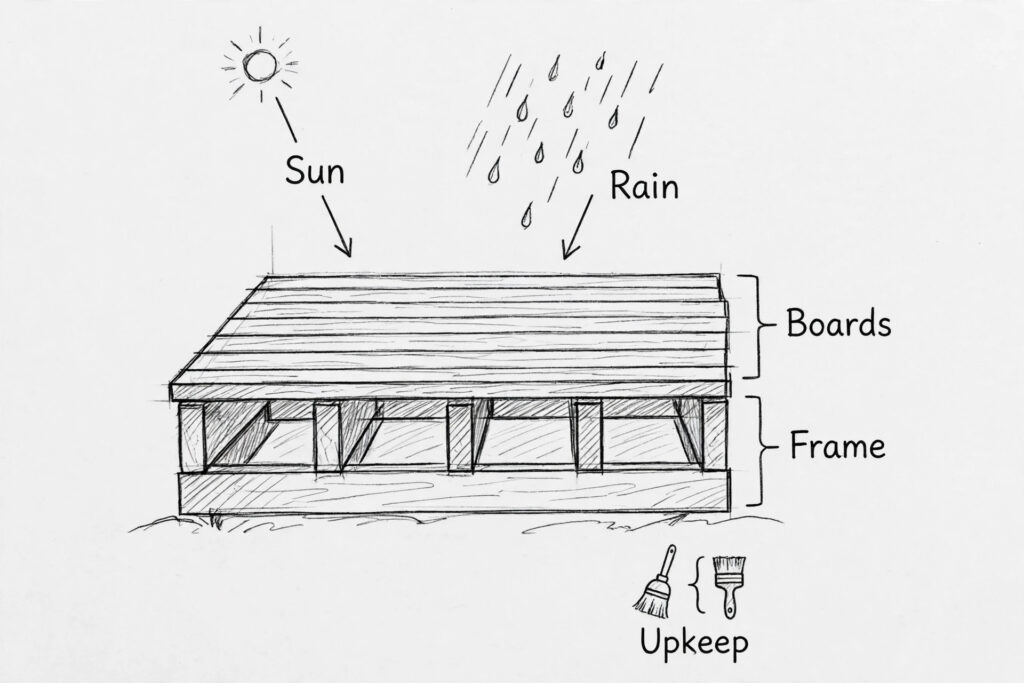
A deck is really two structures stacked together: the walking surface you see, and the frame underneath that carries the load. The boards live in the weather and wear out first. A well-detailed pressure-treated frame, protected from standing water, can outlast two sets of boards, which is why replacing boards is often a repair while replacing a frame is a rebuild.
This split changes how you should read every lifespan claim. When a builder says a deck lasts 30 years, ask whether they mean the boards, the frame, or both. A deck with tired boards on a sound frame is a resurfacing project. A deck with pretty new boards on a rotting frame is a safety problem wearing a fresh coat. The frame fails quietly, because you cannot see joists and beams without crawling underneath, and the most common frame killer is water trapped where boards meet joists, especially at fastener holes.
Three details decide which side of the frame’s lifespan you land on. Joist tape on top of joists and beams keeps water out of the screw holes. Flashing at the ledger, the board that ties the deck to the house, keeps water out of the house framing. And airflow underneath, with clearance above the ground and gaps between boards, lets everything dry after rain instead of staying damp for days. A deck built low to wet ground with no airflow can rot its frame while its boards still look fine from above.
| Part of the deck | Typical service life | What shortens it fastest |
|---|---|---|
| Deck boards (surface) | 15 to 25 years for most woods, longer for tropical hardwoods | Sun, standing water, trapped debris in the gaps, no finish |
| Joists and beams (frame) | 25 to 40 years for treated lumber, when detailed to drain and dry | Trapped water at board-to-joist joints, missing ledger flashing, ground contact |
| Posts and footings | As long as the frame, or much less if set wrong | Soil contact without the right treatment rating, water pooling at the base |
| Railings and stairs | Often shorter than the boards, because they take hands, feet, and weather | Loose fasteners, end grain left unsealed, constant wetting from planters or snow |
If you remember one thing from this section, make it this: budget for boards and frame separately. Boards are a maintenance cycle. The frame is the investment you protect, because once it goes, you are not repairing a deck, you are building one.
What actually ends a wood deck’s life
Wood decks rarely die of old age in the abstract. They die of water, sun, and neglect acting together, and each failure mode leaves a different signature. Learning to read those signatures is what turns a vague worry about your deck’s age into a clear verdict about its condition.
Decay fungi are the main killer, and they need three things: wood, oxygen, and moisture held above about 20 percent for extended periods. That is why the same board lasts decades on a sunny, breezy deck and rots in a few years where leaves pile up against it. Sunlight breaks down lignin, the glue in wood fibers, which roughens the surface and opens it to water. Freeze and thaw cycles then wedge that water into checks and cracks, widening them each winter. Insects matter less than moisture on most decks, but termites and carpenter ants move into wood that is already soft, so insect damage is often a symptom of a moisture problem, not the original cause.
| What you see | What it usually means | How serious it is |
|---|---|---|
| Gray, weathered color | UV has broken down the surface fibers; the finish is gone | Cosmetic on its own, but a sign the wood is unprotected |
| Checking (fine cracks along the grain) | Normal drying movement, worse in full sun | Cosmetic until checks deepen and hold water |
| Cupping across the board width | One face dried faster than the other, or water sat on top | A trip hazard and a water trap; our guide to why deck boards cup explains the causes |
| Soft, spongy spots that a screwdriver sinks into | Decay fungi have broken down the wood structure | Structural: that piece has lost strength and needs replacing |
| Loose, wobbly railing or bouncy floor | Fasteners or framing around the posts have deteriorated | Safety issue: get it assessed before heavy use |
| Dark staining where boards meet joists | Water is trapped in the joint and the joist top is rotting | Serious for the frame even if the boards look fine |
Notice what is missing from the serious column: age alone. A 25-year-old ipe deck with solid framing can have more safe life left than a 12-year-old pine deck whose ledger flashing failed. Age tells you when to look harder. Condition tells you what to do.
How climate and exposure move the number
Two decks built from the same lumber on the same day can be ten years apart in lifespan, purely because of where they sit and what hits them. Exposure is the multiplier on every number in the first table, and it is the part most lifespan articles skip.
Full southern and western sun is the hardest exposure for a finish, because UV and heat cycle the boards daily and bake the finish off faster. Shade sounds gentler, but a deeply shaded deck that never dries is often worse, because damp shade feeds the fungi and the green growth that keep wood wet. Wet climates and low decks, where boards sit close to damp ground with poor airflow, combine both problems: constant moisture and slow drying. Snow country adds freeze and thaw cycles plus months of snow sitting on the surface, and deicing salts and shovels add their own wear. Repeated heat from a deck fire pit is another exposure worth counting, so check whether a fire pit belongs on a wood deck before you set one on the boards.
| Your deck’s situation | Effect on lifespan | What helps most |
|---|---|---|
| Full sun, good airflow, dries fast after rain | Near the top of the range; finish wears faster but wood stays dry | Refinish on schedule, because UV is doing the damage, not rot |
| Deep shade, stays damp for days | Pulled toward the bottom of the range; decay and green growth thrive | Clear debris, open up airflow, clean yearly, keep the finish intact |
| Wet climate or frequent rain | Shortens every wood’s range unless drainage and detailing are excellent | Gaps clear, joist tape, no planters sitting on the boards |
| Low to the ground, poor ventilation underneath | Frame life suffers most; boards can look fine while joists rot | Ventilation, drainage away from the deck, inspect underneath yearly |
| Freeze and thaw winters, snow load | Cracks widen, fasteners loosen, finish fails sooner | Clear snow without gouging, fix popped fasteners in spring |
| Covered porch or roof overhead | Longest realistic life for any wood; finish lasts far longer | Still inspect the ledger and drainage, because covered does not mean dry forever |
Read your own deck against that table before you compare it to a neighbor’s. A shaded cedar deck in a wet climate and a sunny redwood deck in a dry one are not the same product in practice, even though both are called wood decks.
The upkeep that actually moves the needle
Upkeep is the one lifespan factor you control after the deck is built, and not all upkeep is equal. Cleaning and refinishing on schedule buys years. Cosmetic fixes on a deck whose drainage is broken buy nothing. Spend your effort in this order: water control first, cleaning second, finish third.
Water control means keeping gaps between boards clear so rain drains instead of ponding, moving planters and mats that trap moisture, and making sure downspouts and grading do not dump water under the deck. Cleaning means a yearly wash that removes the dirt and organic film fungi feed on, using a cleaner made for decks and a gentle approach that does not chew up the fibers. Finish means recoating when water stops beading and soaking in instead, which is the honest test, rather than recoating on a calendar date regardless of condition. Our wood deck maintenance guide walks through the full seasonal routine if you want the complete checklist; this article stays on what each habit is worth in years.
For the season-by-season version of this checklist, see our seasonal wood deck maintenance routine.
| Habit | Typical interval | What it buys you |
|---|---|---|
| Sweep gaps clear, remove debris and leaves | Several times a year, and every fall | Stops the damp pockets where decay starts |
| Wash the deck surface | Yearly | Removes the grime that holds moisture and feeds growth |
| Recoat with stain or sealer | Every 2 to 3 years for most wood decks, sooner in full sun | Restores water repellency and UV protection; see how often to stain a deck for intervals by finish type |
| Oil a tropical hardwood | Yearly if you want to hold the color; optional for structure | Color only on ipe and similar woods; skipping it grays the deck without shortening its structural life much |
| Inspect framing, ledger, and fasteners | Yearly, in spring | Catches the frame problems that end decks early, while they are still small repairs |
The finish choice matters too, and it is worth one clear distinction. Penetrating stains and oils soak into the wood and wear away gradually, so recoating is mostly a cleaning job. Film-forming finishes like paint sit on top and can peel, which is a bigger repair when they fail. If you are weighing those two paths, our comparison of deck stain versus sealer and our guide to paint for a wood deck lay out which finish suits which deck. For lifespan purposes, the rule is simple: the best finish is the one you will actually maintain, because a premium product left to fail protects nothing.
When it is time to recoat, see how to stain a wood deck for the full preparation, sanding and finishing steps.
One more upkeep truth, because it surprises people: a deck that is never finished at all does not just look gray. Unprotected wood absorbs water freely, checks deeper, and feeds decay faster, so an unfinished cedar deck can lose years compared with the same deck kept sealed. Gray is a look you can choose. Rot is a cost you cannot undo.
How much life does your deck have left? A 5-minute check
Age gives you a rough bracket. This check gives you a verdict. Walk the deck with a flathead screwdriver and your eyes open, and test the places decks actually fail first, not the middle of the prettiest board.
Start with the probe test. Press the screwdriver tip into the wood at board ends, where boards meet the house, around posts, and at stair stringers. Sound wood resists. Decayed wood lets the tip sink in with little effort, and it often feels soft and fibrous rather than firm. Next, bounce gently near the middle of the longest span and lean on the railing with steady pressure. A little flex is normal. A spongy bounce, a sag, or a railing that moves at its posts means the framing or its connections need a closer look. Then look underneath if you can get there safely: dark staining on joist tops, soft spots at the ledger, and rust-streaked fasteners are the three frame warnings that matter most. Finally, look for green growth and debris packed in the gaps, because both hold moisture against the wood; our guide to identifying green growth on a deck helps you tell harmless surface growth from growth that signals a dampness problem.
| What the check finds | What it means for remaining life | Next step |
|---|---|---|
| Surface gray and checking only, probe test firm everywhere | Years left; this is a finish problem, not a wood problem | Clean and refinish; keep up the schedule |
| One or two soft boards, frame firm | Boards are ending, frame is not | Replace those boards; check why they failed (drainage, shade, planter) |
| Soft spots at several board ends or stair treads | The surface is near the end of its service life | Price a resurface, and inspect the frame before committing |
| Soft ledger, soft posts, or bouncy framing | Structural life is ending, regardless of how the boards look | Stop heavy use and get a pro assessment promptly |
| Widespread softness across boards and framing | The deck has reached the end of its safe life | Plan a rebuild, not a recoat |
Be honest about the ledger result in particular. The ledger is the connection to the house, and a failed ledger can drop a deck without warning. If the probe sinks into the ledger or the wood around its bolts, that is not a weekend project. That is a pro call, and it comes before any conversation about stain colors.
Keep it, resurface it, or replace it
Most decks do not need an all-or-nothing verdict. The right move depends on which part is failing, and matching the project to the failure is how you avoid both overspending on a rebuild and underspending on a deck that is past saving.
Keep and maintain the deck when the probe test is firm, the frame is sound, and the problems are cosmetic: gray color, worn finish, a few checked boards. Resurface, meaning new boards on the existing frame, when the boards are widely worn or soft but the frame, posts, and ledger test solid. Rebuild when the frame itself is soft, the ledger has failed, or the cost of piecemeal board replacement is approaching the cost of a new surface on a frame you do not trust. A full repair-versus-replacement breakdown is coming as its own guide; the rule here is to let the frame decide, because boards are replaceable and frames are not a cosmetic item.
| Your situation | The sensible move | Why |
|---|---|---|
| Boards worn and gray, frame and ledger firm | Clean and refinish | The wood still has structural life; only the finish has expired |
| Many boards soft or cupped, frame tests solid | Resurface with new boards | You keep the expensive part (the frame) and replace the worn part |
| Boards fine, frame or ledger soft | Structural repair or rebuild, not a recoat | New boards on a failing frame hide a safety problem |
| Deck is 25-plus years old, low to wet ground, never maintained | Price a rebuild alongside any repair quote | Hidden frame decay is likely, and piecemeal repair can cost more than starting over |
| You want a different material, like composite | Resurface only if the frame can carry it | Composite needs correct joist spacing and a sound frame; check the manufacturer’s span requirements first |
DIY or hire a pro
Checking your deck’s condition, cleaning it, and recoating it are realistic DIY jobs for most homeowners with a free weekend and dry weather. Replacing a few boards is also within reach if the framing underneath tests solid and you can match the board size and fastening.
Hire a pro when the failure is structural: a soft ledger, soft posts or beams, a bouncy or sagging floor, or a railing that moves at its posts. Also hire a pro for elevated decks, decks over living space, and any deck where you cannot safely inspect underneath. A structural assessment is not expensive compared with a rebuild, and it is the only way to know whether a resurface is money well spent or money laid over rot. When you interview a contractor, ask how they will inspect the ledger and framing, not just what boards they will install. The answer tells you whether they are selling a surface or diagnosing a structure.
One safety note that belongs in every deck article: never work underneath a deck you suspect is unstable, and keep guests, grills, and heavy planters off a deck with a soft ledger or bouncy framing until it has been assessed. A deck that looks fine from the top can still be a frame failure waiting for a load.
Frequently asked questions
About 15 to 20 years for the boards with regular cleaning and refinishing, and longer for a well-detailed frame. Neglected boards in damp shade can need replacing much sooner, while a covered, well-kept pressure-treated deck can push past 20 years on its boards.
About 15 to 20 years for the deck surface with regular sealing, and longer in dry, well-ventilated spots with heartwood boards. Cedar left unfinished in a wet climate can show decay in as little as 10 years, which is why the finish schedule matters more than the species name alone.
Yes, but usually not on its first set of boards unless the wood is redwood heartwood or a tropical hardwood. A 30-year-old deck is often a second set of boards on an original frame, or a hardwood deck that has been kept clean and finished. The frame reaching 30 years is common; the original pine boards reaching 30 years is not.
Yes, when the stain is maintained. A penetrating stain or sealer slows water absorption and UV damage, which are the two forces that age wood fastest. A single coat applied once and forgotten does little; the lifespan benefit comes from recoating when water stops beading, every couple of years in most exposures.
No, not on the boards. Composite and PVC boards typically last 25 to 30 years or more with washing alone, while wood boards need regular finishing to reach 15 to 25 years. Wood wins on upfront cost, repairability, and feel underfoot. Composite wins on lifespan per board and on maintenance hours.
Replace it, or at least rebuild the structure, when the frame, posts, or ledger test soft, when the floor bounces or sags, or when widespread softness covers boards and framing together. Replace individual boards when only the surface is worn and the frame tests firm. The frame is the deciding factor, not the age on paper.
Sources
These are the sources actually opened while researching this article.

3 Comments
Pingback: Wood Deck Maintenance: Inspect, Clean & Protect | Home Exterior Lab
Pingback: How to Clean a Wood Deck: With or Without a Washer
Pingback: Can You Put a Fire Pit on a Wood Deck? Clearances and Safer Options