

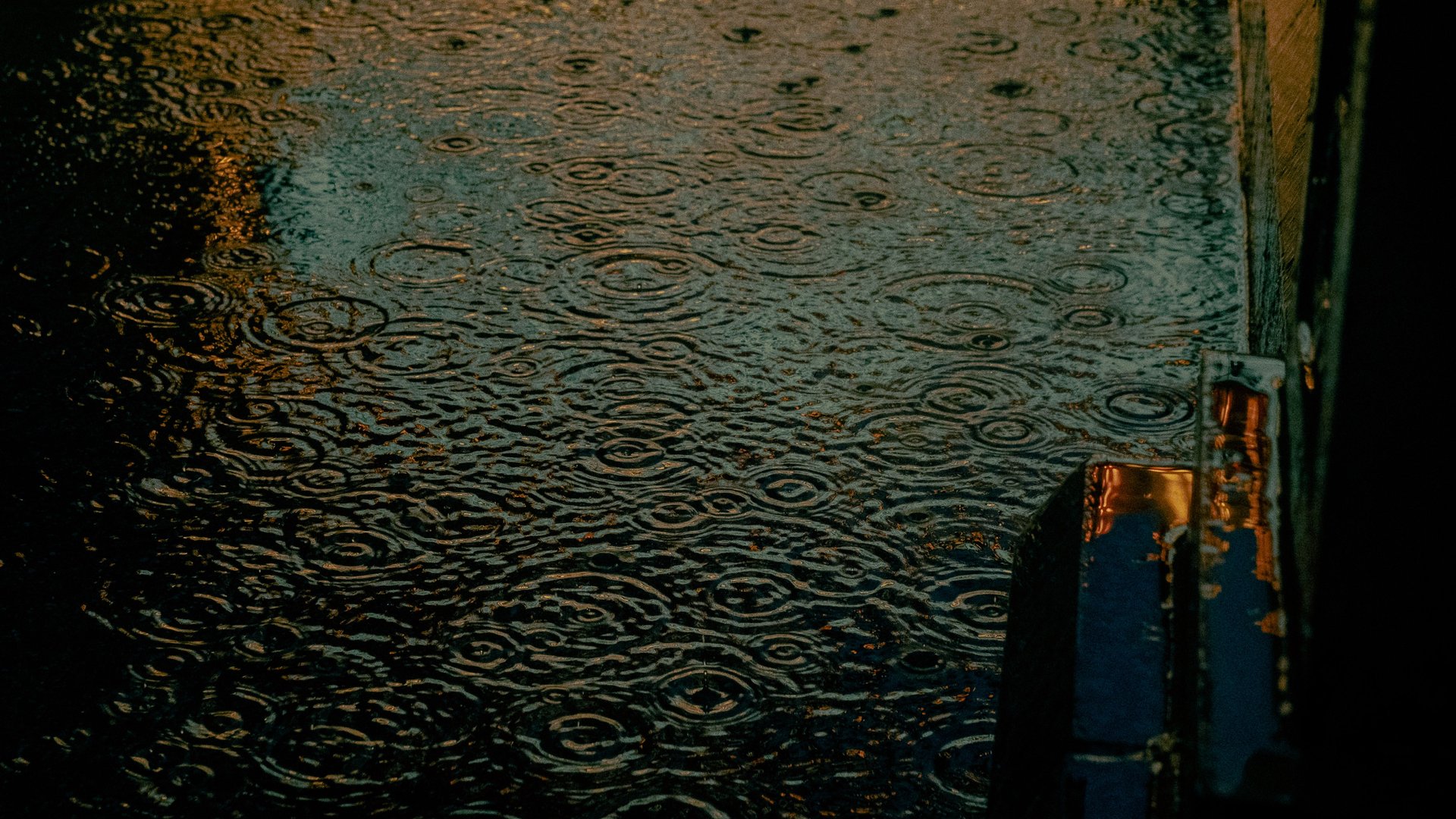
Runoff is the rainwater and snowmelt that flows across the ground instead of soaking into it. Every yard makes some. The question is how much, where it goes, and whether it is quietly working against your house. A roof, a driveway, and a patch of packed-down lawn can turn an ordinary storm into a small river aimed straight at your foundation, and most homeowners only notice it once the basement smells damp or a strip of topsoil washes into the street.
Short answer: runoff is precipitation that cannot soak into the ground fast enough, so it flows over the surface toward the lowest point. It matters because it erodes soil, pushes water against foundations, and carries fertilizer, oil, and sediment into streams. You reduce it by slowing the water down, spreading it out, and giving it places to soak in.
Contents
- What runoff actually is
- The three kinds of runoff
- Where runoff comes from on a typical property
- Why runoff matters: four problems it causes
- Runoff or standing water? The 24-hour test
- How to tell how much runoff your yard makes
- What actually reduces runoff
- When to call a pro
- Questions people ask
- Sources
What runoff actually is
Runoff is the part of rain, snowmelt, or irrigation water that flows over the ground surface instead of soaking into the soil. The US Geological Survey defines runoff as precipitation that appears in streams, rivers, drains, or sewers without ever being held back by a dam upstream, and it splits the idea by source into surface runoff, storm interflow, and groundwater runoff. For a homeowner, the first of those three is the one that shows up in the yard.
Think of a rainstorm as a race between the rain and the soil. Light rain on loose, healthy soil mostly soaks in. Heavy rain on a roof, a driveway, or a lawn that has been walked on for years has nowhere to go, so it starts moving. It follows gravity to the lowest point it can find, picking up speed and volume as more surfaces feed into it. That moving sheet of water is surface runoff, also called overland flow.
Runoff is also a normal part of the water cycle, not a flaw in it. The USGS water cycle pages explain that precipitation falls on the land, flows overland as runoff, and runs into rivers that empty into the oceans. Only about a third of the rain that falls on land runs off into streams and rivers. The other two thirds evaporate, get used by plants, or soak into the ground and feed groundwater. The trouble starts when a built-up property tips that balance, sending far more than its share of water across the surface and far less of it into the soil.
One more distinction clears up a lot of confusion. Runoff is water in motion. A puddle that sits in the same spot for three days is a different problem, usually slow drainage or groundwater pressing up from below. Runoff is the water you see moving during the storm and for a short while after. If you can tell the two apart, you can pick the right fix, and the 24-hour test later in this guide shows you how.
The three kinds of runoff
Not all runoff behaves the same way, and the kind you have decides what will fix it. Surface runoff is the fast, visible kind that sheets across a driveway or lawn during a storm. Storm interflow is the slower kind that soaks a few inches into the soil, then travels sideways just under the surface and seeps out at the bottom of a slope. Groundwater runoff is water that has sunk deep, then comes back up as springs or seepage. The table below compares them the way a homeowner actually meets them.
| Kind of runoff | Where the water travels | How fast you see it | What it looks like at your house | What usually fixes it |
|---|---|---|---|---|
| Surface runoff (overland flow) | Across the ground surface | During the storm | Sheets of water on the driveway, rills across the lawn, a river at the curb | Grading, swales, rain gardens, downspout extensions |
| Storm interflow | Just under the surface, sideways through the topsoil | Hours after the rain | A soggy band at the bottom of a slope that stays wet a day or two | Subsurface drains, soil improvement, planting deep-rooted natives |
| Groundwater runoff | Deep underground, then up through springs or seepage | Days after rain, or all the time in wet seasons | A patch that never dries, water seeping through a basement wall | French drain, sump pump, professional drainage design |
Most yard complaints are surface runoff, sometimes with a little interflow mixed in. That is good news, because surface runoff is the kind a homeowner can usually manage with grading and planting, without digging up the whole yard. Groundwater problems are the ones that call for a contractor, and I will flag those clearly in the section on when to call a pro.
There is one more label you will run into: stormwater runoff. It is the same surface runoff, just named for where it ends up. When runoff from roofs, streets, and driveways reaches a storm drain, it becomes stormwater, and the EPA notes that it flows over impervious surfaces without soaking in, picking up trash, chemicals, and dirt as it goes. Your roof is part of that system the moment rain hits it.
Where runoff comes from on a typical property
Every property has a runoff budget, and it is set by five things: how much hard surface you have, how steep the ground is, how compacted the soil is, how hard it rains, and what your neighbors send your way. Change any one of them and the water behaves differently. The diagram below maps the usual suspects on a typical suburban lot.
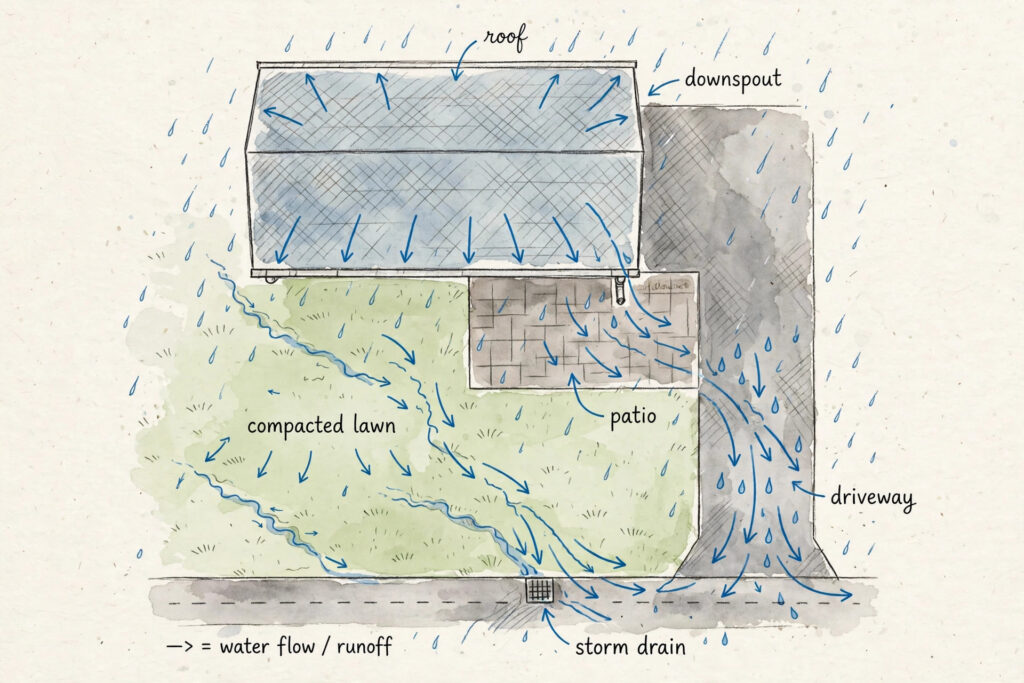
The roof is the biggest single source, and most people underestimate it by a lot. A modest roof sheds hundreds of gallons in a single storm, and every drop leaves through the gutters. If a downspout ends a foot from the foundation, that whole volume lands in one small patch of soil that cannot absorb it, so it spreads across the surface instead. Our guide to how far downspouts should drain from the house walks through the distance that actually works, and it is further than most people guess.
Driveways, patios, and walkways are the second source. Concrete and asphalt shed nearly every drop that lands on them, and the water runs off the edges in a concentrated sheet. A driveway that slopes toward the house, even slightly, feeds that sheet straight at the garage or the front walk. If water pools on the slab itself, the cause is usually a low spot or a failed slope, and our guide on why water pools on a driveway covers how to read it.
Then there is the lawn itself, which surprises people. Healthy turf on loose soil drinks rain well. But a lawn that gets heavy foot traffic, sits under a swing set, or was built on construction fill compacts into something close to pavement. Clay soil makes it worse, since clay holds water in tiny pores that fill up fast and then refuse more. Once the top inch is saturated, the rest of the storm runs off the grass just as it would run off concrete.
Two more sources sit outside your control. A sloped lot, or a neighbor whose yard sits higher than yours, can send water across the property line with every storm. And a clogged gutter or a downspout that has come loose can dump a roof’s worth of water in exactly the wrong spot overnight. If a discharge point keeps making a puddle even after you fix the distance, read why water pools at the end of a downspout for the full diagnosis.
Why runoff matters: four problems it causes
Runoff earns its bad reputation four ways, and they stack. A yard can have one of these problems for years before anyone connects it to the water moving across the surface. The table below matches each problem to the sign you will actually see, so you can trace it back to the source.
| Problem | What you see in the yard | Why it happens | What it costs if ignored |
|---|---|---|---|
| Soil erosion | Exposed roots, rills and small gullies, mulch washed into the street, bare patches on slopes | Moving water strips topsoil, and fast water strips it faster | Thin, weak lawn; plants that never take hold; sediment in beds and drains |
| Foundation and basement water | Damp basement walls, a musty smell after rain, efflorescence (white crust) on concrete, hairline cracks that widen | Runoff pools against the foundation and pushes through joints and cracks | Costly waterproofing, mold remediation, structural repair |
| Pooling and pests | Standing water for days, muddy patches, mosquitoes, dead grass in low spots | Water has no exit path and the soil below is already full | Unusable yard, insect problems, lawn disease |
| Pollution downstream | Green algae in a nearby pond, oily sheen in a storm drain, sediment in a ditch | Runoff picks up fertilizer, pet waste, oil, and sediment and carries them to streams | Fines in some towns, degraded local water, neighborhood friction |
Erosion is the most visible of the four, and the easiest to underestimate. The USGS puts it plainly: flowing water has tremendous power, and runoff changes the ground by the action of erosion. On a flat yard that looks like a thin strip of mulch in the gutter after every storm. On a slope it looks like roots sticking out of the soil and a gully that gets a little deeper each year. Topsoil takes a long time to build and very little time to lose, so stopping the flow matters more than replacing what it took.
Foundation water is the expensive one. Water that collects against a foundation does not just sit there. It presses sideways into the wall, finds the smallest crack or joint, and seeps through. A basement that smells musty for a day after every storm is often a runoff problem wearing a waterproofing costume. Fixing the water path outside is almost always cheaper than sealing the wall inside, which is why downspout extensions and grading come before interior fixes.
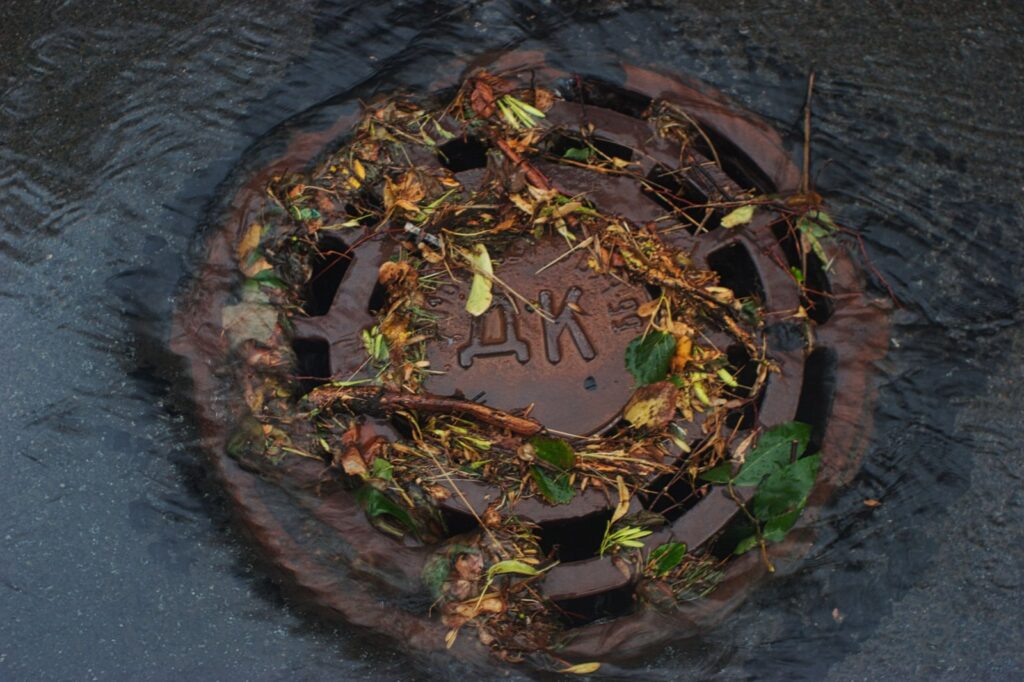
The pollution angle is the one homeowners rarely think about, and it is the reason towns care about runoff at all. The EPA points out that stormwater picks up trash, chemicals, and dirt as it flows, and that it drains into streams, lakes, and groundwater, mostly untreated. Fertilizer spread the day before a storm washes straight off the lawn. Oil drips from a car, pet waste, and lawn chemicals all ride the same sheet of water to the nearest drain. Keeping runoff on your own property, or at least slowing it down, keeps that load out of the water everyone shares.
Runoff or standing water? The 24-hour test
Runoff and standing water get mixed up constantly, and the fix for one can waste money on the other. A French drain will not help a sheet of water racing across a driveway, and regrading will not help groundwater seeping up through a basement floor. The test below takes one storm and one day of watching, and it tells you which problem you actually have.
Watch the wet spot during the storm. If water is moving across the surface, forming small channels or a visible sheet, that is runoff. Mark the path with a few garden stakes so you can see where it starts. Then check the same spot 24 hours after the rain stops. If the water is gone, the problem was surface runoff, and the fix is to redirect it or slow it down. If the spot is still wet after 24 hours, and still wet after 48, the problem is drainage or groundwater, and the fix lives underground.
There is a middle case worth knowing. A low spot that holds water for a day or two after a storm, then dries, is usually runoff that has nowhere to exit, plus soil that is slow to absorb it. That is the easiest kind to fix: a shallow swale, a rain garden, or a catch basin at the low point usually handles it. If the same spot stays wet for three days or more, with no rain in between, stop guessing and get a drainage contractor to look at it, because the water is coming from below.
If the whole yard stays soggy for days after rain and you want the full list of causes, our guide to yard drainage problems and the causes of soggy ground after rain walks through the nine most common culprits, with the test that names each one. This article is the definition piece: what runoff is, why it matters, and how to read it. That guide is the diagnostic follow-up.
How to tell how much runoff your yard makes
You do not need instruments to size up your runoff. You need one good rainstorm and ten minutes of watching. Stand at a window or under the porch during the next heavy rain and watch where the water goes. I have done this on my own place more than once, and the water never goes where you think it will. It finds the path you forgot about: the seam between the driveway and the walk, the low corner of the patio, the strip of lawn the mower compacts every week.
Start at the roof. Watch each downspout and note where the water lands. A downspout that pours onto a walkway or a flat patch of lawn is sending a concentrated stream into soil that can only take so much. Then look at the hard surfaces. Water should sheet off a driveway toward the street or a planted area, not toward the house. If it runs toward the garage door, the slope is wrong. Then look at the lawn. Small rills, those little channels of water cutting across the grass, mark the exact path runoff takes, and they tell you where to put a swale or a planting bed.
After the storm, walk the yard with a notebook. Note the low spots that are still holding water, the places where mulch has moved, and the spots where soil is bare. Those notes are your runoff map, and they are worth more than any generic diagram, because they describe your lot. Bring them to a contractor if you end up hiring one. A pro who sees a marked-up map will give you a better quote than one who has to guess.
What actually reduces runoff
Every fix for runoff does one of three things: it slows the water down, spreads it out, or gives it a place to soak in. The best yards do all three. The list below is ordered by cost and effort, cheapest first, so you can start small and see results before you spend real money.
For the full step-by-step for each of these fixes, see our guide to five ways to redirect runoff away from your home.
First, fix the roof water. Clean gutters keep water in the downspouts instead of spilling over the edge in sheets. Extend each downspout so it discharges at least five feet from the foundation onto a sloped, planted area, or into a rain barrel. A rain barrel on a single downspout will not hold a whole storm, but it takes the first flush, which is the dirtiest part, and it gives you free water for the garden. This one change alone fixes a surprising share of runoff complaints.
Second, fix the ground. Aerate a compacted lawn once a year and top-dress it with compost. Both open up the soil so rain can sink in instead of running off. On slopes, plant deep-rooted natives or a thick ground cover. Roots hold soil in place and pull water down into the ground, and a planted slope erodes far slower than a bare one.
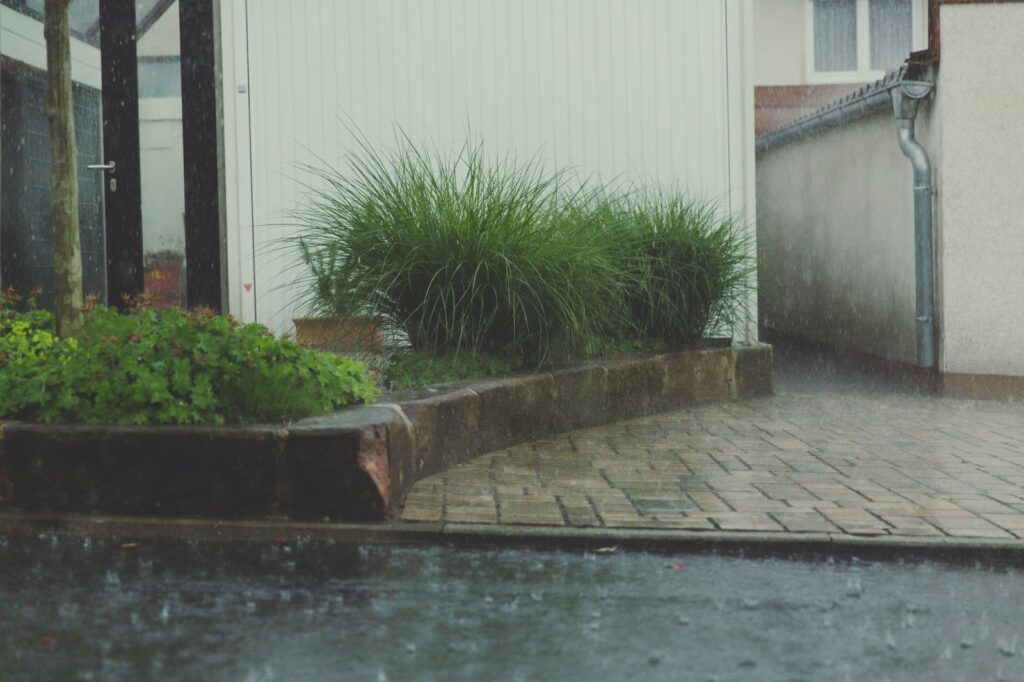
Third, give the water a place to go. A rain garden is a shallow, bowl-shaped planting bed set at least ten feet from the house that catches roof or driveway runoff, holds it for a day or two, and lets it soak in. A swale is a broad, grassy channel that slows water and steers it toward a safe exit. A dry creek bed does the same job with stone, and it looks good doing it. Permeable pavers let rain pass through a patio or walk into a gravel base below, instead of sheeting off the edges.
What does not work is worth saying plainly. Adding sand to clay soil does not loosen it, and it can make the ground set harder. A thin layer of topsoil over a compacted base just washes away in the first storm. And a French drain is the wrong tool for surface runoff: it collects water underground, so it cannot catch a sheet of water racing across the lawn. Match the fix to the kind of runoff you have, using the table near the top of this guide, and you will spend less and get more.
There is one more habit that costs nothing and helps a lot. Sweep fertilizer, leaves, and grass clippings off the driveway and back onto the lawn before it rains. Everything left on a hard surface rides the next runoff straight into the storm drain. The City of Bozeman says it well on its stormwater page: never dump anything into a storm drain, ditch, pond, or stream, because storm drains flow untreated into local waterways.
When to call a pro
Most runoff problems are weekend jobs. The ones below are not, and trying them yourself usually costs more than hiring them out. Call a drainage contractor or a landscaper who does drainage work when the water stays for three days or more after rain with no new storms, when the basement leaks even in light rain, when a slope is actively eroding and taking soil with it, or when the fix would send water onto a neighbor’s property. That last one matters legally as well as practically: redirecting runoff onto someone else’s lot can create a dispute you do not want.
Also call a pro when the yard needs regrading. Moving soil around a foundation looks simple and goes wrong fast. The grade has to fall away from the house, the finished soil has to stay below the siding, and the water has to have a legal place to exit. A contractor with a level and a plan will get that right in a day. A homeowner with a wheelbarrow and a guess often has to pay to fix it twice.
If you want the full step-by-step for the fixes in this guide, our follow-up piece on redirecting runoff away from your home covers the five methods in detail, and the grading guide after that covers slope, tools, and measurements for anyone doing it themselves. Both are coming next in this series.
Questions people ask
Runoff is rainwater or snowmelt that flows across the ground instead of soaking into it. It happens when rain falls faster than the soil can absorb it, or when it lands on a roof, driveway, or other hard surface that cannot absorb it at all.
Runoff is caused by rain or snowmelt landing on surfaces that cannot absorb it fast enough. The usual causes are hard surfaces like roofs and driveways, compacted or clay-heavy soil, steep slopes, and heavy rain that overwhelms even healthy soil.
Runoff itself is a normal part of the water cycle, and rivers depend on it. It becomes a problem when a built-up property makes too much of it, too fast, and sends it toward a foundation, a neighbor, or a stream carrying fertilizer and sediment.
Runoff is the water flowing across the ground. Stormwater is what that runoff is called once it enters a storm drain or drainage system. The same water gets the new name when it leaves your property and joins the public system.
Slow it down, spread it out, and give it places to soak in. Extend downspouts away from the house, aerate and compost the lawn, plant deep-rooted natives on slopes, and add a rain garden or swale where water collects.
Yes, for the roof or driveway water it is sized to catch. A rain garden holds runoff for 24 to 48 hours while it soaks into the ground, which cuts both the volume and the speed of water leaving your property. It needs to sit at least ten feet from the foundation and drain fully within two days.
When water pools against the foundation, seeps into the basement, stays on the surface for more than two days, or carves gullies into a slope. Those signs point to grading, drainage, or groundwater trouble that deserves a professional look.
Sources
- Runoff: Surface and Overland Water Runoff, U.S. Geological Survey Water Science School
- Surface Runoff and the Water Cycle, U.S. Geological Survey Water Science School
- Urbanization and Stormwater Runoff, U.S. Environmental Protection Agency
- Learn About Stormwater, City of Bozeman
Last updated: November 9, 2026
