


Last updated: November 2, 2026
Roof maintenance is the routine inspection, cleaning, and small repair of the whole roof system, the shingles or panels, flashing, valleys, gutters, vents, and attic, done on a schedule so water stays outside and small failures get fixed before they turn into leaks. It is not a single job you do once, and it is not the same as a repair after a storm. Think of it as the care routine that sits between installation and replacement, and it is the part of homeownership that most often gets skipped because the roof is out of sight.
That out-of-sight problem is exactly why a plan matters. A lifted shingle, a cracked vent boot, or a valley full of leaves can sit quietly for months. Nothing drips, nothing stains, and then one hard rain finds the weak spot. This guide covers the whole system, how to check it without climbing on it, what the symptoms mean, when cleaning helps and when it hurts, how ventilation fits in, and how to decide between repair and replacement. For the season-by-season task list, use our seasonal preventative roof maintenance checklist alongside this guide. This guide is the map. That checklist is the calendar.
Contents
- What roof maintenance actually covers
- How often should you inspect your roof?
- How to inspect from the ground and the attic
- Reading the symptoms: what you see and what it means
- Cleaning, moss, and algae: what helps and what harms
- Ventilation and the attic: the part most guides skip
- Roof material and age: how they change the plan
- Repair or replace? How to make the call
- DIY or call a pro: where the line sits
- Records, warranties, and insurance: the paper trail that pays
- Frequently asked questions
- Sources
What roof maintenance actually covers
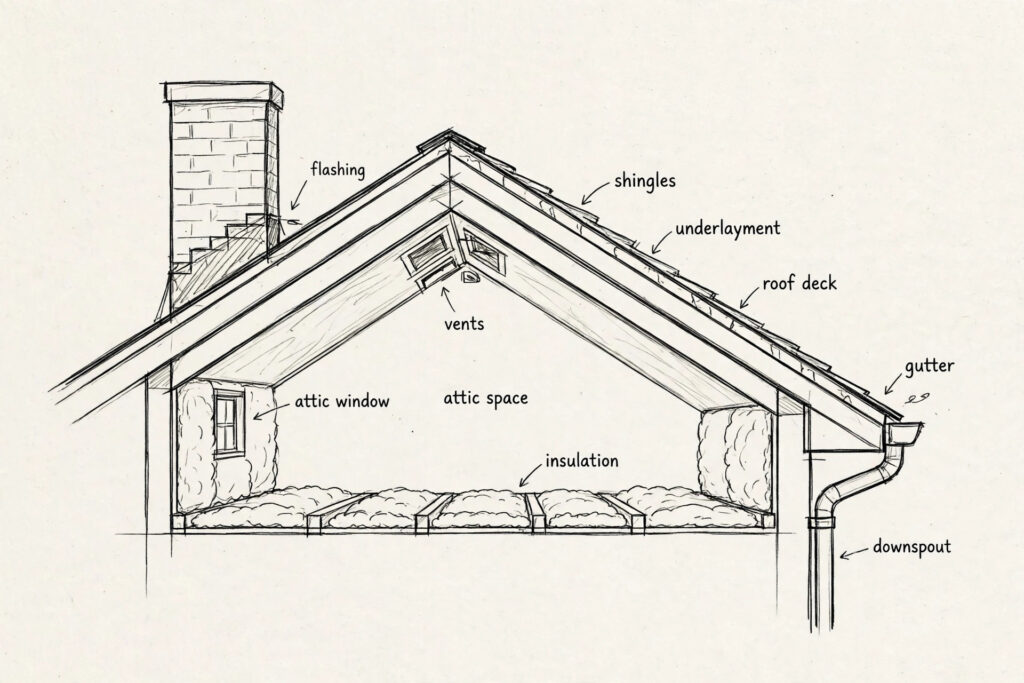
Roof maintenance covers every part of the system that keeps water out, not just the shingles you can see from the street. A roof fails at its joints and edges far more often than in the middle of a clean field of shingles, so the checklist has to follow water: where it lands, where it runs, where it is supposed to leave, and where it can sneak inside.
The table below is the whole system in one view. Work through it in order on each inspection, and you will stop missing the quiet parts.
| Part of the system | What goes wrong there | What to check |
|---|---|---|
| Shingles or panels | Lifting, curling, cracking, missing pieces, granule loss | Broken or bare patches, uneven lines, granules piling at downspouts |
| Valleys | Debris dams, worn granules, rusted valley metal | Leaves and twigs sitting in the V, dark worn strips, bent metal |
| Flashing | Rust, gaps, dried sealant, lifted edges | Metal around chimneys, skylights, vents, and where walls meet the roof |
| Pipe boots and vents | Cracked rubber boots, loose vent caps | Split or shrunken boots, caps that wobble or sit crooked |
| Ridge caps and hips | Cracked or missing caps, wind-lifted edges | Broken cap pieces, gaps along the peak |
| Gutters and downspouts | Clogs, sagging, leaks at joints, poor discharge | Overflow in rain, sagging runs, water pooling near the foundation |
| Fascia and soffits | Rot, peeling paint, blocked soffit vents | Soft or stained boards, vents painted shut or packed with debris |
| Attic and ventilation | Trapped moisture, heat buildup, daylight gaps | Stains on decking, damp insulation, musty smell, blocked vents |
| Trees and debris | Rubbing branches, falling limbs, leaf dams | Branches touching or hanging over the roof, debris in valleys |
Two habits make this table useful instead of just long. First, check the same parts in the same order every time, so a change stands out. Second, photograph each side of the roof from the same spot each season. A photo from last spring turns a vague feeling that something looks worse into a comparison you can show a roofer.
How often should you inspect your roof?
Inspect your roof at least twice a year, once in spring and once in fall, plus an extra check after any major storm, and a professional inspection on top of your own checks for older roofs or after serious weather. Spring finds what winter did before summer storms test it. Fall clears the way for rain, leaves, and freeze-thaw cycles. That twice-a-year rhythm is the standard recommendation from the National Roofing Contractors Association, and it is the backbone of the seasonal checklist linked above.
Frequency is not one-size-fits-all, though. The table below adjusts the baseline for the roofs that need closer watching.
| Situation | Inspection rhythm |
|---|---|
| Newer roof, no known problems | Your own ground and attic check each spring and fall |
| Roof over 15 years old | Add a professional inspection each year on top of your own checks |
| Heavy tree cover | Extra debris and gutter checks through leaf season |
| Previous leaks or repairs | Recheck the repaired area after the next few heavy rains |
| After hail, high wind, or a fallen branch | Ground and attic check as soon as it is safe, then a professional inspection |
| Flat or low-slope roof | Spring and fall checks with close attention to drainage and ponding |
One warning belongs in this section because it shapes everything else. The National Roofing Contractors Association advises homeowners to inspect a damaged roof only from ground level and to leave the roof itself to a professional, because the risk of falling is too great without proper safety systems. If a storm has damaged your roof, do the ground pass and the attic check, take photos, and call a roofer. Do not climb up to see it yourself.
How to inspect from the ground and the attic
A ground-level inspection finds most of what you need to know, without the risk of walking on the roof. Walk all four sides of the house with binoculars, look for lifted, curled, or missing shingles, sagging sections, and damaged flashing, and photograph each side from the same spot every season so changes are easy to compare. Pay special attention to the edges, corners, and ridges, since wind damage usually shows up there first, and to valleys, where debris collects.
Then go inside. The attic tells you what the outside cannot. Look for water stains on the decking, damp or clumped insulation, daylight showing through gaps, and a musty smell that was not there before. Check after rain if you can, when a fresh leak is easiest to see, and note the date and location of anything
unusual. A stain that is dry and firm may be an old leak that was already fixed. A stain that is damp, soft, or growing needs a roofer, soon.
Work through this short sequence on every inspection, and keep it in the same order each time:
- Walk the perimeter from the ground with binoculars, all four sides, and photograph each side from the same spot.
- Check gutters and downspouts for sagging, overflow marks, and granule buildup, and confirm downspouts discharge away from the house.
- Look at flashing, vents, and chimney bases from the best vantage point you have, a second-story window or the ground with binoculars.
- Go into the attic with a flashlight and check decking, insulation, vents, and daylight gaps.
- Check upstairs ceilings and walls for new stains, bubbling paint, or damp spots.
- Write down what you found, with dates and photos, even if the answer is nothing new.
If any step turns up active dripping, a sagging section, or daylight through a large gap, stop the routine and call a roofer. Those are not monitor-and-wait findings.
Reading the symptoms: what you see and what it means
Most roof problems announce themselves quietly, long before they become leaks. The trick is to match what you see to a cause, rather than treating every symptom the same way. A dark streak is not the same as a soft spot. Granules in a gutter are not the same as a missing shingle. The decoder below is the shortcut.
| What you see | What it usually means | What to do first |
|---|---|---|
| Dark streaks on shingles | Algae growth, usually on shaded or north-facing slopes | Clean gently with a soft wash; do not pressure wash |
| Green patches or thick moss | Moisture holding on the surface, often under tree cover | Remove moss carefully and trim back overhanging branches |
| Granules in gutters or at downspouts | Normal wear early on, but heavy or sudden loss signals aging shingles | Compare amounts season to season; heavy loss calls for a roofer’s assessment |
| Lifted or curled shingles | Wind damage, age, or poor ventilation underneath | Replace the affected shingles promptly; check ventilation if it is widespread |
| Water stain on a ceiling | Leak entry point, which may be several feet from the stain | Check the attic above it, trace it uphill, and call a roofer |
| Soft or sagging section | Decking damage or long-term moisture, a serious finding | Call a roofer promptly; do not walk on that section |
| Daylight through the roof in the attic | Missing or damaged material at that spot | Call a roofer; cover the area only as a temporary measure |
| Musty smell in the attic | Trapped moisture or poor ventilation | Check for blocked vents and damp insulation |
Two symptoms deserve extra care because they are easy to misread. First, a ceiling stain is rarely directly below the leak. Water runs along decking, rafters, and pipes before it drips, so the entry point is usually uphill from the stain. That is why the attic check matters more than staring at the ceiling. Second, granule loss is normal in small amounts, especially on a newer roof, but a sudden pile of granules after a storm, or a patch of shingles that looks bald, is different. Photograph it and compare it next season rather than guessing.
Cleaning, moss, and algae: what helps and what harms
Cleaning a roof is not the same as cleaning a driveway, and the wrong method does more damage than the dirt it removes. Pressure washing asphalt shingles strips granules, shortens the roof’s life, and can void a warranty. The safe approach is a soft wash: a low-pressure application of a cleaning solution, left to work, then rinsed gently. For the full method, safety notes, and the pressure-washing warning in detail, see our complete roof cleaning guide and our soft wash vs pressure wash comparison for roofs.
Moss and algae are different problems and need different responses. Algae, the dark streaking most common on shaded slopes, is mostly cosmetic on asphalt shingles, but it holds moisture and looks worse over time. A soft wash handles it. Moss is more serious: it lifts shingle edges, holds water against the surface, and in cold weather it can freeze and expand, cracking the material underneath. Remove moss carefully by hand or with a soft wash, never by scraping it off dry, which tears granules. Then address the cause, usually shade and overhanging branches, or it will return.
Cleaning the roof and the gutters in one visit is often worth asking about, since the crew, the ladder setup, and the debris disposal overlap. Our guide on whether to clean the roof and gutters together covers when bundling saves money and when it just adds a line to the bill. Gutters themselves get their own full treatment in our gutter maintenance guide, and if a downspout is the problem rather than the roof, check the signs of a clogged downspout before you blame the roof.
What not to do matters as much as what to do. Do not use a pressure washer on asphalt shingles. Do not use a wire brush, a stiff broom, or a leaf blower at close range on the surface. Do not walk on a wet roof, on moss, or on a steep slope. And do not use bleach at full strength on the roof, which can harm surrounding plants and damage some materials. If growth covers a large area, if the roof is steep, or if you are not sure of the material, a professional soft-wash service is the safer route.
Ventilation and the attic: the part most guides skip
Ventilation is the part of roof maintenance that does not look like maintenance at all, because nothing gets cleaned or replaced. Yet poor ventilation shortens shingle life, grows mould in the attic, and in cold climates it feeds ice dams. The idea is simple: cool air enters at the eaves through soffit vents, warm air leaves at the ridge or through roof vents, and the attic stays close to outside temperature. When that airflow stops, heat and moisture build up under the deck.
On your attic check, look for the airflow, not just the vents themselves. Soffit vents should be open, not painted shut or blocked by insulation pushed to the eaves. Baffles, the thin channels that keep insulation off the deck at the eaves, should be in place. Ridge vents or roof vents should be clear, not capped by debris or, in winter, by snow. Insulation should be dry, evenly spread, and not blocking the soffits. A bathroom fan venting into the attic, rather than outside, is a common hidden source of moisture and is worth fixing even though it is not strictly a roof job.
Signs of ventilation trouble are often mistaken for roof failure. Curling shingles on a roof that is not that old, mould on the underside of the deck, rusted nails, or frost on the inside of the roof in winter all point to trapped heat and moisture rather than to bad shingles. Fixing ventilation first, then replacing any damaged shingles, saves you from replacing a new roof twice.
Roof material and age: how they change the plan
Maintenance is not the same for every material. Asphalt shingles, the most common choice, are the most forgiving to maintain but the most vulnerable to pressure washing and to heat buildup from poor ventilation. Metal roofs need less frequent attention but still need fastener and sealant checks, because a loose screw or dried sealant is a leak waiting for the next rain. Tile and slate last longer but crack under foot traffic, so they should not be walked on for routine checks. Wood shingles and shakes need debris kept off and moss controlled, because they hold moisture by nature. Flat or low-slope roofs, often on extensions or garages, need drainage checks above all, because standing water is their main enemy.
| Material | Typical lifespan | Maintenance focus |
|---|---|---|
| Asphalt shingles | 20-30 years | Granule loss, curling, ventilation, never pressure wash |
| Metal roofing | 40-70 years | Fasteners, sealant, rust spots, debris in valleys |
| Clay or concrete tile | 50+ years | Cracked or slipped tiles, underlayment age, no foot traffic |
| Wood shingles and shakes | 20-40 years | Debris, moss, moisture, fire treatment in dry areas |
| Flat or low-slope membrane | 20-30 years | Ponding water, seams, drainage, debris removal |
Age changes the plan even more than material. A roof in its first decade usually needs only the twice-a-year checks and gutter cleaning. A roof past fifteen years needs a professional look each year, because small failures become more common and harder to spot from the ground. A roof near the end of its expected life should be inspected with replacement in mind: each repair is judged against how many years it buys, not just whether it stops the leak. That judgement is the subject of the next section.
Repair or replace? How to make the call
Repair is the right answer when damage is local, the roof is well within its expected life, and the rest of the system is sound. Replacement is the right answer when damage is widespread, the roof is near or past its expected life, or repairs keep coming back in the same area. Between those clear cases sits a grey zone, and the table below gives you a way to think through it without relying on a single roofer’s opinion.
| Signal | Leans toward repair | Leans toward replacement |
|---|---|---|
| Age | Well within expected lifespan | Near or past expected lifespan |
| Extent | One area, a few shingles, one flashing detail | Multiple slopes, widespread curling or granule loss |
| Leaks | Single, traced leak with a clear cause | Recurring leaks in different places |
| Decking | Sound, firm decking underneath | Soft, sagging, or rotted decking |
| Repair history | First or second repair in that area | Repeated repairs in the same area |
| Cost comparison | Repair cost is a small fraction of replacement | Repair cost approaches a large share of replacement, or a new roof is already planned within a few years |
Get at least two or three quotes for a replacement, and be sceptical of the lowest bid if it is far below the others. The National Roofing Contractors Association’s storm repair guidance warns homeowners to be cautious of unusually low bids after storm damage, because they often hide shortcuts, missing flashing, or poor underlayment. A good quote lists the material, the underlayment, the flashing work, the ventilation changes, and the disposal, not just a single lump sum. Ask each roofer what they found, not just what they charge, and compare the findings as well as the prices.
DIY or call a pro: where the line sits
Homeowners can safely do a lot of roof maintenance from the ground and the attic, and that is where most of the value sits. Clearing gutters from a stable ladder, trimming branches that overhang the roof, keeping valleys clear of debris, and photographing changes each season are all reasonable DIY tasks. So are the ground and attic inspections in this guide, which cost nothing and catch most problems early.
The line sits at height, slope, and uncertainty. If a job needs you on the roof itself, on a steep slope, near power lines, or in wet or windy weather, it belongs to a professional with fall protection and insurance. The same applies to any repair you are not sure about: replacing a few shingles on a low, walkable slope is one thing, but flashing work, valley work, and anything involving the decking is skilled work where a small mistake becomes a leak. Ladder safety is part of this line too. The OSHA ladder safety guidance as summarised for homeowners comes down to three rules: set the ladder at a four-to-one angle, one foot out for every four feet up, extend the rails three feet above the landing, and keep three points of contact at all times. If you cannot meet those rules, do not climb.
| Task | DIY | Call a pro |
|---|---|---|
| Ground and attic inspection | Yes | If you find active leaks, sagging, or daylight gaps |
| Gutter cleaning from a stable ladder | Yes, with ladder safety rules | If the ladder cannot be set safely, or gutters are high or damaged |
| Trimming overhanging branches | Yes, small branches from the ground | Large limbs, branches near power lines, or work from the roof |
| Replacing a few shingles | Only on a low, walkable slope you are comfortable on | Steep slopes, valleys, flashing, or large areas |
| Flashing, valley, or decking work | No | Yes, always |
| Any work on a wet, icy, or steep roof | No | Yes, always |
Records, warranties, and insurance: the paper trail that pays
Records are the least glamorous part of roof maintenance and the most valuable when something goes wrong. Keep a simple file, physical or digital, with the roof’s installation date and material, each inspection’s date and photos, every repair invoice, every cleaning receipt, and any warranty documents. When a leak appears, that file answers the questions a roofer, a warranty provider, or an insurer will ask: how old is the roof, when was it last checked, what was done, and has this area been repaired before?
Warranties usually have two layers, and they are easy to confuse. The manufacturer’s warranty covers defects in the material itself, often for a long period, but it usually requires proper installation and maintenance, and it may be voided by improper cleaning, such as pressure washing, or by unauthorised modifications. The workmanship warranty comes from the installer and covers installation errors, usually for a shorter period. Read both, note their end dates, and keep proof of maintenance, because a claim without maintenance records is harder to make. If you are unsure whether a task affects your warranty, ask the manufacturer or installer before doing it, not after.
Insurance is similar. A claim for storm damage goes more smoothly with dated photos from before the storm, showing the roof’s condition, and with inspection records that prove the damage is new rather than long-term neglect. Insurers distinguish between sudden damage, which is usually covered, and wear or neglect, which is not. Regular inspections and repairs are how you keep a claim in the first category. After a storm, photograph the damage from the ground, keep receipts for any emergency covering, and do not sign a repair contract on the spot with a contractor who knocked on your door.
A short closing checklist ties the whole guide together. Inspect twice a year and after storms, from the ground and the attic. Clear gutters and valleys, keep branches back, and soft wash rather than pressure wash. Watch ventilation as closely as shingles. Record everything with dates and photos. And when the signal points to a pro, call one early, while the job is still small.
Frequently asked questions
Inspect your roof twice a year, in spring and fall, and after any major storm. Clean gutters and remove debris as part of those checks, and add a professional inspection each year for older roofs or after serious weather.
Yes, from the ground and from the attic, which is where most problems show up first. Do not walk on the roof to inspect it, and after storm damage, inspect only from ground level and leave the roof itself to a professional.
Failures at joints and edges, flashing, valleys, vent boots, and gutters, rather than in the middle of a field of shingles. That is why a maintenance check follows water through the whole system instead of just looking at the shingles.
Yes. Moss lifts shingle edges, holds water against the surface, and can crack material when it freezes. Remove it carefully with a soft wash, never by dry scraping, and trim back the shade and branches that let it
Repair fits local damage on a roof well within its expected life. Replacement fits widespread damage, recurring leaks, or a roof near the end of its life. Age, extent, decking condition, and repair history together make the call, so get a professional assessment before deciding.
Proper maintenance protects a warranty, because most manufacturers require it, while improper work, such as pressure washing or walking on tile, can void cover. Keep invoices, photos, and the installer’s terms, and ask the installer what maintenance your warranty expects.
Yes, in the same visit. Roof debris ends up in gutters, and overflowing gutters soak the fascia and foundation, so doing them together keeps the whole system working and avoids paying for two separate call–outs.
Sources
- IKO’s seasonal roof maintenance tips for homeowners, covering ground-level checks, DIY tasks, when to call a professional, and warning against pressure washing asphalt shingles.
- The National Roofing Contractors Association’s storm repair guidance, advising ground-level inspection only and professional inspection after storm damage, with scepticism toward the lowest bid.
- OSHA ladder safety guidance as summarised for homeowners, four-to-one ladder angle, three feet of rail above the landing, and three points of contact.
- RoofCrafters video on roof maintenance tips, covering gutters, debris, flashing, ventilation, and growth.

3 Comments
Pingback: Preventative Roof Maintenance Checklist by Season - Home Exterior Lab
Pingback: Roof Cleaning Guide: Methods, Safety & When to Hire
Pingback: How to Clean Downspouts: Tools and Technique