

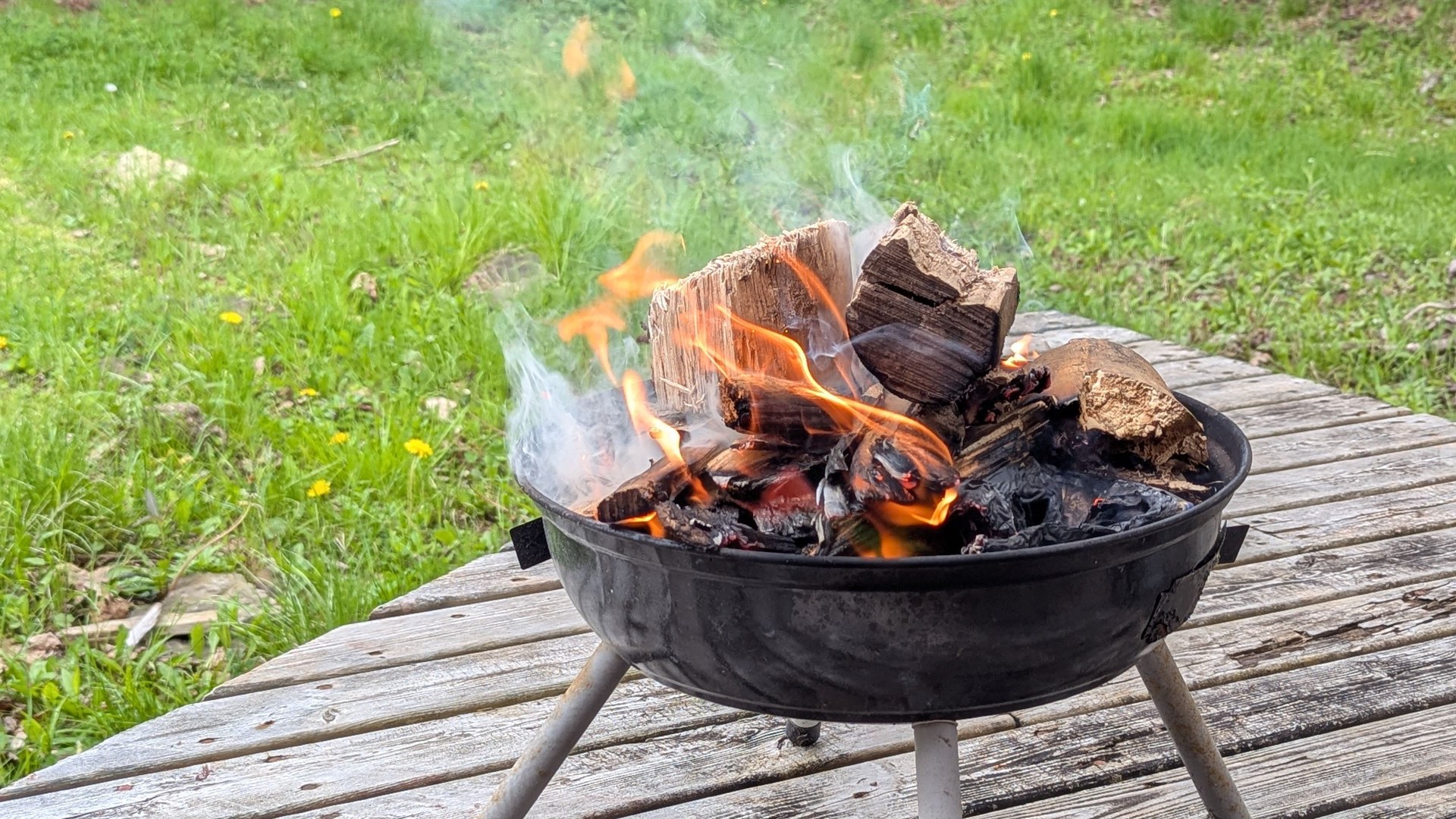
Yes, you can put some fire pits on a wood deck, but only certain types, only on a proper heat barrier, and only when your local rules allow it. A gas or propane fire table that the maker rates for use on a combustible surface is the realistic deck option for most homes. An open wood-burning bowl set straight on the boards is not. That split is the whole story, and most of the confusion online comes from pages that blur it.
A fire pit on a deck has to pass three separate tests at the same time. The heat going down must not scorch or soften the boards. Sparks and embers must have nowhere to land and smolder. And the setup must clear the walls, rails, roof, and seating around it. Fail any one of those and the evenings by the fire are not worth the risk to the deck, or to the house behind it.
A fire pit is an open flame appliance used outdoors for heat and gathering. On a deck, the question is never just whether the pit itself is well made. It is whether the deck under it, the air around it, and the rules that cover it can all handle an open flame night after night.
Contents
- The short answer, by fire pit type
- The three risks that decide it
- Clearances: how much room you actually need
- What goes underneath: mats, pavers, and stands
- Can you use a Solo Stove on a wood deck?
- Wood decks versus composite decks
- Local code, HOA rules, and insurance
- Setting up a deck fire pit, step by step
- When the deck is too small, or the answer is no
- After the burn: cooling, ash, and board checks
- Signs the deck is taking heat damage
- Frequently asked questions
- Sources
The short answer, by fire pit type
Not every fire pit belongs on a deck, and the fuel matters more than the brand. Gas and propane units throw no embers, and their flame can be shut off in seconds. Wood-burning units throw sparks, drop ash, and keep radiating heat long after the flames die down. That difference drives every row of the table below.
| Fire pit type | On a wood deck? | What it needs |
|---|---|---|
| Gas or propane fire table, rated for combustible surfaces | Yes, the best deck choice | Heat barrier under it, maker clearances kept, tank stored and checked per the manual |
| Gas or propane fire bowl, rated for combustible surfaces | Yes, with care | Stand or legs, heat barrier, clearances kept, never left running unattended |
| Smokeless wood-burning stove, such as a Solo Stove, with its stand | Yes, only with the stand plus a barrier | Maker stand, spark shield, heat barrier for long burns, deck maker checked |
| Open wood-burning bowl or chiminea | Usually no, and never on bare boards | Would need a non-combustible base, spark screen, and code permission, which many areas do not give |
| Gel fuel tabletop unit | Often yes for small tabletop models | Maker rating for the surface, stable table, clearances, fuel stored away from heat |
| Built-in gas fire feature | Yes, when built into the deck design | Cut-in installation with fire-resistant surround, gas work by a qualified installer, permits where required |
If your pit’s manual says nothing about combustible surfaces, treat that silence as a no. The manual is the document that decides the question for that exact model, and it outranks any general blog post, including this one. If the manual forbids deck use, no mat fixes it.
Consumer Reports takes the strictest line in this debate, and it is worth hearing plainly: its fire pit safety guide says never put a pit on a wood or composite deck, and it advises at least a 10-foot buffer around a pit in a small yard, or 20 to 25 feet when space allows. That advice is written for open wood fires in general, not for a listed gas table on a proper base. Still, it sets the right mood. A deck pit is an exception you build carefully, not a default.
The three risks that decide it
Most deck fire problems come from one of three directions: down, out, or over time. Thinking in those three directions makes the shopping and setup choices much simpler.
Heat going down
Radiant heat is the quiet risk. You will not see it the way you see a spark, and the damage often shows up as a darkened patch, a softened board, or a finish that peels in one round spot. A fire pit body can run far hotter than the deck surface can tolerate, and the boards closest to the base soak up that heat for the whole burn. Legs and stands help because they let air move under the pit, but air alone is not a guarantee. A heat barrier spreads and blocks that downward heat, which is why a mat or paver base matters even under a legged pit.
Sparks and embers going out
Embers are the risk that turns a small mistake into a real fire. A spark that lands on a cushion, a pile of leaves in a corner, or between deck boards can smolder out of sight. Wood fires make embers. Gas fires do not. That single fact is why gas tables are the safer deck choice even before you look at heat ratings. For any wood fire on a deck, a fitted spark screen that stays closed during the burn is not optional gear. It is part of the setup.
Slow damage over time
The third risk is cumulative. One short, careful burn may leave no mark. Twenty long burns on the same spot, with the same barrier slowly breaking down, can dry out boards, weaken a finish, and open the door to the kind of wear that shortens a deck’s life. Our guide to how long a wood deck lasts shows how much upkeep and exposure change that lifespan, and repeated heat is exposure of the worst kind. Lift the barrier now and then, look at the boards under it, and retire a cracked or warped mat before it becomes decoration.
Clearances: how much room you actually need
Clearances are the distances that keep heat, sparks, and flames away from anything that can catch or be damaged. Two different clearance systems apply here, and mixing them up is a common mistake. Open recreational wood fires fall under fire code rules that are strict, often around 25 feet from a structure or combustible material, with an adult present and a way to put the fire out close at hand. Listed gas appliances follow their own manual, which usually calls for far smaller side and overhead clearances because the flame is controlled and there are no embers. Your local authority has the final word either way, so check before you buy.
| What to clear | Workable rule for a deck gas table | Note |
|---|---|---|
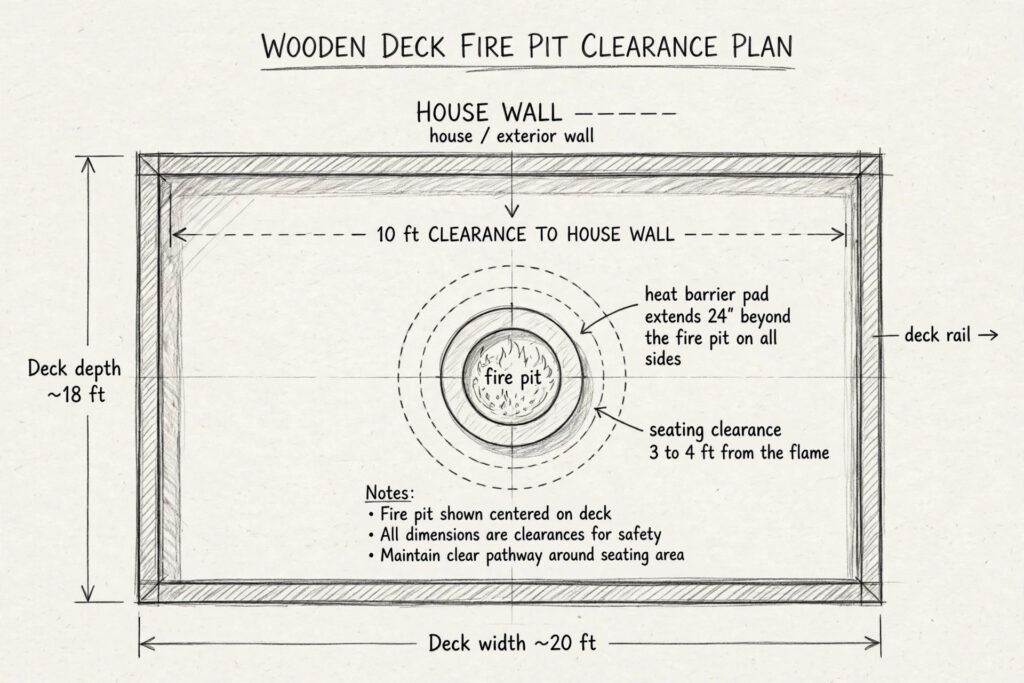
| House wall, siding, and deck rails | At least 10 feet from anything flammable where the manual allows less, follow the manual but never go below it | HGTV’s deck guidance starts at 10 feet from flammables, including furniture, cushions, roof overhangs, and rails |
| Overhead cover, pergola, or roof | Only if the maker allows it, with the manual’s overhead clearance met and open ventilation | Low or enclosed covers trap heat and smoke, so many makers forbid them outright |
| Seating and walking room | About 3 to 4 feet from flame edge to the nearest seat, with a clear path around | People need room to stand and move without stepping toward the flame |
| Overhanging branches and plants | Trimmed back and at least 10 feet clear | Heat dries foliage above a fire over time, even without a spark |
| Open wood fire, where allowed at all | 25 feet from structures and combustibles under the common fire code baseline | That distance alone rules out most decks, which is the point |
Measure your deck before you fall for a fire table. A pit plus its barrier plus seating clearance eats space fast. If the numbers do not fit with room to walk, the deck is telling you the fire belongs on the ground, not on the boards.
What goes underneath: mats, pavers, and stands
The layer under the pit does three jobs: it blocks downward heat, it catches stray ash and embers, and it gives you a stable, level base. One thin decorative rug does none of those jobs. Here is how the real options compare.
| Barrier | How it helps | Watch out for |
|---|---|---|
| Fire-rated deck pad or mat | Built for high heat, easy to move and store, sized to the pit | Must be rated for fire pit use, not just grill use; replace it if it cracks, warps, or thins |
| Concrete pavers, stone, or brick on cement board | Non-combustible, heavy, stable, and good at spreading heat | Weight adds up, so check the deck can carry pit plus base plus people |
| Metal heat shield or stand | Lifts the pit, lets air circulate, reflects heat away from the boards | Must be made for your pit model; a stand alone is not a full barrier for long wood burns |
| Sand layer inside a wood pit | Extra insulation inside the bowl, and it protects the pit itself | It does not replace the barrier under the pit |
Size the barrier generously. HGTV’s fire pit safety guide advises a pad that extends at least 24 inches beyond the fire pit in all directions, and the pit should sit on its stand, never straight on the pad or the boards. That 24-inch margin is what catches the ember that bounces, not just the heat that radiates. For a wood fire, go wider if you have the room, and keep the area swept clear of leaves and debris before every burn.
Weight deserves its own check. A stone fire table, a paver base, and four seated adults can load one section of deck heavily. Most residential decks are built for ordinary foot traffic and furniture, not for a masonry feature. If your setup is heavy, or if the deck is older, get a builder or engineer to confirm the framing and footings can carry it before you commit.
Can you use a Solo Stove on a wood deck?
Yes, with the maker’s stand, and with the same caution that applies to any wood fire on a deck. This is one of the most searched versions of this question, so it deserves a straight answer rather than a vague one.
Solo Stove’s own stand guide says a stand is required when burning on a wood deck, on composite or PVC decking, on grass, and on sand, while concrete, stone, pavers, gravel, and dirt do not need one. For a wood deck, the guide adds that pavers under the stand are the best protection for a burn longer than an hour or two, because the stand lifts the pit and lets cool air circulate under it. The company’s product pages say the same thing in plainer terms: a Solo Stove can be used on a wood deck, but only with the stand, and the deck material still matters because different boards handle heat differently.
Seeing the setup helps more than reading about it. This walkthrough covers using a Solo Stove on a deck, including the stand and the extra mat layer.
That still leaves you with a wood fire, so the rest of the rules still apply. Use the spark shield while burning, put the lid on when you are done so ash stays locked in, and never walk away from a hot stove on a combustible surface, even while it cools. Hot ash can reignite and escape, which is exactly the risk a lid is meant to close off. If your deck is composite, read the next section before you buy, because the board itself changes the answer.
Wood decks versus composite decks
Composite decking looks tougher than wood, and in some ways it is. It resists rot and splinters, and many boards carry a fire-resistance rating. That rating does not make a composite deck fireproof, and it does not make it safe for direct contact with a fire pit.
Trex, the best known composite maker, is clear on this point. Its fire-resistant decking guidance says gas fire pits should be installed by cutting around the decking, not set on top of it, with a fire-resistant material under the pit and a protective stone wall around it. For wood-burning pits, Trex says they should not sit directly on its decking unless a heat barrier is used, and it warns that Trex can soften at temperatures as low as 176 degrees Fahrenheit. A fire pit base can easily pass that temperature, which is why a barrier is not a nice extra on composite. It is the whole protection.
Real wood has a different failure mode. It chars, dries, and can ignite, rather than softening like plastic. A stained or sealed wood deck still needs a stand and a barrier, and the finish under the pit will age faster than the rest of the deck. Either way, check your deck maker’s guidance for your exact board, and keep the fire pit paperwork with it. If you ever claim for heat damage, the first question will be whether you followed both sets of instructions.
Local code, HOA rules, and insurance
General guidance will only take you so far, because fire rules are local. Some cities and counties forbid open flames on a wooden deck outright. Others allow gas tables but not wood fires. Homeowner associations often add their own bans, and some require a permit or an inspection for a permanent fire feature. HGTV’s guide makes the same point: check city, county, and HOA rules before you install, because smoke rules alone can rule out a wood-burning pit in some areas.
Call your local fire department or code office and ask two questions: is this type of pit allowed on a deck here, and what distance does your code require? That one call beats an hour of forum reading, because the answer is specific to your address. Then call your insurer and ask whether a deck fire pit affects your coverage. Some policies restrict open flames on decks, and learning about an exclusion after a claim is the worst time to find it. Keep a note of both answers with your pit manual.
Setting up a deck fire pit, step by step
Once the pit type, the barrier, and the rules all line up, the setup itself is straightforward. Work through it in order, and do not skip the boring steps. They are the ones that prevent the exciting problems.
- Confirm the manual allows deck use, and write down its side and overhead clearances. If the manual is silent or forbids it, stop here.
- Measure the deck and mark the pit position with tape. Check every clearance in the table above, plus room to walk around the seating.
- Sweep the deck clear of leaves, debris, and anything flammable, and move cushions and throws outside the clearance zone.
- Set the barrier first, then the stand, then the pit, centered and level. The barrier should extend at least 24 inches past the pit on every side.
- For a gas unit, check hoses and connections for leaks with soapy water before the first light, and keep the tank where the manual says it belongs.
- For a wood unit, fit the spark screen, use dry seasoned hardwood, and build a modest fire. Overloading the pit makes tall flames and more embers, not more warmth.
- Put a fire extinguisher and a garden hose within reach before you light anything, and agree who stays with the fire until it is fully out.
- When you finish, shut off the gas or let a wood fire burn down, cover it, and wait until everything is fully cool before you move or store anything.
That last step is where many deck stories go wrong. A pit that looks out can still hold hot coals, and a gust can wake them. Consumer Reports advises spreading coals thin and spraying with a hose on a wide pattern until the embers die, rather than dumping a bucket of water on top, which can leave hot coals burning under a crust. Give the pit time, then check it again before you head inside.
When the deck is too small, or the answer is no
A small deck, a low roof, a close neighbor, or a local ban can each turn a deck fire pit into a bad idea, even with the right gear. That is not a failure of planning. It is planning working as it should. The safer options are all better than a tight, hot, smoky setup that you dread using.
- Move the fire to the ground: a concrete, stone, or paver pad in the yard gives you real clearance, real airflow, and no boards to protect.
- Switch to a gas tabletop unit on a stable outdoor table, where the flame is small, controlled, and easy to shut off.
- Use a portable pit on the ground pad for gatherings, and keep the deck for seating and serving instead.
- Build the fire feature into the next deck project, with the cut-in surround and gas line planned from the start, rather than retrofitting it onto boards that were never meant for it.
If the deck is also due for cleaning or refinishing, sort that first. Ash and soot stain a tired finish fast, and heat damage is harder to spot on boards that are already worn. Our guide to how to clean a wood deck and our wood deck staining guide cover the order that works: clean, repair, then protect, and only then add anything that throws heat.
After the burn: cooling, ash, and board checks
The hour after the fire matters as much as the fire itself. Let a gas unit cool before you cover it, and keep the gas valve shut when it is not in use. For wood, wait until the pit is fully cool, then remove ash only when you are sure nothing is still hot. Store ash in a metal container with a lid, away from the house and the deck, for at least a day before you bin it. Embers can hide in ash far longer than most people expect.
Once the pit is cool, lift the barrier and look at the boards under it. You are checking for darkening, soft spots, cupping, and finish that has lifted in a round pattern. A quick look after every few burns catches a failing barrier early, while it is still a cheap fix. Fold this check into your normal deck routine, the same one in our wood deck maintenance guide, so it happens whether or not you remember the fire.
Signs the deck is taking heat damage
Heat damage does not always announce itself with a scorch mark. Watch for these quieter signs, and move the pit off the deck if more than one shows up.
| Sign | What it usually means | What to do |
|---|---|---|
| Dark round patch under the pit | Repeated radiant heat drying or scorching the surface | Stop deck burns, widen the barrier, check the boards for softness |
| Composite boards bowing or rippling near the pit | Heat softening the plastic shell | Move the pit off the deck and ask the deck maker about the boards |
| Finish peeling in one spot | Heat breaking down stain or sealer in that area | Clean, sand lightly if the finish allows, and recoat, then improve the barrier |
| Cupped or cracked boards near the pit | Heat plus moisture cycling stressing the boards | Inspect the framing, replace damaged boards, and rethink the location |
| Smell of hot wood during a burn | Boards or debris heating beyond normal range | Put the fire out, let everything cool, and inspect before the next burn |
If a board feels soft, spongy, or charred, that section needs a proper inspection before anyone uses the deck heavily again. Heat damage and rot can look alike from above, and both weaken a board. Do not just stain over it and hope.
Frequently asked questions
No. Never set any fire pit straight on deck boards. Every deck setup needs a stand or legs plus a fire-rated barrier under the pit, and the pit itself must be rated for use on a combustible surface.
Yes, with its stand. Solo Stove requires a stand on wood decks and composite decking, and it recommends pavers under the stand for burns longer than an hour or two. Use the spark shield, keep the lid on when you finish, and never leave a hot stove unattended on the deck.
Yes, only with the stand, and with extra care. Composite boards can soften at relatively low temperatures, and Trex warns that its boards can soften at temperatures as low as 176 degrees Fahrenheit. Use a stand plus a heat barrier, and check your deck maker’s guidance for your exact board.
A fire-rated deck pad, or concrete pavers or stone on cement board, extending at least 24 inches beyond the pit on all sides, with the pit on its stand. A grill mat, a rug, or a sheet of plywood is not a substitute.
For a deck gas table, keep at least 10 feet from anything flammable where possible, and always meet the manual’s clearances. For an open wood fire, the common fire code baseline is 25 feet from structures and combustibles, which rules out most decks. Your local code has the final word.
Only if the maker allows it, the overhead clearance is met, and ventilation is open. Many makers forbid low or enclosed covers because heat and smoke get trapped. A gas unit is the safer choice under a cover, and a wood fire under a low roof is usually a no.
It can. Some policies restrict open flames on decks, so ask your insurer before you install. Keep the manual, the barrier rating, and a note of what the insurer said, in case you ever need to show the setup was approved.
Sources
Consumer Reports sets out the strict baseline in its fire pit safety guide, including its advice never to put a pit on a wood or composite deck. HGTV covers the deck setup in detail in its fire pit safety rules, including the 24-inch pad margin and the stand rule. Solo Stove explains when a stand is required in its fire pit stand guide. Trex explains its fire pit limits in its fire-resistant decking guidance, including the 176-degree softening point.
Last updated: October 29, 2026

1 Comment
Pingback: How Long Does a Wood Deck Last? Lifespan by Wood Type