

If you are set on paint, buy a premium 100% acrylic (or urethane-modified acrylic) porch-and-floor paint that is labeled for exterior horizontal walking surfaces. Regular house paint is the wrong product for a deck floor, no matter how good it looks on siding. That said, paint is not the best finish for every wood deck. On a bare, fully exposed deck with boards worth showing off, a penetrating stain usually ages more gracefully, because it fades instead of peeling. The rest of this guide sorts out which camp your deck falls into, so you pick once and live with the result instead of scraping it off in two years.
Last updated: October 26, 2026
Table of contents
- What counts as deck paint, and what does not
- The paint types, compared side by side
- When paint is the right call
- When stain is the better call
- Why deck paint peels, and how to read the risk before you buy
- Prep at a glance: what paint demands before the first coat
- How long deck paint lasts, and what upkeep really looks like
- Restore or replace: reading a painted deck that has seen better days
- DIY or hire a pro
- Frequently asked questions
- Sources
What counts as deck paint, and what does not
Deck paint is a film-forming coating made to be walked on, not just looked at. It builds a solid, opaque layer on top of the boards, hides the grain, and survives foot traffic, furniture, standing water, and sun. If the label does not name decks, porches, floors, or steps, it is not deck paint.
That one distinction explains most deck paint failures. House paint is engineered for vertical surfaces. It is thicker, less flexible underfoot, and not rated for the abrasion a deck floor takes every day. Put it on horizontal boards and it tends to crack, then peel, often within a season or two of weather. A proper porch-and-floor paint is a different animal: it flexes a little as boards swell and shrink, resists scuffing, and is tested for exactly the abuse a deck floor dishes out.
Three terms will keep you out of trouble at the paint counter. A film-forming finish (paint and solid-color stain) sits on top of the wood and can crack and peel. A penetrating finish (semi-transparent and transparent stains, exterior wood oils) soaks into the fibers and wears away gradually instead of peeling. A resurfacer is a thick-build coating that bridges small cracks, hides splinters, and adds texture to worn boards. Resurfacers look like paint, but they are sold for tired decks specifically, and they still cannot rescue wood that has gone soft.
One more definition worth nailing down early: a solid-color stain is not paint, even though it looks like it. It is thinner, so it penetrates the wood surface more than paint does, and that gives it a real edge against peeling. If you want an opaque color but you are nervous about paint, solid-color stain is the middle path this whole article keeps coming back to.
The paint types, compared side by side
For a wood deck floor, the honest shortlist is small: acrylic latex porch-and-floor paint, alkyd (oil-based) paint, and thick-build resurfacers. Each one suits a different deck, and the table below is the fastest way to see which one matches yours. Read it as a buying filter, not a brand ranking, because label details matter most.
The best all-around pick for most painted decks is a premium 100% acrylic porch-and-floor coating, with mildew resistance and abrasion resistance on the label, plus a compatible primer from the same product line. Acrylics dry fast, clean up with soap and water, hold color well in sun, and flex with seasonal wood movement, which is exactly what keeps a film from cracking. Urethane-modified acrylics add surface hardness, which helps on stairs and high-traffic paths.
| Paint type | How it behaves on wood | Best for | Watch out for |
|---|---|---|---|
| 100% acrylic latex porch-and-floor paint | Flexible film on the surface, good color hold, soap-and-water cleanup | Most painted decks, covered porches, decks that need a color change | Needs a matched primer on bare wood; film can still peel if moisture gets under it |
| Urethane-modified acrylic porch-and-floor paint | Harder, more scuff-resistant film than standard acrylic | Stairs, main walking paths, homes with dogs and kids | Costs more per gallon; still a film, so prep rules still apply |
| Alkyd (oil-based) paint | Harder film, strong moisture resistance, slower to dry | Vertical parts like railings and skirting, sheltered boards | Long dry times, solvent cleanup, lap marks if applied unevenly, and some areas restrict it for VOC reasons |
| Thick-build resurfacer | Very thick coating that bridges cracks and splinters and adds texture | Old, rough, weathered boards that are still structurally sound | Heavy film hides problems; will not fix soft or rotted wood; removal later is a big job |
| Solid-color stain (the paint lookalike) | Thinner than paint, penetrates the surface, fully opaque | Anyone who wants paint’s look with less peel risk | Still a film-forming product at heart, so it needs good prep; recoats are easier than paint’s |
A note on alkyd paint, because older advice still recommends it for everything. Oil-based products do penetrate and resist moisture well, and on railings and other vertical wood they can be a fine choice. On a deck floor, though, the slow dry time and tendency to show lap marks make them harder to apply evenly, and most modern porch-and-floor lines have moved to acrylic for a reason. If a contractor suggests alkyd for your deck floor, ask what problem it solves that a urethane-modified acrylic does not.
Color deserves a quick word too. Dark colors soak up heat, and a dark painted deck floor can get uncomfortably hot under bare feet in summer. Dark paint also shows wear, dust, and scratches sooner than a mid-tone color does. If you love a deep shade, test it on a few boards first and walk on it in full sun before you commit to the whole deck.
When paint is the right call
Paint earns its keep when the deck needs covering, not showcasing. If the boards are already painted and the old coating is mostly sound, repainting with a compatible porch-and-floor system is the practical move, because stripping back to bare wood just to switch to stain is a major job.
The same logic holds for a deck that has had boards replaced: new boards rarely match old ones, and an opaque coat is the simplest way to make the whole surface read as one deck again. Paint is also the right call when you want a color that stain cannot give you. Stains live in wood tones and a modest range of grays, blues, and blacks. Paint gives you the full color deck, which matters if you are matching siding, trim, or a porch ceiling and you want the deck to be part of that scheme rather than a separate wood feature. On a roof-protected porch floor, paint has its best-case scenario: less rain, less direct sun, and the longest realistic film life you will get from any deck coating.
| Your situation | Paint makes sense because | Still check first |
|---|---|---|
| Deck already painted, coating mostly sound | Sticking with a film finish avoids a full strip | Loose spots must come off; test adhesion in several areas |
| Boards replaced, colors no longer match | Opaque color unifies old and new boards | New boards must be dry enough to coat |
| You want a non-wood color (white, sage, navy) | Stain cannot reach those colors | Dark shades run hot and show wear sooner |
| Covered porch floor with a roof overhead | Least weather exposure, longest film life | Traction still matters; add texture on steps |
| Old boards are rough but solid | Paint and resurfacers hide splinters and small cracks | Probe for soft wood first; no coating fixes rot |
When stain is the better call
Stain is the better call for most bare, fully exposed wood decks, and the reason comes down to how each finish fails. Paint fails in patches: it cracks, moisture gets underneath, and the film lifts. Stain fails by fading: it wears away evenly, and the next coat usually needs nothing more than a cleaning.
If your boards have grain worth looking at, stain keeps it visible, and that is not a small thing on cedar or redwood. Penetrating stains also handle the daily flex of a deck floor better, because they move with the wood instead of sitting on top of it. And if you change your mind later, a stained deck can be recoated or switched to another stain color without the stripping ordeal that a painted deck demands. For the timing, our guide to how often to stain a deck breaks down recoat intervals by exposure and stain type.
There is a simple test I use when friends ask me this question in person. Stand on the deck and ask: do I want to see wood, or do I want to see color? If the answer is wood, stain wins. If the answer is color, and the deck is bare and exposed, look hard at solid-color stain before you reach for paint: it gives you the opaque look with a thinner, more forgiving film.
Here is where the boundary matters for your reading. The choice between stain and sealer, and the full application process for stain, each belong to their own guides. This article stays in the paint-choice lane: it tells you when paint beats stain and when it does not, and it points you onward rather than repeating those guides. If you land on stain after reading this section, follow the stain guide for the product types and the application guide for the steps.
Why deck paint peels, and how to read the risk before you buy
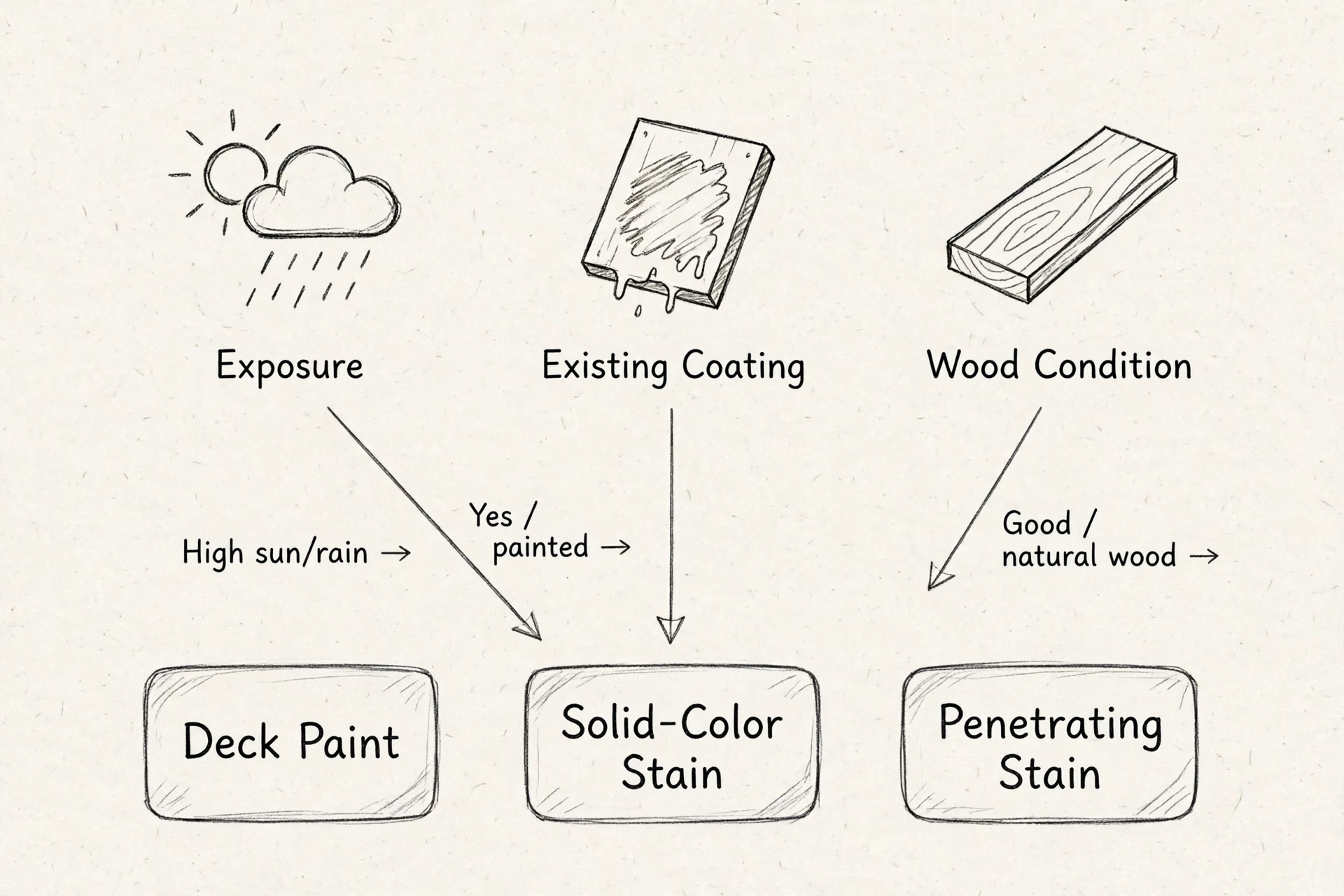
Deck paint peels when moisture gets under the film, and on a horizontal surface that is not a question of if but of how soon. Boards expand and contract with every swing in temperature and humidity, and a rigid film cannot stretch forever, so it cracks. Once a crack opens, water slips underneath and the peeling spreads.
Read your own deck’s peel risk before you buy a single can. Fully exposed boards in full sun and rain carry the highest risk. Boards under a roof, or on a porch that dries fast after rain, carry the lowest. Shaded decks that stay damp carry a different risk: mildew under the film, which breaks adhesion from below. Decks with poor drainage, debris packed between boards, or downspouts dumping nearby will feed moisture to the film no matter how good the paint is. Fix the water problem first, or the paint job is just a countdown.
| Peel-risk factor | What it does to a paint film | Lower the risk by |
|---|---|---|
| Full sun and rain exposure | Cycles the film through expansion, UV, and wetting daily | Consider stain instead, or accept shorter film life |
| Trapped moisture (wet boards, poor drainage) | Lifts the film from beneath, causes bubbling | Let boards dry to the product’s spec; fix drainage and gaps |
| Wrong product (house paint on a floor) | Film is not built for foot traffic or standing water | Use only paint labeled for horizontal walking surfaces |
| Skipped or thin prep | Paint bonds to dirt, mildew, or loose coating instead of wood | Clean, dry, sand, and prime to the label’s directions |
| Heavy coats instead of two thin ones | Thick film skins over and cures unevenly | Two thin coats at the stated spread rate |
| Painting in sun, heat, or before rain | Flash drying, lap marks, and wash-off before cure | Paint in shade, in the label’s temperature range, with dry days ahead |
Prep at a glance: what paint demands before the first coat
Prep is where deck paint jobs are won or lost, and it is also where paint asks more of you than stain does. A painted deck needs sound wood first: replace soft or rotted boards, tighten fasteners, and fix the moisture source before any coating goes on.
From there, the sequence runs: remove loose and failing coating, clean the surface, rinse thoroughly, let the deck dry to the coating’s specification, sand weathered fibers and feather the old coating’s edges, prime where the system requires it, then apply two thin coats. Behr’s porch-and-floor paint directions give a concrete picture of the standard: surfaces must be clean, sound, and dry; failing coating comes off with a stripper or scraper; glossy surfaces get scuff sanded; and a compatible primer goes over uncoated and previously coated wood. Application happens between 50 and 90 degrees Fahrenheit, with about an hour to dry to the touch, 4 to 6 hours before recoat, and 72 hours before normal use.
That dry-to-spec point deserves emphasis, because “looks dry” and “dry enough to coat” are not the same thing. A moisture meter reading at or below the level on the technical data sheet is the honest test, and freshly installed pressure-treated lumber often needs far longer than people expect. Painting over damp boards is the fastest way to guarantee peeling, because the moisture you trap under the film has nowhere to go.
One safety note before you sand anything: if your deck or its old coating predates 1978, treat lead paint as a real possibility and check the EPA’s lead-safe guidance before you disturb it. Lead dust is not a problem to improvise around, and a pro with lead-safe certification is the right call for that job.
How long deck paint lasts, and what upkeep really looks like
A well-prepped paint job on a deck floor can last several years, and a covered porch floor can go longer still, but the honest range depends on exposure more than on brand. When paint finally fails, it fails in patches that need scraping, sanding, and spot priming before recoating.
Plan on a yearly look-over: sweep debris out of the gaps, wash the surface with a mild cleaner, and check the edges of boards and the spots where water sits. Touch up small chips early, because a small break in the film is an open door for moisture, and a door left open through a wet season becomes a peeling patch. Keep a record of the product, color, and date somewhere you will find it again, because the next recoat goes much faster when you are not guessing at the can. That yearly check fits into a broader seasonal deck maintenance routine that covers inspection, cleaning, and protection together.
Also plan around the cure, not just the dry time. Behr’s porch-and-floor paint, for example, is dry to the touch in about an hour and ready for recoat in 4 to 6 hours, but it asks for 72 hours before normal use and a full 30 days before the cured film should be washed with detergent. Walking on it early, dragging furniture across it, or washing it hard in the first weeks can mark a film that would otherwise have lasted years.
Restore or replace: reading a painted deck that has seen better days
Not every peeling painted deck is worth repainting, and knowing the difference saves real money. The decision turns on the wood under the paint, not the paint itself. If the boards are solid and the framing is sound, a repaint after proper prep is a reasonable project.
If the boards are soft, spongy, or crumbling at the ends, or the framing flexes underfoot, no coating restores structure. Those boards come out, and in bad cases the deck itself is the project, not the paint. Use this quick read before you commit to a repaint:
| What you find | What it means | The right move |
|---|---|---|
| Paint peeling in spots, boards solid and dry | Coating failure, wood is fine | Scrape, sand, spot prime, repaint with a compatible system |
| Peeling plus dark, soft spots on boards | Moisture has reached the wood | Probe with a screwdriver; replace soft boards before coating |
| Widespread peeling across the whole floor | System failure or chronic moisture | Check drainage and exposure; consider stain after stripping, or a full recoat only if the cause is fixed |
| Boards cupping, cracked through, or flexing | Structural wear, not a finish problem | Replace boards; check framing and fasteners |
| Framing soft at posts or ledger | Structural decay | Stop and get a pro assessment before spending on finish |
There is also a point of no return worth naming plainly. If you have repainted twice and the film keeps failing in the same areas, the problem is probably moisture or wood condition, not the paint brand. Spending a third time on the same system without fixing the cause is throwing good money after bad. At that point, stripping back to bare wood and switching to a penetrating finish, or replacing the worst boards, is the cheaper path over the next five years.
DIY or hire a pro
Painting a deck floor is a realistic DIY job if the deck is small, the boards are sound, and you can give it several dry days in a row. The work is mostly prep: cleaning, scraping, sanding, and priming, with the actual painting being the fastest part.
Where DIY goes wrong is usually the calendar, not the skill. People paint on a hot afternoon in direct sun, or the day before rain, and then blame the can for what the weather did. Hire a pro when the deck is large or multi-level, when railings and stairs multiply the detail work, when the old coating needs full stripping, or when you suspect rot, structural trouble, or lead paint. A good contractor also earns their fee on prep: they will find the soft boards and the moisture sources that a weekend painter walks past. Ask any pro you interview how they handle prep, what primer system they use, and what they do about drainage problems they find. Vague answers on prep are a warning sign, because prep is the job.
Sources
These are the sources actually opened while researching this article.
- DeckStainHelp’s comparison of deck stain and paint
- DeckStainHelp’s guide to why deck paint fails
- CoverPro Painting’s guide to choosing deck paint
- Behr’s porch and patio floor paint product guide
- The EPA’s lead information for pre-1978 homes
Frequently asked questions
No, not on the floor. House paint is made for vertical surfaces like siding and trim, and it is not built for foot traffic, dragged furniture, or standing water. On deck boards it tends to crack and peel within a season or two. Use a porch-and-floor paint labeled for exterior horizontal walking surfaces instead.
For most decks, a premium 100% acrylic or urethane-modified acrylic porch-and-floor paint, with a compatible primer from the same product line. It flexes with the wood, holds color in sun, and resists scuffing. On stairs and high-traffic paths, the urethane-modified version’s harder film is worth the extra cost.
For most bare, fully exposed decks, stain is the better call, because it soaks in and fades evenly instead of peeling in patches. Paint wins when the deck is already painted, when boards no longer match, when you want a color stain cannot give you, or when a roof protects the floor from weather.
Not without real prep. Stain residue and oils in the wood interfere with paint adhesion, so paint laid over stain tends to peel early. To switch from stain to paint, strip and clean the deck to a sound surface and prime it first. If you want an opaque color with less risk, solid-color stain is often the simpler switch.
It depends on exposure more than brand. A well-prepped job on a covered porch can last many years, while a fully exposed deck floor in harsh weather will show wear sooner. When paint fails, expect scraping and sanding before recoat, which is more work than refreshing a faded stain.
Yes, on bare wood and on patched areas, and the primer should come from the same product system as the paint. Behr’s porch-and-floor line, for example, pairs its paint with a multi-surface stain-blocking primer for wood. Skipping primer on bare wood is one of the most common reasons a new paint job lets go early.
Usually no. Capped composite and PVC boards are designed to shed coatings, and painting them can void the warranty. Some older uncapped composite boards accept coatings, but only with the decking manufacturer’s current approval in writing. Check before you buy anything.

4 Comments
Pingback: Wood Deck Maintenance: Inspect, Clean & Protect | Home Exterior Lab
Pingback: Deck Stain vs. Sealer: What's the Difference?
Pingback: How to Stain a Wood Deck: Prep, Sanding & Lasting Finish
Pingback: How Long Does a Wood Deck Last? Lifespan by Wood Type