

Vetting a gutter cleaning company means running a short, structured interview that confirms insurance, pins down the exact scope of work, checks how the crew works at height, and ties the price to a written quote, all before anyone touches a ladder.
Most gutter cleaning jobs look simple from the ground. They are not. Someone will lean a tall ladder against your roofline, walk the length of your gutters, and flush water through your downspouts while your siding, landscaping, and roof edge sit inches away. The difference between a good visit and a bad one comes down to the questions you ask before you book, not the price you haggle afterward.
This guide gives you 15 questions in four interview-ready checklists. Each question includes what a confident answer sounds like and the red-flag answers that should make you move on. Keep them on your phone during the call, work through one checklist per topic, and you will know exactly who you are hiring.
Contents
- Do You Actually Need a Pro, or Is This DIY?
- How to Use These Checklists
- Checklist 1: Insurance and Licensing Questions (the Non-Negotiables)
- Checklist 2: Scope Questions (What the Visit Actually Covers)
- Checklist 3: Method and Safety Questions (How the Crew Works at Height)
- Checklist 4: Price and Payment Questions (Pinning Down the Quote)
- After the Calls: How to Compare Two or Three Quotes
- FAQs
- Sources
Do You Actually Need a Pro, or Is This DIY?
Hire a gutter cleaning company when the job outruns your tools, your time, or your comfort on a ladder. This Old House recommends calling a professional when you lack the right equipment or time, the gutters are severely clogged or damaged, the home is more than one story, or you are not comfortable working at height.
For a single-story home with easy access, routine gutter maintenance is a fair Saturday job: a sturdy ladder, work gloves, a scoop, and a hose. The moment the roofline gets high, the gutters have been ignored for years, or you feel uneasy on the third rung, that is the job to hand off. NRCA’s homeowner guidance agrees, noting that when homeowners are not comfortable with routine maintenance like gutter cleaning, hiring a professional contractor is the recommended move.
The video below walks through the full DIY cleaning process, and it includes a dedicated chapter on when to stop and call a pro instead. Watch it first. If your situation matches the pro conditions, come back and work through the checklists with your phone in hand.
And if you are still on the fence about timing, see how often gutters need cleaning for the schedule that fits your tree cover. Clogged downspouts are the most common reason a cleaning turns into a repair call, so it also helps to know the signs of a clogged downspout before the crew arrives.
How to Use These Checklists
Do not read all 15 questions like a script. Group them the way the call naturally flows: credentials first, then scope, then safety, then price. A good company answers the first four without flinching. A shaky company starts dodging by question two, which saves you the rest of the call.
For each question you will find three things: the exact question to ask, what a confident answer sounds like, and the red-flag answer that means you should keep looking. Ask the same questions to every company you call so the answers compare cleanly side by side.
Checklist 1: Insurance and Licensing Questions (the Non-Negotiables)
Insurance and licensing questions protect you from the two worst outcomes: an injured worker with no coverage and property damage nobody pays for. Ask for the license, ask for proof of general liability insurance, and confirm workers’ compensation covers the crew. A reputable company expects these questions and answers them in plain language.
| Ask this | What a good answer sounds like | Walk away if you hear this |
|---|---|---|
| Are you licensed to do this work where I live? | They give you a license number or tell you exactly which city or county license they hold, and where you can verify it. The Better Business Bureau’s hiring guidance says to check that a contractor is licensed and bonded in your city and state, so a pro will make that check easy. | “We don’t need a license for cleaning” with no way to verify, or they change the subject. |
| Can you show proof of general liability insurance? | “Yes, I can have our insurer email you a certificate today.” No hesitation, no offense taken. This is the paper that pays for your siding or landscaping if a ladder goes sideways. | “We’re fully insured” said with confidence but never backed by a document. |
| Does workers’ compensation cover everyone who will be on my property? | Yes, including any subcontractors or helpers. This one matters more than most people realize: if a worker is hurt on your property and the company carries no coverage, you can end up in the middle of the medical bills. | “Everyone here is an independent contractor, so we don’t need it,” offered with no paperwork to support it. |
| Who exactly will show up: your employees or hired help? | A regular crew, the same technicians each season, people the company can name. Consistent crews are a good sign. | Day labor they will find that morning, or nobody can tell you who is coming to your house. |
If a company fails this checklist, stop here. There is no price low enough to make uninsured ladder work on your home a good deal.
Checklist 2: Scope Questions (What the Visit Actually Covers)
A full gutter cleaning visit covers four things: all debris removed from the troughs, downspouts flushed until water runs clear, hangers and seams checked and tightened, and the fascia given a visual once-over. If any of those four is missing from the quote, you are buying a partial cleaning at full price.
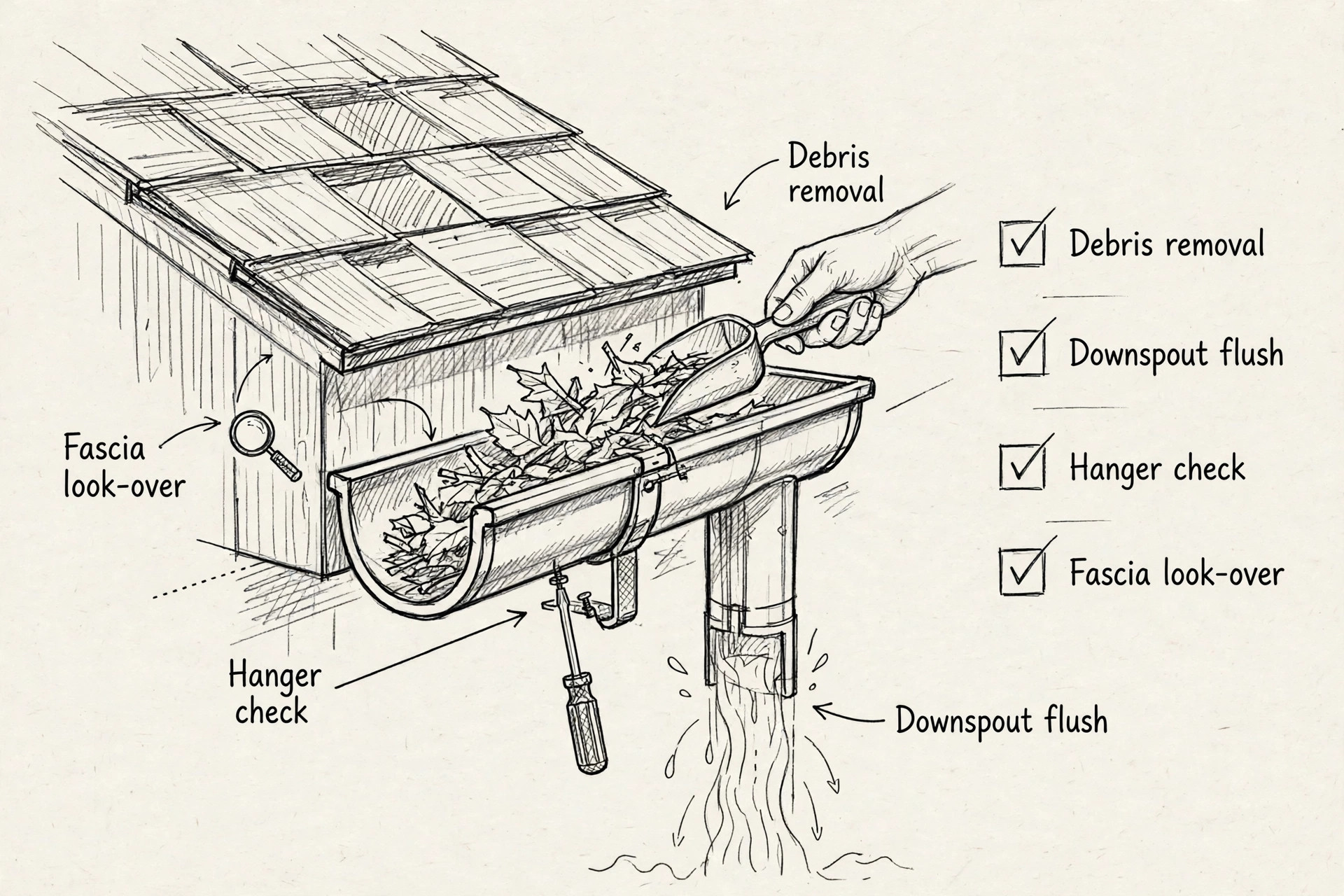
Use the sketch above as your mental picture of a complete visit. Then run through these five questions.
| Ask this | What a good answer sounds like | Walk away if you hear this |
|---|---|---|
| What exactly is included in a standard cleaning? | They name the four checks from the sketch above, plus ground cleanup, without you prompting them. Specifics beat slogans every time. | “We clean the gutters.” That is the whole answer, and it tells you nothing. |
| Do you flush the downspouts, or is that extra? | Included. They run a hose through each downspout until the water runs clear. A downspout that stays clogged keeps the whole system backed up, and the signs of a clogged downspout are worth knowing before the crew arrives, so this question is doing double duty. | “We scoop the troughs; downspouts cost extra,” revealed only after you ask. |
| Do you check hangers, seams, and slope while you are up there? | Yes. They retighten loose hangers, reseal small seam leaks, and at minimum report what they find. The crew is already at the roofline; a look costs them two minutes. | “We only clean.” Problems then sit unnoticed until the next heavy storm finds them. |
| What happens to the debris? | Bagged and hauled away, or at least bagged neatly for your bins. Beds and lawn left the way they found them. | Tossed over the side onto the lawn for you to rake up. |
| Do you take before-and-after photos? | Yes, standard practice, sent to you after the visit. Photos are your proof of what was done, and your baseline for the next cleaning. | No documentation at all. Then it is your word against theirs if a section was skipped. |
Checklist 3: Method and Safety Questions (How the Crew Works at Height)
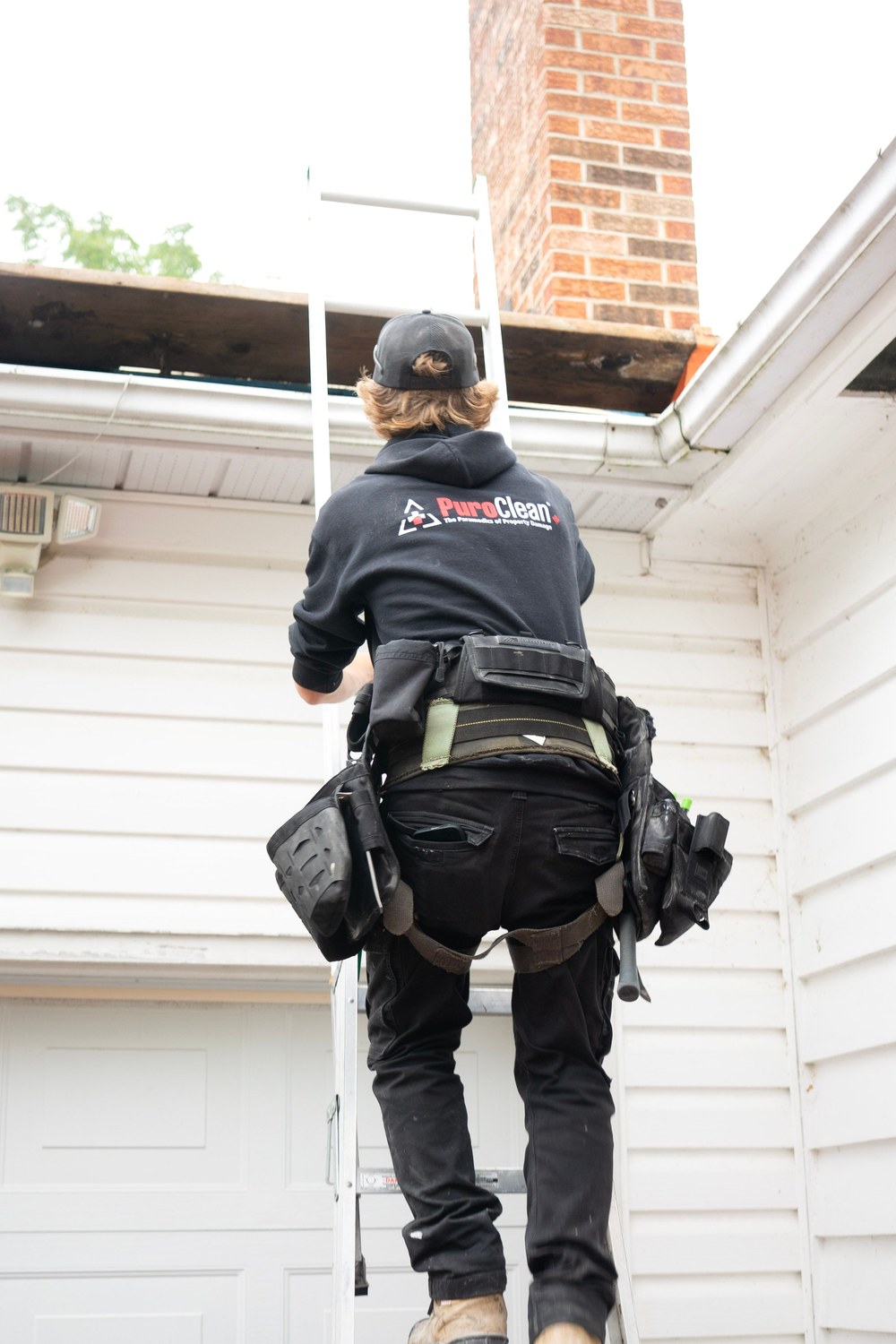
Safe gutter work means ladders, not roofs, and a crew that can describe its setup without thinking. OSHA’s ladder guidance treats falls from portable ladders as one of the leading causes of occupational fatalities and injuries, so ask how the crew sets up, what they stand on, and who is responsible if something breaks.
| Ask this | What a good answer sounds like | Walk away if you hear this |
|---|---|---|
| How do your technicians reach the gutters? | Extension ladders with stabilizers or standoffs, set on level ground, with three points of contact while climbing. OSHA’s portable ladder guidance calls for the ladder to extend at least three feet above the support point and says never to stand on the top three rungs. A crew that knows this will say so. | “We just climb up on the roof,” or a ladder leaned directly against the gutter itself. This Old House’s safety advice is explicit: stay on the ladder rather than working from the roof, and use a standoff so the ladder rests against the roof, not the gutter. |
| What tools and methods do you use? | Hand scoops and brushes first, then a hose flush to finish. Pressure washers only at low pressure on sturdy gutters. They can explain why they work this way. | They cannot describe the method, or the whole plan is “we blast everything with the pressure washer.” Full pressure on old seams and hangers does more harm than good. |
| If your crew damages my gutters, siding, or landscaping, what happens? | They point to their liability insurance and walk you through the claims process right on the call. Damage is rare with a good crew, but the plan for it should not be. | “That never happens,” or a long pause followed by nothing concrete. |
Ladder work is the single most dangerous part of gutter cleaning, for the crew and for your property. The company that takes five minutes to explain its setup is the company that has thought about it.
Checklist 4: Price and Payment Questions (Pinning Down the Quote)
Gutter cleaning is priced by the job: a flat rate for a typical single-story home, more for a second story, heavy debris, or gutter guards in the way. This Old House puts the range at $140 to $300 based on 2024 Angi data, with gutter length and job complexity moving the number. Get the quote in writing before anyone climbs.
| Ask this | What a good answer sounds like | Walk away if you hear this |
|---|---|---|
| Is this a flat rate or per linear foot, and what would change it? | A clear pricing model plus an honest list of what moves it: stories, linear feet, debris volume, guards, repairs. Our breakdown of what shapes a gutter cleaning quote walks through each of these factors in detail. | “We’ll see when we get there” as the entire pricing policy. |
| What costs extra that is not in this quote? | They name the add-ons upfront: second story, severe buildup, guard removal and reinstall, minor repairs, downspout disassembly. Surprises should be impossible by the end of this answer. | A “$99 for everything” headline with the upsell saved for your driveway. |
| Do I get the quote in writing, and when do I pay? | A written quote spelling out scope, price, and timing, with payment due after the work is done. The BBB’s hiring guidance stresses getting every agreement and change in writing before work continues. No big deposit for a half-day cleaning job. | Full payment upfront, cash only, no paperwork. That combination is the oldest warning sign in home services. |
Six things that move a gutter cleaning quote, so you can sanity-check any number you hear:
| Price factor | Why it changes the quote |
|---|---|
| Number of stories | Ladder work gets slower and more complex above the first floor. Two-story homes almost always cost more. |
| Linear feet of gutter | More trough to scoop and flush means more time on the ladders. |
| Debris type and volume | Wet, compacted muck and pine needles take longer than dry leaves. Years of neglect cost more than routine maintenance. |
| Gutter guards installed | Guards have to be worked around or partially removed, which adds labor. If you are weighing that tradeoff, read whether gutter guards are worth it before you decide. |
| System condition | Sagging sections, separated seams, and loose hangers turn a cleaning into a cleaning plus minor repairs. |
| Access difficulty | Steep roofs, dense landscaping, fences, and no flat ground for ladders all slow the crew down. |
After the Calls: How to Compare Two or Three Quotes
Do not pick the cheapest number. Pick the most complete answer sheet. Lay the quotes side by side and score each company on the same six points:
| What to compare | How to score it |
|---|---|
| Insurance proof received | Yes or no. A “no” here ends the comparison. |
| Scope items covered | Count them against the four checks in Checklist 2. |
| Downspout flush included | Included, extra charge, or not mentioned. |
| Debris and cleanup | Hauled away, bagged, or your problem. |
| Written quote | Scope, price, and timing in writing, or a verbal number. |
| Guarantee | A return visit if something was missed, or nothing promised. |
The winner is rarely the lowest bid. It is the company whose answers were specific, whose quote is written down, and whose crew you would trust on a ladder above your flower beds. Book that one, then keep the quote and the before-and-after photos in a folder. NRCA’s homeowner guidance treats a detailed written scope and a maintenance record as part of smart roof system ownership, and your gutters are part of that system.
Frequently asked questions
At least two or three. You want comparable written quotes, not one number in a vacuum. Ask every company the same 15 questions so the answers line up side by side, then score them on the six points in the comparison table above.
No, but stay reachable by phone. A good crew can work around a locked house as long as gates are open and pets are inside. Ask them to text the before-and-after photos when they finish, and walk the property yourself before you pay if you can.
A good company stops, photographs what it found, and explains your options before doing any extra work. Set this expectation on the first call: nothing outside the written quote happens without your approval. That one sentence prevents most billing disputes.
Yes. Ask how they clean around or under your specific guard type, whether removal and reinstallation costs extra, and whether they service guards at all. Some companies skip guarded systems entirely. If you are still deciding on guards, our guide on whether gutter guards are worth it breaks down the maintenance tradeoff first.
Twice a year for most homes: late spring and early fall, which matches This Old House’s recommended schedule. Heavy tree cover can push that to three or four visits. See how often gutters need cleaning for the full schedule by situation.
Sometimes. This Old House notes that some companies discount regular maintenance contracts, which can make sense if your home needs three or four visits a year. Sign one after a good first visit, not before. A plan locks you to a company you have not vetted yet, which defeats the whole point of the checklists above.
Sources
- NRCA’s Professional Roofing magazine explains its homeowner guidance, including the recommendation to hire professional contractors for routine maintenance like gutter cleaning when homeowners are not comfortable doing it themselves: Guidance for homeowners
- OSHA’s Portable Ladder Safety Quick Card covers three-point contact, ladder setup, and the rule against standing on the top rungs: Portable Ladder Safety
- The Better Business Bureau’s tips for hiring construction and remodeling services cover inspecting prior work, verifying licensing and bonding, and checking BBB profiles: BBB Tip: Hiring construction and remodeling services
- This Old House’s gutter cleaning guide covers when to hire a pro, typical costs based on Angi data, and ladder safety practices: How to Clear Your Home’s Gutters

2 Comments
Pingback: Gutter Cleaning Cost Factors: 10 Things That Change Your Quote (2026)
Pingback: Gutter Maintenance Guide for Homeowners | Home Exterior Lab