


Gutter cleaning cost factors are the property and job details a company uses to turn a base rate into your actual quote. The two that matter most are the total length of your gutters and how high they sit off the ground. Everything else, from roof pitch to packed-in debris, stacks on top of those.
On this page
- How a gutter cleaning quote is actually built
- The two factors that move the quote most
- Every other cost factor, ranked by weight
- Why a small house can cost more than the per-foot math says
- What a real line-item quote should include
- How to compare two quotes fairly
- Red flags in a quote
- DIY vs. hiring: how the same factors change the math
- The one cost factor you fully control
- Frequently asked questions
- Sources
How a gutter cleaning quote is actually built
Most companies price a gutter cleaning one of three ways: a flat rate for a standard home, a per-linear-foot rate that scales with gutter length, or a minimum charge for small jobs. HomeGuide’s cost breakdown reports published per-foot rates of $0.50 to $2.50, with flat rates most common for typical homes. The per-foot method is the most transparent, because you can check the math against your own measurements.
| Pricing method | How it works | When you usually see it |
|---|---|---|
| Flat rate | One price for a “standard” home, often split by stories | Local companies quoting typical ranches and two-stories |
| Per linear foot | A rate multiplied by your total gutter length | Companies that measure the roofline before quoting |
| Minimum charge | A floor price that applies no matter how short the gutters | Small homes, quick jobs, and single-story ranches |
The flat rate and the per-foot rate are usually the same math wearing different clothes. A company quotes $175 flat for a single-story home because that is roughly what its per-foot rate comes to on a typical footprint. Knowing your own gutter length is what lets you tell whether a flat quote is fair or padded. If you have never measured, our gutter size calculator walks through the roofline measurement in a few minutes.
The two factors that move the quote most
Gutter length and roof height are the two cost factors that move a gutter cleaning quote most. Longer runs mean more scooping and flushing time, and higher gutters mean bigger ladders, slower setups, and sometimes a second worker to foot the ladder. HomeGuide reports most homes carry 150 to 200 linear feet of gutter, and each added story lifts the quote noticeably.
Length is straightforward. A crew walks the perimeter at the roofline and adds up each run, and gutters on a lower roof section are priced at the lower height, not the tallest point of the house, as LawnGuru’s gutter cleaning cost guide points out. Corners, inside angles, and short runs around dormers add time without adding much length, which is why two houses with the same footage can still get different numbers.
Height is the bigger multiplier. Clean Pro publishes its premiums openly: about 25 percent more for two stories and 50 percent more for three, according to LawnGuru’s cost guide. HomeGuide’s per-foot bands tell the same story, with the rate climbing as the story count rises. A taller roofline does not just mean a longer ladder. It means more careful setup at every section, slower movement, and on some jobs a second person standing at the base. That is labor, and labor is most of what you are paying for.
Every other cost factor, ranked by weight
Once length and height set the baseline, the rest of the factors adjust it up or down. Not all of them carry the same weight. Here they are, ranked by how much they tend to move the final number.
| Cost factor | What it means | Weight on the quote |
|---|---|---|
| Roof pitch and access | Steep roofs force ladder work at every section; landscaping, slopes, fences, or tight side yards slow setup | High |
| Debris type and buildup | Pine needles and wet, rotted sludge take longer to scoop and bag than dry leaves | Medium to high |
| Time since the last cleaning | A routine seasonal clean is quick; years of neglect means compacted muck and seedlings | Medium to high |
| Gutter guards | Screens must be removed and refit to clean underneath; adds $30 to $80 per HomeGuide’s cost breakdown, or $50 to $150 per Clean Pro’s published pricing via LawnGuru’s cost guide | Medium |
| Downspout work | Flushing is sometimes included; badly clogged downspouts cost $50 to $100 extra, per LawnGuru’s cost guide | Medium |
| Gutter condition | Sagging sections, open seams, and loose hangers turn into repair line items, not cleaning time | Medium |
| Location | Metro labor rates run higher than rural ones, per HomeGuide’s cost breakdown | Medium |
| Season and timing | Spring and fall are peak season; off-peak scheduling can earn a discount | Low to medium |
| Gutter type | Sectional gutters have seams that trap debris; seamless runs flush faster, per Angi’s Portland cost data | Low to medium |
| Debris hauling | Some crews bag it and leave it; hauling it away runs $20 to $35 extra, per HomeGuide’s cost breakdown | Low |
A few of these deserve a closer look. Debris is the one crews talk about most, because it is the factor they cannot price until they see it. Gutters under pines or oaks fill faster and pack denser than gutters on an open lot, and wet, rotted debris takes longer to scoop and bag, as LawnGuru’s cost guide explains. A house cleaned every fall is a quick visit. The same house ignored for three years is a different job, with sludge that has to be dug out and seedlings rooted into it.
Access is the quiet factor. Landscaping beds, a pool enclosure, a sloped lot, or a fence line that blocks the ladder all slow the setup, and slow setups are billable time. And gutter guards split into two camps: some crews lift light screens as part of the visit, while others treat removal and refit as a separate charge. Ask which camp your company is in before you book.
Why a small house can cost more than the per-foot math says
On a small house, the minimum charge is your real price, not the per-foot rate. Crews charge a minimum to cover the drive, the ladder setup, insurance, and the fact that one stop eats a slot in the day no matter how short the gutters are. LawnGuru’s cost guide reports that Clean Pro posts a $215 minimum and that jobs under about 125 linear feet usually fall under it, while Homewyse builds a two-hour labor minimum into its estimates.
Do the math on an 80-foot ranch and the per-foot figure says something modest. The invoice will still say around $200, because the crew spent the same fixed time getting there, setting up, and packing out. That is why comparing per-foot rates between companies helps less than you would think on a small home. Ask each company for its minimum charge up front. It is the number that will actually decide your price.
What a real line-item quote should include
A complete gutter cleaning quote should itemize the base cleaning, downspout flushing, debris handling, and any add-ons separately, instead of handing you one bare number. HomeGuide’s description of a standard visit covers debris removal, waste collection and disposal, flushing the system, and checking fasteners and seals. If a quote does not say what happens to your downspouts and your debris, you are comparing it blind.
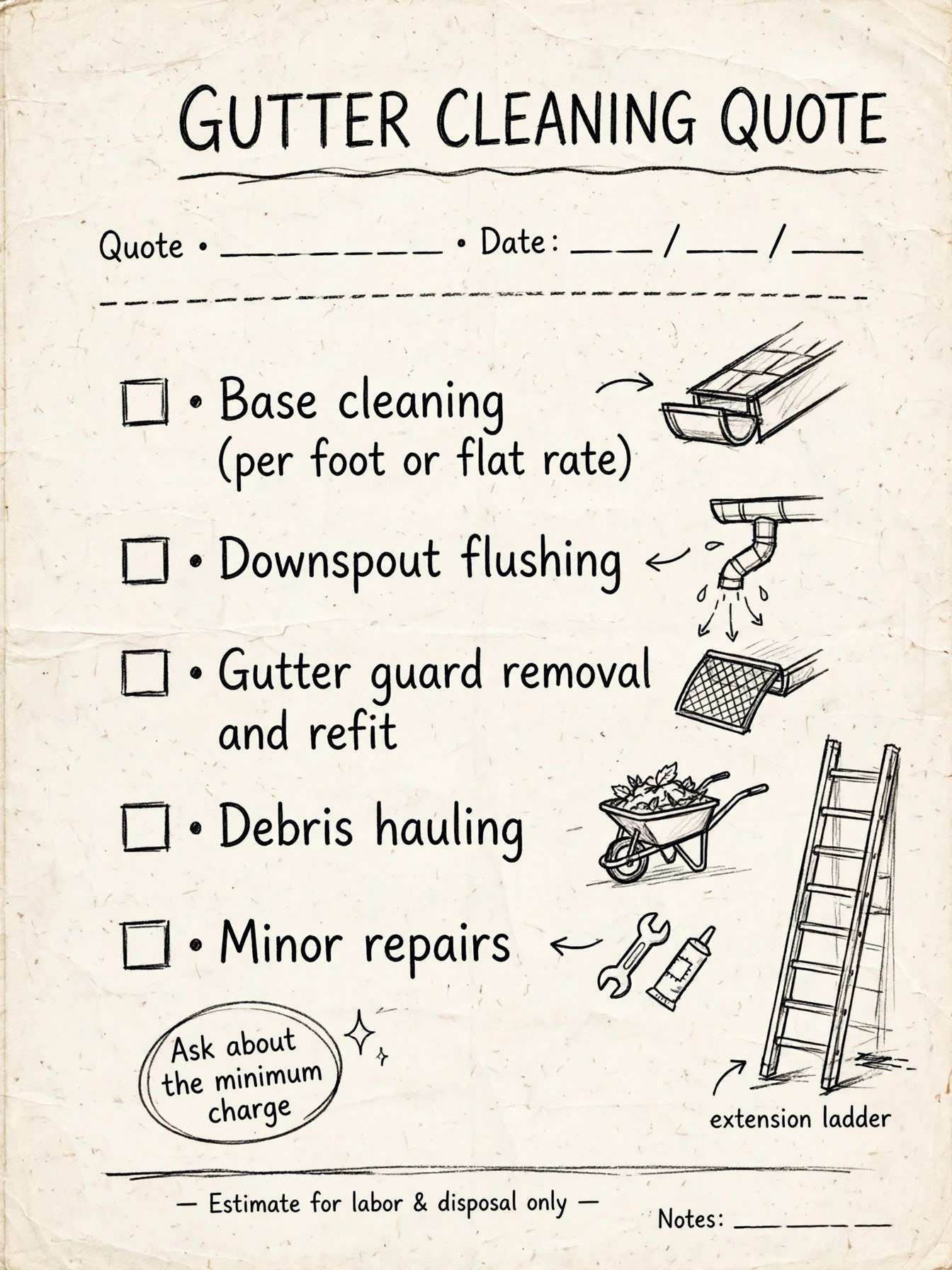
Here is the checklist a real quote should cover:
- Base cleaning. Scooping every gutter run and flushing it with water. This is the per-foot or flat-rate line.
- Downspout flushing. Confirming each downspout drains freely, not just the open trough. This is the line most often skipped, so read it closely.
- Debris handling. Bagged at the curb or hauled away? The answer changes the price and your Saturday.
- Gutter guard handling. Lifted, cleaned under, and refit, or charged as an add-on? Get it in writing.
- Minor repairs found on the job. A crew that finds water dripping behind the gutters, for example, is really finding a resealing or re-hanging job. Repairs are priced separately, but the quote should say how they will be handled if discovered.
- The minimum charge. Ask for it explicitly on small homes.
One line worth special attention is downspout flushing. A gutter can look clean while the downspout is packed solid at the elbow, which is what causes most overflow. LawnGuru’s cost guide puts clearing a badly clogged downspout at $50 to $100 extra when it is not part of the base quote.

How to compare two quotes fairly
Compare gutter cleaning quotes by scope, not just the bottom number. A lower bid that skips downspout flushing or leaves debris bagged in your driveway is not cheaper than a higher one that includes both. Get each company’s line items in writing, then check the same five things on every estimate: what is included, what costs extra, how debris is handled, whether guards are lifted, and what the minimum charge is.
This is where most quote comparisons go wrong. One company prices “a gutter cleaning” as scooping the troughs and leaving. Another prices it as scooping, flushing, testing every downspout, and hauling the bags. The second number looks higher until you realize the first one would have left you hiring someone again for the downspouts. I always ask for the same line items from every company, then compare the lines, not the totals.
Ask each company these questions, in the same words, and write down the answers:
Once the numbers are in, the questions move beyond price: our checklist of the questions to ask a gutter cleaning company before hiring walks through the 15 insurance, scope, safety, and pricing questions to put to every company you call.
| Question | What a solid answer sounds like |
|---|---|
| Are the downspouts flushed and tested? | “Yes, every downspout, included in the base price.” |
| Where does the debris go? | A clear plan: bagged curbside or hauled away, with the fee stated. |
| Do you lift and refit the gutter guards? | “Yes, included” or a stated add-on price, not a shrug. |
| What is your minimum charge? | A straight number, no hedging. |
| What happens if you find damage? | Repairs quoted separately before any work starts, never sprung at the end. |
Red flags in a quote
A quote is a preview of the job. These are the signs the job will disappoint:
- One bare number with no line items. You cannot compare what you cannot see.
- Downspouts excluded entirely. Some companies only clear the open trough. If the quote says nothing about downspouts, assume they are not touched.
- A price far below every other bid. A much lower number usually means skipped steps, no insurance, or a crew that is in and out in twenty minutes.
- No debris plan. “We leave it in your bins” is fine if they say so. Silence is not.
- A big deposit demanded up front. HomeGuide’s hiring guidance warns against large upfront payments for this kind of work. A small booking fee is normal; half the job in advance is not.
- No mention of insurance or what happens on damage. Professional cleaners carry coverage. If it is not mentioned, ask.
DIY vs. hiring: how the same factors change the math
The same factors that move a professional quote move the DIY math, just in a different direction. Height and steep pitch are safety problems for you, not line items. West Virginia University Extension says to set ladders on level, flat ground, stay off the top two rungs of a stepladder, extend an extension ladder three rungs past the roof edge, and never walk out onto the roof. OSHA’s portable ladder safety quick card adds the 4-to-1 setup angle and three points of contact while climbing.
On a single-story home with a light debris load, DIY is a reasonable Saturday job: gloves, a scoop, a bucket, and a hose. The economics flip on two stories or a steep roof. That is exactly where a professional’s ladder equipment, a second worker, and insurance start earning their keep, and it is the same height premium that shows up in their quote. If you are not steady on a ladder, that is the whole decision right there.
The one cost factor you fully control
Cleaning frequency is the one gutter cleaning cost factor you fully control, and it pushes every other factor down. A routine seasonal visit is the quickest, cheapest job a crew does. The expensive visits are the ones where neglect did the crew’s scheduling for them. West Virginia University Extension recommends cleaning gutters at least twice a year, and Oklahoma State Extension gives the same twice-a-year baseline in its stormwater guidance.
Frequency works on the quote in two ways. First, regular visits keep each visit short, which is what you are really buying. Second, a company that sees you twice a year often discounts the annual plan, since a guaranteed spring and fall visit fills their schedule. If you want the full picture of what regular maintenance covers, our gutter maintenance guide lays out the year-round routine, and our answer to how often gutters should be cleaned breaks down the timing by tree cover and climate.
And there is a visible reason to keep the schedule. When gutters do clog, the classic symptom is gutters overflowing in heavy rain, with water spilling over the front lip instead of running to the downspouts. By the time you see that, the job is already the expensive kind.
Frequently asked questions
Why do gutter cleaning quotes vary so much for the same house?
Price variation usually reflects differences in scope, not just pricing strategy. One company includes downspout flushing and debris hauling while another prices only the trough cleaning. Measurement method and each company’s minimum charge add the rest of the spread. Always compare line items before comparing totals.
Do companies charge by the linear foot or a flat rate?
Both. Many companies quote per linear foot, which HomeGuide reports at $0.50 to $2.50, while others quote a flat rate for a standard home. On small homes the minimum charge often decides the price either way, so ask for it up front.
Does a two-story house cost more to clean?
Yes. Taller gutters mean bigger ladders, slower setups, and sometimes a second worker to foot the ladder. Clean Pro publishes about 25 percent more for two stories and 50 percent more for three, according to LawnGuru’s cost guide, and HomeGuide’s per-foot bands climb the same way.
Do gutters with gutter guards cost more to clean?
Usually. Guards keep leaves out of the trough but still need service, and removing and refitting them adds labor. HomeGuide’s cost breakdown puts that at $30 to $80 extra; Clean Pro’s published pricing, via LawnGuru’s cost guide, runs $50 to $150. Ask whether it is included before you book.
What should a written quote list?
The base cleaning, downspout flushing, debris handling, guard handling if you have guards, the minimum charge, and how minor repairs are priced if the crew finds any. If any of those lines is missing, ask for it in writing.
Is gutter cleaning worth the cost?
For most homes, yes. A clogged gutter dumps roof water where you do not want it: against the fascia, down the siding, and into the soil at the foundation. Two routine cleanings a year cost far less than rotted fascia or a wet basement corner, and regular maintenance also keeps gutters from corroding and pulling loose from their mountings, as West Virginia University Extension notes.
When is the cheapest time to book a cleaning?
Spring and fall are peak season. HomeGuide notes that booking in early winter or midsummer can mean faster service and cheaper rates. If your trees allow it, an off-peak visit is the easiest discount in this whole guide.
Sources
- LawnGuru’s gutter cleaning cost guide, covering per-foot rates, story premiums, minimum charges, and common add-ons
- HomeGuide’s cost breakdown for gutter cleaning, covering per-foot and flat-rate pricing, guard removal, debris disposal, and hiring guidance
- Angi’s Portland gutter cleaning cost data, covering per-foot rates by stories and seamed versus seamless gutter cleaning
- West Virginia University Extension’s gutter safety guide, covering cleaning frequency, ladder setup, and protective gear
- Oklahoma State Extension’s downspout stormwater fact sheet, covering twice-a-year cleaning and gutter and downspout inspection points
- OSHA’s portable ladder safety quick card, covering the 4-to-1 setup angle, three-foot rail extension, and three points of contact

1 Comment
Pingback: Gutter Maintenance Guide for Homeowners | Home Exterior Lab