

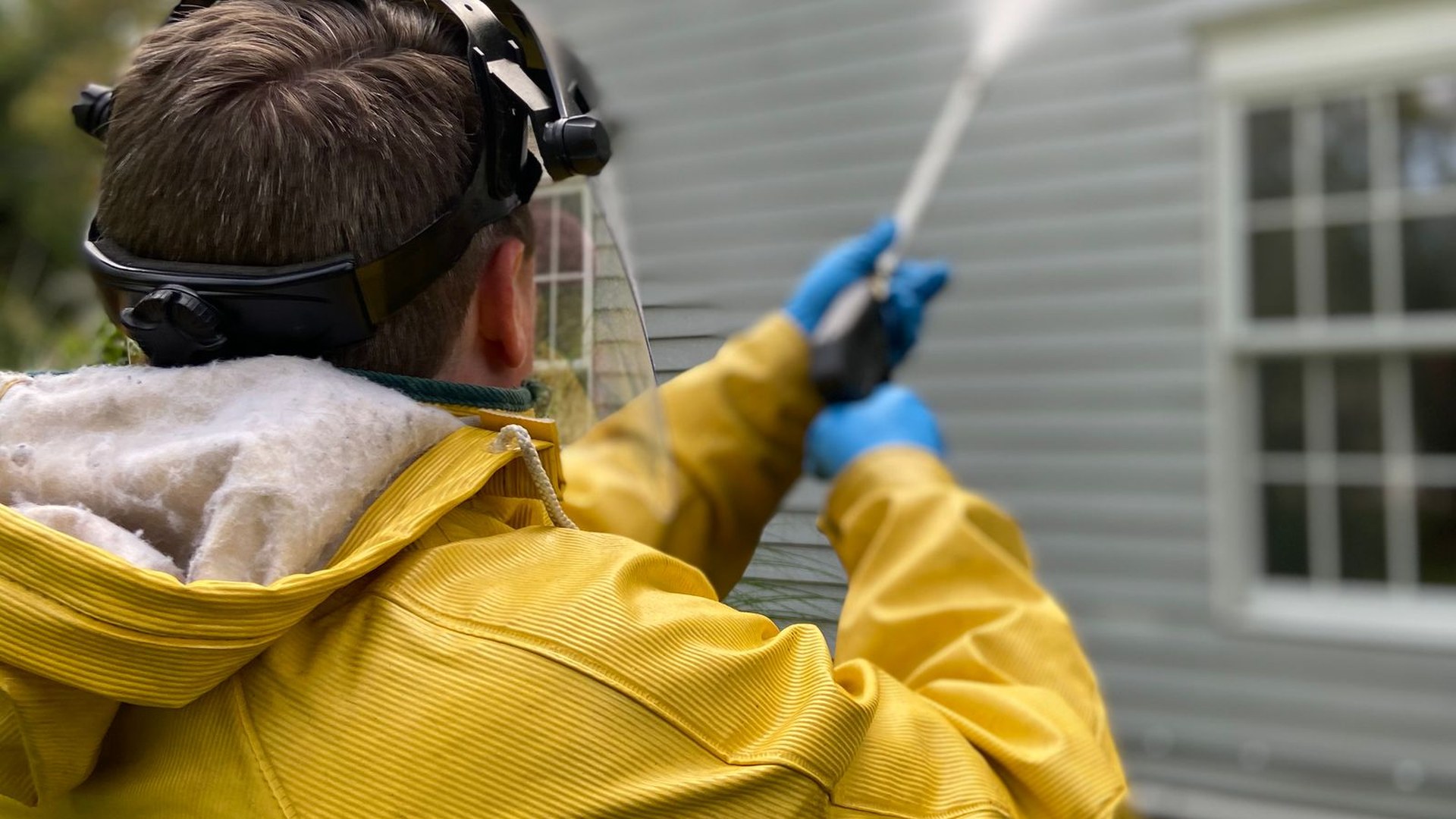
A house-washing quote is built from six things: the size and shape of your home, how many stories it has, what the siding is made of, how heavy the growth and staining has gotten, how hard the property is to work on, and the company itself. Understanding these soft washing cost factors is what lets you compare two quotes instead of just picking the smaller number.
Soft washing is the low-pressure cleaning method most reputable pros use on siding, stucco, brick, and roofs. Instead of blasting grime off with force, a pump applies a cleaning solution at roughly garden-hose pressure, the solution dwells while it kills algae, mold, and mildew at the root, then everything rinses away gently. It is the method for the simple reason that force is what damages siding, not chemistry.
If you have ever collected three quotes for the same house and wondered why one is half the price of the others, this guide is for you. Here is what each factor really means, what is usually included in a standard wash, what typically costs extra, and the red flags that separate a bargain from a gamble.
Watch a professional crew soft wash heavy organic growth off second-story siding: low-pressure application, dwell time, then the rinse. Video: Underdog Power Washing on YouTube.
Contents
- How a house-washing quote actually gets built
- Factor 1: Size and shape of the house
- Factor 2: Stories, height, and access
- Factor 3: Siding material
- Factor 4: How far the growth has gone
- Factor 5: Landscaping and property quirks
- Factor 6: Where you live and who you are hiring
- What is included vs. what costs extra
- How to compare two quotes without guessing
- Red flags: when a cheap quote is a gamble
- Where DIY ends and the pro earns the quote
- Frequently asked questions
- Sources
How a house-washing quote actually gets built
A soft washing estimate is a labor-and-materials calculation, not a number pulled from thin air. Most companies start from the amount of surface they have to treat, then adjust for difficulty. The common pricing bases are square footage of the walls, linear footage around the perimeter of the house, or a flat per-job figure for standard homes.
The square footage method scales directly: more wall area means more cleaning solution, more rinse water, and more time on site. The linear-foot method is popular for siding work because crews measure the perimeter of the house and multiply by a per-foot rate that bakes in the average wall height. Smaller companies often skip the math and quote a flat price for a typical one-story home, then add for anything unusual.
Minimum service fees are real too. A small job still takes a truck roll, setup, and teardown, so very small projects can cost more per square foot than a large one. None of this is padding; it is how the math of a service business works.
Factor 1: Size and shape of the house
Size is the single biggest driver of a house-washing quote. A 1,500-square-foot ranch and a 4,000-square-foot estate simply are not the same job. More wall area means more solution, more time, and more rinsing, and every reputable estimator prices that in.
Shape matters as much as raw size. A simple rectangular ranch is fast to walk and spray. A house with bump-outs, dormers, recessed porches, bay windows, and fussy trim takes longer per square foot because the crew slows down around every edge and detail. Two homes with the same square footage can get different quotes if one is simple and the other is architecturally busy.
What this means for you: if your quote seems high relative to a neighbor’s, compare the shapes, not just the square footage. A bigger footprint and more detail work explain most of the gap.
Factor 2: Stories, height, and access
A two-story home almost always costs more to wash than a one-story home of the same footprint. The upper walls are not reachable from the ground, so the crew brings longer poles or ladders, moves equipment more often, and spends more time on every wall. Three-story homes step that up again.
Height is also a safety cost. Working above the first story means ladder work, and OSHA’s construction fall-protection standard requires protection for workers on surfaces 6 feet or more above a lower level, which is one reason professional crews plan taller homes differently than one-story ones. A company that prices height into the quote is being honest; a company that does not ask about stories before quoting is guessing.
Access complicates things further. Steep slopes behind the house, tight side yards, a deck that blocks wall access, or a home on a hillside all slow the crew down and add setup time. When an estimator mentions access as a reason for a higher number, ask exactly what is hard about your property. A good answer is specific (“the grade drops eight feet on the east side, so we ladder every wall there”). A vague answer is a shrug.
Factor 3: Siding material
Not all siding washes the same way, and the material changes the chemistry, the dwell time, and the care the crew has to take. That is a cost factor because careful work is slower work.
| Siding material | Why the method changes | Effect on the quote |
|---|---|---|
| Vinyl | The easiest surface; solution goes on, dwells, rinses off | Tends toward the lower end |
| Painted wood | Low pressure only; crew watches for failing paint and old caulk | Higher; more inspection and slower passes |
| Stucco | Porous surface that holds dust and growth; needs thorough wetting and gentle rinsing | Higher; more solution and time per wall |
| Brick and stone | Tolerates more; mortar joints need checking so solution and water do not sit in cracks | Moderate; often paired with stain spot-treatment |
| Fiber cement (Hardie board) | Dense surface that can need more passes for even coverage | Higher; crews work in smaller sections |
| Cedar or shingle siding | Delicate grain; wrong pressure furrows the wood permanently | Higher; specialist care, slow work |
If your quote mentions the siding material by name, take it as a good sign. A company that treats vinyl and stucco as interchangeable has not thought about your house.
You can see why method matters so much for your siding type by comparing how the two approaches actually clean: soft washing relies on chemistry while pressure washing relies on force, and the right answer depends on your surface. If you are matching the method to the material across the whole house, our exterior house cleaning guide by surface covers which approach suits each one. Oxidation is a separate case worth knowing about too. Faded, chalky siding that leaves a film on your hand is not dirt at all; telling oxidation apart from dirt matters because oxidation often needs a different treatment and sometimes a different price.
Factor 4: How far the growth has gone
The condition of the surfaces is the second-biggest cost factor after size. A house washed two years ago with light dust costs the crew far less time than one that has not been touched in six years and wears a coat of green algae on every north-facing wall.
Heavy biological growth changes the job in three ways. First, the solution concentration and blend may need to be stronger, which costs more in chemicals. Second, dwell time gets longer; the crew applies, waits, checks, and sometimes re-treats the worst patches instead of making one quick pass. Third, heavily shaded or tree-covered homes often have embedded growth in grooves, joints, and under trim that needs a slower, more deliberate rinse.
Growth level also explains why an annual or biennial wash costs less per visit than a one-time deep clean. Regular maintenance washes are lighter jobs. Letting growth build for years turns the next wash into a restoration project.
If your north-facing walls are wearing the green coat right now, here is what that growth actually is and how it is cleaned off vinyl siding without damage, which is exactly the judgment call that separates a maintenance wash from a restoration job.
What this means for you: if two companies quote different numbers, ask each how they are pricing the condition of your siding. The one that asks about shade, trees, and how long it has been since the last wash is pricing your actual house.
Factor 5: Landscaping and property quirks
Soft wash solutions are effective precisely because they are biocides, and that means a professional job includes protecting what you do not want treated. Dense foundation plantings, flower beds tight against the walls, vegetable gardens, koi ponds, and outdoor pets all require prep work: pre-wetting plants, rinsing during the job, and sometimes covering the most delicate beds.
That protection is labor, and it is priced in. A home with a simple lawn strip around the foundation costs less to prep than a cottage garden planted right up to the siding. Outdoor living features add time too. Pergolas, screened porches, outdoor kitchens, and heavy patio furniture in the spray zone have to be moved, covered, or worked around.
Water access can be a factor on larger properties. If the crew has to bring their own water because the spigot is far from the work area or the well pressure is weak, expect that to show up in the quote.
Factor 6: Where you live and who you are hiring
Labor markets set the floor. A full house wash in a high-cost metro area runs noticeably higher than the same job in a rural market, because wages, insurance, and fuel cost more there. Humid regions also tend toward more growth and more frequent washing, which shapes how local companies structure their pricing. None of this is negotiable by the homeowner, but it explains why the number your cousin paid two states away tells you nothing about yours.
The company itself is the last cost factor, and it is the one where cheap goes wrong. A legitimate operation carries general liability insurance, uses commercial-grade equipment, mixes solution to the siding and growth level rather than using one jug for every house, and budgets time for plant protection and a final walkthrough. An uninsured operator with a homeowner-grade pressure washer and a flat “one mix for everything” approach can quote half the price because they are carrying half the cost structure. The question is whether you want to be their learning experience.
What is included vs. what costs extra
The biggest source of quote confusion is not price; it is scope. One company’s “house wash” includes the roof wash. Another’s includes only the siding. Always confirm scope in writing before you book.
| Usually included in a standard house wash | Typically an add-on (extra charge) |
|---|---|
| All exterior walls and siding | Roof cleaning or soft wash |
| Soffits, fascia, and eaves | Gutter interior clean-out |
| Exterior window rinse (not detailed window cleaning) | Driveway, sidewalk, and patio washing |
| Removal of cobwebs, wasp nests, and debris | Deck or fence washing |
| Visible foundation walls | Rust stain, artillery fungus, or efflorescence removal |
| Plant protection during the service | Oxidation removal or chalky-siding restoration |
| Spot treatment of heavy algae patches | Paint overspray or graffiti removal |
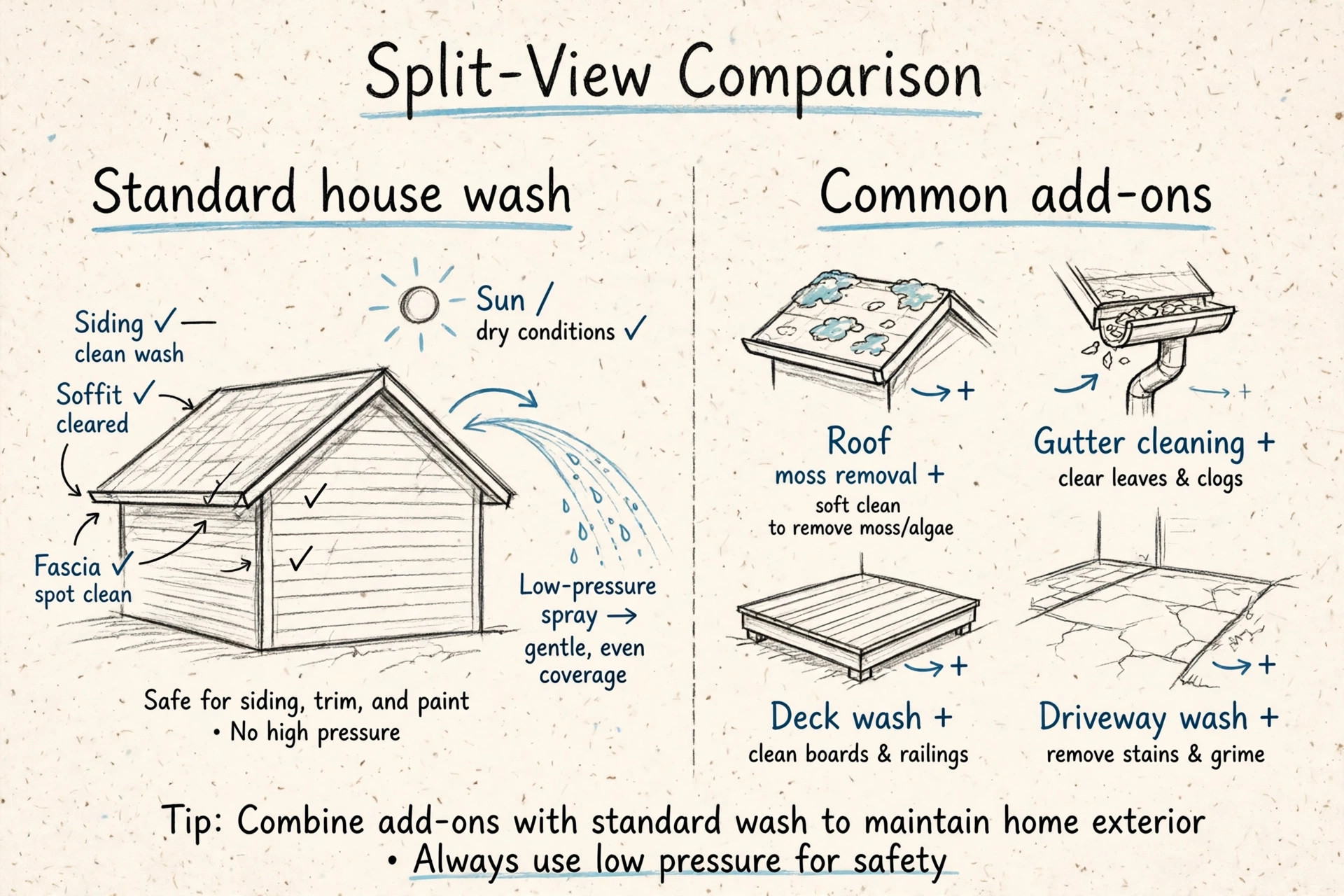
When a quote arrives, map it against that table. If something you expected is missing, ask whether it is included or extra. Misunderstandings about scope cause more disappointment than the price ever does.
How to compare two quotes without guessing
When you have two or three written quotes in hand, run each one through this worksheet. Score each line yes or no, then compare the pattern, not just the totals.
Is the scope itemized? The quote should name what is being washed: siding, soffits, fascia, windows, foundation. A one-line “house wash” with no breakdown cannot be compared to anything.
Is the method named? Look for “soft wash” or “low-pressure wash” on the siding. A quote that does not name the method is a quote you cannot evaluate.
Did they ask about the house before pricing? Stories, siding material, shade, and last wash date should come up. Quotes priced sight unseen from a satellite photo alone deserve a second look.
Are add-ons priced separately? Roof, gutters, driveway, and deck should each carry their own line or their own bundle price, not be smuggled into the base number.
Is plant and property protection mentioned? Pre-wetting, covering, and rinsing landscaping is a line item in a professional quote, even if it is baked into the price rather than listed separately.
Are they insured? General liability insurance is the minimum. Ask; do not assume.
What is the guarantee? A simple re-treat window for missed spots tells you the company stands behind the work.
A quote that is 20 percent higher but answers all seven lines well is usually the better deal. A quote that is 40 percent lower and answers none of them is usually a gamble.
Red flags: when a cheap quote is a gamble
A low number is not automatically suspicious; markets differ and some companies run lean. These are the specific signs that a cheap quote is cheap for the wrong reasons.
The price never changes. Every house gets the same number regardless of size, stories, or condition. That is not pricing; that is a lottery ticket.
No questions about your house. An estimator who never asks about siding material, shade, or access has not priced your job.
High pressure on siding. If the plan is “pressure wash the whole house” with no mention of soft washing or low pressure on delicate surfaces, walk away. Force is what damages siding.
No plant protection mentioned. If the crew plan includes nothing about your landscaping, your plants are the plan’s acceptable loss.
No insurance proof offered. “We are insured” without a certificate on request is a claim, not a fact.
Cash-only or no written quote. Legitimate companies put scope, method, and price in writing. Always.
Pressure tactics. “This price is only good if you book today” is a sales technique, not a reflection of the work.
I have seen the aftermath of the cheapest-quote approach more than once: etched vinyl, oxidized paint, dead foundation beds, and a homeowner paying twice, once for the damage and once for the redo. The cheapest wash is the one done right the first time.
For the full interview playbook, see our guide to the questions to ask a pressure-washing company before you hire.
Where DIY ends and the pro earns the quote
A single-story ranch with vinyl siding, light dust, and clear access is a reasonable DIY project if you own or can rent the right equipment, use a proper house-wash mix, and respect plant protection. Plenty of people do it well.
The line moves once the job gets tall, delicate, or complicated. Second stories, steep or unstable ground, painted wood or cedar siding, heavy growth that needs stronger mixes, and elaborate landscaping all push the job toward professional work. Working at height around ladders and wet surfaces is where most DIY injuries happen, and the wrong chemical strength on the wrong siding is how a Saturday project becomes a repaint quote.
Honest rule of thumb: if you would need a ladder to reach most of the wall, or if you cannot name what your siding can tolerate, get a pro. The quote pays for judgment as much as for water.
Frequently asked questions
Why do soft washing quotes vary so much from company to company?
Because the inputs vary. House size, stories, siding material, growth level, access difficulty, local labor rates, and the company’s insurance and equipment all feed the number. Two quotes that look wildly different usually reflect different scope or different assumptions, which is why an itemized quote beats a single number.
What should a standard house wash actually include?
Exterior walls and siding, soffits and fascia, an exterior window rinse, cobweb and debris removal, visible foundation walls, and plant protection during the service. Roof, gutters, driveway, deck, and stain-specific treatments are almost always separate line items or add-ons.
Why is washing a two-story house so much more expensive?
Everything about the upper walls costs more: longer poles or ladder setups, slower passes per wall, more solution to reach and dwell on upper surfaces, and added safety planning. The crew simply spends more time and equipment on the second story, and the quote reflects that.
Does it cost more to wash a house that has not been cleaned in years?
Usually, yes. Heavy algae and mold need stronger solution blends, longer dwell times, and often a second treatment on the worst patches. A house on a regular washing schedule is a lighter job each time, which is why maintenance washes cost less per visit than a first-time deep clean.
Is the cheapest quote ever the right choice?
Sometimes a lower quote just reflects a leaner company in a cheaper market. But watch for the red flags: no written scope, no named method, no questions about your house, no insurance, and no plant protection. If several of those are missing, the low price is a warning, not a deal.
Can I do anything to bring the quote down?
Yes, within reason. Clearing access around the house, moving patio furniture and grills away from the walls, trimming bushes that press against the siding, and bundling the house wash with the driveway or gutters often lower the per-service price. What you should not cut is plant protection or insurance; those are the two things that protect your property.
Sources
- Engineer Fix’s soft washing cost guide explains the square-foot and linear-foot pricing bases, the effect of surface area, growth severity, accessibility, and regional labor variation: How Much Does Soft Washing Cost?
- Wash Hawk Softwash’s Louisiana house-washing pricing guide lists the five main cost factors, the typical included-versus-extra scope split, and the risks of ultra-cheap quotes: How Much Does House Washing Cost in Louisiana?
- OSHA’s interpretation of the construction fall-protection standard covers the requirement for protection on walking/working surfaces 6 feet or more above a lower level: OSHA fall protection requirements
- Underdog Power Washing’s video shows a professional low-pressure soft wash of heavy organic growth on second-story siding: HOA Sent Him a Warning! One Driveway Job Turned Into More Business!
- Featured photo of a person washing house siding with a sprayer, photographed by Caitlin Whealy on Pexels: Back View of a Person Pressure Washing a House
