

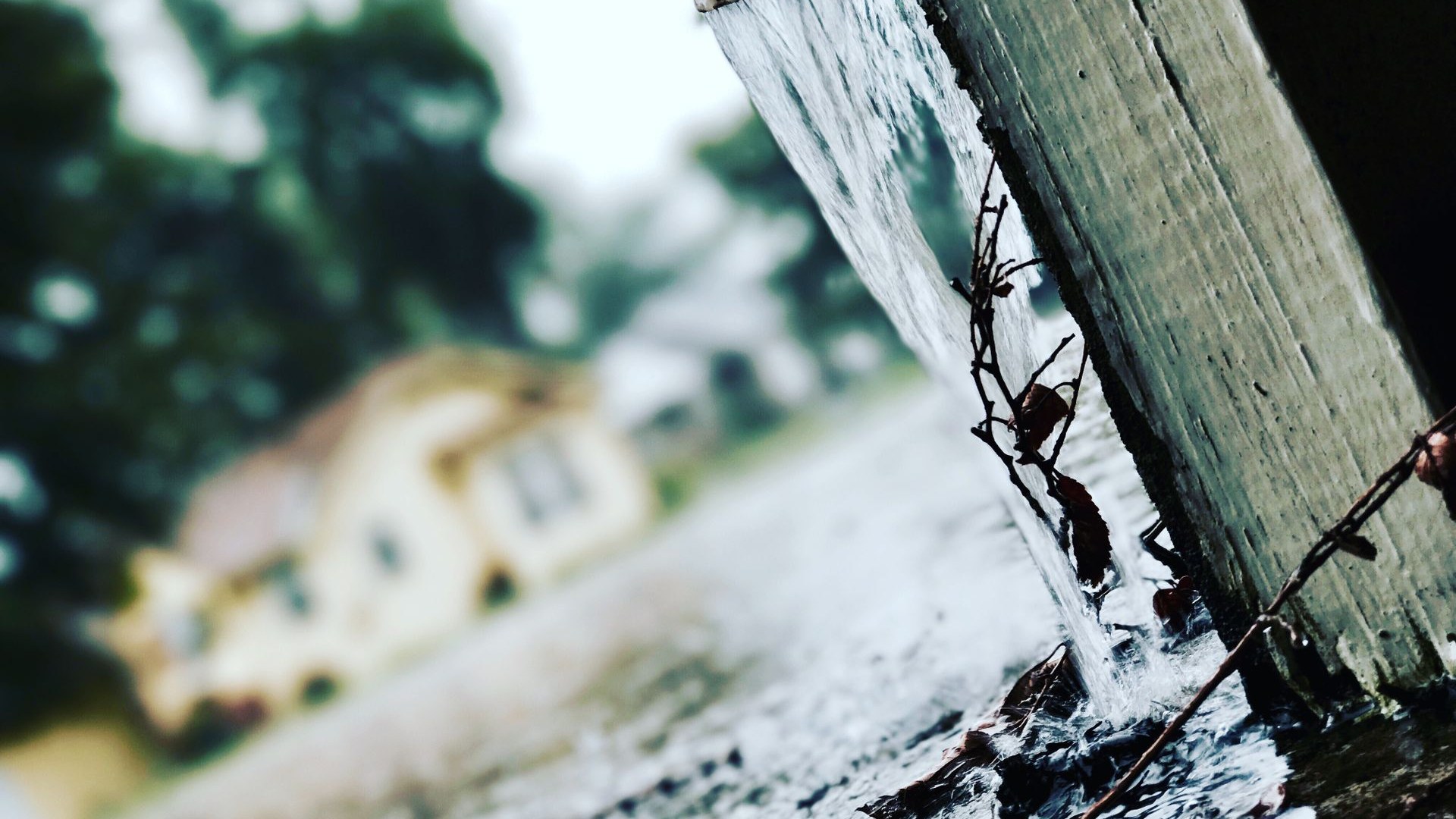
A clogged downspout is a vertical rain pipe that leaves, seed pods, or sediment have partially or fully blocked, so water from your gutters can no longer drain freely to the ground. The clog itself is usually small, a ball of wet leaves about the size of a fist, wedged where the pipe bends or narrows.
Most people discover a clogged downspout the dramatic way. During a hard rain they hear water roaring over the gutter edge like a waterfall, or they notice the downspout standing silent and dry while the gutters slosh back and forth. I have been on both ends of that discovery, and the good news is that a blocked downspout is one of the easiest exterior problems to confirm. You can diagnose most of them from the ground in about two minutes, and you can often clear them without a ladder at all.
The short answer
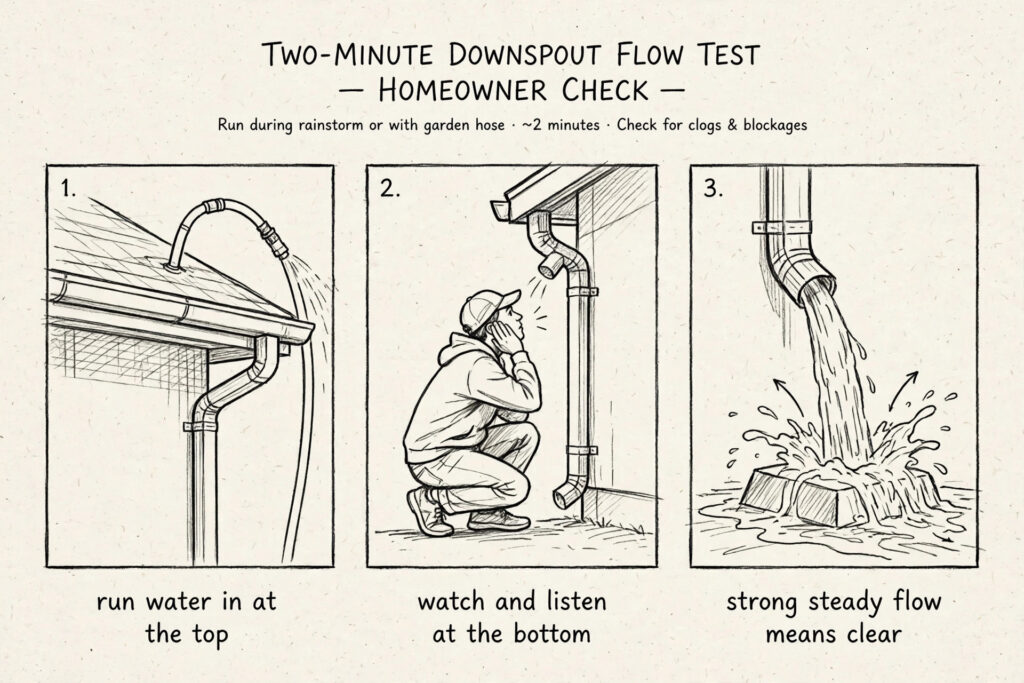
A downspout is probably clogged when no water comes out the bottom during rain, water shoots over the gutter edge near the outlet, or the pipe gurgles and drips from its seams. Run the flow test: a garden hose into the gutter outlet, watched at the bottom. Strong steady flow means clear, a trickle or nothing means a blockage. Debris collects at bends, so clogs form first at the gutter outlet, the top elbow, and the bottom elbow.
In this guide
- Where clogs actually form
- Seven signs your downspout is clogged
- What to check first: the two-minute diagnosis
- Aboveground clog or underground drain problem?
- How to unclog a downspout safely
- DIY or call someone
- Keeping it from happening again
- Frequently asked questions
- Sources
Where clogs actually form
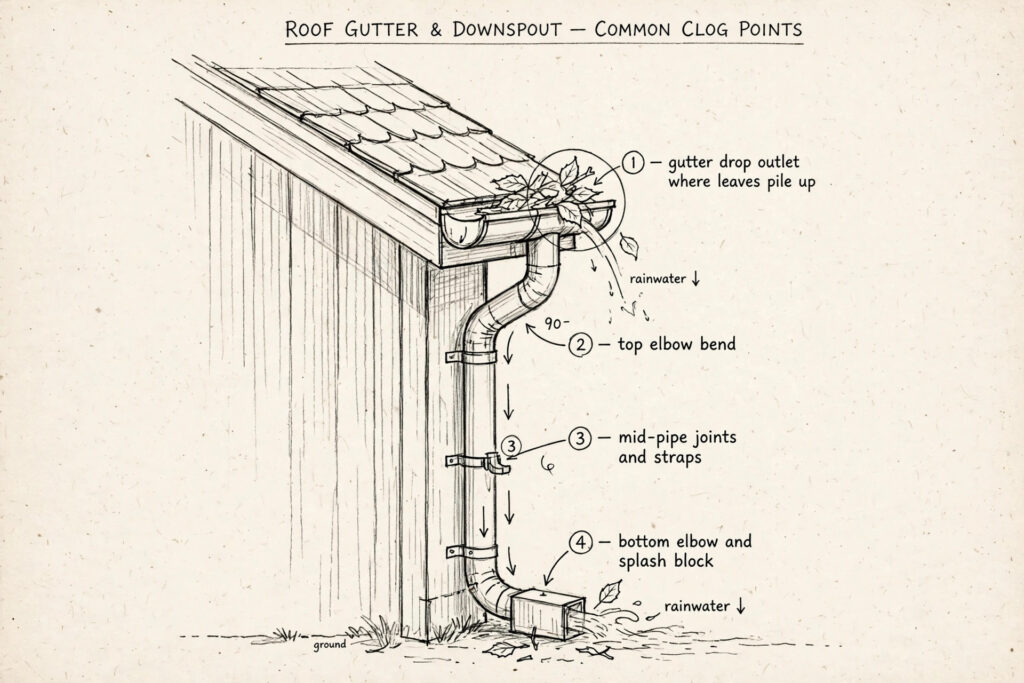
Clogs form where the pipe changes direction or narrows, never in a straight open run. The five spots to know are the gutter drop outlet, the top elbow just below it, the mid-pipe joints where sections overlap, the bottom elbow, and any underground drain line the downspout feeds into. Leaves mat down at the outlet, twigs and seed pods catch in the elbows, and grit settles in the bottom bend. Check these five spots in order, from the ground up, before you touch a ladder.
| Clog location | What collects there | How it announces itself |
|---|---|---|
| Gutter drop outlet | Wet leaves, pine needles, maple helicopters | Water backs up in the gutter and shoots over the edge at that corner |
| Top elbow | Twigs, seed pods, shingle grit | Gurgling or choking sounds; water drips from the elbow seams |
| Mid-pipe joints | Moss mats, sediment, stray leaves | A solid thud when you tap the pipe at that height |
| Bottom elbow | Mud, roof grit, compacted debris | Barely a trickle comes out during rain; leaks at the lower seams |
| Underground drain line | Silt, roots, crushed pipe sections | Downspout runs fine but water backs up at the base or never leaves |
That table is the whole diagnostic game. Match what you see to a row, and you know where to look first instead of dismantling the entire downspout.
Seven signs your downspout is clogged
A clogged downspout rarely stays quiet. Water is heavy and noisy, and when its path closes off, it finds louder ways out. Work through these seven signs during the next rain, and you will know not just whether you have a clog, but roughly where it sits.
No water comes out the bottom during rain
This is the single clearest sign, and it answers the question in one glance. During steady rain, a working downspout pours a strong stream onto the splash block or into the drain. If rain is falling and the bottom of the downspout stays dry or drips weakly, water is trapped somewhere above.
Note one exception before you worry. A very light drizzle may not push enough water down a long run to make the bottom flow hard, especially on a big roof with several downspouts splitting the load. Judge this sign during real rain, not a mist.
Water shoots over the gutter edge near the outlet
When the downspout cannot accept water, the gutter above it fills like a bathtub and the excess spills over the lowest or weakest point, usually right at the outlet corner. Watch for a waterfall effect at one specific corner while the rest of the gutter behaves normally. That local overflow points straight at the downspout below it.
This sign is easy to confuse with undersized gutters, which overflow along their whole length. If the spill is concentrated at one outlet, the pipe is the suspect, not the gutter. Our guide to why gutters overflow in heavy rain walks through that distinction in more detail.
The pipe gurgles, drips, or pops
A clear downspout sounds like a steady pour. A blocked one talks. You may hear gurgling as water forces its way past a partial clog, dripping that continues for an hour after the rain stops, or the occasional pop as air escapes around wet debris. Put your ear near the pipe at ground level during rain and listen.
The tap test works on the same idea. Tap the pipe lightly from the bottom upward with a knuckle or screwdriver handle. A hollow metallic clang means empty pipe. A dull thud means something is packed behind that point. Mark where the sound changes and you have found the neighborhood of the clog.
Water leaks out of the seams
Downspout elbows and joints are overlapped and crimped, not sealed like plumbing. They tolerate normal flow fine, but when a blockage below them builds pressure, water starts weeping or spraying from the seams. A leak at a seam is almost always a symptom of a clog sitting just below the leak, not a failure of the seam itself.
Check the elbow immediately below the leak first. Nine times out of ten the blockage is right there in the bend. Resealing the seam without clearing the clog just moves the pressure to the next weakest joint.
The gutter is full but the downspout stays dry
If you can see standing water in the gutter above the outlet, or water pooling in the trough long after rain has stopped, while the downspout below stays dry, the blockage is at the very top of the system. This usually means the drop outlet itself is sealed over by a mat of wet leaves, or an outlet strainer has caught so much debris that it has become the clog.
This is the easiest clog to clear and also the easiest to prevent. Scoop the mat off the outlet, check whether a strainer basket is packed, and the system usually springs back to life on the next rain.
Stains or streaks appear on the siding below the gutter
When water repeatedly takes the wrong path, it leaves evidence. Look for dark vertical streaks, green algae lines, or water stains on the siding or fascia directly below the gutter outlet. These marks mean overflow has been happening at that spot for a while, long enough for algae and dirt to build up.
Take this sign as a nudge toward urgency. A permanent stain line means the clog has been there for weeks or months, and the water has had time to work on the fascia behind it.
Debris or vegetation pokes out of the outlet
Sometimes the clog introduces itself. Seed pods, twigs, or even small plants growing from the gutter corner at the outlet mean the blockage has been sitting long enough to compost. Plants growing out of a downspout elbow are an unmistakable sign, and a sign you have waited a little too long.
Clear the visible growth first, then run the flow test below to confirm the whole pipe is actually open. Surface growth often hides a packed plug a few inches down.
What to check first: the two-minute diagnosis
Before you dismantle anything, run this sequence in order. It starts from the ground, needs no tools, and tells you where the clog is with surprising accuracy. The idea is simple: confirm the blockage, then narrow its location, then pick the fix that matches.
| What you see | Likely clog location | Check this first |
|---|---|---|
| No flow at the bottom during rain | Bottom elbow or underground line | Unclip the bottom elbow and look inside |
| Overflow at one gutter corner | Gutter drop outlet | Scoop the outlet mat off from the ladder |
| Gurgling or post-rain dripping | Top elbow or mid-pipe | Tap-test the pipe from the bottom up |
| Leaks at a seam | Clog just below that seam | Open the elbow below the leak |
| Stains on siding below outlet | Long-standing outlet clog | Check the outlet mat and strainer |
| Standing water in gutter, dry pipe | Drop outlet sealed by leaf mat | Clear the mat, then flow-test |
| Growth from the outlet | Packed plug at the outlet | Scoop, then flow-test to confirm |
Step 1: Watch a rainstorm. If rain is coming, that is your test equipment. Stand at the bottom of the downspout and watch. A healthy run pours steadily for the whole storm. A clogged one dribbles, stops and starts, or stays dry while the gutter above overflows. No rain in the forecast? Skip to step 3 and make your own.
Step 2: Tap the pipe from the bottom up. Tap lightly with a knuckle or a screwdriver handle, starting at the bottom elbow and working upward in foot-long steps. Empty pipe rings hollow. A packed blockage thuds. The spot where the sound changes is where your clog lives. This takes thirty seconds and keeps you off the ladder.
Step 3: Run the hose test. This is the definitive check, and it is the one West Virginia University Extension’s gutter safety guide recommends. Feed a garden hose into the gutter outlet and turn it on at full pressure, then watch the bottom of the downspout. If water is not freely flowing out of the spout, the guide says, a blockage is present. Keep spraying the hose directly down the spout at full pressure to push the obstruction through. If that does not release it, a plumber’s snake can knock the obstruction free.
Step 4: Check the bottom elbow first. If you only take apart one thing, make it the bottom elbow. Disconnect it from the straight run above, look inside both pieces, and scoop out whatever is packed in there. Most grit and sediment clogs live in that bend, and the elbow usually comes off with a couple of screws or a simple slip joint.
Watch: Erik Von Ancken walks through unclogging a downspout step by step in this Getting Results at Home segment, including the hose and wrench approach used above.
Aboveground clog or underground drain problem?
Some downspouts do not end at a splash block. They connect into a buried drain line that carries water away from the house. That distinction matters, because an underground line clog behaves differently and is mostly pro territory.
The downspout is probably blocked above ground if tapping finds a thud, the hose test stops flow inside the pipe, or clearing the bottom elbow fixes everything. The underground line is the suspect if the downspout itself runs clear in the hose test but water backs up at the base, drains painfully slowly out of the elbow, or the soil near the bottom stays soggy for days after rain.
| Test result | Aboveground clog | Underground line problem |
|---|---|---|
| Hose test flow | Stops inside the pipe | Runs clear through the pipe, then backs up at the base |
| Tap test | Thud somewhere in the pipe | Hollow all the way down |
| After clearing the elbow | Problem solved | Barely improves |
| Soil near the base | Normal | Soggy for days, sometimes with standing water |
| Your next move | Clear it yourself with the steps below | Call a drainage contractor |
Do not try to snake an underground line yourself with a garden hose at full blast. Buried lines can be crushed, root-filled, or disconnected at a joint, and pressure can make all three worse. This is the cleanest DIY-to-pro boundary in the whole downspout business.
How to unclog a downspout safely
Most aboveground downspout clogs clear from the ground or a low ladder. Work in this order, from least invasive to most: hose pressure from the top, a plumber’s snake from the bottom, then take the elbows apart. Start every job by asking whether you actually need the ladder, because many clogs give up before you climb anything.
Hose it from the top. With a helper steadying the ladder, aim the garden hose into the gutter outlet at full pressure and let it run for a minute or two. Wet leaf mats often break apart and wash straight through. When the flow at the bottom turns strong and steady, you have won.
Snake it from the bottom. If the hose alone does not do it, feed a plumber’s snake or a drain auger up through the bottom elbow and work it in and out. Short, firm strokes break up compacted debris better than one long shove. Run the hose again after snaking to flush the loosened material out.
Take the elbows apart. Elbows usually come off with a few sheet-metal screws or a simple slip fit. Start with the bottom elbow, then the top one. Scoop the packed debris out by hand with gloves, check the straight run between them with the snake, then reassemble. Take a phone photo before you remove anything so the pieces go back exactly as they came off.
Stay on the ladder, off the roof. This is the safety line that matters. West Virginia University Extension’s gutter safety guide is blunt about it: never crawl out onto a roof, it says, because that is considered extremely dangerous. Use a sturdy ladder on level, flat ground, wear heavy gloves and safety glasses, and never work in rain, ice, or any weather where precipitation is possible.
If you do need an extension ladder to reach the gutter, follow the basics from OSHA’s portable ladder safety quick card. Extend the ladder three feet above the support point, set the base out one quarter of the ladder’s working length from the wall, keep three points of contact at all times, and never stand on the top three rungs. Have someone hold the ladder for you, inspect it for damage before you climb, and keep an eye out for overhead power lines.
Two things to avoid. Do not blast a pressure washer into the downspout, since the concentrated pressure can blow apart crimped seams and straps. And skip chemical drain cleaners, which can corrode metal downspouts and do nothing useful against a packed ball of wet leaves. Water pressure, a snake, and your hands are the right tools.
DIY or call someone
Clear it yourself when the clog is above ground, you can reach it safely, and the pipes and brackets are intact. The hose test, the snake, and removing an elbow are all comfortable weekend jobs with basic care.
Call a pro when the clog is in the underground line, the blockage sits above a comfortable ladder reach, the gutter is pulling away from the fascia at the downspout, or water has already found its way into the basement or crawl space. Those are different jobs: buried-line jetting, gutter rehanging, and water-intrusion repair. Knowing which job you have is the skill; this guide just gave it to you.
Keeping it from happening again
A cleared downspout will clog again if nothing changes. These are the moves that actually hold.
Fit an outlet strainer. A simple mesh or wire basket that drops into the gutter outlet costs a few dollars and catches leaves before they enter the pipe. Pull it out and shake it off twice a year, which takes less time than clearing one real clog.
Clean on schedule. West Virginia University Extension recommends cleaning gutters at least twice a year, and homes exposed to severe storms need more. Our guide to how often gutters should be cleaned helps you find your own number based on your trees and climate.
Cut back the branches. Anything overhanging the roof is a debris factory aimed at your gutters. Trimming back gives you the biggest reduction in cleaning frequency of any single move.
Move the discharge point. A downspout that dumps at the foundation will always be a suspect in water problems. The U.S. EPA’s Soak Up the Rain program suggests redirecting downspout water onto lawn or garden areas where it can soak in, which also reduces runoff. Our downspout distance guide covers how far from the house is far enough. If the discharge point keeps creating a puddle even after the fix, read why water pools at the end of a downspout to diagnose the cause.
Consider guards, but clean first. Gutter guards reduce how much debris reaches the outlet, but they are not maintenance-free, and no guard should go on a dirty system. AmeriMax’s gutter guard installation instructions start with one demand: thoroughly clean the gutter and downspout of any debris before beginning installation. We will cover whether guards are worth it in a dedicated guide soon.
Frequently asked questions
Yes, over time. When a downspout cannot drain, water overflows the gutter and dumps next to the foundation with every storm. Repeated soaking erodes soil, stains foundation walls, and can feed basement moisture. A single clogged downspout will not crack a foundation overnight, but a season of ignored overflow can start the kind of damage that gets expensive. Extending the discharge point away from the house, as our downspout distance guide explains, is the cheapest insurance.
Run the hose test from the gutter outlet. If water stops inside the pipe or the tap test finds a thud, the clog is in the downspout. If the pipe runs clear but water backs up at the base or drains very slowly out of the bottom elbow, the problem is in the buried line below. Soggy soil near the base for days after rain is another underground clue.
Because pressure from a blockage below is forcing water out through the crimped joints, which are overlapped rather than sealed. A seam leak is a symptom, not the disease. Look for the clog in the elbow or pipe section directly below the leak, clear it, and the seam usually goes back to being watertight on its own.
Gurgling while water forces past a partial blockage, dripping that continues long after the rain stops, and occasional popping as trapped air escapes. A clear downspout is comparatively boring: a steady pour during rain, then silence. Sounds are a useful early warning, before the overflow starts.
Often, yes. The tap test, the rain observation, and unclipping the bottom elbow all happen at ground level, and the bottom elbow alone resolves a large share of clogs. You need the ladder only when the blockage sits at the gutter outlet or the top elbow.
They reduce them but do not eliminate them. Guards keep most leaves out of the trough, so less debris reaches the outlet, but needles, seed pods, and roof grit still get through. Keep inspecting the outlets, and always start with a clean system before guards go on.
If the trough is clear and the downspouts test open, the system may be undersized or under-sloped for the roof it serves, or there may not be enough downspouts for a heavy storm. Our guide to why gutters overflow in heavy rain walks through the capacity side of that problem.
Sources
- West Virginia University Extension’s guide to gutter safety, including the downspout blockage test and twice-a-year cleaning recommendation
- OSHA’s portable ladder safety quick card (hosted on eLCOSH), for ladder setup and climbing rules
- The U.S. EPA’s Soak Up the Rain program, on redirecting downspout water to lawn and garden areas
- Penn State Extension’s guidance on reducing water pollution, on disconnecting downspouts from sanitary sewers and redirecting roof runoff away from the home
- AmeriMax’s gutter guard installation instructions (PDF), on cleaning gutters and downspouts before guard installation

4 Comments
Pingback: How Often Should Gutters Be Cleaned? (Full Schedule)
Pingback: Fall Exterior Home Maintenance Checklist: 35 Tasks Before Winter
Pingback: Water Dripping Behind Your Gutter? Causes and Fixes
Pingback: Water Pooling at Downspout: 7 Causes & How to Diagnose