


Gutter maintenance means clearing leaves and debris from your gutters at least twice a year, typically in spring and fall, and inspecting the full system for clogs, leaks, sagging, and downspout problems. Most single-story homes can handle this as a DIY job with a stable ladder and basic safety precautions, but two-story homes, steep roofs, and any sign of structural damage are jobs for a professional.
Last updated: November 26, 2026
Contents
- Why Your Gutters Deserve a Maintenance Plan
- Know the Parts Before You Maintain Them
- The Decision-Based Maintenance Calendar
- Read the Symptoms: What Your Gutters Are Telling You
- The Rainy-Day Inspection: Check Your Gutters Without a Ladder
- How to Clean Your Gutters Safely, Step by Step
- DIY or Call a Professional? Use These Boundaries
- Don’t Forget the Downspouts: They’re Half the System
- Gutter Guards: An Honest Assessment
- Frequently Asked Questions
- Sources
Why Your Gutters Deserve a Maintenance Plan
Your gutters have one job: collect rainwater from your roof and move it safely away from your house. When they do it well, you never think about them. When they don’t, water ends up where it causes the most expensive damage: against your foundation, under your shingles, and inside your walls.
The volume of water involved is easy to underestimate. University of Minnesota Extension notes that a single inch of rain drops roughly 1,250 gallons of water on the roof of a 2,000-square-foot house. Without working gutters and downspouts, a meaningful share of that water can end up flowing toward your foundation instead of away from it. The same source identifies defective or missing gutters and downspouts as a common cause of basement moisture problems, and adds that a great number of those problems can be solved simply by handling rainwater properly.
The EPA’s moisture-control guidance frames this as a first principle: controlling liquid water is the foundation of keeping a building dry. Gutters are one of the most visible, most maintainable parts of that system, which makes them one of the highest-return maintenance tasks a homeowner can do.
Know the Parts Before You Maintain Them
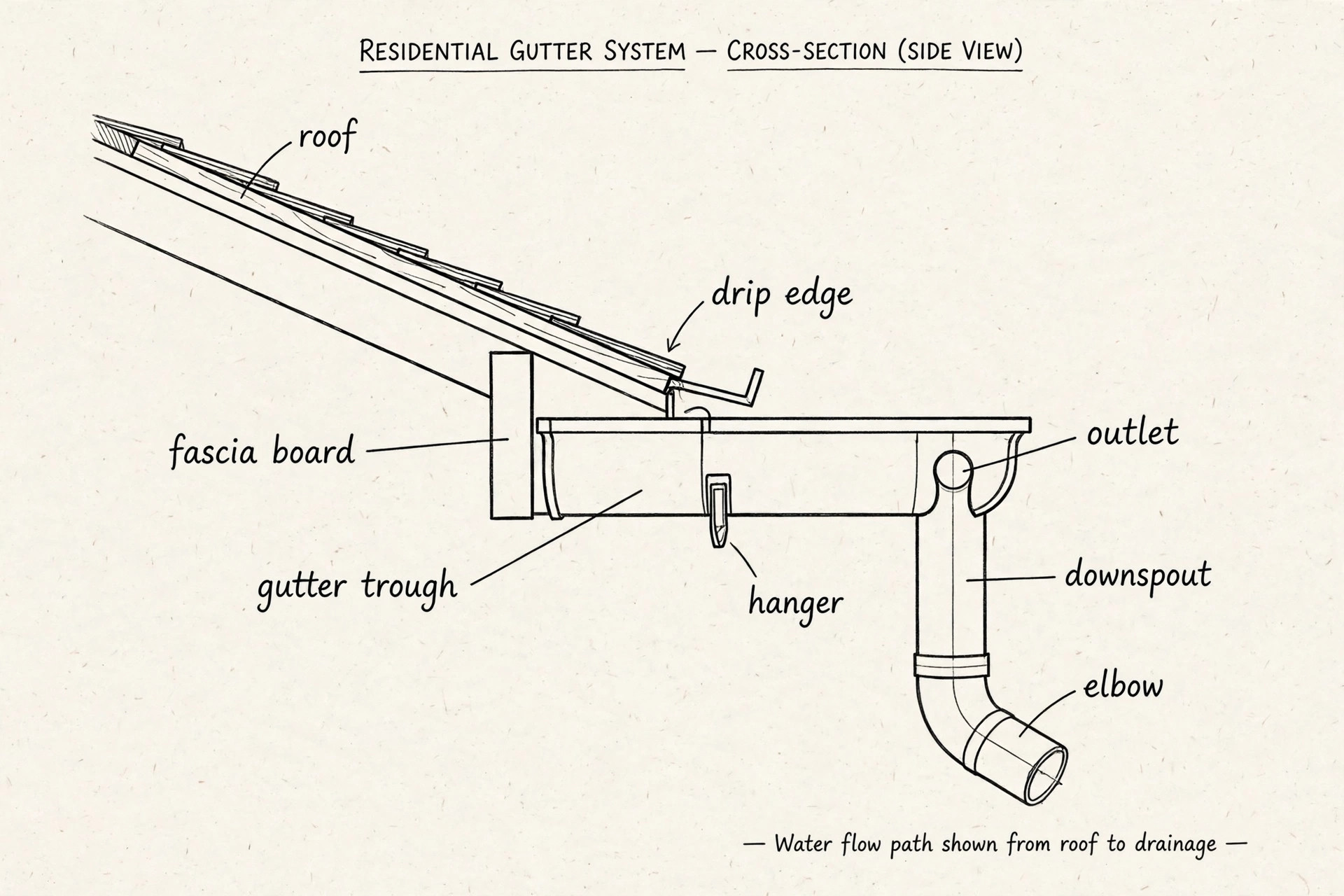
Six parts make up the system: gutters catch runoff at the roof edge, downspouts carry it to the ground, fascia and soffit frame the edge, hangers hold the trough, and elbows and extensions direct water away from the foundation. Knowing the names makes every diagnosis below faster.
Gutter guides throw around component names without explaining them. Here’s the short version, because you’ll need these terms to diagnose problems:
- Gutters (troughs): The horizontal channels along your roof edge that catch runoff.
- Downspouts (leaders): The vertical pipes that carry water from the gutters to the ground.
- Fascia: The flat board along the roof edge that gutters are attached to. If your fascia is rotting, your gutters have nothing solid to hang from.
- Soffit: The underside of the roof overhang. Water stains here often point to gutter overflow above.
- Hangers/brackets: The hardware holding the trough to the fascia. Loose hangers cause sagging.
- Elbows and extensions: The angled fittings at the bottom of downspouts that direct water away from the foundation.
The Decision-Based Maintenance Calendar
The standard advice, clean in spring and fall, is a fine starting point, but it’s incomplete. The right schedule depends on what’s dropping into your gutters and how often storms test the system. Use this calendar as your base, then adjust with the frequency table below it.
Seasonal gutter maintenance calendar
| Season | What to do | Why it matters now |
|---|---|---|
| Spring | Full clean-out and inspection. Clear winter debris, check for ice or wind damage, test water flow with a hose, and confirm downspouts discharge away from the foundation. | Winter is hard on gutters. Spring is when you find out what it did. |
| Summer | Light inspection, especially after major storms. Look for overflow marks on siding, new sagging, and debris washed in by wind. Trim back branches hanging over the roofline. | Summer storms arrive fast and dump hard; a partially clogged gutter fails exactly when you need it most. |
| Fall | The year’s most important cleaning: after most leaves have dropped, not before. Inspect hangers and seams, and make sure downspouts are clear before freeze season. | Wet, compacted leaves left over winter turn into a dense blockage and add serious weight to the system. |
| Winter | No ladder work. Observe from the ground during thaws: look for icicle patterns that suggest trapped water, and check for new sagging after heavy snow. | This is a monitoring season, not a repair season. Note what you see and act in spring. |
Gutters are only one part of getting a house ready for winter — our fall exterior home maintenance checklist walks through the full pre-freeze routine for the roof, siding, deck, and driveway too.
How often should your gutters be cleaned? Decide with this table
| Your situation | Recommended cleaning frequency |
|---|---|
| Few or no trees near the house, simple roofline | Twice a year (spring + late fall) |
| Mature deciduous trees overhanging or near the roof | 3-4 times a year (add a mid-summer and mid-fall check) |
| Pine or evergreen trees nearby | 3-4 times a year. Needles mat down, slip into downspouts, and resist flushing |
| Frequent severe storms or high winds | Twice a year minimum, plus an inspection after every major storm |
| Gutter guards installed | Inspect twice a year anyway; clear the guards and check for fine debris underneath |
The practical rule behind the table: clean on a schedule, then adjust based on what you find. If every inspection reveals only a light layer of debris, twice a year is enough. If you’re regularly pulling out packed material or seeing slow drainage, shorten the interval before a backup causes damage.
Read the Symptoms: What Your Gutters Are Telling You
Most gutter problems announce themselves before they cause damage. Water spilling over the edge points to a clog, drips behind the trough point to a failed seal, and a sagging section points to loose hangers. Match what you see to the likely cause, then take the safe first check.
Most homeowners notice a gutter problem long before they understand it. This table connects what you can see to what it likely means, what you can safely check yourself, and what the right next step is.
| What you notice | Likely cause | Safe first check (from the ground or a stable ladder) | Next step |
|---|---|---|---|
| Water spilling over the gutter edge during rain | Clogged trough or blocked downspout outlet | Watch during the next rain: is water coming out of every downspout? | Clean the trough; if the downspout stays dry, clear it from the top with a hose or a plumber’s snake. |
| Water dripping behind the gutter, down the siding | Deteriorated seal where gutter meets fascia, or water overshooting a misaligned trough | Look for staining on the siding and gaps between gutter and fascia | Reseal or realign; if the fascia board is soft or rotted, call a professional. |
| A section visibly sagging or pulling away | Loose or failed hangers, or excessive debris weight | Sight along the gutter line from the ground. Sags show clearly in profile | Tighten or replace hangers; if a long section has detached, get professional help rather than rehanging it yourself. |
| Standing water visible in the trough after rain | Lost slope (pitch) or a low spot from shifting hangers | After rain, look for water sitting instead of draining | Minor hanger adjustment is DIY-able; re-pitching a full run usually isn’t. |
| Granules collecting in the gutter | Asphalt shingles shedding surface granules as they age | Scoop a small sample during cleaning and look at its texture | The EPA’s roof maintenance checklist flags granule buildup as a possible sign of worn shingles. Worth a roof inspection, not just a gutter cleaning. |
| Plants or moss growing in the trough | Long-standing trapped debris holding moisture | Visible from the ground in most cases | Clean thoroughly; recurring growth means the cleaning interval is too long. |
| Rust spots, pinholes, or orange streaks | Corrosion, often at seams or where paint has failed | Check during your spring cleaning when the trough is empty | Small holes can be patched with gutter sealant; widespread corrosion means replacement is coming. |
| Downspout dumping water right at the foundation | Missing or too-short extension | Walk the perimeter after rain and note where each downspout releases | Add extensions so water releases well away from the house (see the downspout section below). |
The Rainy-Day Inspection: Check Your Gutters Without a Ladder
The most revealing gutter inspection happens during heavy rain, with both feet on the ground. Walk the perimeter and watch four things: water leaving every downspout, overflow points, drips behind the gutter, and pooling at the foundation. Ten minutes of notes beats an hour of guessing from a ladder.
Here’s the step competitors skip: walk your home’s perimeter while it’s raining hard and look up. You’re watching for four things:
- Water coming out of every downspout. A downspout that’s dry while its gutter overflows is telling you exactly where the blockage is.
- Overflow points. Note where water sheets over the edge. That’s your cleaning priority list.
- Drips behind the gutter. Water running down the siding behind the trough means the seal at the fascia has failed.
- Pooling at the foundation. Watch where downspout discharge lands and whether it flows toward or away from the house.
Take notes or photos. This ten-minute walk tells you more about your system than an hour of guessing from the top of a ladder, and it carries zero fall risk.
How to Clean Your Gutters Safely, Step by Step
Clean gutters from a stable ladder with gloves, safety glasses, a bucket, and a scoop: set the ladder correctly, scoop from the low end near the downspout, flush toward the outlet, clear the downspout, then inspect the empty trough for loose hangers, open seams, rust, and granule buildup.
This method follows university extension guidance (West Virginia University Extension’s gutter safety guide, specifically) and works for standard sectional gutters. What you’ll need: A sturdy extension or step ladder, heavy work gloves, safety glasses, a bucket, a garden trowel or gutter scoop, and a garden hose with a pistol-grip or adjustable nozzle. If you want the full comparison before you buy, our guide to rain gutter cleaning tools covers every scoop, wand, vacuum kit and ladder setup, and which kit fits your house.
Clean standard sectional gutters from a stable ladder: set the ladder correctly, scoop debris from the low end, flush toward the downspout, clear the downspout, and inspect the empty trough.
- Set the ladder right
Place it on firm, level ground. For an extension ladder, use the 4-to-1 rule: for every 4 feet of height, the base sits 1 foot out from the wall. Extend the side rails at least 3 feet above the roof edge, and have another person steady the base.
- Never rest the ladder against the gutter itself
Gutters are not structural; leaning on them dents the trough and can pull it from the fascia. Lean on the wall or roof edge instead, or use a ladder stabilizer that spans the gutter.
- Scoop from the low end
Start near the downspout outlet and work away from it, scooping loose debris into your bucket. Go back over encrusted patches and scrape them loose.
- Flush toward the outlet
Spray water toward the downspout opening, working away from your body. Watch the downspout exit: free flow means the pipe is clear; a trickle or backup means a blockage.
- Clear the downspout
Spray the hose directly down the spout at full pressure. If that does not free it, feed a plumber’s snake down from the top to break up the clog.
- Inspect while it is empty
With the debris gone, check for loose hangers, open seams, rust, and granule buildup. Tighten what you can; note what you cannot.
- Set the ladder right. Place it on firm, level ground. For an extension ladder, use the 4-to-1 rule: for every 4 feet of height, the base sits 1 foot out from the wall (OSHA’s ladder standard, 29 CFR 1926.1053, specifies this angle for non-self-supporting ladders). Extend the side rails at least 3 feet above the roof edge so you have something to hold when stepping on or off. Have another person steady the base. The Consumer Product Safety Commission specifically recommends a spotter for ladder work like gutter cleaning.
- Never rest the ladder against the gutter itself. The EPA’s building maintenance guidance explicitly warns against this. Gutters aren’t structural, and leaning on them dents the trough and can pull it from the fascia. Lean on the wall or roof edge instead, or use a ladder stabilizer that spans the gutter.
- Scoop from the low end. Start near the downspout outlet (the low end of the run) and work away from it, scooping loose debris into your bucket. Go back over encrusted patches and scrape them loose.
- Flush toward the outlet. With the hose, spray water toward the downspout opening, working away from your body. Watch the downspout exit: if water flows freely, the pipe is clear. If it trickles or backs up, there’s a blockage.
- Clear the downspout. Spray the hose directly down the spout at full pressure. If that doesn’t free it, a plumber’s snake fed down from the top will usually break up the clog.
- Inspect while it’s empty. With debris gone, check for loose hangers, open seams, rust, and granule buildup. Tighten what you can; note what you can’t.
Safety rules that aren’t optional
- Never work on a ladder during storms, in rain, or when ice is possible. Wet rungs and gusty wind turn a routine job dangerous.
- Keep the ladder away from power lines. Use a fiberglass ladder (non-conductive) if any electrical lines are near the work area.
- Stay on the ladder and off the roof. The National Roofing Contractors Association’s homeowner guidance is explicit: keep roof work to inspection from a firmly braced ladder, and don’t walk the roof.
- Wear gloves and eye protection. Gutters hide sharp screws, metal edges, and decomposing debris you don’t want in your eyes or hands.
- Don’t overreach. Move the ladder instead of leaning sideways. Reaching is how balance gets lost on a ladder.
DIY or Call a Professional? Use These Boundaries
Routine single-story cleaning with easy ladder access is DIY work. Two-story homes, steep rooflines, sagging or detached runs, rotted fascia, nearby power lines, and any water inside the house are pro territory. Use the boundaries below before you climb, not after something goes wrong.
This is where most guides wave their hands. Here’s a concrete decision table instead.
| Situation | DIY or pro? |
|---|---|
| Single-story home, easy ladder access, routine cleaning | DIY, with the safety steps above |
| Two-story home or high eaves | Pro recommended. Fall consequences rise sharply with height, and most homeowners lack the right ladder |
| Steep roofline above the work area | Pro: if a slip would put you on a steep slope, don’t climb |
| Sagging sections, detached runs, widespread leaks | Pro. Rehanging and resealing full runs needs proper pitch and fasteners |
| Soft, rotted, or visibly damaged fascia behind the gutter | Pro: this is now a carpentry repair, not a cleaning job |
| Electrical lines near the gutter line | Pro, or at minimum a fiberglass ladder and extreme caution. When in doubt, hire it out |
| Any sign of water inside the house (ceiling stains, basement moisture) | Pro assessment. The gutter may be a symptom of a larger drainage problem |
| You’re uncomfortable at height for any reason | Pro. Discomfort causes rushing, and rushing causes falls. No shame in it. |
If you hire this out, knowing what shapes a gutter cleaning quote helps you compare estimates fairly. Here are the main cost factors.
For the price ranges themselves, see what gutter cleaning costs.
Don’t Forget the Downspouts: They’re Half the System
A spotless gutter with a clogged or misdirected downspout still fails, because the downspout is half the system. Confirm water flows freely from every downspout, release it well away from the foundation, and check that long roof runs have enough downspouts to handle heavy rain.
Downspouts deserve their own attention: For a dedicated walkthrough of downspout tools, methods and safety, see our guide on how to clean downspouts.
- Keep them clear. During every cleaning, confirm water flows freely out of each downspout. A dry downspout during rain means a blockage between the trough and the ground.
- Release water away from the foundation. University of Minnesota Extension recommends downspout extensions that discharge water at least 4 feet beyond the house wall. North Carolina State’s healthy-homes guidance goes further: it prefers downspout-to-underground-drainpipe systems that release water at least 10 feet downhill from the house, and notes that simple splash blocks release water too close to the home to be reliable. Treat 4 feet as the minimum and 10+ feet as the goal, especially if you’ve had basement moisture.
- Size the system to the roof. Minnesota Extension suggests a minimum of one downspout per 50 linear feet of roof eave. If your home has long gutter runs with a single downspout, overflow during heavy rain may be a capacity problem, not a clog. For the full diagnosis, see why gutters overflow in heavy rain. Use our gutter size calculator to check if your gutters match your roof area.
Much of what clogs a gutter starts on the roof, so our complete roof cleaning guide is worth reading before you blame the gutters alone.
Gutter Guards: An Honest Assessment
Gutter guards reduce how much large debris enters the trough, which can stretch the interval between full cleanings under heavy tree cover. They are not maintenance-free: fine debris and roof grit still get through, and the guards themselves need periodic clearing and inspection to keep working.
What guards actually do is narrow the problem, not end it. Leaves and twigs are the debris that fills a trough fastest, and a guard that keeps most of that material out means each cleaning removes less. What still gets through is the fine fraction: roof grit, seed pods, and the small debris that mats into sludge at the low end of the run. That is why the cleaning interval stretches instead of disappearing, and why the downspout outlet still needs checking on the same schedule as before.
The maintenance also changes shape. Debris that would have landed in the trough now sits on top of the guard, where it can hold moisture against the roof edge and block water from entering during heavy rain. So the job becomes clearing the guard surface and confirming water still enters the trough, plus the same inspection you would do anyway: hangers, seams, and the fascia line behind the gutter. A guard installed over a sagging run or a soft fascia board hides the problem instead of fixing it, so those repairs come first.
Guards earn their keep in a narrow set of situations: heavy leaf fall from overhanging trees, a long run that clogs between scheduled cleanings, or a two-story eave where every cleaning is a ladder job you would rather do less often. They make less sense where the debris is mostly fine material, where the roof sheds heavy grit, or where you cannot safely reach the eave to clear the guard surface. Weigh the installed cost against what you would pay for professional cleanings over the same years, and read our full breakdown of whether gutter guards are worth it before you decide.
Frequently Asked Questions
At least twice a year, once in spring and once in late fall, according to both roofing trade guidance and university extension services. Add extra cleanings if you have overhanging trees, pine needles nearby, or frequent severe storms, and inspect after every major wind event.
Single-story homes with easy ladder access are reasonable DIY jobs if you follow ladder safety basics: stable 4-to-1 ladder angle, a spotter, and no work in wet or icy conditions. Hire a professional for two-story homes, steep roofs, or any structural damage.
Water overflowing during rain, plants growing in the trough, visible sagging, peeling paint or water stains on siding below the gutter line, and pooling water near the foundation after storms. Any of these means the system isn’t moving water where it should.
Both. Downspouts clog just like gutters, and a blocked downspout makes a clean gutter useless. Every cleaning should include a flow test: run water through and confirm it exits freely at the bottom, discharging at least 4 feet from the foundation.
No. Guards cut down on large debris and can extend the time between cleanings, but fine material still accumulates and the system still needs inspection. Think of guards as reducing maintenance, not eliminating it.
Clogged or failing gutters send roof runoff toward your foundation instead of away from it, contributing to basement moisture, soil erosion, fascia rot, and siding damage. University extension research ties a large share of basement water problems directly to mishandled roof runoff.
This guide was prepared by the Home Exterior Lab Editorial Team as a research summary, not a substitute for professional assessment. If you see signs of structural damage, active water intrusion, or anything you’re unsure about, get a qualified local professional to look at it in person.
Sources
Only sources actually opened and used to support claims in this article are listed. All URLs were verified live on 2026-10-01.
- U.S. EPA, Moisture Control Guidance for Building Design, Construction and Maintenance (EPA 402-F-13053, December 2013). Covers the roof/gutter inspection checklist (“check gutters and downspouts for loose or missing fasteners, loose joints, corrosion and debris”; “do not rest ladders against gutters”; shingle granules in gutters as a wear signal); moisture control principle #1 (control liquid water). https://www.epa.gov/sites/default/files/2014-08/documents/moisture-control.pdf
- National Roofing Contractors Association (NRCA), Roofing Resources. Notes biannual roof inspections; homeowner maintenance confined to fall/spring inspection and cleaning gutters of debris; ladder guidance (firmly braced or tied-off ladder, rubber safety feet, rubber-soled shoes, stay on the ladder and off the roof). https://www.nrca.net/roofing-guidelines/resources
- University of Minnesota Extension, “Moisture in basements: causes and solutions”. States that 1-inch rain ≈ 1,250 gallons on a 2,000 sq ft roof; defective/missing gutters and downspouts as a cause of basement moisture; one downspout per 50 linear feet of eave; extensions discharging at least 4 feet beyond the wall; grading 1 inch per foot for 6 feet. https://extension.umn.edu/garden-and-home/home-maintenance/caring-for-a-home/moisture-in-basements-causes-and-solutions
- U.S. OSHA, 29 CFR 1926.1053 (Ladders): 4-to-1 angle for non-self-supporting ladders (§1926.1053(b)(5)(i)); side rails extending at least 3 feet above the upper landing (§1926.1053(b)(1)); use only on stable, level surfaces; defective ladders withdrawn from service. https://www.osha.gov/laws-regs/regulations/standardnumber/1926/1926.1053
- U.S. Consumer Product Safety Commission (CPSC), “Consumers Should Spring into Safety with the New Normal” (2021). Gives ladder guidance for DIY projects including gutter cleaning: feet on solid, level ground; another adult on site as a spotter; keep ladders away from power lines. https://www.cpsc.gov/Newsroom/News-Releases/2021/Consumers-Should-Spring-into-Safety-with-the-New-Normal
- West Virginia University Extension Service, “Gutter Safety” (Wayne Lundstrom & Mark Fullen). Describes the gutter cleaning method (scoop from low end near outlet, flush toward outlet, plumber’s snake for stubborn clogs); heavy gloves and safety glasses; sturdy ladder on level surface; never crawl onto a roof; never work in storms or when ice/precipitation is possible; clean at least twice a year. https://extension.wvu.edu/community-business-safety/home-safety/gutter-safety
- NC State Extension, Healthy Homes: “Moisture Control and Prevention: Gutter Management”. Recommends gutters cleaned, inspected, and repaired regularly; downspout-to-drainpipe systems preferred; splash blocks release water too close to the home; underground discharge at least 10 feet downhill away from the house. https://healthyhomes.ces.ncsu.edu/documents/271440/Moisture-Control-and-Prevention-Gutter-Management.pdf

4 Comments
Pingback: How Much to Clean Gutters: 2026 Prices by Story & Foot
Pingback: Rain Gutter Cleaning Tools: What to Buy & What to Skip
Pingback: How Much Does Gutter Cleaning Cost? 2026 Average Prices
Pingback: How to Redirect Water Runoff: 5 Ways That Work