
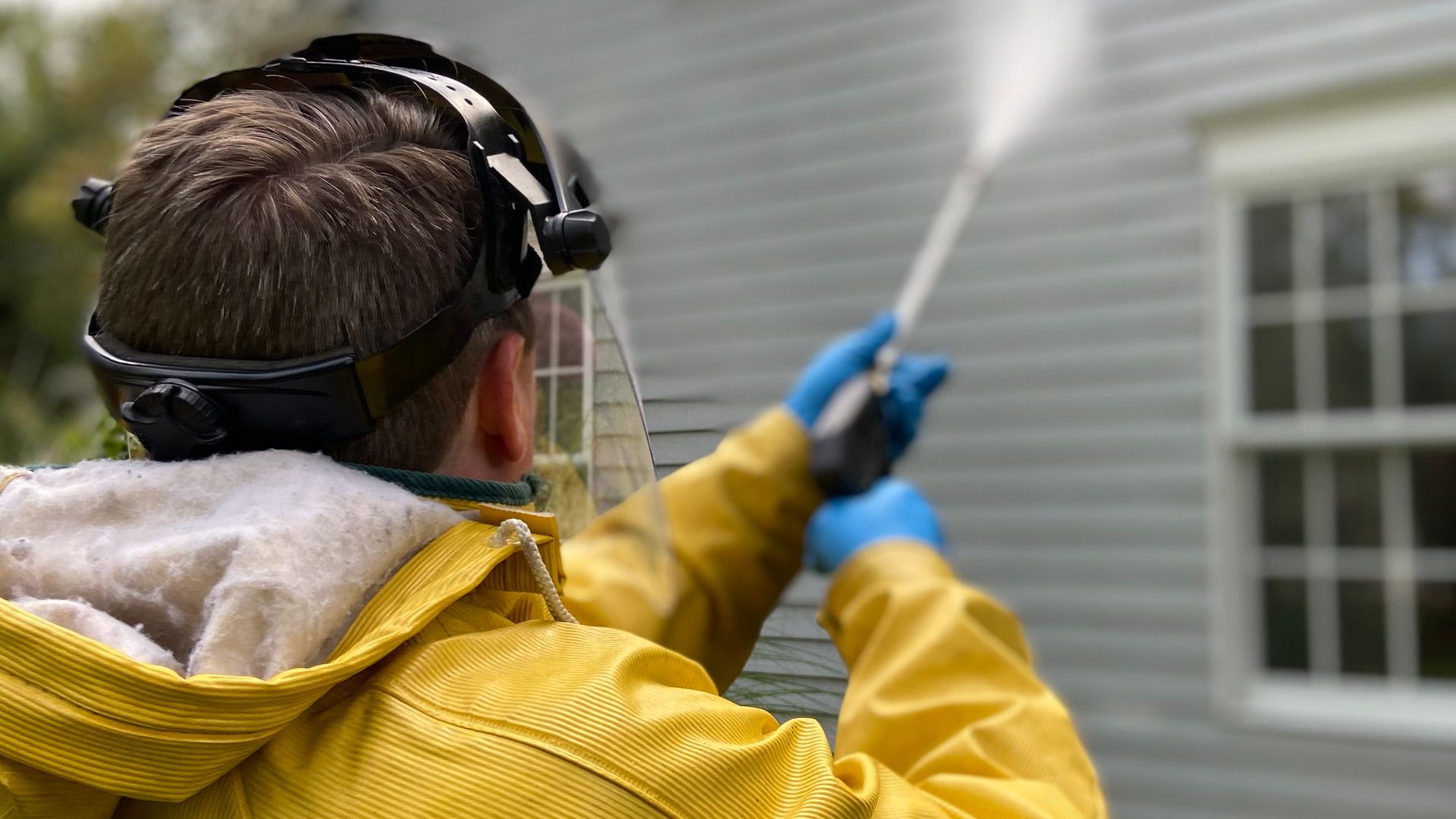
A pressure washing company cleans exterior surfaces with high-pressure water, sometimes with detergents mixed in. A soft-washing company does the same job at low pressure, more like a garden hose, and lets cleaning solutions do the heavy lifting. Both exist because algae, mildew, and grime do not rinse off a house with rain alone. Knowing which type of company you are hiring, and how to tell a good one from a bad one, is the whole point of the questions below.
If you are still deciding which parts of your home even need attention, start with our surface-by-surface exterior cleaning guide, then come back here to vet the companies. Hiring the right crew is a separate skill from knowing what needs washing.
The short version: a trustworthy pressure washing company carries insurance and proves it, explains which surfaces get soft wash and which get pressure, controls its runoff, and puts the full scope in writing. The nine questions below are designed to expose the opposite: uninsured operators, pressure-only thinking, vague processes, and quotes built on guesswork. Ask all nine on the phone before anyone touches your house.
Contents
- Why your questions matter more in this trade than most
- The nine warning signs, and the question that exposes each
- 1. They can’t show you proof of insurance
- 2. “We just blast everything”: the pressure-only mindset
- 3. They can’t describe their process in plain words
- 4. They have no answer for where the wash water goes
- 5. The quote arrives without anyone seeing your property
- 6. Nothing goes in writing
- 7. No plan for your plants, pets, or fixtures
- 8. No proof they’ve done this before
- 9. High-pressure sales tactics or cash-only terms
- The green-flag scorecard
- What a strong contractor sounds like on the phone
- What quotes actually tell you
- Should you just rent a machine and do it yourself?
- Before the crew arrives: a 10-minute prep list
- Frequently asked questions
- Sources
Why your questions matter more in this trade than most
Pressure washing looks simple, and that is exactly the problem. A machine costs a few hundred dollars at a hardware store, so the trade attracts more fly-by-night operators than most home services. A bad wash can strip paint, etch concrete, force water behind your siding, kill a flower bed, and leave you holding the bill if a worker gets hurt on your property. Asking sharp questions before you book is the cheapest insurance you can buy.
There is no national license for pressure washing, and only a handful of states license it as a distinct trade, so your questions are doing the filtering that a licensing board would do elsewhere. The industry does have a professional backbone: the Power Washers of North America, a nonprofit trade association founded in 1992, sets training and compliance standards for contractors and keeps a public directory of member companies that have agreed to its code of ethics. A company that knows what the PWNA is, and can speak to safety and compliance, is already ahead of the guy with a rented machine and a flyer.
The nine warning signs, and the question that exposes each
1. They can’t show you proof of insurance
Ask: “Can you send me a current certificate of insurance?”
A legitimate pressure washing company carries general liability insurance and workers’ compensation, and it will gladly prove it. If a company stalls, makes excuses, or tells you insurance is not really necessary for this kind of work, that is the single biggest red flag in this guide. Without coverage, damage to your home or an injury to a worker on your property can turn into your problem, not theirs.
A good answer sounds like this: “Of course. I’ll have our agent email you the certificate today.” They name their coverage types without hesitation and they do not act offended that you asked. Ask for the certificate to come from their insurance agent, not as a photocopy they made themselves, and check that the dates are current. This is the one question where hesitation is an automatic disqualifier. There is no good reason a real company cannot produce this paper.
Why it matters beyond the obvious: pressure washing crews work on ladders, handle chemicals, and run equipment at thousands of pounds per square inch of pressure. The PWNA’s compliance guidance for contractors points to OSHA workplace safety standards, EPA environmental rules, and DOT transport rules as the three regulatory areas every legitimate operator has to respect. A company that will not show you insurance is a company that is not thinking about any of that.
2. “We just blast everything”: the pressure-only mindset
Ask: “Which of my surfaces will you soft wash, and which will you pressure wash?”
Any company that plans to use high pressure on everything is telling you it does not understand surfaces. Vinyl siding, stucco, painted wood, and asphalt shingle roofs should be soft washed, meaning low-pressure water plus detergents that kill the growth at its root. Real pressure belongs on hard surfaces like concrete driveways, pavers, and walkways. A professional names the method for each surface without being prompted.
A good answer sounds like this: “We’ll soft wash the siding and the gutters, use low pressure with a surface cleaner on the driveway, and hand-clean around the windows.” That is a plan. Compare that with “we’ll hit the whole thing with the 4,000 PSI,” which is a confession. I have seen rental-machine specials turn a routine house wash into a siding repair, and it always starts with this exact misunderstanding.
If you want the full breakdown of which method suits which material, our soft washing vs. pressure washing guide walks through every common surface.
3. They can’t describe their process in plain words
Ask: “Walk me through exactly what you’ll do at my house, step by step.”
A professional can narrate the job the way a cook can narrate a recipe: pre-wet the landscaping, apply the detergent, let it dwell, rinse at low pressure, post-treat the stubborn growth, do a final walkthrough with you. Vague answers like “we’ll spray it down real good” or “we use the good stuff” signal someone who is winging it, and winging it is how siding gets zebra-striped and shrubs get burned.
Listen for one word in particular: dwell. The cleaning solution needs time sitting on the surface to kill algae and mildew, usually several minutes, and a company that cannot name its dwell time does not really have a process. It has a hose. There is a difference.
4. They have no answer for where the wash water goes
Ask: “Where does the runoff go during the job?”
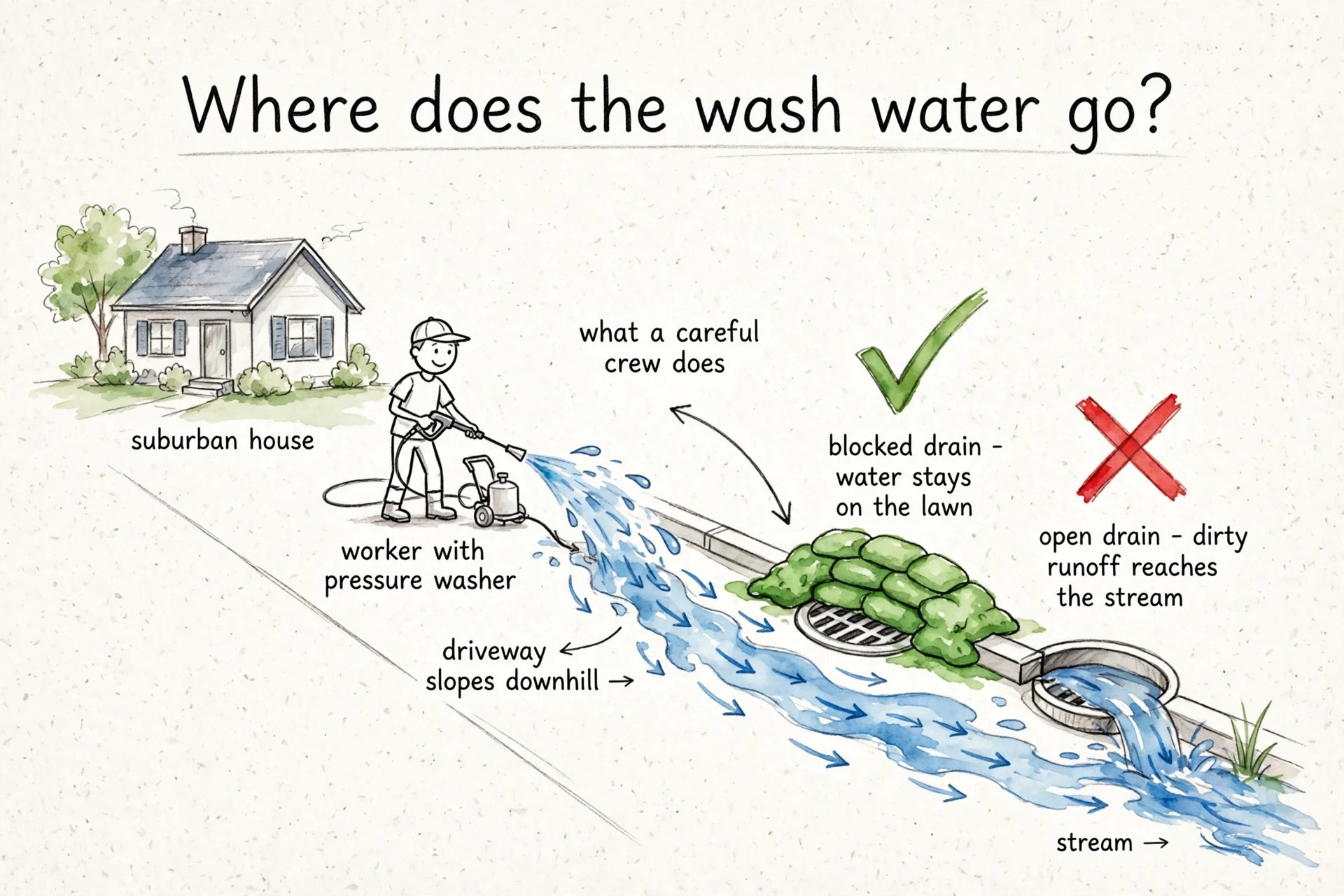
Wash water that carries soap, bleach, paint chips, or oil cannot just run down the driveway into the storm drain. The Clean Water Act puts that obligation squarely on the contractor, and plenty of cities spell it out in plain language. Portland’s published rules for pressure washing are a good example: block or divert around storm drains, keep wash water on the property, and never discharge pollutants into the stormwater system. Storm drains in most cities carry water straight to rivers and streams with no treatment.
So ask the question and watch the reaction. A shrug, a blank stare, or “it just runs off, that’s normal” means this company has never thought about it, and in many cities that ignorance can earn the homeowner a citation too. A good answer sounds like this: “We block the nearest storm drains with berms before we start, keep the water on your lawn, and vacuum up anything heavy.” That is someone who has done this before.
5. The quote arrives without anyone seeing your property
Ask: “Will you walk the property before giving me the price?”
A quote given over the phone, sight unseen, is a guess. Guesses turn into surprise charges on the day, or into corner-cutting when the guess turns out too low. Algae on the shaded north side, chalky oxidized siding, oil stains on the driveway, delicate old stucco, a second story with no good ladder footing: none of that shows up in a satellite photo, and all of it changes the work.
Any company serious about the job wants to see the house first. The walkthrough is also your interview in reverse: you get to watch how they look at your property. Do they check the siding material? Do they ask about the age of the paint? Do they notice the storm drain at the curb? A thorough walkthrough predicts a thorough wash.
6. Nothing goes in writing
Ask: “Will you put the full scope and price in writing before the job?”
A written scope should name every surface being cleaned, the method for each one, what is excluded, the total price, and the guarantee terms. Verbal promises evaporate the moment something goes wrong, and “we said we’d do the back too” is a miserable argument to have with a crew that has already packed up and left.
If a company resists paperwork, assume the vagueness is deliberate. The classic tells travel together: cash only, no written quote, “don’t worry, we’ve got you,” and a price that is somehow both vague and urgent. Legitimate companies write things down because legitimate companies have nothing to hide.
7. No plan for your plants, pets, or fixtures
Ask: “How do you protect my landscaping, pets, and outdoor fixtures?”
Soft-wash detergents can burn plants and irritate pets. High pressure can crack light fixtures, dent gutters, force water into exterior outlets, and shred window screens. A careful crew pre-wets the plants, rinses them again after the wash, covers delicate beds, asks whether pets will be outside, and avoids or tapes off outlets and fixtures. “We’ve never had a problem” is not a plan; it is luck with a good streak.
This is also where you learn whether the person quoting the job is the person doing the job. Ask who will actually be on site, and whether that crew follows the same protection routine. Subcontracting is not automatically bad, but you should know who is coming and whether they carry the same standards.
8. No proof they’ve done this before
Ask: “Can you show me before-and-after photos of jobs like mine, or give me references?”
A company proud of its work keeps photos. Most post them constantly on Facebook or their Google profile, because transformations are the whole advertisement. Hesitation here usually means one of two things: they have no track record, or the track record is not worth showing. Either way, you should not be the test case.
Read the reviews yourself while you are at it, and read the bad ones first. A pattern of damage complaints tells you more than ten five-star raves. And if you want one more credibility check, the PWNA keeps a public contractor directory of members who have committed to its code of ethics. Membership is not required to be good at this work, but it is a reasonable tiebreaker between two otherwise equal bids.
9. High-pressure sales tactics or cash-only terms
Ask: “What are your payment terms, and do I sign anything?”
Legitimate companies accept normal payments, give you a written agreement, and do not need your answer today. Be wary of the classics: the door-knocker who appears right after a storm, the “today only” discount that evaporates if you hesitate, the demand for cash up front, the refusal to leave a written quote behind. A good company is busy enough to let you think it over, and confident enough to put its promises on paper.
The green-flag scorecard
Nine questions is a lot to hold in your head on a phone call, so here is the condensed version. If you hear the left column, keep looking. If you hear the right column, you are probably talking to a pro.
| The question you asked | Red-flag answer | Green-flag answer |
|---|---|---|
| Can you send proof of insurance? | Stalls, excuses, or “we don’t need it” | Certificate from their agent, same day |
| Which surfaces get soft wash vs. pressure? | “We blast everything” | Names the method per surface |
| Walk me through the job step by step | “We’ll spray it down real good” | Pre-wet, detergent, dwell time, rinse, walkthrough |
| Where does the runoff go? | Shrug, or “it just runs off” | Blocks storm drains, contains wash water |
| Will you walk the property first? | Quotes over the phone, sight unseen | Insists on seeing the house before pricing |
| Will you put it in writing? | Cash only, no paperwork | Written scope, price, and guarantee terms |
| How do you protect plants and pets? | “We’ve never had a problem” | Pre-wet, cover, rinse, asks about pets |
| Can you show past work? | No photos, no references | Before-and-afters and reviews, readily shared |
| What are the payment terms? | Cash up front, decide today | Normal payments, written agreement, no rush |
What a strong contractor sounds like on the phone
Theory is useful, but it helps to hear the difference. Here is roughly how the call goes with a company worth hiring. You describe your house: two stories, vinyl siding, a stained driveway. They say something like this:
“Sure, I can picture it. We’d soft wash the siding and gutters, low pressure with detergent, and we rinse all the plants before and after. The driveway gets a surface cleaner, a degreaser on the oil spots, and a post-treatment so the algae doesn’t come back in a month. We block the storm drain at the curb before we start. I’ll email you the written scope and our insurance certificate before we schedule anything, and the quote is good for 30 days.”
Notice what that answer contains: a method named for each surface, the plant routine, the runoff plan, documentation offered before you asked, and no pressure to decide on the spot. That is the sound of a company that has done this hundreds of times. Compare it with “yeah, we can do the whole thing Tuesday for two-fifty, cash is fine,” and the choice makes itself.
What quotes actually tell you
Quotes are information, not just prices. The cheapest bid often skips the pre-soak, the plant protection, the proper dwell time, and the insurance, while a higher bid that itemizes methods and guarantee terms can be the better value by a wide margin. If you want the full breakdown of everything that moves a house-washing quote, from stories and siding material to access headaches, our soft washing cost factors guide walks through each one.
Watch the outliers in both directions. A bid far below the others usually means skipped steps or missing coverage. A bid far above the others should be able to explain itself line by line: proper runoff control, evening or weekend scheduling, a real guarantee. “Because we’re the best” is not an explanation. Ask for the why behind the number, and hire the company that can defend it.
Should you just rent a machine and do it yourself?
For a small concrete patio or a dirty walkway, renting a machine for the weekend is reasonable. For siding, a roof, or anything above the first story, the math changes: the injury risk is real, water forced behind siding causes damage you will not see for months, and a scratched-up DIY job on a two-story house can cost more to fix than the pro would have charged. If you are weighing it, watch Tim Carter of Ask the Builder walk through pressure washer basics and the mistakes even working pros make. It is a useful reality check on what the tool can do in careless hands.
Before the crew arrives: a 10-minute prep list
Once you have hired well, make the job easy. Move patio furniture, grills, and potted plants a few feet from the walls. Close every window and door, including the pet door. Unlock the gates and move the cars off the driveway so the crew can reach everything. Walk the property once yourself and note anything odd: chalky oxidation, peeling paint, a cracked fixture. Point those out before the washing starts, not after. And ask where they will connect their water, so nobody is surprised by a hose running through your garage.
Frequently asked questions
Ask for a certificate of insurance sent directly from their insurance agent, not a copy the company printed itself. Check that the dates are current and that it lists both general liability and workers’ compensation. If anything looks off, call the agent named on the certificate. It takes five minutes and it is the highest-value five minutes in this whole process.
Soft washing, for the house itself. Low pressure plus detergents cleans siding, stucco, and painted surfaces without forcing water behind them or stripping finishes. Save the real pressure for concrete, pavers, and other hard surfaces. Our soft washing vs. pressure washing guide maps every common surface to its right method.
Yes, get three. Three quotes show you the real price range in your area and, more importantly, let you compare how each company describes the work. The company with the clearest explanation of methods is usually the company that does the clearest work.
It depends on the size and stories of your home, the siding material, how heavy the growth is, and how tricky the property is to work on. We broke down every factor that moves a house-washing quote in our soft washing cost factors guide, including what is usually included and what costs extra.
Usually not, as long as the crew has access to an outdoor spigot, the gates are unlocked, and the cars are moved. Most homeowners go about their day. Just make sure windows are closed and pets are inside, and do a walkthrough with the crew lead when they finish.
Tell the company about delicate landscaping and pets before the job, and confirm their plant routine: pre-wetting, covering sensitive beds, and a thorough rinse after. Keep pets indoors during the wash and until the crew gives the all-clear. If a company seems annoyed by these questions, refer back to warning sign number seven.
It is not required, but it is a useful tiebreaker. Members of the Power Washers of North America have agreed to a code of ethics and have access to ongoing safety and compliance training, and you can search the association’s public contractor directory for companies near you. Think of it as one more data point, not a guarantee.
Sources
- The Power Washers of North America’s FAQ explains its certifications, training programs, and public contractor directory: PWNA frequently asked questions
- The PWNA’s compliance overview covers the OSHA, EPA, and DOT rules that apply to exterior cleaning contractors: PWNA industry compliance
- The City of Portland publishes plain-language best practices for keeping pressure-wash runoff out of storm drains: Portland’s pressure washing pollution rules

1 Comment
Pingback: Soft Washing vs Pressure Washing: Surface Guide | Home Exterior Lab