

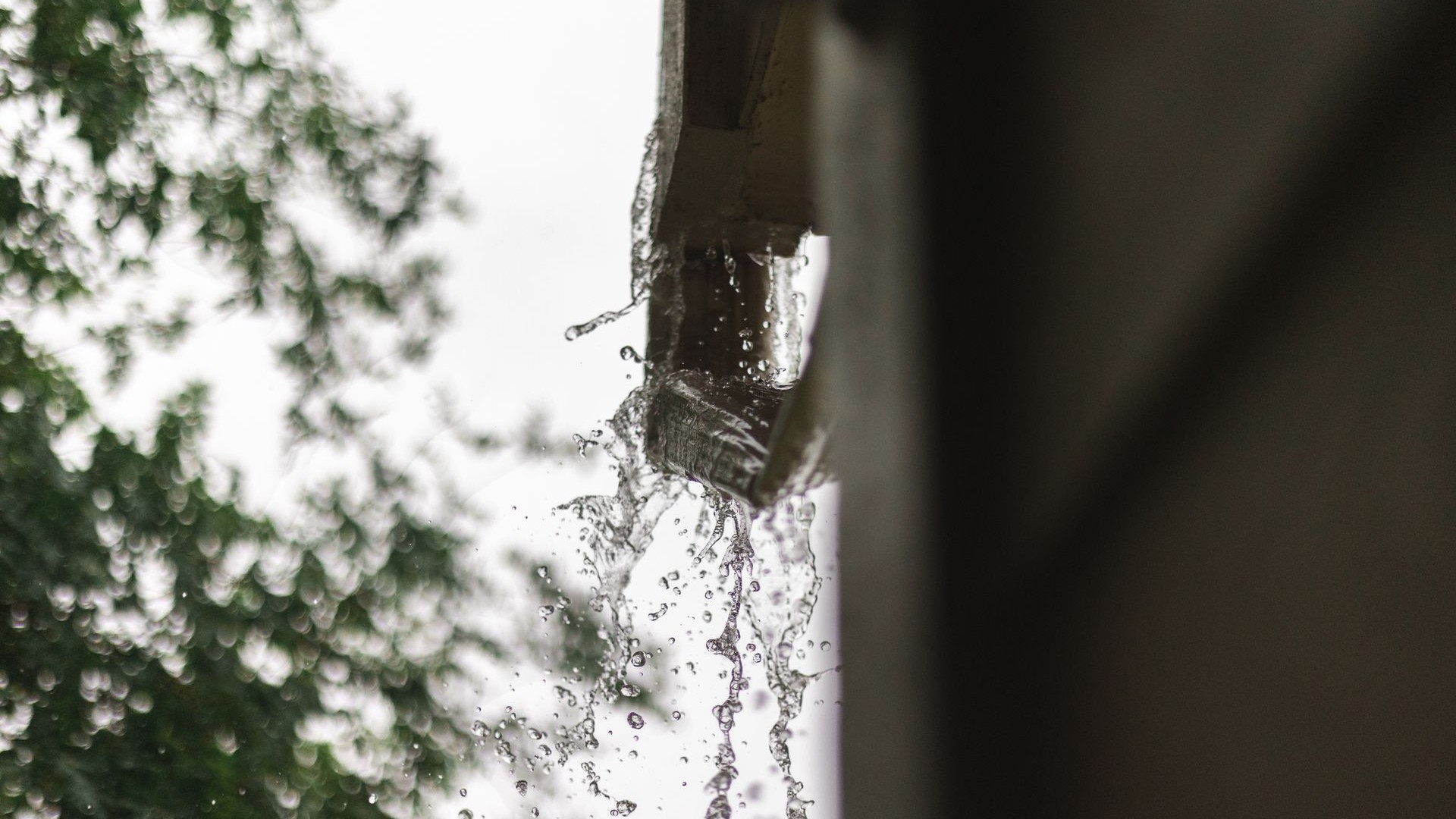
Water pooling at the end of a downspout means the roof water has somewhere to land but nowhere to go. The discharge point is working, the exit path is not. In most yards this comes down to one of seven causes: the outlet stops too close to the house, the ground tilts back toward the foundation, the soil drinks too slowly, the water table is high, the outlet is frozen, a buried pipe or dry well is overwhelmed, or the downspout itself is partly clogged. The puddle’s shape, location, and timing tell you which one you have.
Table of Contents
- What “downspout discharge pooling” actually means
- First question: is this even a problem?
- Read the puddle: a symptom map
- Cause 1: The discharge stops too close to the house
- Cause 2: The ground slopes back toward the foundation
- Cause 3: The soil can’t drink fast enough
- Cause 4: The water table is high or there’s a hardpan layer
- Cause 5: The outlet is frozen or blocked in winter
- Cause 6: The dry well or buried pipe is full or failing
- Cause 7: The downspout is partly clogged
- Four quick tests that point to the cause
- What actually fixes pooling, and what each fix fits
- What to do yourself, and what to hand to a pro
- When the puddle is really a foundation warning
- Frequently asked questions
- Sources
What “downspout discharge pooling” actually means
Downspout discharge pooling is what happens when rainwater leaves the gutter system in one concentrated stream and collects on the ground instead of spreading out and soaking in. A roof gathers far more water than most people expect, and all of it funnels through a pipe a few inches wide. A small wet ring after a storm is physics, not failure. A puddle that sits for a day or longer means the ground, the grade, or the outlet is not handling the volume.
First question: is this even a problem?
Stand at the downspout the morning after a solid rain and look with fresh eyes before you worry.
A shallow puddle that disappears within a few hours on a warm day is normal. The water arrived faster than the soil could take it, then the soil caught up. I’ve seen this on healthy, well-drained lawns, and it needed nothing.
A puddle still there the next morning, ground that squishes underfoot two days later, or any puddle sitting against the foundation wall is a different story. Judge your downspout by how it behaves in an ordinary rain, not by the storm that flooded the street.
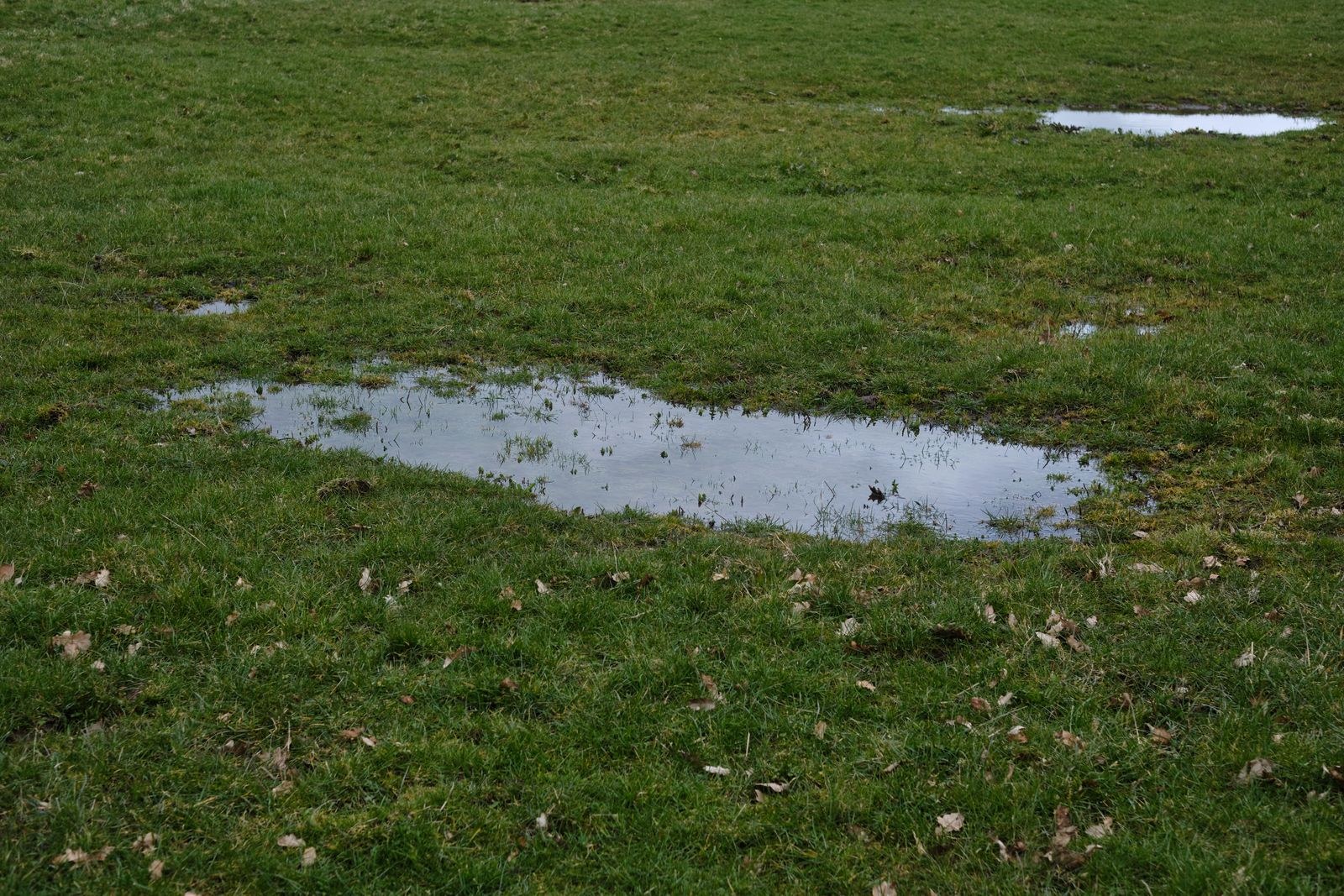
Read the puddle: a symptom map
Where the water sits, how long it stays, and when it appears are the clues.
| What you see | When it happens | Most likely cause |
|---|---|---|
| Puddle hugs the foundation wall, right where the downspout ends | Every rain, clears slowly | Discharge stops too close to the house |
| A shallow channel runs back toward the house from the outlet | Every rain, sometimes growing | Ground slopes toward the foundation (negative grade) |
| Water shoots past the splash block and lands in a bowl of mud | Heavy rains especially | Short outlet plus worn-out landing spot; splash block overwhelmed |
| Puddle sits a foot or two out, drains in a day or two, grass still healthy | Every moderate rain | Clay or compacted soil draining slowly |
| The whole area stays soft for days, even between storms | Wet seasons, spring melt | High water table or hardpan layer |
| Ice sheet forms at the outlet; meltwater runs sideways across the surface | Winter and early spring | Frozen outlet or frozen ground |
| Water burps up around the base of the pipe, or gurgles at the inlet | Starts suddenly, often mid-season | Buried pipe, dry well, or outlet full or broken |
| Water seeps from the seams above the elbow; the puddle seems small but the gutter overflows at that corner | Moderate rain, gradually getting worse | Partial clog in the downspout |
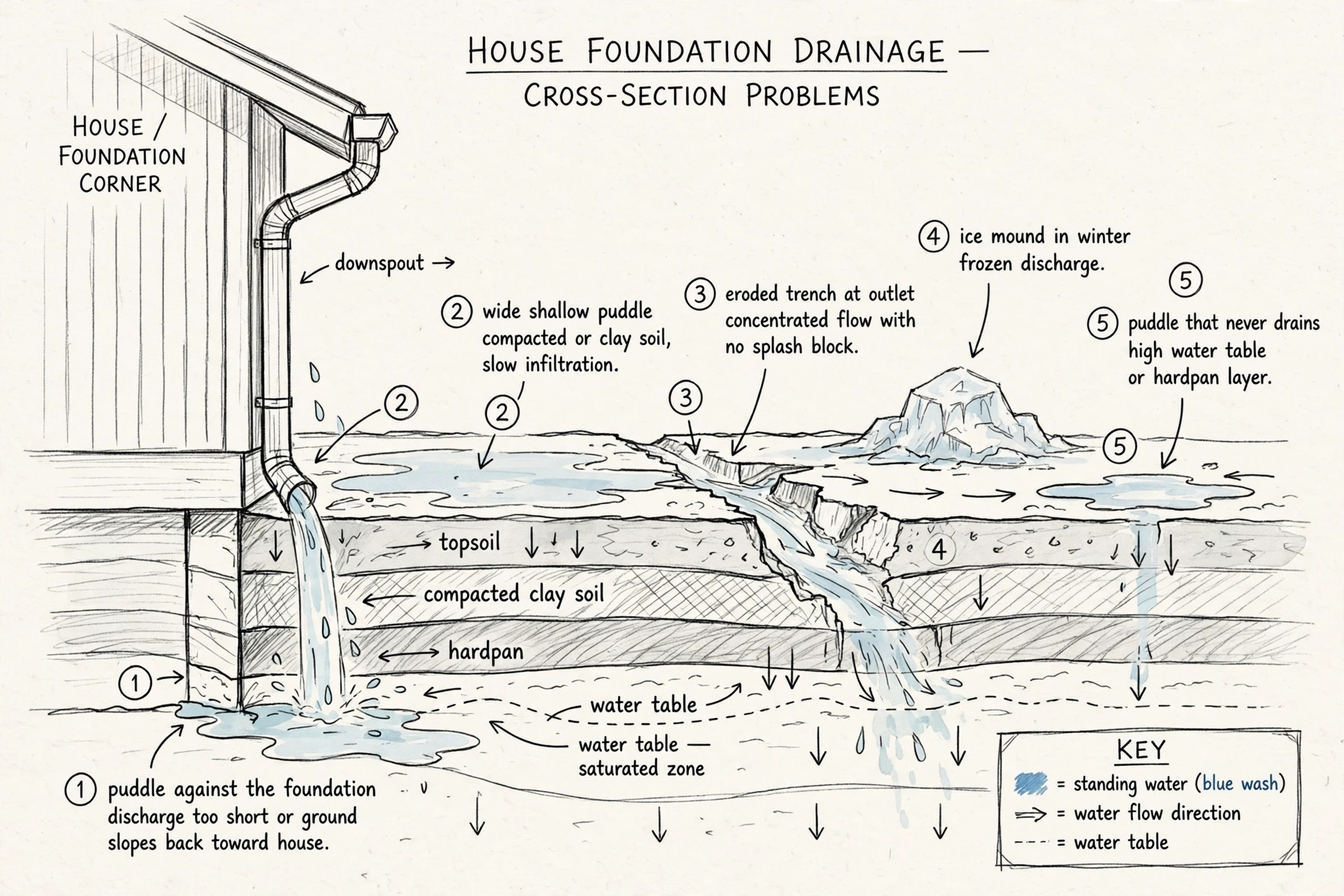
Cause 1: The discharge stops too close to the house
A downspout that ends a foot or two from the wall concentrates an entire roof’s runoff into one spot, and that spot saturates fast. This is the most common reason water pools at the end of a downspout, and the easiest to rule out: look at where the elbow ends and where the water goes from there.
The fix starts with distance. Home inspector guidance says downspouts suspected of trouble should be redirected to discharge at least six feet away from the building, and our full breakdown of discharge distances lives in the guide on how far downspouts should drain from the house. If your elbow points at bare soil two feet from the wall, you have found the problem.
Also check the landing spot. A splash block that has sunk, cracked, or tilted sends water sideways instead of forward, and mowers knock them loose too.
Cause 2: The ground slopes back toward the foundation
Sometimes the downspout is long enough, but the ground works against it. Backfill soil settles over the years, most of all right against the wall, forming a shallow bowl that catches the discharge and walks it back to the house. Mulch piled against the siding, edging boards, and raised beds can act as a small dam between the water and the rest of the yard.
Home inspector guidance recommends ground sloping away from the foundation at roughly half an inch to an inch of drop per foot for the first several feet. Check yours with the string-line test below. If the ground at the outlet is flat or tilts toward the house, no extension will fix the pooling until the grade does.
Cause 3: The soil can’t drink fast enough
Here the downspout and the grade are both fine, but the soil says no. Heavy clay, compacted construction fill, and lawns driven over for years all absorb water slowly. Penn State’s rain garden research puts numbers on it: rain soaks into sandy soil at about 2.5 inches per hour, into silty soil at about half an inch per hour, and into clay at roughly a third of an inch per hour.
The signature is patience. The puddle drains, just slowly, and the grass often looks fine. Compacted spots behave the same way, and they turn up exactly where downspouts discharge: near walkways, patios, and anywhere trucks parked during construction.
Cause 4: The water table is high or there’s a hardpan layer
A high water table means the ground is already full before the rain starts. In low areas and during wet springs, the soil below the surface is saturated, so downspout water has nowhere to infiltrate. The puddle lingers for days, the whole zone feels spongy, and neighbors’ yards often show the same symptoms.
Hardpan is the same problem in miniature: a dense layer of compacted subsoil that acts like a shallow bathtub. If the whole area stays wet no matter which outlet you check, the downspout is a contributor, not the culprit. To read your whole yard’s wet pattern and name which of the nine common causes is behind it, see our guide to yard drainage problems.
Cause 5: The outlet is frozen or blocked in winter
Winter changes the rules. Ice forms inside the elbow or across the splash zone, and frozen ground stops absorbing entirely, so meltwater and winter rain run sideways across the surface and pool wherever it dips. Home inspectors in cold regions report that many homeowners who never see a dry-season puddle discover basement leakage in spring for exactly this reason.
The winter signature is timing. If pooling appears only near freezing and vanishes once the ground thaws, the system is probably fine and the season is the problem. But winter puddles also expose weak spots: a discharge point that barely drains in summer ices up first and thaws last. Keep the outlet clear of snow and ice, and never pack snow against the discharge point.
Cause 6: The dry well or buried pipe is full or failing
Many homes send downspouts into buried pipes leading to a dry well, a pop-up emitter, or a daylight outlet at a slope. As these systems age, sediment fills them, roots find the joints, and dry wells in clay soil stop accepting water. The visible downspout looks fine, but water backs up at the underground connection and surfaces around the pipe’s base or along its path.
Watch for gurgling at the downspout-to-pipe connection during rain, wet stripes in the lawn tracing the buried line, a pop-up emitter that never pops, or a dry well cover sitting in a permanent soggy ring. If the system worked for years and the pooling started suddenly, suspect a failure underground. One more stack-up to check: a sump pump discharge pipe dumping near the same outlet, since the two water sources together can overwhelm soil that handled either one alone.
Cause 7: The downspout is partly clogged
A partial clog is the quietest cause on this list. Leaves, shingle grit, and tennis-ball-sized wads of debris wedge into elbows and seams, letting some water through but backing the rest up. During a moderate rain, the visible symptom is not a dramatic puddle at the outlet but water seeping from the seams above the elbow, the gutter overflowing at that corner, or the downspout bulging and swaying under weight it should never carry.
Rule this out early, because it changes everything downstream of your diagnosis: a clogged pipe makes every other test misleading, and the grade and soil both look guilty while innocent. Our guide to the signs of a clogged downspout walks through the full checklist.
Four quick tests that point to the cause
These take an afternoon, cost nothing, and beat guessing. Do them in order.
1. The hose test. On a dry day, run a garden hose at a moderate trickle where the downspout discharges for ten minutes, roughly matching a steady rain. If a puddle forms quickly with no roof water involved, the problem is the soil, the grade, or the outlet, not the gutters. If the ground handles the hose but ponds in real storms, suspect volume: the roof delivers far more water than a hose.
2. The string-line grade check. Push a stake into the ground at the foundation next to the downspout and another ten feet out. Tie a string between them at the same height, level it, and measure how far the ground has dropped away from the house. Flat or reversed readings at the discharge point confirm a grading problem, and this is the test to run before spending money.
3. The shovel-slice check. An hour after rain stops, push a spade straight down at the puddle’s edge and pull out a slice. If the top few inches are soaked and the soil below is dry and hard, you are looking at compaction or shallow hardpan, not a grade problem. If the slice is saturated deep down, the water table or a deeper clay layer is the limit.
4. The elbow check. During a rain, look at the elbow where the downspout meets the ground. Water dribbling from the seams or the connection, instead of flowing cleanly out the bottom, points to a partial clog or a blocked buried connection. Just timing and a raincoat.
What actually fixes pooling, and what each fix fits
Penn State Extension’s stormwater guidance starts with the simplest moves: redirect downspouts onto lawn and garden areas where water can spread and soak in, and always send that water away from foundations. A rain garden, which soaks up about 30 percent more water than the same patch of lawn, is one of their recommended options, placed at least ten feet from the house. Their short overview is worth a few minutes before you pick a fix.
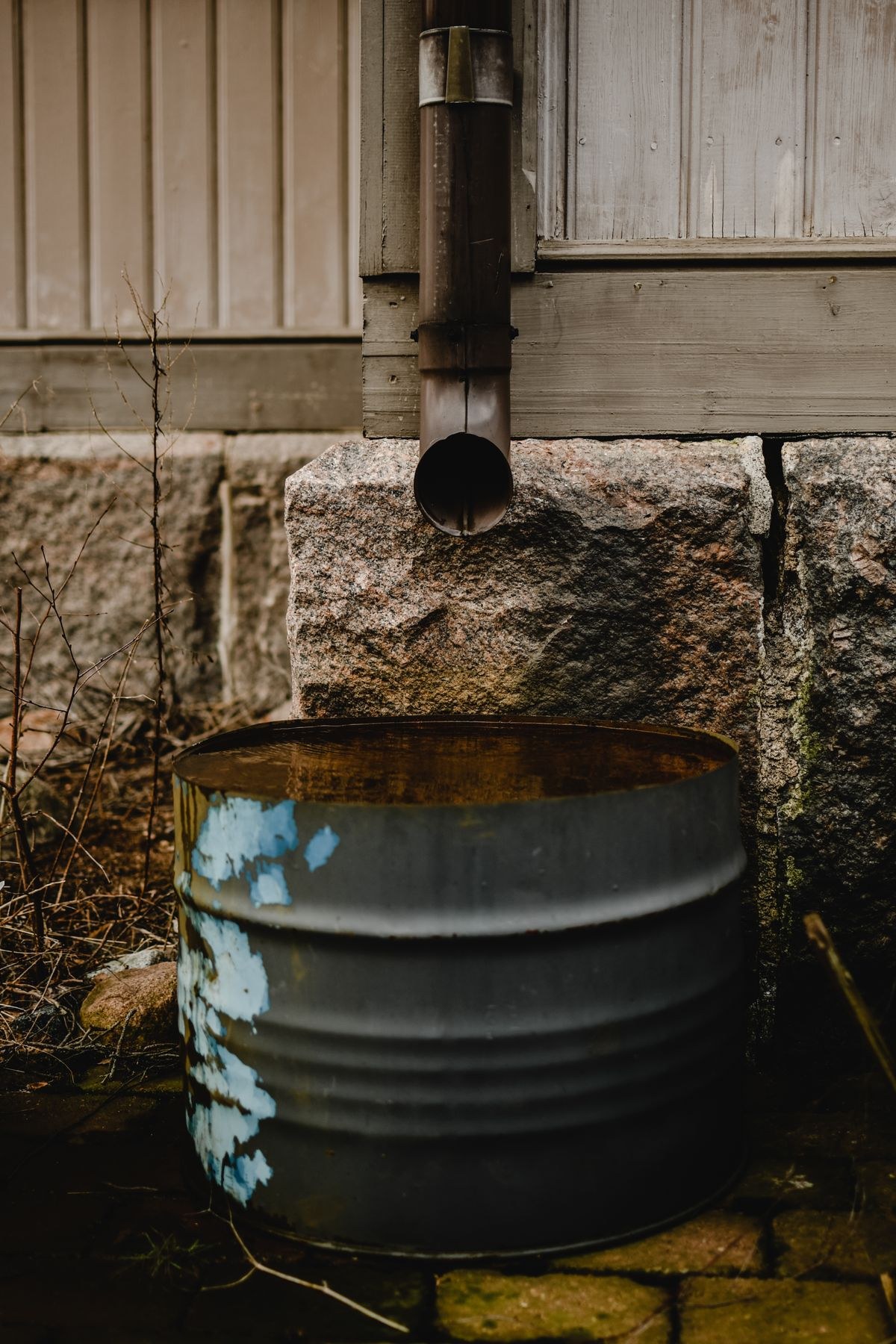
The table below compares the real options: the fix, what it solves, when it fits, and its limits.
| Fix | What it solves | Best fit | Limits and cost signal |
|---|---|---|---|
| Downspout extension | Discharge ending too close to the house | Flat yard with room to run; the most common case | Trips people, annoys mowers. Cheapest fix, weekend DIY. |
| Splash block | Minor splashing, landing-spot erosion | Light water, outlet already far from the wall | Doesn’t move water. Cheap, afternoon job. |
| Regrading | Water running back toward the house | Settled backfill, negative grade | Keep new soil below the siding. Small areas are DIY; big regrades are a pro job. |
| French drain | Persistent surface and shallow subsurface water | Long soggy strips | Needs a lower outlet. Skilled DIY or pro. |
| Dry well | No good place for the water to go | Tight lots | Fills up in clay. Usually a pro job. |
| Sump reroute | Sump water stacking up with downspout water | Homes with a sump pump near an outlet | Must stay unfrozen and code-legal. Pro recommended. |
A note on burying downspouts: buried pipe looks clean, but corrugated pipe catches debris in its ridges and every buried line is a future clog you can’t see. If you bury, use smooth-wall pipe with cleanouts, and keep a sketch of where it runs.
What to do yourself, and what to hand to a pro
| Situation | DIY or pro? |
|---|---|
| Clearing debris from the elbow, re-seating a splash block, adding a surface extension | DIY, no question |
| Checking and correcting grade along one wall with a few wheelbarrows of fill | DIY if you keep soil below the siding and slope it away |
| Rerouting a gutter or cutting into an existing buried line | Careful DIY only if you know where the line goes; otherwise pro |
| French drain or dry well in easy soil with a clear outlet | Ambitious DIY possible; call your local utility line service (811 in the US) before any digging |
| Persistent basement seepage, water entering near the downspout corner | Pro inspection first; exterior fixes rarely cure interior entry alone |
| Anything involving the foundation itself, drain tile, or structural work | Pro, always |
One rule covers all of it: never dig blind. Utility lines cross exactly the spots where drainage work happens, so have them marked before a shovel goes in.
When the puddle is really a foundation warning
Most downspout puddles are a yard problem. A few are a house problem wearing a yard costume:
- Dampness or actual water in the basement that appears after rain, especially near the wall below the problem downspout. Inspectors note that problem downspouts are usually characterized by leakage adjacent to the downspout.
- A whitish powder (efflorescence) on the inside of the basement wall or just above ground level outside.
- Soil that has settled into a trench along the foundation, mulch washed into channels pointing at the wall, or siding that stays damp long after the rain stops.
- A musty smell in the basement that shows up a day or two after storms.
Any one of these means the water is no longer just sitting on your lawn. It is pressing against the house, and that is the point to bring in a professional for a site inspection rather than trying one more extension.
Frequently asked questions
Briefly, yes. A hard storm delivers water faster than most soil can absorb, so a shallow puddle for a few hours is normal. If the spot is still wet the next morning, something on this page’s cause list is at work.
On a warm day, surface water from an ordinary rain should be gone within several hours. Penn State expects even a purpose-built rain garden to drain fully within 24 hours. Regularly longer than that means the soil or grade is the bottleneck.
It spreads the stream and stops the landing spot from eroding, but it doesn’t move water anywhere. If the puddle sits on flat ground or against the foundation, a new splash block just gives it a nicer platform.
Frozen ground can’t absorb water and ice can seal the outlet, so winter rain and snowmelt run across the surface and collect in low spots. Keep the outlet clear of snow and ice.
Over time, yes. Saturated soil against a wall lets water seep through cracks and untreated concrete, and repeated wetting is one of the most common causes of basement dampness inspectors see. Years of soaking at the same corner is how slow foundation problems start.
Above ground is cheaper, easier to inspect, and simpler to clear, which makes it the right first move for most people. Burying looks better but buried lines clog out of sight and can freeze. If you bury, use smooth-wall pipe with cleanouts, and keep the outlet at least six feet from the house.
Sources
- Penn State Extension’s guidance on controlling stormwater, which recommends redirecting downspouts onto lawn and garden areas and away from foundations.
- Penn State Extension’s introduction to rain gardens, with placement rules including the ten-foot minimum from the house and the 24-hour drainage expectation.
- Penn State Extension’s rain garden how-to, which covers the percolation test, soil infiltration rates, and walking the property in the rain to observe stormwater flow.
- The Ontario Association of Home Inspectors’ basement water infiltration guide, on grading slopes, downspout discharge distance, and how problem downspouts show up as leakage adjacent to them.
- Penn State Extension’s video How Can I Control Stormwater on My Property?, embedded above.

4 Comments
Pingback: How Far Should Downspouts Drain? Distance Guide | Home Exterior Lab
Pingback: Why Mulch Washes Away on a Slope: Causes & Fixes
Pingback: Yard Drainage Problems: 9 Causes of Soggy Ground
Pingback: 7 Signs Your Downspout Is Clogged (and What to Check First)