


Gutters overflow in heavy rain when water arrives faster than the system can move it out. The usual causes, in rough order of frequency: debris clogging the trough or the outlet, a blocked downspout or elbow, lost pitch that lets water pool instead of flow, too few downspouts for the run, gutters that are undersized for the roof area and local rainfall, concentrated flow from a roof valley, or water shooting clean past the gutter from a steep roof.
Don’t start by buying bigger gutters. Start by watching where the water first comes over. That location names the cause. The first wet spot matters more than the biggest splash, because water travels after it escapes.
Last updated: November 7, 2026
Contents
- How to Read Your Overflow: The Symptom-to-Cause Map
- Cause 1: The Trough or the Outlet Is Clogged
- Cause 2: The Downspout Is Blocked, or Too Small for the Job
- Cause 3: The Gutter Lost Its Pitch
- Cause 4: Too Few Downspouts for the Run
- Cause 5: The System Is Undersized for the Roof and the Rain
- Cause 6: Roof Valleys Concentrate Water, or Steep Roofs Launch It Past
- When Overflow Is “Normal” (and When It Isn’t)
- What Ignoring It Actually Costs
- DIY vs. Pro: Where the Line Is
- Prevention: Keep It From Coming Back
- Frequently Asked Questions
- Sources
How to Read Your Overflow: The Symptom-to-Cause Map
Stand where you can see the gutter line during steady rain (stay on the ground; a rainy roofline is no place to learn ladder lessons). Match what you see to this table.
| What you see | Most likely cause | Check first |
|---|---|---|
| Uniform sheeting over the front edge along the whole run, only in heavy rain | System undersized for roof area and rainfall | Capacity check (see below) |
| Overflow at one spot directly below a roof valley | Valley concentration / overshoot | Valley section during rain |
| Overflow at the far end from the downspout, or mid-run on a long straight section | Too few outlets, or lost pitch | Downspout count and spacing; standing-water test |
| Water pouring at a corner | Corner/miter restriction or a clogged outlet near the corner | Outlet and corner fitting |
| Water running behind the gutter, down the fascia board | Drip edge or back-edge problem, not gutter capacity | Roof edge and gutter attachment |
| Water launching past the gutter and landing well out from the house | Steep-roof overshoot: water never enters the trough | Roof pitch and gutter position |
| Downspout barely trickles while the gutter above overflows | Blockage in the downspout, elbows, or underground line | Downspout flow test |
| Water still sitting in the trough a day after the rain | Lost pitch or sag | Hose test for drainage |
Once you’ve matched your symptom, read the matching cause below. Each one ends with the fix, and whether it’s yours to do or a pro’s.
Cause 1: The Trough or the Outlet Is Clogged
This is still the number-one cause, and it’s the one most often hiding behind “but they look fine.” A gutter can look clear from the ground while the outlet (the hole where water drops into the downspout) is sealed shut by a mat of leaves, pine needles, and fine sediment. Asphalt shingle granules wash down and mix with organic debris into a heavy sludge that quietly shrinks the gutter’s working volume. Water then rises and crosses the front lip long before the gutter is genuinely full.
The fix is the straightforward one: scoop the trough, clear the outlet, and flush toward the downspout with a hose. Our gutter maintenance guide walks through the full twice-yearly routine, including the outlet check most people skip. WVU Extension’s gutter-safety guidance recommends cleaning at least twice a year and working from the low end near the outlet so debris moves toward the exit, not away from it.
If the gutters were recently cleaned and the problem persists in heavy rain only, move on. Your cause is further down this list.
Cause 2: The Downspout Is Blocked, or Too Small for the Job
Downspouts are the narrowest point in the system, and elbows are where debris compacts into plugs. A gutter can be spotless while its downspout is packed solid, and the symptom is distinctive: during rain, the gutter overflows above while the downspout below barely trickles. A downspout running at full capacity, by contrast, produces a heavy, steady stream at its outlet.
Test it on a dry day: run a garden hose into the gutter above the outlet and watch what comes out the bottom. Weak flow means a restriction. Disconnect the bottom elbow first (that’s where clogs lodge), then flush from the top down. If the downspout ties into an underground drain and flow stays poor, the blockage may be below grade, which is camera-and-shovel territory for a pro. NC State Extension’s gutter management guide prefers downspout-to-drainpipe systems and wants underground discharge at least 10 feet downhill from the house. Worth knowing, because a too-short or crushed buried line will back water up into a perfectly good downspout.
But blockage isn’t the only downspout problem. Size matters, and it’s the most commonly undersized part of the system:
- 2×3 inch downspouts (the residential default) have about 6 square inches of cross-section.
- 3×4 inch downspouts have about 12 square inches, double the area and roughly double the water-carrying capacity. LSU AgCenter’s gutter design publication lists both sizes in its standard downspout table, and trade sources like Blue River Gutters put the practical difference at roughly 600 vs. 1,200 square feet of roof area served per downspout.
The pairing rule is simple: 5-inch K-style gutters go with 2×3 downspouts; 6-inch gutters go with 3×4, per Angi’s gutter sizing guide. A 6-inch gutter feeding a single 2×3 downspout is a bottleneck wearing a bigger trough’s clothes. The outlet chokes before the gutter’s extra capacity ever matters.
Cause 3: The Gutter Lost Its Pitch
Gutters need slope to move water, and slope is fragile. Hangers loosen, fascia shifts, ice and debris loads bend the run, and a section that once drained starts holding water. LSU AgCenter notes that most residential gutters are mounted nearly level for appearance, but about 1/16 inch of drop per foot of run is desirable for actual drainage. That’s a subtle slope, around an inch over a 16-foot section, which is exactly why it drifts out of true without anyone noticing.
The tell is standing water. If water is still sitting in the trough a day after the rain stops, the pitch is wrong in that section. On a dry day, run a hose into the high end and watch: water should travel steadily to the outlet, not stall in the middle. Minor re-hanging, tightening or repositioning hangers on a short, accessible single-story section, is reasonable DIY. Re-pitching a long run, or any section where the fascia behind it is soft or the fasteners no longer bite, belongs to a pro. (If the fascia is rotted, new hangers have nothing solid to hold. That’s a carpentry job first, per the water-damage discussion below.)
Cause 4: Too Few Downspouts for the Run
Every outlet can only swallow so much water per minute, and every foot of gutter between outlets adds load. A long run with a single downspout at one end forces all the water to travel the full distance, and during peak flow, the far end simply can’t get its water out fast enough.
Two widely used spacing rules:
- University of Minnesota Extension recommends one downspout per 50 linear feet of eave.
- LSU AgCenter places typical downspout spacing at 20 to 50 feet, with 60 feet as a maximum.
If your gutter run is 45 feet long with one downspout at the far end, you’re asking one outlet to drain 45 feet of roof in a storm. Adding a second downspout, ideally near the middle or the far end, roughly halves each outlet’s drainage load and shortens the water’s travel path. This is frequently the cheapest real fix for clean gutters that overflow: an added downspout costs far less than a full re-gutter, and it directly addresses the bottleneck. Placement and routing into proper discharge (see the NC State 10-foot guidance in Cause 2) are pro work, but recognizing the shortage is a homeowner diagnosis.
Cause 5: The System Is Undersized for the Roof and the Rain
This is the cause that hides behind “but they’re clean.” A gutter system is sized for a design storm: a specific rainfall intensity over a specific roof area. Exceed either input and the math breaks.
The water math is bigger than it feels. One inch of rain on 1,000 square feet of roof is about 620 gallons of water arriving in that hour. University of Minnesota Extension puts the same figure at roughly 1,250 gallons for a 2,000-square-foot roof. In a fast-moving thunderstorm dropping two inches in an hour, double it. Your gutters have to move that volume as it arrives, not eventually.
Roof pitch multiplies the load. A steep roof doesn’t just collect more rain. It delivers it faster, in a harder sheet. LSU AgCenter’s sizing method adjusts roof plan area upward for pitch: multiply by 1.05 for a 4:12 to 5:12 roof, 1.10 for 6:12 to 8:12, 1.20 for 9:12 to 11:12, and 1.30 for a 12:12. A big, steep roof on standard 5-inch gutters is the classic undersizing story.
Local rainfall intensity matters more than annual rainfall. Gutter design uses short, intense bursts. LSU’s method designs around a 10-year, 5-minute storm intensity, which can be several times the hourly rate. A system that’s fine in Seattle drizzle can fail in a Gulf Coast or Midwest thunderstorm. This is why “my neighbor’s gutters are fine” isn’t diagnostic: their roof area, pitch, and downspout count differ.
Do this 5-minute capacity check:
- Measure the roof section feeding one gutter run: length × width (plan view, in feet) = square feet.
- Multiply by the pitch factor above (1.05–1.30).
- Divide by the number of downspouts on that run = square feet of roof per downspout.
- Compare: as a rough rule of thumb, one 2×3 downspout serves around 500–600 square feet of roof; one 3×4 serves around 1,000–1,200 (Blue River Gutters). If your number is well above those ranges, or if overflow is uniform along the whole run in heavy rain, the system is undersized.
The fix ladder, cheapest first: clear everything (Cause 1), add a downspout (Cause 4), upsize downspouts to 3×4, then upsize the trough from 5-inch to 6-inch K-style. Installers generally credit 6-inch gutters with roughly 40% more capacity than 5-inch, which is why they’re the standard recommendation for large or steep roofs. But buy the upgrade only after the diagnosis says capacity is actually the problem.
If your gutters are undersized for your roof area, our gutter size calculator helps you check what size you actually need.
Cause 6: Roof Valleys Concentrate Water, or Steep Roofs Launch It Past
Two roof planes meeting in a valley dump their combined runoff into one short gutter section, sometimes double or triple the water per foot that a straight eave sees. Watch that spot during rain: if water sheets over the lip right below the valley while the rest of the run behaves, you’ve found a concentration problem, not a system-wide one.
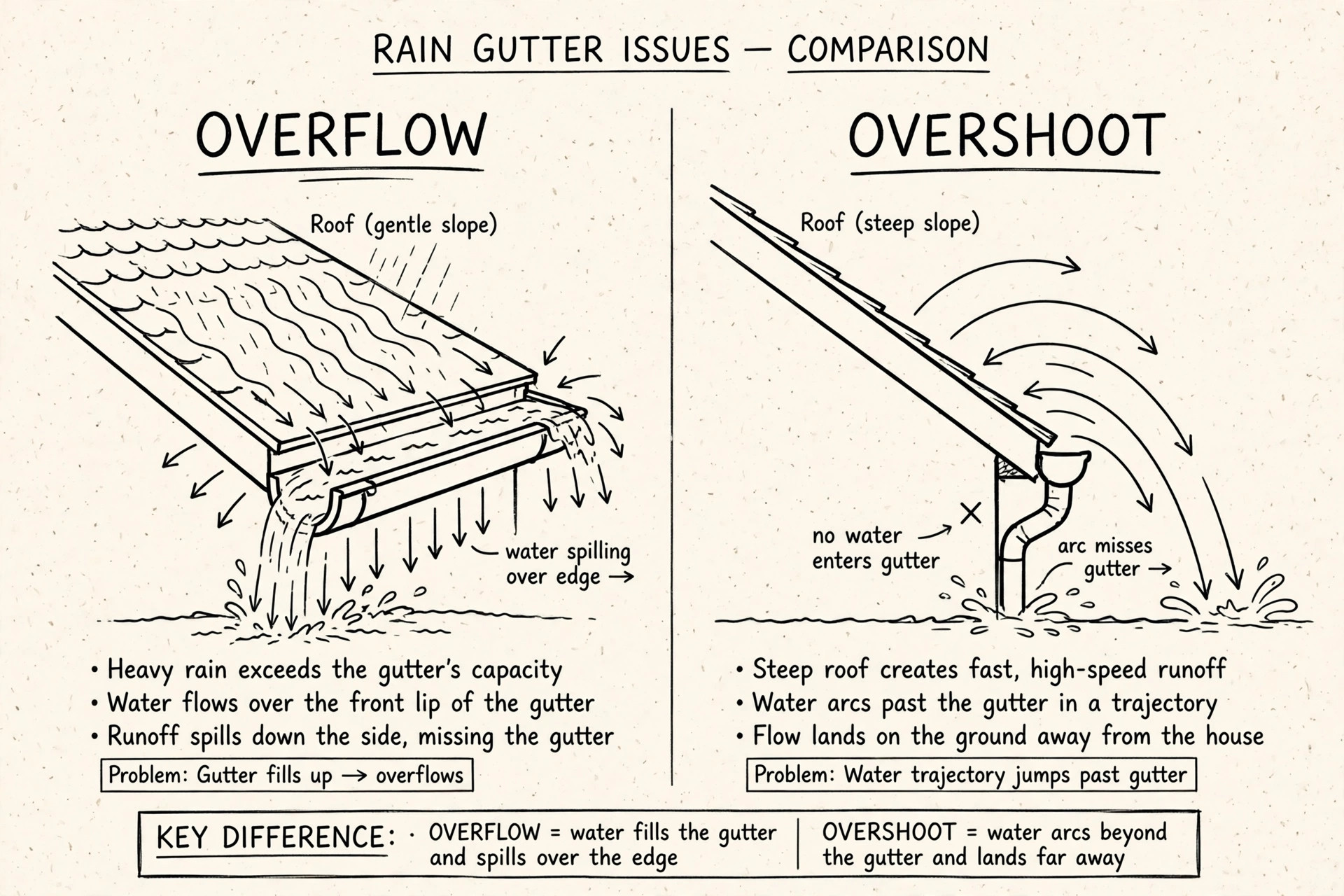
Its cousin is overshoot, and telling the two apart matters. On steep roofs, water can leave the roof surface with enough speed to sail clean over the gutter and land on the ground well out from the house. That’s not overflow. The gutter never gets a chance. The fix isn’t bigger gutters; it’s gutter position (higher and closer to the roof edge), a wider trough to catch the trajectory, or a splash guard/diverter at the valley. These are pro adjustments. They involve repositioning runs and matching roof-edge flashing, but the diagnosis is yours: overshoot lands away from the house; overflow sheets over the front lip.
When Overflow Is “Normal” (and When It Isn’t)
Not every spill means something is broken. Gutter systems are designed for a design storm (that 10-year, 5-minute burst in LSU’s method), and real storms sometimes exceed it. Use this table to calibrate:
| Situation | Normal? | What it means |
|---|---|---|
| Brief overflow during an extreme downpour, system recovers immediately | Usually yes | Storm exceeded design capacity |
| Overflow in moderate, ordinary rain | No | Blockage, pitch, outlet, or sizing problem |
| Same section overflows every storm | No | Localized cause: valley, outlet, pitch |
| Water behind the gutter or on the fascia | No | Attachment or drip-edge issue, not capacity |
| Overflow only since a new roof, addition, or tree removal | No | Changed runoff conditions. Re-check sizing |
“Normal” still deserves a watch. Even occasional overflow dumps hundreds of gallons where they weren’t planned to go, which is the next section.
What Ignoring It Actually Costs
Overflow isn’t a cosmetic issue; it’s water delivered to the worst possible places. The EPA’s moisture-control guidance treats controlling liquid water as the first principle of keeping a building dry, and gutters are the most visible part of that system. University of Minnesota Extension names defective or missing gutters and downspouts as a common cause of basement moisture problems, and notes that a great number of those problems are solved simply by handling rainwater properly.
The damage path is predictable: chronic overflow saturates soil at the foundation, erodes landscaping into trenches that steer even more water toward the house, stains and rots siding and fascia, and backs moisture into soffits and roof edges. NC State’s warning is worth repeating here: splash blocks release water too close to the home. If your “fix” for overflow is a two-foot splash block, you’ve moved the problem about two feet.
DIY vs. Pro: Where the Line Is
Cleaning and testing are homeowner territory. Anything that changes the system itself belongs to a pro. The split looks like this:
Do it yourself:
- Cleaning the trough and clearing the outlet, single story with a stable ladder.
- Flushing a downspout with a hose or snaking an elbow, with normal ladder safety.
- Re-hanging a short, accessible section, tightening or repositioning a few hangers.
Call a pro:
- Two stories, a steep roof, or any discomfort at height. Falls are the whole ballgame here.
- A downspout tied into a blocked underground drain. That is camera-and-shovel work.
- Adding a downspout. Outlets, routing, and discharge need pro layout. Our downspout drainage distance guide covers how far that discharge needs to go.
- Upsizing gutters or downspouts, fitting a valley splash guard, or repositioning a run. System changes, not maintenance.
Ladder work follows the same rules as any gutter task: set extension ladders at about a 4-to-1 angle and extend rails at least 3 feet above the roof edge, per OSHA’s ladder standard; keep feet on solid, level ground, have another adult on site, and stay clear of power lines, per CPSC ladder-safety guidance. Never rest the ladder against the gutter itself. The EPA’s inspection checklist specifically warns against it. And stay off the roof: NRCA’s homeowner resources limit homeowner roof work to inspection and gutter cleaning from a ladder.
Prevention: Keep It From Coming Back
- Run the twice-yearly cleaning routine in our gutter maintenance guide: spring and fall at minimum, more often under heavy tree cover.
- After every major storm, do a 60-second ground check: overflow marks, new stains on siding, erosion at downspout outlets.
- Keep discharge honest: extensions or buried pipe carrying water well away from the foundation (remember NC State’s 10-foot downhill minimum for underground outlets), not splash blocks at the wall.
- If one section overflows every storm, diagnose it with the table at the top of this article instead of waiting for it to become fascia rot.
Frequently Asked Questions
Clean gutters overflow when the design, not debris, is the problem. The usual suspects are too few downspouts, lost pitch, undersized troughs or downspouts for the roof area and local rainfall, or a valley concentrating water into one section. Run the capacity check in the article: if each downspout is serving far more roof area than the rule-of-thumb ranges, cleaning was never going to fix it.
As a starting rule, University of Minnesota Extension recommends one downspout per 50 linear feet of eave, and LSU AgCenter places typical spacing at 20 to 50 feet with a 60-foot maximum. Long runs, large roof areas, steep pitches, and high local rainfall intensity all push you toward the tighter end of that range, or toward larger downspouts.
They carry roughly 40% more water by most installer estimates, which makes them the standard recommendation for large or steep roofs and heavy-rainfall regions. But ‘bigger’ only helps if capacity is the actual problem. A 6-inch gutter with a single 2×3 downspout still chokes at the outlet. Diagnose first, then size the fix to the cause.
Localized overflow means a localized cause: a roof valley dumping concentrated flow into that section, a clogged or undersized outlet serving it, a pitch problem holding water there, or a downspout that’s blocked below. Uniform overflow along the whole run points to system-wide undersizing; one bad section points to something at that spot.
Yes, in two ways. Debris can mat on top of a guard and form a bridge that water sheets right over, and some solid-surface guards can’t admit water fast enough in a true downpour, so it overshoots the edge. Guards reduce cleaning frequency; they don’t repeal hydraulics.
Not as a first move. Work the diagnosis in order: clean and clear the outlet, check downspout flow, check pitch, count your downspouts against the spacing rules, then do the capacity check. Many ‘undersized system’ diagnoses turn out to be a $0 cleaning or a single added downspout. Replace or upsize when the math says the system can’t carry the roof’s water. Not before.
Call a pro for anything two stories up, any steep roof, soft or rotted fascia, persistent overflow after a full cleaning, underground drain problems, and any resizing or repositioning work. Cleaning, outlet clearing, and hose-testing a downspout are reasonable single-story DIY with proper ladder safety; system design changes are not.
Sources
- West Virginia University Extension Service, “Gutter Safety” (Wayne Lundstrom & Mark Fullen). Cleaning method and ladder safety for gutter work; clean at least twice a year. WVU Extension: Gutter Safety
- NC State Extension, Healthy Homes: “Moisture Control and Prevention: Gutter Management.” Downspout-to-drainpipe systems preferred; splash blocks not recommended; underground discharge at least 10 feet downhill from the house. NC State Extension: Moisture Control and Prevention, Gutter Management (PDF)
- LSU AgCenter, “Designing Roof Gutters for Barns” (Pub. 3140). Gutter pitch guidance (1/16 inch per foot); downspout spacing 20 to 50 feet with a 60-foot maximum; roof-pitch adjustment factors; 10-year, 5-minute design storm; standard downspout sizes table. LSU AgCenter: Designing Roof Gutters for Barns, Pub. 3140 (PDF)
- Blue River Gutters, “Gutter Downspout Sizes.” Trade sizing guide: 2×3 downspouts serve roughly 600 sq ft of roof, 3×4 roughly 1,200 sq ft. Blue River Gutters: Gutter Downspout Sizes
- Angi, “Gutter and Downspout Sizes, and How to Choose Them.” Pairing guide: 5-inch K-style gutters with 2×3 downspouts, 6-inch with 3×4. Angi: Gutter and Downspout Sizes, and How to Choose Them
- University of Minnesota Extension, “Moisture in basements: causes and solutions.” 1,250 gallons per inch of rain on a 2,000 sq ft roof; defective gutters as a basement-moisture cause; one downspout per 50 linear feet of eave. UMN Extension: Moisture in Basements, Causes and Solutions
- U.S. EPA, Moisture Control Guidance for Building Design, Construction and Maintenance (EPA 402-F-13053). Control liquid water as the first principle; roof inspection checklist. EPA: Moisture Control Guidance for Building Design, Construction and Maintenance (PDF)
- U.S. OSHA, 29 CFR 1926.1053 (Ladders). Ladder angle and 3-foot rail-extension rules. OSHA 29 CFR 1926.1053: Ladders
- U.S. Consumer Product Safety Commission, “Consumers Should Spring into Safety with the New Normal” (2021). Ladder spotter and power-line guidance. CPSC: Consumers Should Spring into Safety with the New Normal (2021)
- National Roofing Contractors Association (NRCA), Roofing Resources. Homeowner roof work limited to inspection and gutter cleaning from a ladder. NRCA Roofing Resources

1 Comment
Pingback: How Much to Clean Gutters: 2026 Prices by Story & Foot