


Last updated: October 2026
Stand in the exterior finish aisle for five minutes and you will watch the confusion happen in real time. A shopper picks up a can labeled sealer, then a can labeled stain, then looks back and forth between them like the difference is printed in invisible ink. It is not. The difference is simple once someone explains it plainly, and it matters, because the wrong choice leaves you with either a deck that turns gray by August or a peeling mess you get to scrape off next spring.
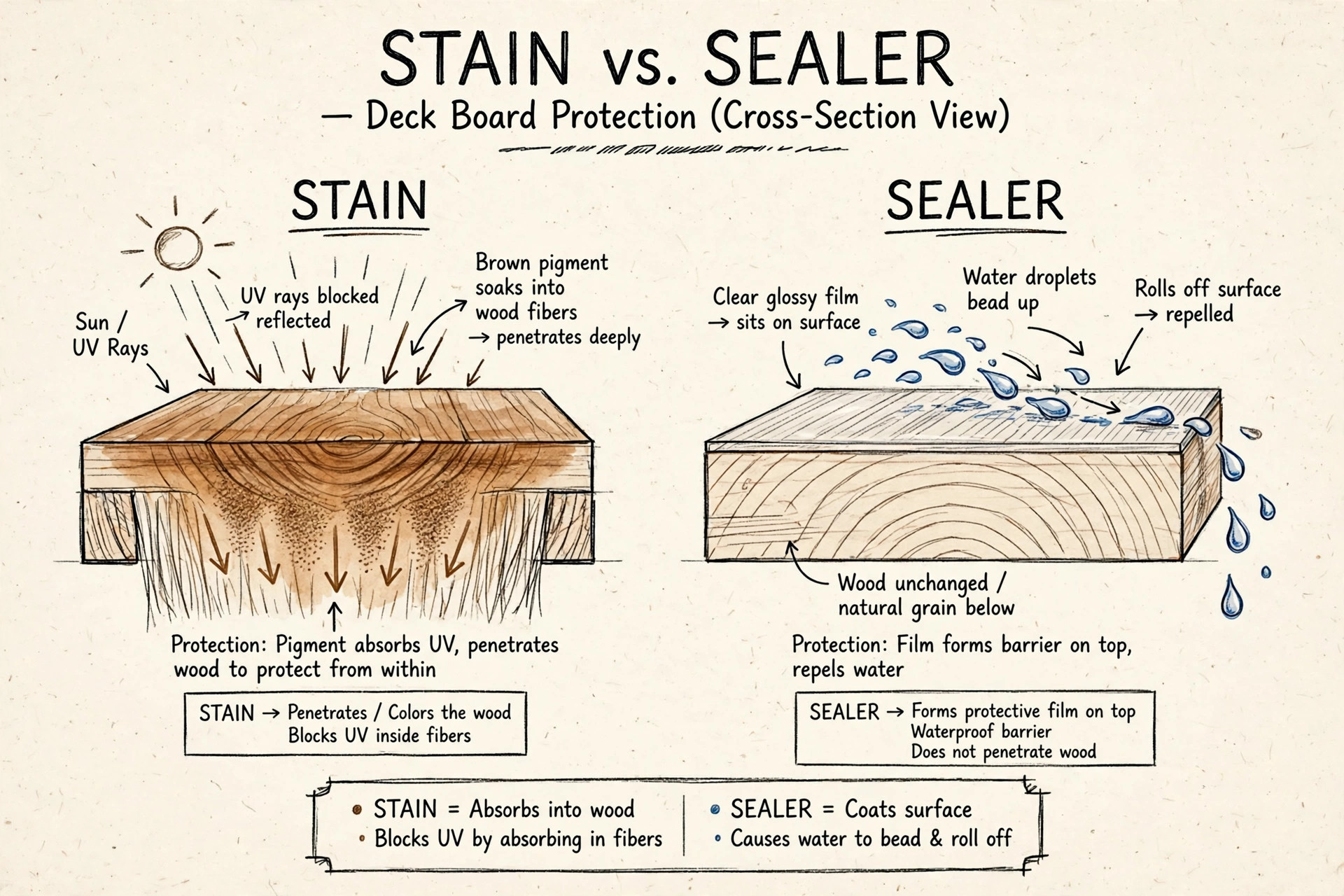
Here is the plain version: a sealer is your deck’s raincoat, a stain is its raincoat plus sunscreen, and the pigment in the can is what makes the difference. The rest of this guide covers the details that actually change what you buy: how each one works, how long each lasts, how to read the finish already on your boards, and the one situation where neither product is the answer.
The short answer: Deck stain and deck sealer both protect wood from water, but only stain protects against the sun. Sealer is a clear or nearly clear coating that repels water. Stain adds pigment, and that pigment blocks the UV rays that turn wood gray and break down its fibers. If your deck gets real sun, stain does more.
Scott Paul of DeckStainHelp.com walks through the different types of deck stains and where each one fits.
On this page
- Stain vs. sealer vs. 2-in-1, side by side
- What is a deck sealer?
- What is a deck stain?
- Oil-based vs. water-based: does the base matter?
- What finish is on your deck right now?
- Which should you buy? The decision matrix
- The honest catch with stain-and-sealer-in-one products
- When the wood is too far gone for either
- DIY or hire a pro?
- Frequently asked questions
- Sources
Stain vs. sealer vs. 2-in-1, side by side
| Deck stain | Deck sealer | Stain-and-sealer combo | |
|---|---|---|---|
| Main job | Color plus water and UV protection | Water repellency | Both, in one can |
| Color | Yes, from sheer to solid | Clear or nearly clear | Yes |
| UV protection | Yes, stronger with darker or more opaque colors | Very little | Yes, from its pigment |
| Water repellency | Yes | Yes, often stronger | Yes |
| Wood grain | Visible with transparent and semi-transparent types | Fully visible | Visible with semi-transparent types |
| Typical recoat cycle on deck boards | Every 2 to 3 years | Every 1 to 2 years | Every 2 to 3 years |
| How it fails | Fades gradually (penetrating types) | Wears thin; film types can peel | Fades gradually |
| Best for | Sunny decks, refreshing color | The natural wood look, shaded decks | One-step convenience |
What is a deck sealer?
A deck sealer is a clear or lightly tinted finish whose main job is keeping water out of wood. Penetrating sealers soak into the fibers and harden there; film-forming sealers dry into a thin clear layer on the surface. Because most sealers carry little or no pigment, they preserve the wood’s natural color but do almost nothing to stop UV graying.
The classic form is the water-repellent preservative, often shortened to WRP. InspectApedia’s deck finish guide describes these as the products also sold as “sealers”: a water-repelling wax blended with a drying oil or varnish base, usually with a mildewcide mixed in. They soak into the wood rather than sitting on it, and after application water should bead up the way it does on a freshly waxed car.
Sealers come in two behaviors, and the behavior matters more than the brand. Penetrating sealers soak in, never form a film, and simply fade away when they wear out, which makes recoating easy. Film-forming sealers lay down a clear skin that gives a tougher water barrier while it is intact, but that skin can crack and peel once sun and moisture work their way underneath. Purdue University’s extension bulletin on exterior wood finishes draws the same line for finishes in general: penetrating finishes will not blister or peel even if moisture gets into the wood, while clear film-forming finishes have limited durability in severe exposure and can start failing within about a year, at which point the old film has to come off completely before recoating.
On timing, plan to recoat a sealer every one to two years, or whenever water stops beading on the surface. The Southern Pine Association’s deck finishing guide recommends applying an effective water repellent as soon as possible after construction and reapplying about every two years.
A sealer is the right pick when the wood itself is the look you want. Shaded decks, damp climates where water is the main enemy, and beautiful cedar or redwood you would hate to tint all argue for a sealer. It also works as a base coat: InspectApedia notes that a semitransparent stain applied over a compatible water-repellent preservative gives some of the best long-term protection a deck can get, though not every sealer accepts a topcoat, so the label gets the final word.
What is a deck stain?
A deck stain is a pigmented finish that colors wood while protecting it from moisture and sun. The pigment is what blocks UV: it absorbs and scatters the rays that break down lignin, the natural glue holding wood fibers together, which is what turns unprotected decks gray. Most deck stains also include water repellents, so one product handles both jobs.
Stains are sold on an opacity scale, and where you land on it decides how much grain shows and how much sun protection you get:
| Opacity | Pigment load | Grain visibility | UV protection | Typical recoat | Best for |
|---|---|---|---|---|---|
| Transparent / toner | Lightest | Fully visible | Light | 1 to 2 years | New wood, a hint of tone |
| Semi-transparent | Moderate | Clearly visible | Good | 2 to 3 years | Most decks; the sweet spot |
| Semi-solid | Heavy | Mostly hidden | Strong | 3 to 4 years | Weathered boards, stronger color |
| Solid | Opaque, paint-like | Hidden | Strongest | 3 to 5 years | Hiding flaws; better on railings than floor boards |
Two things from the research are worth knowing before you choose. First, Purdue’s extension bulletin explains that solid-color stains carry far more pigment than semitransparent ones, hide the grain completely, and, in oil-based form, build a film much like paint, which means they can peel. Semitransparent penetrating stains work the opposite way: they soak in, stay porous, form no surface film, and will not blister or peel even when moisture gets into the wood. They fade instead, and fading is far easier to recoat than peeling.
Second, the heaviest option is not always the best one for the floor you walk on. Both InspectApedia and the Southern Pine Association advise against paint and solid-color stains on decking boards and stair treads: they show wear paths under foot traffic and tend to bubble, peel, or crack once moisture gets through. Solid stain can be a fine choice for railings and vertical surfaces while the floor gets a penetrating semi-transparent coat.
The working rule from contractor Scott Paul of DeckStainHelp.com, who has restored thousands of decks, matches all of this: the darker and more pigmented the stain, the more UV protection it gives, with solid stains blocking the most sun, and a penetrating semi-transparent stain giving most decks the best balance of protection, visible grain, and easy reapplication.
Oil-based vs. water-based: does the base matter?
The base changes how the finish behaves in the can and on the brush more than how it protects. Oil-based products typically soak deeper into the wood and last longer between recoats, but they smell stronger, dry slower, and clean up with mineral spirits. Water-based products dry in a few hours, clean up with soap and water, and carry fewer VOCs, but plan on recoating sooner.
| Oil-based | Water-based | |
|---|---|---|
| Penetration | Deeper into the wood fibers | Shallower; stays closer to the surface |
| Dry time | 24 to 72 hours for a full cure | A few hours is typical |
| Cleanup | Mineral spirits | Soap and water |
| Odor and VOCs | Stronger; higher VOC content | Low odor; fewer VOCs |
| Time between recoats | Longer | Shorter |
| Watch out for | Oil-soaked rags can spontaneously combust; Purdue’s bulletin says to bury them, immerse them in water, or seal them in an airtight metal container right after use | Do not apply in direct hot sun; it can dry too fast to penetrate properly |
| Best for | Harsh weather, dense or weathered wood | Fast weekend projects, low-odor needs |
One practical note: some regions restrict oil-based finishes under VOC rules, so check what your local store actually stocks before you set your heart on a formula. And whichever base you buy, get a product made specifically for decks and horizontal exterior wood, not a general-purpose exterior stain.
What finish is on your deck right now?
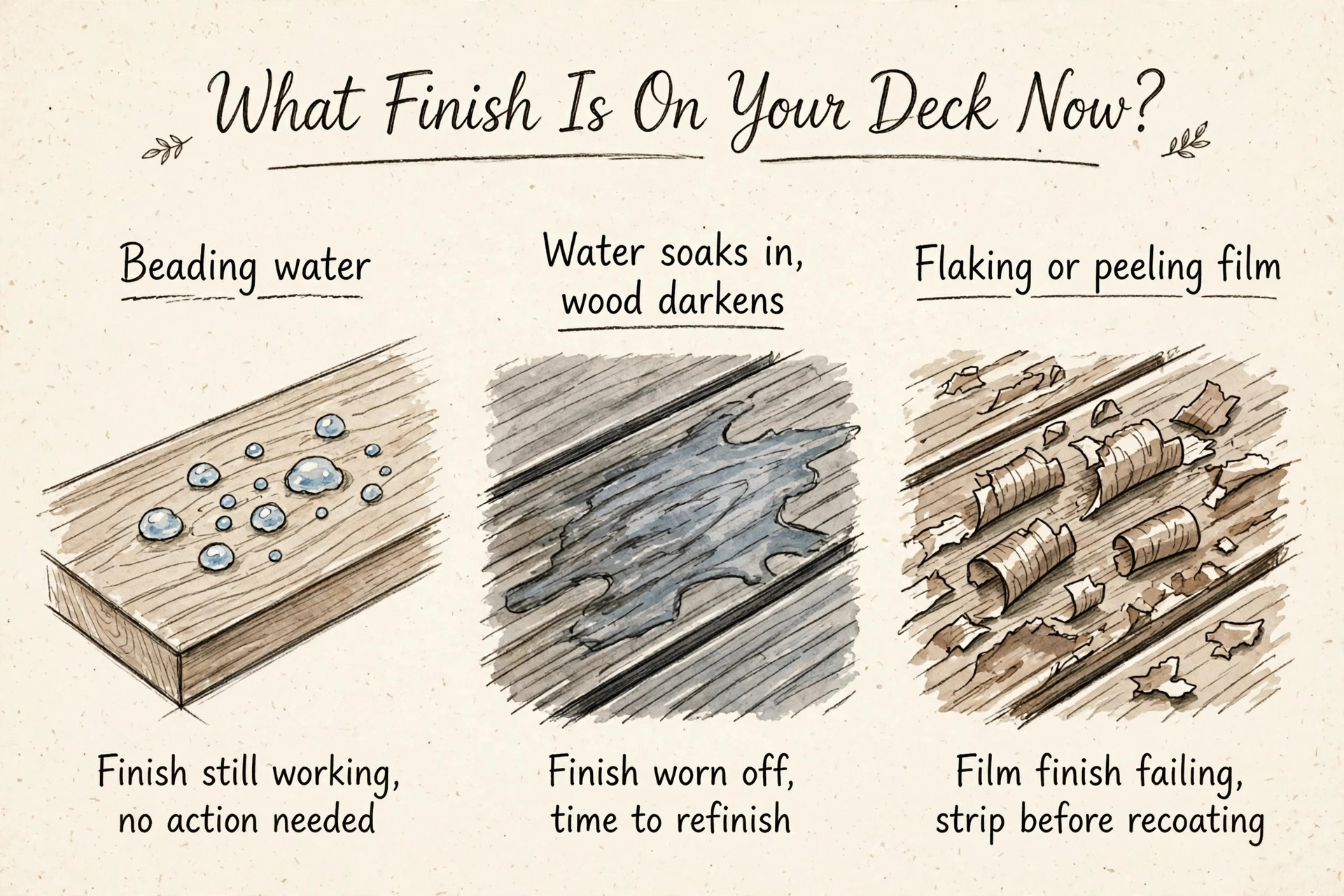
You cannot choose the next coat until you know what is already on the boards, because compatibility decides everything. The good news is that switching from a sealer to a stain is usually straightforward once the wood is properly cleaned and brightened, since sealers build little film. The bad news is that a failing film finish, old solid stain, varnish, or a film-forming sealer, has to come off first. Film finishes peel, and new product applied over peeling old product just peels with it. Run these three checks on a dry day:
- The splash test. Flick a little water onto the boards. If it beads up, the existing finish is still working and you can likely wait. If the water soaks in and the wood darkens, the protection is worn off and it is time to recoat. The Southern Pine Association uses exactly this test to answer “when should you reapply,” and InspectApedia gives the same rule: recoat when water no longer beads and is quickly absorbed.
- Check for a film. Look closely for flaking, peeling, or cracking sheets, especially on railings and board edges. A failing film means stripping or sanding back to sound wood before anything new goes on. And never layer oil-based over water-based, or the reverse, without stripping the old coat first.
- Read the color. Color that is fading evenly back toward bare wood means a penetrating stain wearing thin, which is the easiest recoat of all. Boards that have gone gray with no color change were likely sealed clear or left bare. Glossy patches that bead water in spots mean a film sealer is hanging on unevenly and needs attention before you recoat.
If green or black growth is part of the picture, sort that out before you buy any finish. Our guide on how to identify green growth on a deck before cleaning walks through telling algae, mold, and mildew apart so you clean correctly the first time.
Which should you buy? The decision matrix
| Your situation | Best pick | Why |
|---|---|---|
| Deck in full sun, and you want the color to last | Semi-transparent stain | Pigment blocks UV; penetrating types fade instead of peeling |
| Shaded or damp deck, and you love the natural look | Penetrating clear sealer | Water protection without changing the look; accept gradual graying |
| Cedar or redwood, and you want to keep the honey tone | Clear sealer with UV inhibitors, or a light toner stain | Preserves the look; a toner adds a little UV help |
| Older deck with stains, nail marks, and patchy color | Semi-solid stain, or solid on railings with semi-transparent on the floor | Hides flaws without putting a peel-prone film underfoot |
| You want one product and one weekend | 2-in-1 stain-and-sealer | Genuine convenience; pick a deck-specific formula from a known brand |
| Freeze-thaw winters and wet springs | Penetrating stain or penetrating sealer | Films trap moisture underneath, and freeze cycles turn that into peeling |
Climate is the tiebreaker when you are torn. Sun is the great destroyer of deck finishes, so a deck that bakes all afternoon wants pigment, full stop. In wet, shady regions the main enemy is water, and a penetrating water repellent earns its keep. In freeze-thaw country, avoid film-forming finishes: water that gets under a film freezes, expands, and pops the coating off in sheets.
The honest catch with stain-and-sealer-in-one products
Combination products are convenient and genuinely popular, but it helps to know what you are trading. Bob Vila’s sealing guide puts it plainly: a dedicated stain is still better at UV protection, and a dedicated sealer is still better at pure moisture resistance. A 2-in-1 splits the difference.
Here is the nuance most comparisons skip: most quality deck stains already contain water repellents. Purdue’s bulletin notes that penetrating stains may include a water repellent in the formula, and InspectApedia points out that oil-based semitransparent stains share many of the same ingredients as a water-repellent preservative, with pigment being the main difference. So “stain plus sealer in one can” is often just describing what a good stain already is.
The strongest system, according to InspectApedia, is a compatible water-repellent preservative as a base coat with a semitransparent stain over it. That is two products and two steps, which is exactly what the 2-in-1 buyer is trying to avoid. My read: a combo product from a reputable brand is a fine choice for a straightforward recoat, but do not expect a bargain 2-in-1 to outperform a proper two-step system on a demanding deck. Either way, read the label for mildewcide and UV blockers rather than trusting the front of the can.
When the wood is too far gone for either
No finish rescues rotten wood, and this is the most expensive mistake in deck care: coating boards that should have been replaced. Replace, do not coat, when boards feel soft or spongy underfoot, when rot reaches the ledger board, joists, or posts, when screws pull out of punky wood, or when the structure sways or bounces. Those are carpentry problems, and stain is not carpentry.
Refinish with confidence when the wood is sound but ugly: gray weathered surfaces, shallow surface checking, light splintering, or boards that have cupped but remain solid. Cupping alone is a moisture-movement issue, not a death sentence; our guide on why deck boards cup explains the mechanism and when a cupped board can stay.
A simple field test: press a screwdriver into the wood with light hand pressure. If it sinks in, that board is done. If the wood resists, it can take a finish. When you are unsure about the structure itself, a contractor’s inspection costs far less than staining a deck you will be replacing next year.
DIY or hire a pro?
| Do it yourself when | Hire it out when |
|---|---|
| The deck is structurally sound and just needs cleaning plus recoating | Peeling film covers large areas; stripping is miserable work |
| You can spare a full weekend and the weather gives you two dry days | The deck is large; a crew with spray equipment saves days |
| Railings and spindles are simple | There is rot, a loose ledger, or wobbly railings; carpentry comes first |
| You own or can borrow a sprayer, brushes, and a sander | You want a sprayed finish with back-brushing and zero lap marks |
Two safety notes that are not optional. Oil-soaked rags really can spontaneously combust; Purdue’s extension bulletin instructs readers to bury them, immerse them in water, or seal them in an airtight metal container immediately after use, and that advice is worth following to the letter. And keep foot traffic off the finished deck for 24 to 48 hours so the coating cures instead of scuffing.
Frequently asked questions
Can I put stain over an old sealer?
Usually, yes. Sealers build little film, so once the wood is properly cleaned and brightened, switching to a stain is straightforward. If the old finish is flaking, glossy, or peeling anywhere, strip or sand those areas back to sound wood first; new finish over failing finish just fails with it.
Do I need to seal after staining?
Usually not. Most deck stains already contain water repellents, so a separate clear topcoat adds little and can cause adhesion problems. The professional two-step system is a compatible water-repellent preservative under a semitransparent stain, not a sealer over a stain.
Will a clear sealer stop my deck from turning gray?
No. Graying is UV damage, and clear sealers contain no pigment to block it. A sealed deck still grays, just with the wood staying drier underneath. If keeping color matters to you, you need pigment, which means stain.
How often will I be doing this again?
As a rough guide: clear sealers every one to two years, semi-transparent stains every two to three, solid stains three to five on vertical surfaces and less underfoot. But the splash test beats the calendar every time. Check high-traffic areas like stairs and the boards outside the door first; they always wear fastest.
Can I stain a brand-new pressure-treated deck right away?
For stain, wait until the wood dries out. The Southern Pine Association suggests about 30 days before applying a semi-transparent oil-based stain to new treated lumber, and longer for solid stains and paints. A water repellent can go on sooner. The splash test tells you when the wood is ready: if water beads, wait; if it soaks in, coat.
Oil-based or water-based: which is better for a deck?
Oil-based finishes usually soak deeper and last longer between recoats; water-based finishes are faster, lower-odor, and clean up with soap and water. Either works if the product is made for decks. Check local VOC rules before buying oil-based, since some areas restrict it.
Sources
- Purdue University Extension’s guide to selecting and applying exterior finishes for wood, by Daniel L. Cassens and William C. Feist of the USDA Forest Service Forest Products Laboratory: the reference for penetrating versus film-forming finishes, solid versus semitransparent stains, and water-repellent preservatives.
- InspectApedia’s guide to finishes, stains, coatings, and preservatives for decks: the deck-specific reference for water-repellent preservatives, recoating intervals, and why solid films are a poor choice for deck boards.
- The Southern Pine Association’s deck finishing, maintenance, and inspection guide: the source for the splash test, reapplication timing, and finishing new pressure-treated lumber.
- DeckStainHelp.com’s deck sealer versus deck stain comparison, by contractor Scott Paul: field experience on pigment and UV protection, the semi-transparent sweet spot, and switching from sealer to stain.
- Bob Vila’s guide to sealing a deck: the dos and don’ts reference, including combination products and cure times.
- EvoDek’s complete guide to deck sealers: sealer types, application conditions, and reapplication intervals.

2 Comments
Pingback: How Often to Stain a Deck: A Realistic Restain Schedule
Pingback: Deck Cleaning Cost Factors: What Changes the Price? (2026)